Pharmaceutical manufacturers running SAP MII or SAP xMII for Statistical Quality Control face a uniquely difficult modernization decision. SAP's mainstream maintenance for the MII / ME stack ends in 2027. The official replacement — SAP Digital Manufacturing Cloud (DMC) — is cloud-only, which creates immediate questions about GxP validation status, data integrity boundaries, 21 CFR Part 11 audit trail continuity, and Annex 11 supplier governance. For Digital Transformation Leaders in pharma, the calculus is harder than in other industries because the cost of getting the validation right is enormous and the cost of getting it wrong is enforcement action, recall risk, or warning letter exposure. iFactory AI offers a third path purpose-built for pharma constraints — AI-native SQC optimization, AI Vision Inspection for tablets, vials, ampoules, and lyophilized product, multivariate process control with adaptive control limits, all running on a pre-configured NVIDIA appliance on-premise inside the validated environment. GAMP 5 categorization, 21 CFR Part 11 alignment, Annex 11 traceability, and ALCOA+ data integrity are built into the platform rather than configured later. Deployment is 6–12 weeks. The same platform is also available as fully managed cloud for pharma operations with hybrid IT strategies. This is the strategic comparison for pharma leaders: what changes when SAP MII reactive SQC monitoring becomes iFactory AI predictive quality intelligence.
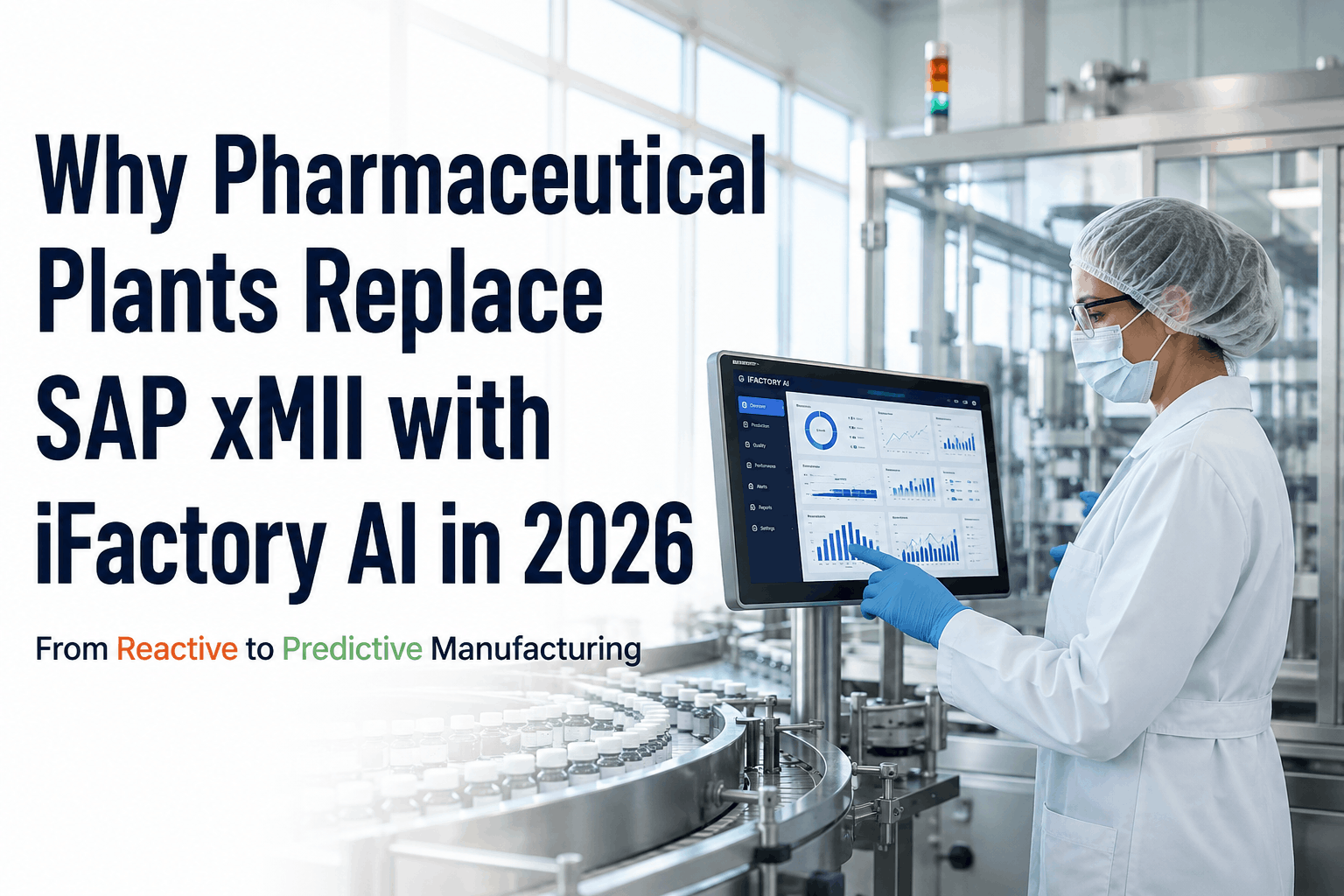
Why Pharmaceutical Plants Replace SAP xMII with iFactory AI in 2026
iFactory AI is the on-prem, AI-first alternative to SAP MII and SAP DMC for pharmaceutical SQC optimization — built around AI Vision Inspection, adaptive control charts, multivariate process control, and GAMP 5 / 21 CFR Part 11 / Annex 11 / ALCOA+ compliance evidence. Three migration paths from the SAP MII 2027 deadline; this guide explains the AI-native one for pharma.
Three Migration Paths from the SAP MII 2027 Deadline
Every pharma plant running SAP MII for SQC monitoring has the same decision to make in the next 12–24 months. The choice isn't whether to modernize — that's forced by SAP's roadmap — it's which modernization path fits the validated environment, the data integrity requirements, and the operational reality. The three available paths differ substantially in regulatory risk profile and cost.
For pharma specifically, the SAP DMC cloud-only requirement creates a unique problem. The validated state of MII today exists inside the plant boundary. Lifting that to a cloud-only DMC environment requires re-establishing the entire GxP validation envelope around an external supplier, with Annex 11 supplier governance, 21 CFR Part 11 records continuity, and ALCOA+ data integrity all needing fresh validation evidence. iFactory AI's on-prem deployment keeps the validated boundary inside the plant where it already exists, dramatically reducing the validation effort and timeline.
Want a sized migration analysis for your specific pharma operation comparing all three paths? Schedule an AI Manufacturing Transformation Workshop — iFactory's team will model your specific cost, validation effort, and capability outcomes across the three paths with your plant size, current MII footprint, and product portfolio. Sessions available this week.
AI Vision Inspection — Where Pharma Quality Intelligence Lives Today
The single largest pharma SQC improvement of the past decade
AI Vision Inspection has rewritten what's possible in pharma quality assurance. Tablets, capsules, vials, ampoules, blister packs, and lyophilized product — all inspectable inline at production speed with detection accuracy that exceeds human inspectors operating under the same conditions. iFactory's CNN-based vision models ship pre-trained on pharma defect taxonomies and fine-tune on your specific products during the 6–12 week deployment.
Tablet & Capsule Inspection
Chips, cracks, foreign material, color variation, embossing verification — every unit, every batch.
Vial & Ampoule Inspection
Particulate detection, fill level verification, cosmetic defects, seal integrity — meets USP <790> and Annex 1 requirements.
Blister Pack & Packaging
Missing tablet, wrong tablet, broken cavity, foil seal integrity, label and serialization verification (DSCSA).
Lyophilized Product Inspection
Cake appearance, collapse, browning, residual moisture indicators, reconstitution clarity prediction.
Want to see the iFactory AI Vision Inspection running on representative pharma products? Schedule the AI Manufacturing Transformation Workshop — sessions include a vision-inspection demonstration with tablet, vial, or blister product types matched to your portfolio.
Side-by-Side — SAP MII, SAP DMC, and iFactory AI for Pharma
Capability comparison across the dimensions that matter most for pharmaceutical Statistical Quality Control. Same operations, three different platform philosophies.
| Capability | SAP MII / xMII | SAP DMC | iFactory AI |
|---|---|---|---|
| Deployment model | On-prem (legacy) | Cloud-only | On-prem appliance OR cloud |
| GxP validation envelope | Existing on-prem | Full re-validation | Preserves on-prem boundary |
| AI Vision Inspection | Not native | Add-on integration | Native — CNN pre-trained |
| Predictive SQC | Static control limits | Static + alerts | Adaptive + 9-model AI |
| 21 CFR Part 11 records | Configured | Configured | Pre-built · pharma templates |
| Annex 11 supplier governance | Established | Re-establish | Established · on-prem maintained |
| ALCOA+ data integrity | Manual processes | Configurable | Built-in workflows |
| GAMP 5 categorization | Category 5 (custom) | Category 4 (cloud) | Category 4 · pre-validated |
| Electronic batch record (eBR) | Add-on | Integrated | Native · AI-explained deviations |
| Typical TCO (3-yr, mid-plant) | $2.5–4.5M | $4–8M | $0.8–3M |
| Deployment + validation time | n/a (existing) | 24–36 months | 6–12 weeks |
| Works during WAN outage | Yes (on-prem) | No (cloud-only) | Yes (on-prem deployment) |
The GxP Validation Question — Answered
Specification
User Requirements (URS), Functional (FRS), and Configuration Spec (CS) templates pre-built for pharma SQC use cases.
Design Verification
Risk-based assessment per ICH Q9. CSV strategy aligns to GAMP 5 Category 4 — minimal custom code, configured product.
Verification Testing
IQ / OQ / PQ protocols pre-written. Test scripts for SQC, AI Vision, data integrity, and 21 CFR Part 11 workflows included.
Operational Readiness
Change control, periodic review, and continuous validation framework. AI model governance separate from validation envelope.
The single biggest pharma-specific advantage of iFactory AI's approach is what it does for GxP validation effort. The on-prem appliance keeps the validated boundary inside the plant where it already exists, and the platform itself ships pre-validated as a Category 4 configured product with IQ/OQ/PQ artifacts included. Most pharma plants complete the full SQC migration validation effort in 8–14 weeks total, versus the 18–36 months typical for a SAP DMC cloud migration.
Six Pharma Verticals Where Migration Pays Back Fastest
Pharma isn't monolithic — different dosage forms have different SQC priorities, different regulatory pressure, and different ROI from AI-native modernization. Here are the six where the migration math works out fastest.
Oral Solid Dose
AI Vision at the press catches chips, cracks, and embossing defects in real-time. Predictive SQC on weight, hardness, friability, and thickness reduces in-process holds.
Sterile Injectables
USP <790> visible particulate detection by AI Vision · fill level accuracy · seal integrity · CCIT correlation tracking · Annex 1 compliance evidence.
Biopharma / Biologics
Multivariate process control on bioreactor parameters · predictive yield forecasting · cell line drift detection · process analytical technology (PAT) integration.
Lyophilized Product
Lyo cycle monitoring · cake appearance AI Vision · residual moisture prediction · collapse / browning detection · reconstitution clarity inspection.
Blister Packaging
100% inspection of every cavity for missing/wrong tablet · foil seal integrity · serialization verification · DSCSA aggregation evidence built automatically.
API & Intermediate Manufacturing
Reaction parameter monitoring · crystallization endpoint prediction · drying curve forecasting · ICH Q7 evidence with continuous process verification.
Want a vertical-specific migration analysis for your pharma operation? Send your top SQC use cases and current MII footprint to iFactory support and the pharma team will return a vertical-tuned ROI analysis with validation effort estimate and 12-month roadmap — typically within 3 business days, no obligation.
21 CFR Part 11, Annex 11 & ALCOA+ — Built Into the Platform
Pre-built workflows for the major pharma compliance frameworks
- 21 CFR Part 11 — electronic records and electronic signatures
- EU Annex 11 — computerized systems supplier governance
- ALCOA+ data integrity — all 9 attributes built into workflow
- ICH Q9 — quality risk management framework alignment
- ICH Q10 — pharmaceutical quality system support
- GAMP 5 — Category 4 configured product validation
- USP <790> · Annex 1 — visible particulate inspection compliance
- DSCSA — serialization aggregation and forward/back trace
Unlike SAP MII or SAP DMC where compliance workflows require custom configuration or third-party integrations, iFactory AI ships with these frameworks pre-built and pre-validated. Pharma plants typically save 8–14 months of validation effort during migration because the compliance layer is already aligned to GxP regulatory practice and ships with executable IQ/OQ/PQ artifacts.
Two Real Pharma Migration Outcomes
Mid-size generic pharma manufacturer with 6 tablet press lines facing 2027 EOL
A generic pharma manufacturer running SAP MII for SQC monitoring across 6 tablet press lines (multiple SKUs, 24×7 operations). SAP DMC quote came in at $6.4M over 30 months including full GxP re-validation effort. Manual visual inspection at the press created consistency challenges across shifts. Evaluated iFactory AI as alternative.
Specialty injectable manufacturer with 3 sterile filling lines facing Annex 1 compliance pressure
A specialty injectable manufacturer operating 3 sterile filling lines for vials and prefilled syringes. SAP xMII handled SQC and visual inspection coordination. EU Annex 1 revision drove pressure for 100% particulate inspection coverage. SAP DMC migration would have required 28 months of re-validation effort plus integration with separate vision inspection vendor.
Neither scenario matches your situation? Send your current SAP MII footprint, dosage forms, and validation pressures to iFactory support and the pharma team will return a customised migration analysis with three-path comparison, validation effort estimate, and 12-month roadmap — typically within 3 business days, no obligation.
iFactory's Pharma Deployment — On-Premise or Cloud
Same AI-native platform on either deployment model. Same AI Vision Inspection, same predictive SQC, same 21 CFR Part 11 / Annex 11 / GAMP 5 framework, same audit trail. The deployment choice depends on your IT strategy, validated state preservation goals, and multi-site approach.
iFactory On-Premise Appliance Default for pharma plants preserving existing validated state
- Pre-configured NVIDIA AI server — racked, software-loaded, ready to plug in.
- 24×7 monitoring — continuous AI coverage across all production lines.
- Validated boundary inside plant — preserves GxP envelope, minimizes CSV effort.
- Works during WAN outages — operations and vision inspection continue uninterrupted.
iFactory Cloud For multi-site pharma operations with central QA oversight
- Fully managed — no rack, no facility requirements.
- Same AI-native platform — Vision Inspection, predictive SQC, compliance.
- Cross-site benchmarking across all pharma plants in one tenant.
- Fastest deployment — first site live in 2–4 weeks.
The SAP MII deadline is fixed. Validation strategy isn't.
Pharma plants have until 2027 to modernize from SAP MII — and the official replacement (SAP DMC) is cloud-only with full GxP re-validation required. iFactory AI offers a third path: AI-native, on-premise or cloud, AI Vision Inspection, predictive SQC, GAMP 5 / 21 CFR Part 11 / Annex 11 / ALCOA+ built-in. The AI Manufacturing Transformation Workshop sizes your migration across all three paths with concrete cost, validation effort, and capability projections.
Frequently Asked Questions
How does iFactory AI handle our existing GxP validation state?
The on-premise appliance keeps the validated boundary inside your plant. The platform itself ships pre-validated as a GAMP 5 Category 4 configured product, with IQ/OQ/PQ artifacts, URS/FRS/CS templates, and pharma SQC test scripts included in the deployment package. Most pharma plants complete the migration validation effort in 8–14 weeks total. Existing SAP MII can run in parallel during the verification period.
Is the AI Vision Inspection model itself validated, or just the platform?
Both. The platform is GAMP 5 Category 4 validated. The AI models are validated as configured items with model performance qualification (PQ) protocols — initial validation, performance verification, and ongoing model monitoring. Model governance operates separately from the platform validation envelope, allowing model refinements without triggering full platform re-validation. This pharma-specific approach is built into the deployment.
How does this integrate with our existing eBR / MES / LIMS?
iFactory integrates with major pharma eBR, MES, and LIMS systems via standard interfaces — OPC UA for process data, REST APIs for application integration, S88/S95 standards for batch context, and HL7/SLIM for lab integration. Audit trail data flows bidirectionally as needed. Existing batch records remain in their system of record; iFactory adds the AI-native quality intelligence layer above them.
What about Annex 11 supplier governance for cloud deployment?
For cloud deployment, iFactory provides a complete Annex 11 supplier evidence package — quality manual, change control procedures, validation framework, security documentation, business continuity, and audit access provisions. On-premise deployment substantially simplifies Annex 11 by keeping the data and processing inside your validated boundary, reducing supplier scope considerably.
Do I have to buy NVIDIA servers separately?
No. iFactory's on-premise appliance ships fully loaded — pre-configured NVIDIA AI server, software pre-installed, network gear, cabling, industrial cameras and lighting for vision inspection, edge devices for line-side inference. You provide rack space, line power, Ethernet, and PLC/SCADA integration points. The deployment team handles installation, validation, and configuration. For cloud, no hardware investment at all.
Can we migrate one line first before going plant-wide?
Yes — that's the recommended approach. Start with one line where AI Vision Inspection delivers the highest impact (typically tablet press or vial filling). Validate the AI capabilities, prove the GAMP 5 framework execution, build operator and QA confidence. Then expand line-by-line in 2–4 week waves. Full plant migration for a 6–10 line pharma operation typically completes in 4–6 months.
What does the Transformation Workshop actually cover?
The half-day workshop covers — current-state SAP MII assessment with your team, three-path migration comparison sized to your operation with validation effort included, ROI modeling with your cost inputs, live iFactory platform walkthrough with pharma-specific use cases, AI Vision Inspection demonstration matched to your dosage forms, GAMP 5 validation approach review, and 12-month deployment roadmap with validation milestones. Outcome is a concrete migration recommendation. Suitable for digital transformation leaders, IT, QA, and finance representatives.
Don't re-validate the same SQC paradigm. Validate the predictive one.
The SAP MII deadline is forcing every pharma plant to modernize. The strategic question is whether to spend 24–36 months re-validating SAP DMC's same conceptual approach, or to leapfrog to AI-native predictive manufacturing with iFactory AI in 8–14 weeks. The Transformation Workshop is the fastest way to see what each path means specifically for your operations — sessions available this week, on-premise NVIDIA appliance or fully managed cloud deployment.