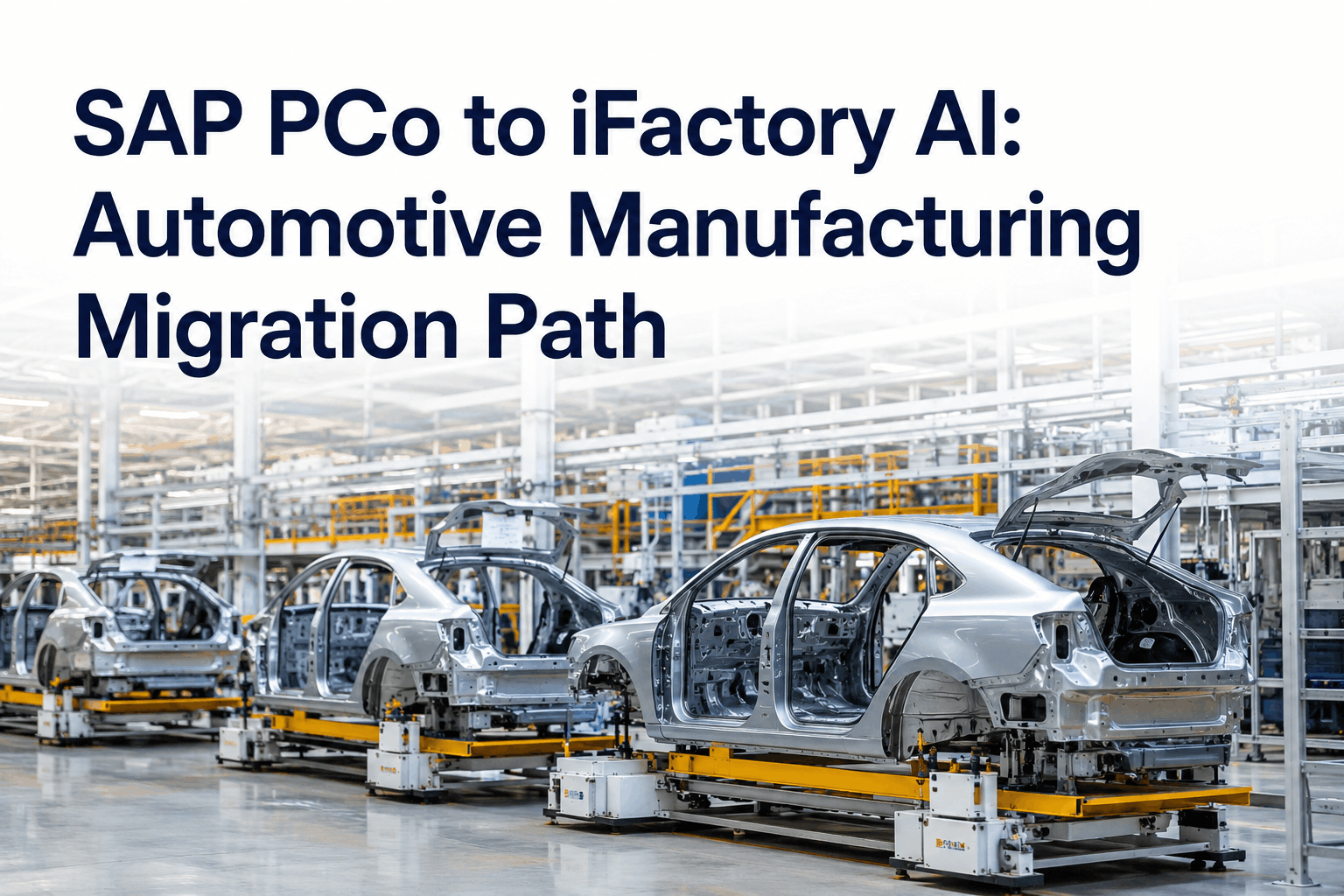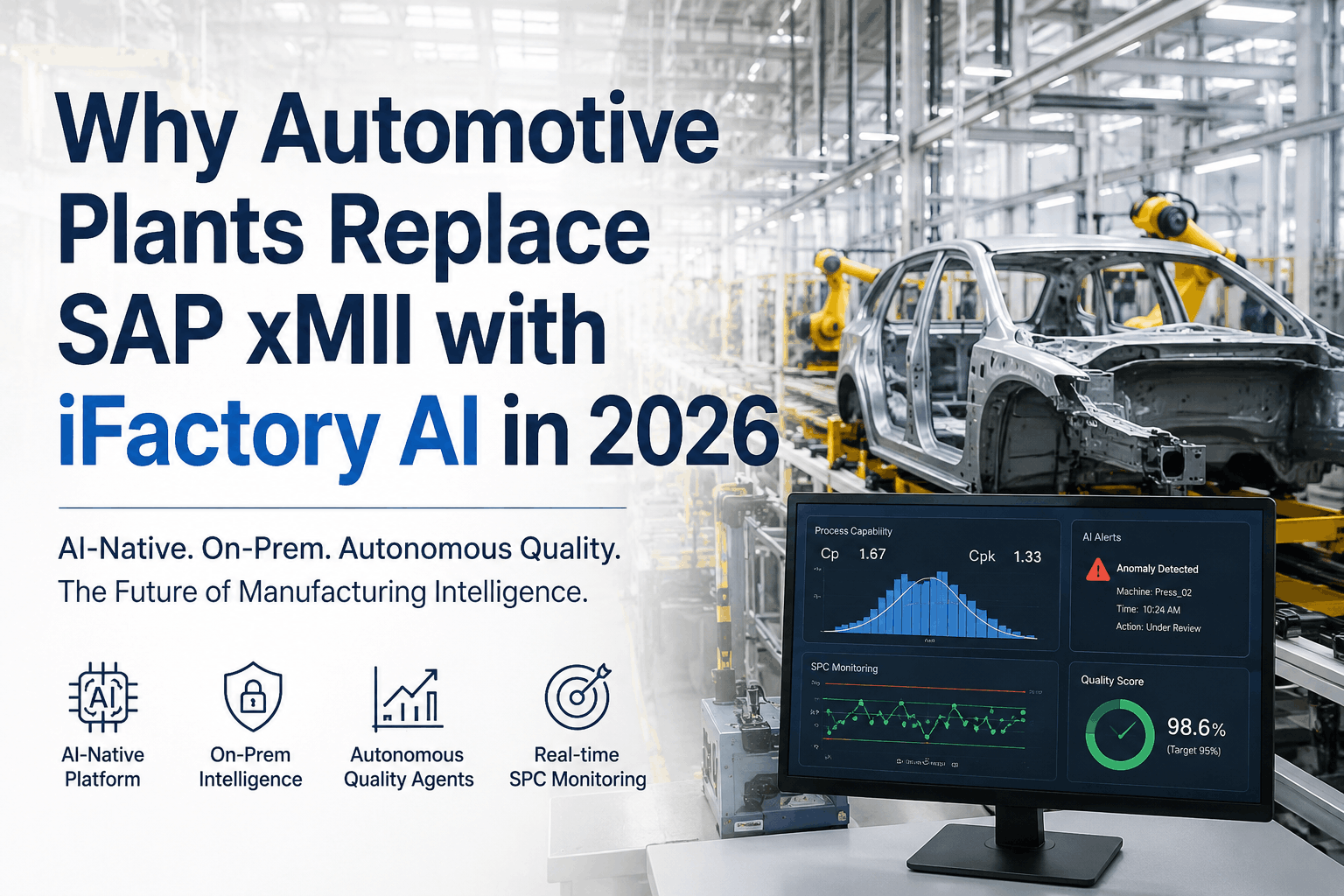
Automotive manufacturing has the toughest SPC bar in industry. IATF 16949 mandates Cpk ≥ 1.67 for critical characteristics. PPAP submissions require statistical proof for every product launch. Tier 1 suppliers face customer-specific requirements (CSRs) layered on top — Ford's Q1, GM's BIQS, Stellantis's PIST, Toyota's SQA — each with its own acceptance criteria. For 20 years, plants ran this on SAP xMII with custom BLS transactions, i5 control charts, and threshold-based alerts. With SAP MII reaching end of mainstream maintenance December 2027 (extended support to ~2030), every automotive plant faces the same strategic question — migrate to SAP Digital Manufacturing Cloud (SAP DMC) and rebuild reactive SPC in a cloud-only architecture, or move to AI-native on-prem SPC that predicts process drift before it impacts a single part. This guide compares iFactory AI, SAP DMC, and legacy SAP xMII head-to-head for automotive SPC — feature by feature — and shows where on-premise AI changes the economics. iFactory ships both an on-premise NVIDIA appliance and fully managed cloud, so the deployment decision stays yours.
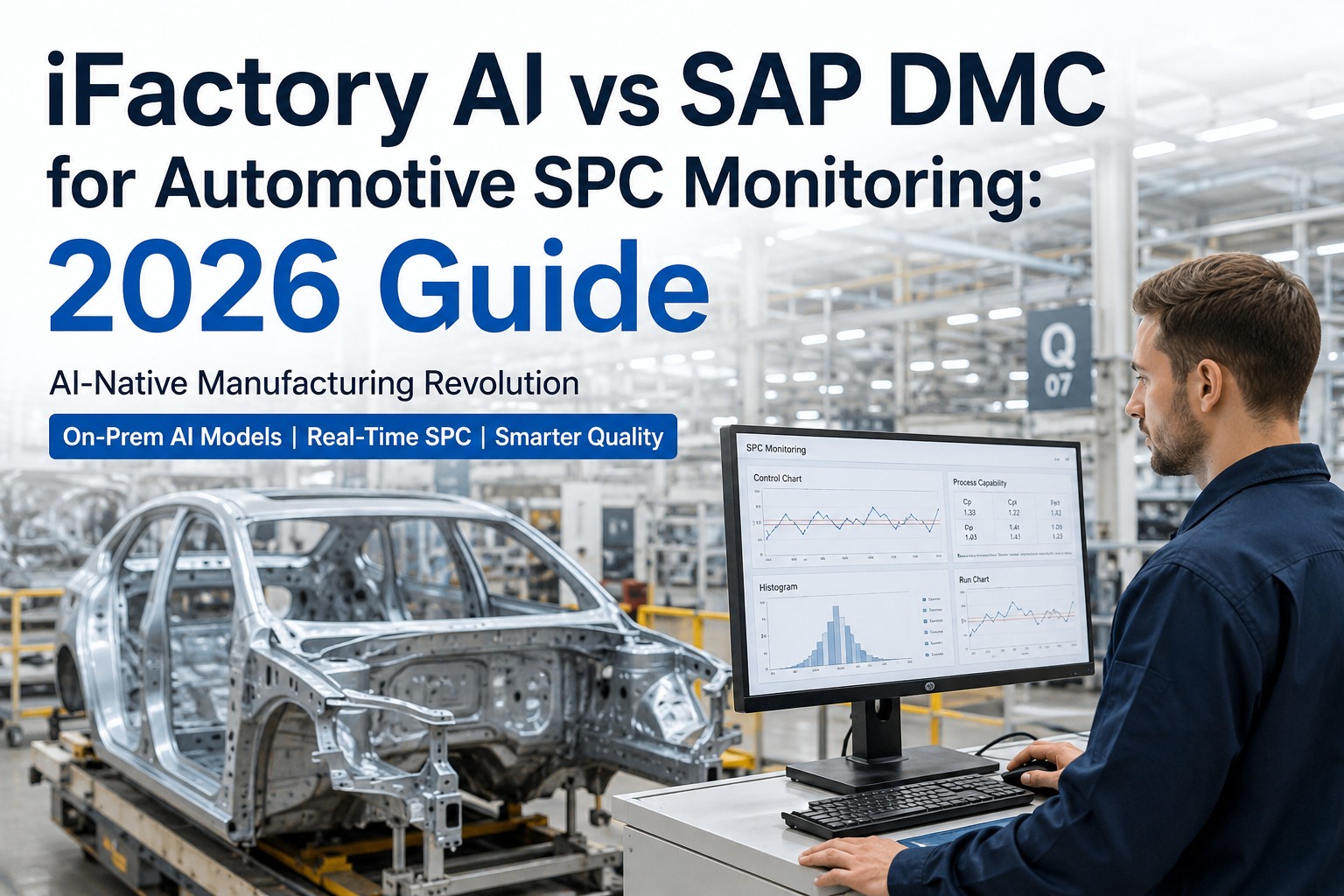
iFactory AI vs SAP DMC for Automotive SPC Monitoring: 2026 Guide
The head-to-head strategic comparison for Tier 1 suppliers and OEMs migrating off SAP xMII. AI-native on-prem SPC, IATF 16949 preserved, CSRs covered. Body shop, paint, assembly, machining — all four automotive SPC frontiers.
Why Automotive SPC Needs a Revolution
The automotive industry's SPC playbook has barely changed since the 1980s. Subgroup five parts, measure, compute X-bar and R, plot on control chart, react if a Western Electric Rule fires. Cpk gets summarized at the end of each shift. Operators chase out-of-control points after the fact. PPAP submissions wait for enough good parts. The reactive cycle is everywhere — and it's built into every legacy SAP xMII deployment.
The problem is that automotive tolerances have tightened, electrification has introduced new critical characteristics (battery cell uniformity, motor stator quality, software OTA correlations), and customer-specific requirements demand earlier detection. Reactive SPC alone no longer covers the gap. The plants pulling away from their competitors are the ones that detect process drift in upstream signals before any part goes out of spec — and that requires AI-native on-prem capability that legacy SAP xMII and even SAP DMC don't ship strongly with.
Curious how many control limit breaches your current SAP xMII SPC catches only after-the-fact? Request a retrospective SPC audit from iFactory support — we'll analyze 90 days of your weld nugget, paint thickness, torque, or dimensional data and identify subtle drift patterns that occurred 2–6 hours before each control limit breach, returned within 5 business days.
iFactory AI vs SAP DMC vs SAP xMII — Strategic Comparison
Head-to-Head — Three Paths for Automotive SPC in 2026
SAP xMII
- Familiar to ops teams
- Tight SAP S/4HANA integration
- Validated for current PPAP
- Reactive SPC only (no AI)
- Univariate threshold rules
- No predictive drift detection
- EOL clock ticking
- Bridge through 2030 only
SAP DMC
- Modern cloud architecture
- Native S/4HANA integration
- Embedded analytics (DMI)
- Long-term SAP roadmap
- Cloud-only deployment
- Limited native AI for SPC
- Custom xMII logic redesign
- CSR data-residency challenges
- Right MES, missing AI layer
iFactory AI
- On-prem AND cloud — your choice
- LSTM drift prediction 2–6 hr lead
- Multivariate & adaptive limits
- Operator AI assistant grounded in SOPs
- Direct S/4HANA + xMII integration
- Not a full MES replacement alone
- Pairs with SAP DMC or alongside xMII
- The AI layer that unlocks automotive SPC
Detailed Feature Comparison — What Actually Matters for Automotive SPC
The headline cards make the strategic case. The line-by-line comparison shows where the capability differences land in daily operations.
| Capability for automotive SPC | SAP xMII | SAP DMC | iFactory AI |
|---|---|---|---|
| Real-time control charts (X-bar, R, S, IMR) | Yes — Native | Yes — Native | Native + AI-augmented |
| Cpk / Ppk capability indices | Yes — BLS-computed | Yes — Built-in | Yes — Built-in + predictive |
| Western Electric / Nelson Rules | Yes — All rules | Yes — All rules | Yes — All rules + autoencoder |
| Predictive drift detection (LSTM) | No — Not available | ~ Limited DMI add-on | Yes — 2–6 hr lead time |
| Adaptive control limits | No — Static only | ~ Manual recompute | Yes — Auto-adapting per mix |
| Multivariate SPC (correlated tags) | No — Univariate | ~ Basic | Yes — PCA + autoencoder |
| Operator AI assistant (natural language) | No — Not available | No — Not available | Yes — Vector-RAG grounded |
| On-premise deployment option | Yes — On-prem only | No — Cloud-only | Yes — On-prem OR cloud |
| Sub-50ms inference at the line | No — N/A | No — Cloud RTT-bound | Yes — Native (NVIDIA on-prem) |
| Customer-Specific Requirements (CSR) support | ~ Custom BLS work | ~ Clean-core redesign | Yes — Pre-built per OEM |
| IATF 16949 audit trail | Yes — Validated | Yes — Validated | Yes — Validated + tamper-evident |
| Migration timeline | Already deployed | 12–24 months | 6–12 weeks turnkey |
Want this feature comparison tuned to your specific automotive plant — body shop, paint, assembly, or machining? Schedule an AI Transformation Workshop — bring your top 10 SPC characteristics and the iFactory team will walk through how each capability lands on your tags, with side-by-side projection of xMII vs DMC vs iFactory AI.
Adaptive SPC — The Capability Static Tools Can't Deliver
Traditional SPC sets control limits once, often at PPAP, and freezes them. Real automotive processes don't behave that way — tool wear, ambient temperature, material lot variation, and shift dynamics all cause natural drift in process distributions. Adaptive SPC re-estimates control limits continuously based on operating context, distinguishing process drift from environmental variation and reducing false alarms while catching real issues earlier.
Four Automotive SPC Applications — Where AI Changes the Game
Automotive SPC isn't one thing — it's four distinct domains, each with its own characteristics and AI opportunities. iFactory ships pre-built model templates for all four, accelerating deployment versus building from scratch.
Body Shop SPC
Spot weld nugget diameter, torque values, dimensional repeatability, robotic gun alignment. Variability driven by electrode wear, sheet thickness variation, and shunting effects.
Paint Shop SPC
Paint film thickness (DFT), color uniformity (ΔE), orange peel, dirt/contamination defects. Variability driven by humidity, booth temperature, paint viscosity, and gun fouling.
Assembly Line SPC
Bolt torque, joint sequence, gap-and-flush measurements, leak test, ECU programming verification. Variability driven by tool drift, fixture wear, and inline mix variation.
Machining SPC
Dimensional tolerance (CMM data), surface roughness, hole position true position, tool life management. Variability driven by tool wear, thermal expansion, coolant condition.
The On-Premise AI Advantage — Why It Matters for Automotive
Why automotive plants choose iFactory's on-premise NVIDIA appliance
SAP DMC is cloud-only. iFactory ships both on-premise and cloud. For automotive, the on-premise option is often the deciding factor — not because cloud is inadequate, but because the on-premise architecture solves four specific automotive challenges that cloud-only platforms can't.
Sub-50ms inference
Real-time AI prediction at the line cycle time. Cloud round-trip adds 200–500ms, breaking takt time on high-speed lines.
CSR data residency
Many OEM customer-specific requirements forbid production data leaving the plant. On-premise satisfies CSRs without exception management.
WAN-resilience
Plant operations continue uninterrupted during internet outages. Critical for 24×7 production lines and lights-out machining cells.
IP protection
Body-in-white geometry, paint formulations, assembly tolerances stay inside the perimeter. Important for OEM IP and Tier 1 confidentiality.
Bandwidth economics
Streaming all process tags to cloud burns significant bandwidth at scale. On-premise inference + selective cloud sync is more economical.
Predictable cost
CapEx appliance amortizes over 4–5 years. No surprise OpEx escalation as data volumes grow. Easier to budget for finance teams.
For multi-site automotive operations, the right answer is often hybrid — on-premise at sensitive sites, iFactory Cloud for fleet benchmarking. Request the on-prem vs cloud decision framework from iFactory support — we'll return a sized recommendation per plant based on CSRs, IT capacity, and budget posture, typically within 3 business days.
IATF 16949 Compliance — Preserved Through Migration
Every IATF requirement that affects SPC migration
- Process capability evidence (Cpk / Ppk per characteristic)
- Control plan alignment with PFMEA outputs
- Measurement System Analysis (MSA) audit trail
- Reaction plan execution evidence
- Layered Process Audit (LPA) integration
- Customer-Specific Requirements (CSRs) traceability
- PPAP submission data continuity
- Tamper-evident electronic records
iFactory's migration approach preserves all of these. Audit trail format matches existing eQMS expectations. Control plan linkages carry over. CSR-specific reporting (Ford Q1 data, GM BIQS reports, Stellantis PIST submissions) ships as pre-built modules rather than custom development.
Migration Approach — Five Steps to AI-Native Automotive SPC
SPC content audit
Inventory every SPC chart, every Cpk/Ppk calculation, every alert rule across body shop, paint, assembly, machining. Tag each by criticality tier and CSR coverage. Output is a prioritized migration scope.
Parallel deploy iFactory alongside SAP xMII
Stand up iFactory on-prem appliance on the same historian + PLC tags. Both systems compute charts and Cpk in parallel. Equivalence validated chart-by-chart against current MII outputs.
Activate AI-native capabilities
Turn on LSTM drift prediction, multivariate models, adaptive limits, operator AI assistant. Operators see predictive alerts alongside traditional control charts. CSR-specific reporting modules go live.
Retire SAP xMII SPC wave by wave
Once equivalence is validated and AI advisory layer is operationally trusted, retire MII SPC charts in waves by IATF criticality. Each wave gets change-control documentation. Audit trail continuity preserved.
Optional — pair with SAP DMC for full MES
If MES execution also migrates to SAP DMC, iFactory integrates with both DMC and S/4HANA directly. AI-native SPC operates on top of DMC, capturing the AI value DMC alone doesn't deliver. Hybrid is the realistic norm for multi-plant programs.
Building a wave plan for your automotive SPC migration takes about 90 minutes with iFactory's automotive engineers. Schedule an AI Manufacturing Transformation Workshop and you'll leave with a sequenced 6-month migration roadmap covering all four SPC domains — body, paint, assembly, machining — with concrete Cpk improvement projections and CSR coverage milestones.
Two Real Automotive SPC Migration Outcomes
Stamped component supplier with multi-OEM CSRs and aging xMII SPC
A Tier 1 stamped-and-welded component supplier running SAP xMII SPC since 2015 across 18 robotic weld cells. CSRs from three OEMs (Ford Q1, GM BIQS, Stellantis PIST). Static control limits, weekly Cpk reviews, reactive responses. PPAP submissions slowed by data assembly time.
Vehicle assembler with 4 paint shops, cloud-first IT, SAP DMC migration approved
A vehicle OEM with 4 paint shops across North America. SAP xMII running paint thickness and color ΔE charts. Corporate IT mandate is cloud-first; SAP DMC migration approved at executive level. Operations team wants AI capabilities (multivariate paint defect prediction, AOI vision) that DMC doesn't ship strongly.
Neither scenario matches your situation exactly? Send your automotive SPC content summary to iFactory support and the team will return a customised scenario walkthrough — feature mapping, IATF impact assessment, and migration roadmap — typically within 3 business days, no obligation.
iFactory's Automotive Deployment — On-Premise or Cloud
The reason automotive plants pick iFactory over SAP DMC isn't AI alone — it's the freedom to choose deployment model based on plant-specific reality. Same AI stack on either model. Pick what fits your CSRs, IT strategy, and budget posture.
iFactory On-Premise Appliance Default for body shop, paint, sensitive assembly
- Pre-configured NVIDIA AI server — racked, software-loaded, ready to plug in.
- Sub-50ms inference at the line — fits takt time for high-speed cells.
- All production data stays inside the plant — CSR-compliant by design.
- SAP S/4HANA integration certified — direct, no MII intermediary required.
iFactory Cloud For multi-plant fleet benchmarking and cloud-first IT
- Fully managed — no rack, no facility requirements.
- Same AI stack — adaptive SPC, multivariate models, operator AI assistant.
- Fleet-wide benchmarking across all plants in one tenant.
- Fastest deployment — first plant live in 2–4 weeks.
The AI Manufacturing Revolution starts with one workshop.
iFactory's AI Manufacturing Transformation Workshop is a focused 90-minute strategic session covering your current SAP xMII SPC footprint, your CSR portfolio, your IATF 16949 audit posture, and the AI capabilities that will unlock your Cpk targets. Output is a sized migration roadmap with concrete cost and timeline. On-premise appliance or fully managed cloud, your call on deployment.
Frequently Asked Questions
Why is iFactory better than SAP DMC for automotive SPC specifically?
Three structural reasons. First, iFactory ships AI-native SPC (LSTM drift prediction, multivariate models, adaptive limits) that SAP DMC doesn't strongly support. Second, iFactory offers on-premise deployment — critical for OEM CSRs and high-speed line takt times where cloud round-trip breaks budgets. Third, iFactory delivers turnkey in 6–12 weeks versus 12–24 months for full SAP DMC. The pragmatic pattern is hybrid — SAP DMC for MES execution, iFactory for the AI-native SPC layer on top.
How does iFactory preserve IATF 16949 compliance through migration?
Three elements — tamper-evident audit trail logging compatible with existing eQMS; pre-built reporting modules for OEM customer-specific requirements (Ford Q1, GM BIQS, Stellantis PIST, Toyota SQA); and validated documentation supporting GAMP 5 risk-based qualification. iFactory provides IQ/OQ/PQ test script templates, change control framework, and migration-specific equivalence-validation documentation.
Can iFactory work alongside our existing SAP xMII during transition?
Yes — and this is the recommended pattern. iFactory's edge layer subscribes to the same OPC UA / MQTT / historian sources xMII uses. Both systems compute SPC in parallel. Equivalence is validated chart-by-chart before MII SPC is retired. SAP xMII can continue running other functions through 2030 extended support if needed.
Do I have to buy NVIDIA servers separately?
No. iFactory's on-premise appliance ships fully loaded — pre-configured NVIDIA AI server, software pre-installed, network gear, cabling, edge devices for line-side inference. You provide rack space, line power, and Ethernet. For the cloud option, there's no hardware at all.
What's the typical AI drift prediction lead time for automotive applications?
Varies by application. Body shop weld nugget drift averages 4–6 hours lead time. Paint film thickness drift averages 2–4 hours. Machining tool wear averages 6–10 hours. Assembly torque drift averages 1–3 hours. Lead time depends on process dynamics, AI model architecture, and historical training data volume.
How does the cost compare — iFactory vs SAP DMC?
For SPC scope specifically — iFactory deploys in 6–12 weeks turnkey at substantially lower total cost than rebuilding SPC content inside a SAP DMC migration. For full MES migration, SAP DMC delivers MES execution and iFactory delivers the AI layer; together the hybrid typically costs less than rebuilding the AI capabilities natively in SAP DMC. Specific numbers depend on plant size and customization depth — the workshop produces concrete figures.
Can iFactory support our multi-OEM customer-specific requirements?
Yes — pre-built modules support Ford Q1, GM BIQS, Stellantis PIST, Toyota SQA, Honda HG-EX, VW Group FAQ, and others. Custom OEM requirements are handled through iFactory's open workflow engine (Python/TypeScript service code). Multi-OEM Tier 1 suppliers typically run several CSR modules in parallel from the same SPC data.
The 2027 deadline is a forcing function. Use it to win, not just rebuild.
Every automotive plant migrating off SAP xMII will spend the budget anyway. The question is whether you end up with reactive SPC on a new platform, or AI-native SPC that predicts process drift hours before it impacts a part — with on-premise data sovereignty and operator AI assistant included. iFactory's AI Manufacturing Transformation Workshop makes the answer concrete in 90 minutes.