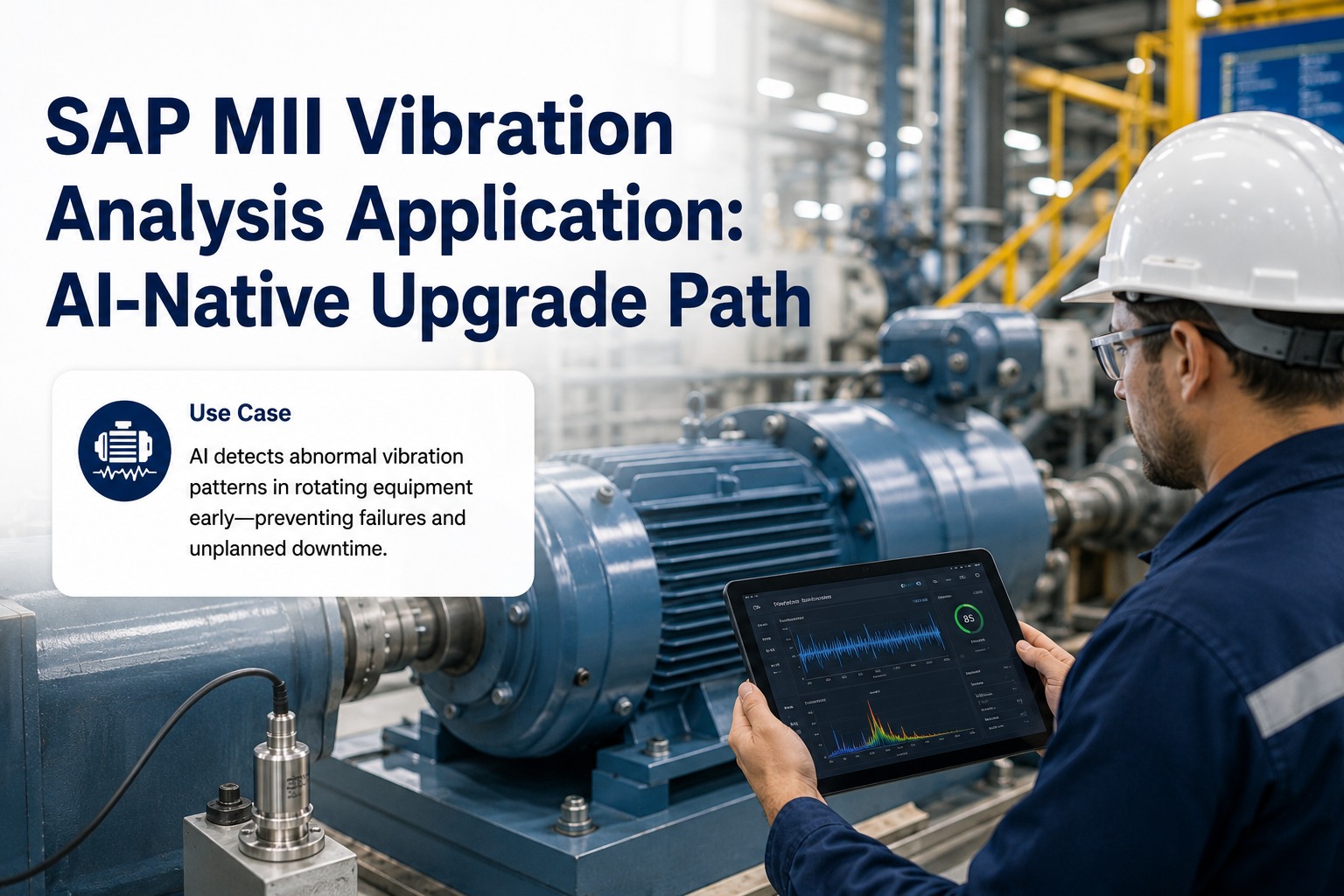
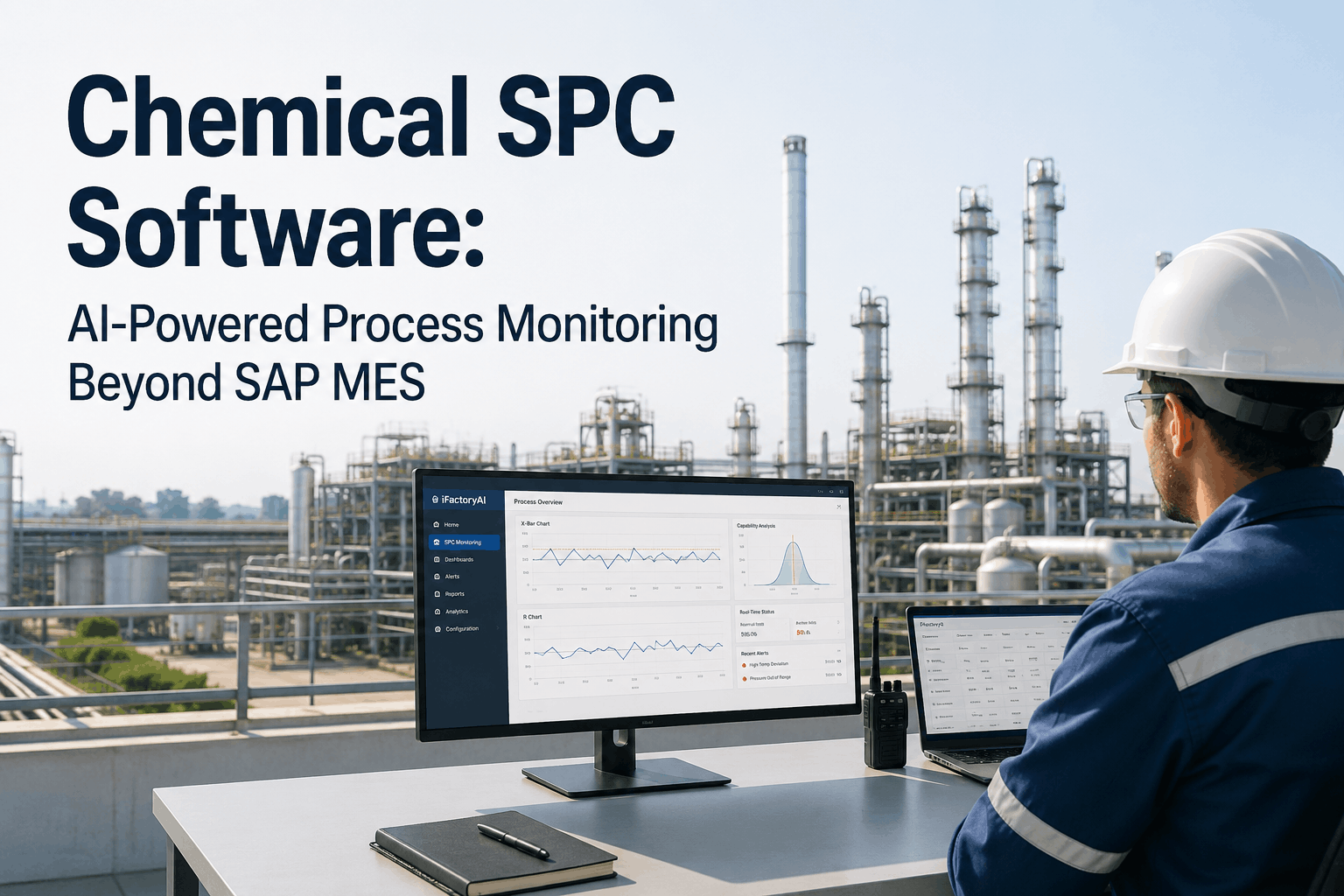
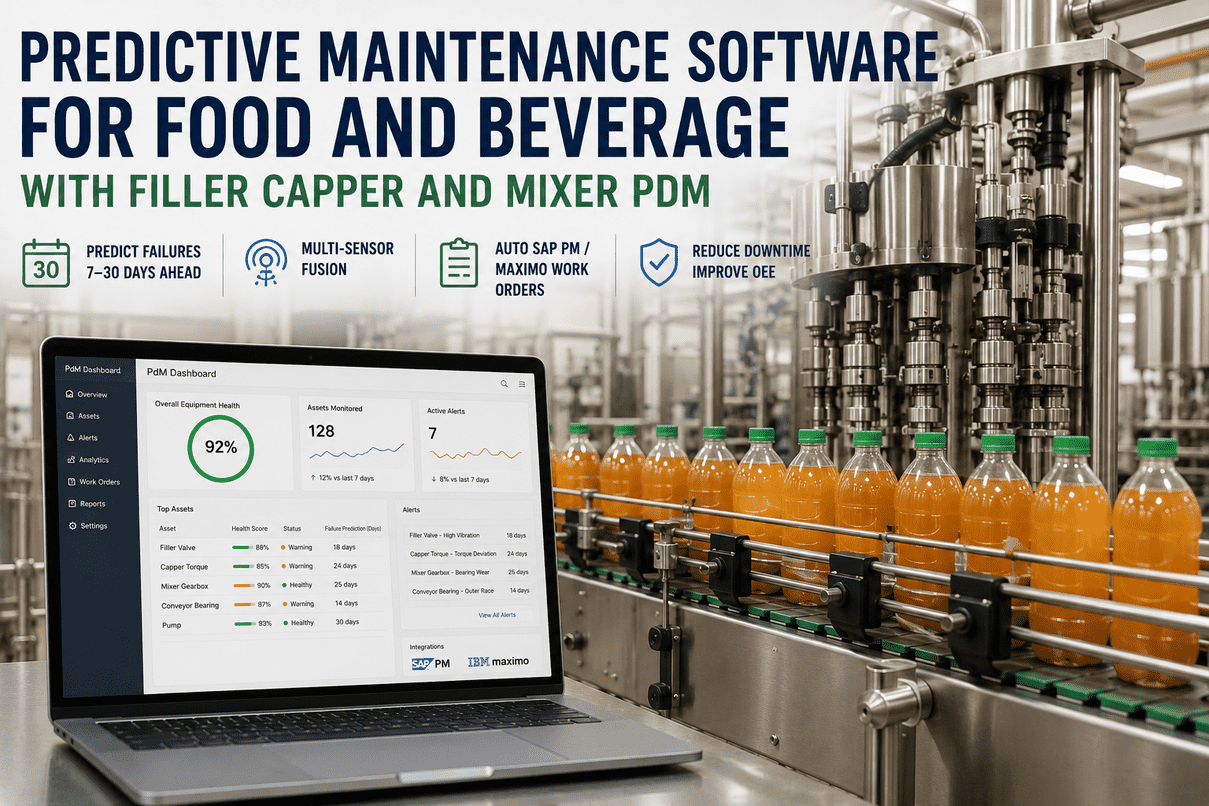
A pump bearing fails on Tuesday morning. By Tuesday lunchtime an emergency crew is on site, a 36-hour overhaul is in progress, and the production line is down. Six months earlier — the moment that bearing actually started failing — a vibration sensor on the pump housing detected a tiny ultrasonic emission at 4.2 kHz. Three months later the FFT spectrum showed a small peak at the outer-race fault frequency (BPFO). Six weeks before failure the peak was tall enough that ISO 10816 had moved the machine from Zone A to Zone C. SAP MII dashboards plotted the velocity RMS trend the entire time. None of them ever ran FFT, classified the fault as "outer race bearing defect," or predicted the failure date. AI-native vibration analysis does all three. Book a 30-minute vibration-analysis walkthrough with our deployment engineers.
FFT · ISO 10816 · BEARING FAULT CLASSIFICATION
SAP MII Plots the Vibration Trend. AI-Native Vibration Analysis Names the Fault and Predicts the Failure Date.
SAP MII vibration dashboards show velocity RMS over time and trigger basic threshold alarms that hand off to SAP PM. The gap is everything between the alarm and the work order — FFT spectrum analysis, bearing fault frequency lookup (BPFO, BPFI, BSF, FTF), ISO 10816 severity zoning, P-F curve positioning, and the predicted-failure-date calculation. AI-native vibration analysis on NVIDIA on-prem hardware closes that gap. Pilot in 6 to 12 weeks. Perpetual license. Source code included.
The Four Fault Signatures · How AI Reads the FFT Spectrum
Every rotating machine fault has a distinct fingerprint in the FFT frequency spectrum. SAP MII dashboards plot the raw velocity RMS trend but do not run FFT and do not identify which fault produced the rising trend. AI-native vibration analysis decomposes every reading into the spectrum, identifies which signature is dominant, and routes the work order accordingly. Talk to our reliability engineering support team about your specific asset list.
FAULT 01UNBALANCE
Single dominant peak at 1× RPM, radial direction. Amplitude scales with speed². Stable phase angle.
ROOT CAUSE Mass distribution uneven — debris on impeller, broken vane, bent shaft.
FAULT 02MISALIGNMENT
Strong 2× RPM peak, often taller than 1×. High axial vibration. 180° phase shift across coupling.
ROOT CAUSE Coupling angular or parallel offset — bad alignment after maintenance.
FAULT 03LOOSENESS
Harmonics at 1×, 2×, 3×, 4× RPM. Noise floor lifts. Half-harmonics may appear at 0.5×, 1.5×.
ROOT CAUSE Foundation bolts loose, bearing housing fit, worn supports.
FAULT 04BEARING DEFECT
Non-synchronous peak at BPFO / BPFI / BSF / FTF with sidebands at ±1× RPM. Noise floor rises in kHz range.
EVERY READING CLASSIFIED · ISO 10816 ZONE + DAYS-TO-FAILURE
FFT + AI + SAP PM work-order auto-generation
The P-F curve says vibration analysis catches faults 6 months before failure — at the earliest detection point. The question is what happens between detection and the SAP PM work order. AI-native vibration analysis does the FFT, identifies which of the four fault types is dominant, applies ISO 10816 severity zoning, and predicts the days-to-failure number that drives scheduling. Book a 30-minute walkthrough where we run a live FFT against your actual asset list.
Two Real Reliability Scenarios · How the On-Prem Stack Solves Them
"Our SAP MII dashboard showed a slow upward vibration trend on cooling-water pump 7B for four weeks. The threshold never tripped. The pump seized on a Saturday. How does the new platform catch this?"
THE PROBLEM
Discrete manufacturing plant, 90 critical rotating assets monitored. Cooling-water pump 7B vibration velocity drifted upward — 1.8 mm/s baseline to 2.9 mm/s over four weeks. SAP MII vibration dashboard showed the trend but threshold was set at 4.5 mm/s ISO Zone C boundary. No alarm fired. Pump seized on a Saturday morning. Emergency replacement, 28-hour overhaul, production line idle for 22 hours. Cost: $84K direct + $310K lost production. The root cause came back from the lab: outer-race bearing failure with classical BPFO signature visible in the FFT four weeks before failure — but no one ran the FFT.
HOW THE ON-PREM STACK SOLVES IT
The Sensor Edge (Jetson)
Reads triaxial accelerometers on every critical asset at 25 kHz sampling rate. Computes 2,048-line FFT spectrum on the box every 60 seconds. Streams compressed spectrum data to the FFT + AI Brain.
The FFT + AI Brain (RTX)
Identifies the rising peak at BPFO frequency (142 Hz for pump 7B bearing geometry) on day 4 of the drift. Classifies fault as "outer race bearing defect." Applies ISO 10816 zoning. Predicts days-to-failure based on degradation slope.
SAP PM Work Order
Auto-generates SAP PM work order with fault type, predicted failure date, recommended action, and attached FFT spectrum. Schedules for next planned downtime. 2-hour bearing replacement instead of 28-hour emergency overhaul.
THE RESULT
Fault caught 38 days before failure. $394K event avoided. Bearing replaced during planned weekend stop.
SCENARIO 02
"Our compressor train has 22 alarms a week from the SAP MII vibration system. 90% are false alarms from process upsets. Reliability engineers have stopped reading them. How does AI separate real faults from noise?"
THE PROBLEM
Petrochemical plant. 6-stage centrifugal compressor train. SAP MII threshold-based vibration alarms fire every time inlet temperature swings, every time recycle valve repositions, every time the unit ramps. Reliability engineering gets 22 alerts per week, ~20 of which are process-noise false positives. Engineers have configured email rules to filter the alerts to a folder no one reads. The two real bearing-degradation events that mattered in the last 18 months were missed because they were buried in alarm fatigue. Plant manager wants the signal-to-noise problem solved.
HOW THE ON-PREM STACK SOLVES IT
The Sensor Edge (Jetson)
Captures vibration plus process context — inlet temperature, suction pressure, recycle valve position, load. Tags every FFT snapshot with the operating condition at the moment of capture.
The FFT + AI Brain (RTX)
Operating-condition-aware models distinguish vibration changes that track process variables (process-induced) from changes that persist independent of process (mechanical degradation). Suppresses the process-induced alerts; surfaces only the real faults.
Fleet Models (DGX)
Trains the operating-condition-aware model on 18 months of compressor train history. Cross-references against similar trains at sister plants. Fleet-wide pattern learning improves the classifier every quarter.
The most common questions reliability engineers, maintenance managers, and plant directors ask when upgrading the SAP MII vibration application to AI-native vibration analysis. Talk to our reliability deployment support team.
Do we have to replace the SAP MII vibration application immediately?
No. The AI-native platform runs alongside SAP MII during the transition. Vibration FFT, fault classification, ISO 10816 zoning, and days-to-failure prediction move to the new platform on the RTX FFT + AI Brain. SAP MII continues to handle any existing vibration dashboards and the link to SAP PM until you're ready to switch them over. By December 2027 you complete the cutover, but you operate on the new platform from week 8 onward — typically as the primary alerting source by week 12.
Will it work with our existing vibration sensors and SAP PM setup?
Yes. The Jetson Sensor Edge connects to all major vibration sensor brands — SKF, IFM, Banner, Wilcoxon, PCB Piezotronics, Bently Nevada — via 4-20 mA, IEPE, Modbus, OPC-UA, or wireless protocols. The platform speaks bidirectionally to SAP PM via standard BAPI/IDoc interfaces — work orders are auto-generated with fault type, predicted failure date, recommended action, and the FFT spectrum attached as a PDF. SAP PM notifications, planning, and execution stay exactly where they are today.
What fault types does the platform classify automatically?
Four primary mechanical faults — unbalance (1× RPM signature), misalignment (2× RPM signature), looseness (1×, 2×, 3×, 4× harmonics), and bearing defects (BPFO, BPFI, BSF, FTF non-synchronous peaks). Plus secondary classes — gear mesh defects (GMF with sidebands), belt drive problems, electrical motor faults (line frequency × pole-pass), oil whirl/whip in fluid-film bearings, pump cavitation, and resonance excitation. Classification confidence is shown with every alert; low-confidence cases route to a reliability engineer for manual review.
How does ISO 10816 severity zoning work in the platform?
Every asset is tagged with its ISO 10816 group (1: large machines >300 kW, 2: medium 15-300 kW, 3: small/pumps, 4: gas turbines) and foundation type (rigid vs flexible). The platform applies the correct Zone A/B/C/D thresholds per group automatically, plots the live measurement against the zone band, and changes alert color from green (Zone A) through amber (B/C) to red (D). The 2× baseline rule — a doubling of baseline vibration is significant even in Zone A — is also applied automatically.
How fast can we get a pilot live?
Eight weeks from contract signature for a 20-asset pilot. Weeks 1-2 — site survey, critical-asset list confirmed, sensor placement reviewed, SAP PM integration scope. Weeks 3-4 — Jetson Sensor Edge boxes deployed near asset clusters, accelerometer wiring connected, baseline FFT spectra captured. Weeks 5-6 — RTX FFT + AI Brain live, fault classifiers loaded with bearing geometry per asset, ISO 10816 zoning configured. Weeks 7-8 — SAP PM work-order integration tested with real fault events, reliability engineers trained on the new dashboards. Expansion to additional assets runs 2-3 weeks per 20-asset batch.
Vibration Edition · FFT + AI Classification · 8-Week Pilot
Stop Plotting Trends. Start Naming Faults and Predicting Failure Dates.
Book a 30-minute call with our reliability deployment engineers. Walk through your critical asset list, your SAP MII vibration dashboards, and your SAP PM work-order flow. See AI-native vibration analysis live against your actual asset spectra. Pilot in 8 weeks. Buy it once, own it forever — no monthly fees, source code included.