The headline quote for an SAP ME migration is rarely the real cost. Vendor proposals cover the visible items — license, implementation, training — but the budget blow-ups happen below the waterline, in line items that nobody puts on the first PowerPoint. Custom development inventory and remediation. Validation cycles for regulated production. Operator productivity loss during cutover. Master data cleansing. Test environment management. Consultant rate inflation as the 2027 deadline tightens. Add them up and the hidden costs typically equal or exceed the visible costs. This guide breaks down both halves of the iceberg — every cost category that lands on a real migration P&L — and shows how lift-and-shift and parallel-architecture approaches (like iFactory's turnkey on-premise NVIDIA appliance or fully managed cloud) can cut total migration cost by up to 60% compared to a full SAP DM rebuild.
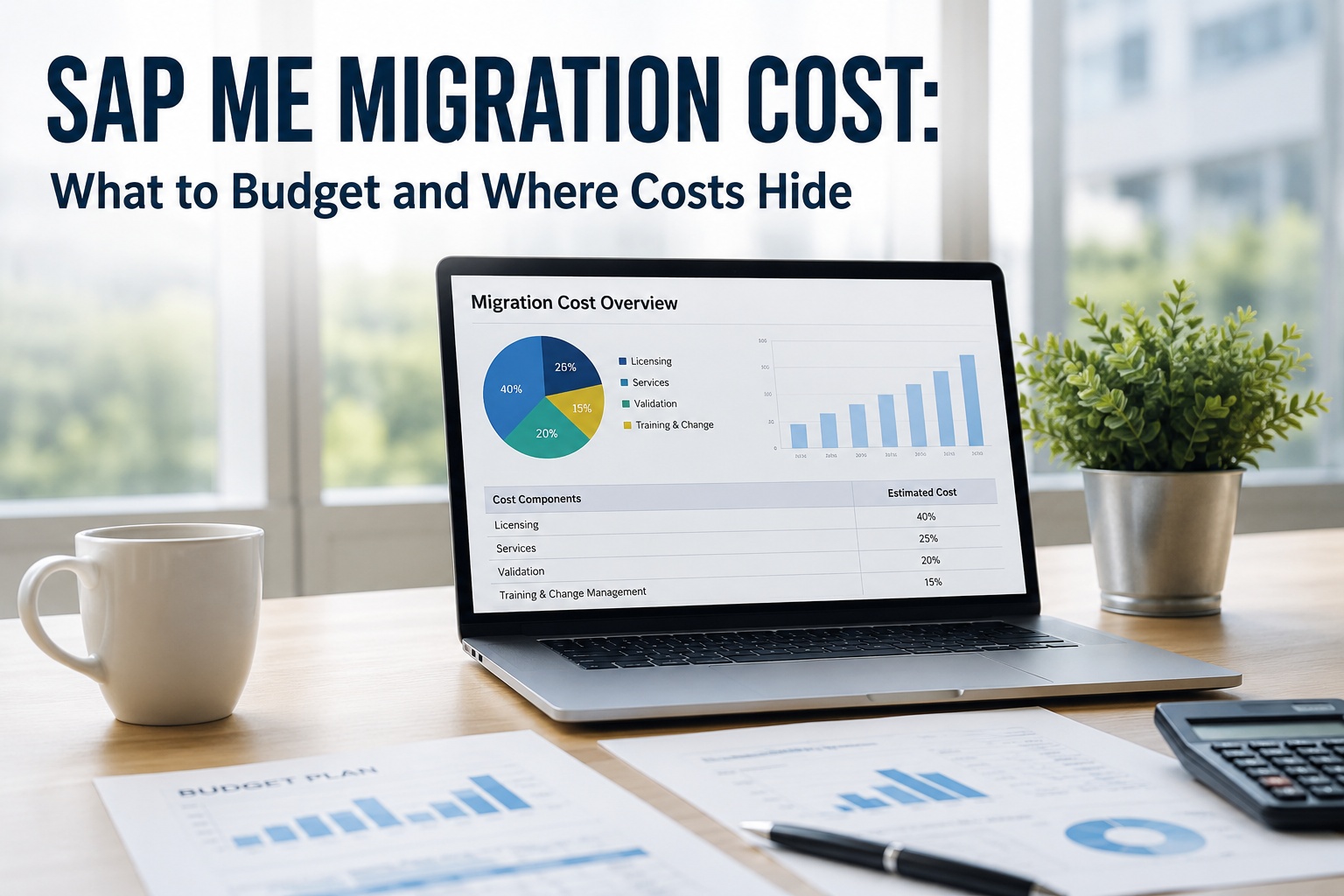
SAP ME Migration Cost: What to Budget and Where Costs Hide
Real line-item cost breakdown for SAP ME migration — visible costs every vendor quotes, hidden costs that blow budgets, and the lift-and-shift approach that cuts total cost by up to 60%. Honest ranges, two scenario walkthroughs, and a budgeting framework.
The Migration Cost Iceberg
The "what does this cost" question splits cleanly into two halves. The visible costs — what you'll see in the first vendor proposal — typically account for 40–50% of total spend. The remainder lives below the waterline, in cost categories that don't appear in headline quotes but consume real budget once the project starts.
Visible Costs — What Vendor Quotes Show
These are the cost categories that appear in every initial proposal. Real numbers vary by plant size, customization, and chosen target platform — ranges given are for a single mid-size plant.
| Cost category | What it covers | Typical range (single plant, 5-yr) |
|---|---|---|
| License / subscription | SAP DM Cloud subscription, third-party MES license, or iFactory platform | $400K–2.5M |
| Implementation services | Consultant time for assessment, build, configuration, integration | $500K–3M |
| Initial training | Admin training, super-user training, operator orientation | $60K–200K |
| Hardware / infrastructure | BTP capacity, networking, edge devices, NVIDIA AI server (if iFactory on-prem) | $80K–500K |
| Project management | PMO, vendor management, executive reporting | $150K–400K |
Want a vendor-neutral cost range tailored to your plant size, customization depth, and target platform? Request a custom SAP ME migration cost estimate from iFactory support — we'll return a categorized range comparing SAP DM Cloud, third-party MES, and iFactory paths, typically within 3 business days, no obligation.
Hidden Costs — Where Budgets Actually Blow Up
These are the categories under-budgeted in 70% of SAP ME migrations. None are optional. Each one is described with the typical magnitude as a percentage of the visible-cost subtotal.
Custom development remediation
Years of custom ME logic — Java extensions, custom POD screens, ABAP RFC bridges — must be inventoried, classified, and either ported, redesigned, or retired. The clean-core constraint in SAP DM means most cannot be lifted directly.
Validation & revalidation
Regulated industries (pharma, medical devices, food) must revalidate the new MES against 21 CFR Part 11, FDA GxP, or equivalent. Test scripts, IQ/OQ/PQ cycles, change-control documentation. Typically 6–18 months of additional effort.
Parallel running
SAP ME and the new platform run in parallel during cutover — both fully licensed, both consuming consultant time for reconciliation. Typically 3–9 months of duplicated cost across waves. Common in regulated and high-volume sites.
Master data cleansing
Bills of material, routings, work centers, recipes, material masters — all must be cleaned, harmonized, and migrated. Years of accumulated drift surface here. Often the longest-running parallel workstream.
Integration rework
S/4HANA connectors, historian feeds (PI, Proficy, InSQL), PCo replacement, third-party MES interfaces, custom RFCs. Each integration touchpoint typically requires redesign rather than reuse with SAP DM's clean-core APIs.
Operator productivity loss
Operator training, ramp-up time on new screens, error rates during transition. Plants typically see 5–15% throughput dip for 2–4 weeks per wave. Often the largest hidden cost in high-volume manufacturing.
Consultant rate inflation
As the 2027 deadline tightens, demand for SAP DM, SAP ME, and integration specialists surges. Plants engaging consultants in late 2026 see day-rate premiums of 15–35% vs early 2025 rates. Late-starters pay more for less.
Test environment management
Dev, QA, UAT, pre-prod environments — each fully licensed, configured, and maintained for the duration of the migration. Often 2–3x the production environment count. Add data refresh and synchronization costs.
Have you costed all eight hidden categories into your current budget plan? Schedule a 30-minute hidden-cost audit — iFactory's migration team will walk through your current budget line by line and flag categories typically under-estimated, with concrete uplift estimates for your specific situation.
Three Migration Approaches — Cost Comparison
The migration approach you choose determines whether you pay the full hidden-cost stack or compress it dramatically. Three approaches dominate in 2026, with very different cost profiles.
- SAP-recommended path
- Full clean-core redesign
- Highest visible + hidden costs
- Longest timeline
- Best for SAP-centric, low-custom plants
- SAP DM for execution
- iFactory for AI capabilities
- Rationalize before rebuild
- Cuts cost ~40%
- Best for multi-site CPG, mid-complex plants
- Keep SAP ME running to 2030
- Add iFactory parallel-architecture
- No custom code rebuild
- Cuts cost up to 60%
- Best for regulated, heavy-custom, mid-market
The 60% Cost Reduction — How Lift-and-Shift Works
The lift-and-shift approach (Approach 3 above) cuts total migration cost by up to 60% by eliminating the cost categories that consume most of the hidden-cost stack. Custom development rebuild — skipped. Full clean-core redesign — skipped. Lengthy parallel running — compressed. The visible-cost difference vs full SAP DM rebuild is substantial, but the hidden-cost difference is where the real savings land.
Representative 5-year totals for a mid-size plant with moderate SAP ME customization. Your specific numbers will vary based on customization depth, regulatory requirements, and plant count.
Budget Planning Framework — Five Practical Steps
Inventory the visible-cost categories
Get firm proposals from at least three vendor paths — SAP DM Cloud, one third-party MES, and an iFactory deployment. Each proposal covers license + implementation + training + infrastructure. This is your visible-cost baseline.
Estimate every hidden-cost category
Apply the 8 hidden-cost categories from the iceberg section as % uplifts on the visible-cost subtotal. Use the middle of each range for a realistic estimate. The sum is your hidden-cost reserve.
Add risk premiums for execution and timing
Add 10–20% contingency for execution risk. Add an additional 5–15% if your migration starts after mid-2026 (consultant rate inflation). Add validation premium for regulated industries — typically another 10–25%.
Compare three migration approaches
Apply the budget framework to all three approaches — full rebuild, hybrid, lift-and-shift. The lift-and-shift number typically wins on cost; the full rebuild number typically wins on long-term capability. Find your right answer in between.
Build the productivity-uplift offset
The migration cost is partly offset by productivity gains — warranty reduction, downtime reduction, yield improvement, energy savings. Add a conservative 5-year uplift estimate (typically $500K–3M for a mid-size plant) as the gross-cost reducer.
Building this 5-step framework for your specific plant takes about 90 minutes with iFactory's migration engineers. Schedule a budget planning session and you'll leave with a fully populated 5-year cost projection across the three approaches, with sensitivity analysis on the productivity-uplift assumptions.
Two Real Budget Scenarios — With the Line Items
Lift-and-shift wins — full rebuild economics don't pencil
A pharmaceutical API manufacturer running heavily customized SAP ME under GxP validation since 2011. 180 BLS transactions, 60 SAPUI5 pages, 21 CFR Part 11 batch genealogy. Full SAP DM Cloud migration estimated at $6.5M with 18-month validation tail. Plant doesn't have budget or appetite for that scope.
Hybrid SAP DM + iFactory wins — full rebuild cost cut by 40%
A consumer-goods manufacturer with 8 plants, central SAP ME deployment. Cloud-first IT mandate. SAP DM Cloud migration approved at executive level. Internal team wants AI capabilities (predictive maintenance, vision inspection) that SAP DM doesn't ship deeply.
Want this line-item breakdown applied to your plant? Send your current SAP ME deployment summary to iFactory support and the migration team will return a customised 5-year budget projection across all three migration approaches — visible + hidden line items, productivity offsets, and net cost — typically within 3 business days.
iFactory's Cost Model — On-Premise CapEx or Cloud OpEx
iFactory's role in cutting migration cost is structural — it's a parallel architecture that plugs into the existing SAP stack rather than replacing it, available in two cost models so you can match your finance preference.
iFactory On-Premise Appliance CapEx — lowest 5-year TCO at sustained high utilization
- $80K–500K CapEx typical, depending on plant size — amortizes over 4–5 years.
- Pre-configured NVIDIA AI server — racked, software-loaded, ready to plug in.
- SAP S/4HANA integration certified — direct, no MII layer required.
- All production data stays inside the plant — air-gap, GxP, ITAR friendly.
iFactory Cloud OpEx — fastest deployment, lowest upfront cost
- $2K–50K+/mo OpEx depending on plant count and consumption.
- Fully managed — no rack, no facility requirements.
- Fastest deployment — first pipeline live in 2–4 weeks.
- Fleet benchmarking across multi-plant deployments in one tenant.
Get your real number — not the headline number.
iFactory's 60-minute SAP ME cost assessment plugs your plant's actual numbers into the visible + hidden + productivity framework — across all three approaches. Output is a defensible 5-year budget projection, NPV at your hurdle rate, sensitivity analysis, and the right deployment model for your finance posture.
Frequently Asked Questions
Why do hidden costs eat so much of an SAP ME migration budget?
SAP DM's clean-core architecture means custom ME logic, integrations, and workflows must be redesigned rather than ported. That redesign work is rarely scoped accurately in initial proposals because the custom-code inventory hasn't been done. Add validation cycles for regulated industries, master data cleansing, parallel running, and operator productivity dip — and the hidden categories routinely match or exceed the visible-cost subtotal.
How does iFactory cut migration cost by up to 60%?
By eliminating the cost categories that drive the hidden-cost stack. Lift-and-shift keeps SAP ME running through extended support, so there's no custom-code rebuild, no clean-core redesign, no full revalidation. iFactory plugs in as a parallel architecture (on-prem or cloud) and integrates with SAP S/4HANA directly. The total spend is dominated by the iFactory platform cost plus extended SAP ME support, with no big-bang migration cost.
Is the lift-and-shift approach a temporary fix?
It can be a permanent strategy or a runway to a later full migration — both are valid. For regulated industries where revalidation is uneconomic, lift-and-shift through 2030 plus a later phased migration to whatever the right MES is by then often wins on total cost. For mid-market plants, lift-and-shift may simply be the right permanent answer because the full SAP DM economics never pencil.
Do I have to buy NVIDIA servers separately if I go with iFactory on-premise?
No. iFactory's on-premise appliance CapEx ($80K–500K typical) includes the pre-configured NVIDIA AI server, software pre-installed, network gear, cabling, and edge devices. You provide rack space, line power, and Ethernet. For the cloud option, there's no hardware investment at all.
How do I decide between iFactory on-premise CapEx and Cloud OpEx?
The general rule — on-premise has lower 5-year TCO for sustained high-utilization production workloads, plants with data residency requirements (GxP, ITAR, defense), and CapEx-preferred finance profiles. Cloud has lower 5-year TCO for multi-site fleets, lower-utilization use cases, greenfield plants, and OpEx-preferred finance profiles. The 60-minute cost assessment computes the crossover point for your specific situation.
Are these cost ranges real or marketing-padded?
The ranges given are based on industry benchmarks and recent SAP MII / ME customer migrations across pharma, CPG, automotive, and discrete manufacturing. They're representative, not exact for any specific plant. The wide ranges reflect genuine variability — your business case needs your numbers plugged in via the 60-minute cost assessment.
Should I include opportunity cost in my budget?
Yes — and it's typically the largest single line item missing from initial budgets. Internal IT and plant resources tied up in migration aren't available for other work. Operator productivity dips during cutover have real revenue impact. A defensible budget includes both — typically as a 10–25% uplift on the visible + hidden subtotal.
Don't be surprised by your migration cost in 2027. Get the number now.
Plants that build the full visible + hidden + productivity framework in 2026 have time to choose the right approach, negotiate from a position of knowledge, and avoid consultant rate inflation. Plants that wait pay 15–35% more for the same work. iFactory's 60-minute cost assessment is the starting point — on-premise or cloud, your call on deployment.