SAP MII SPC for Oil and Gas Refinery Process Control
By Riley Quinn on May 15, 2026
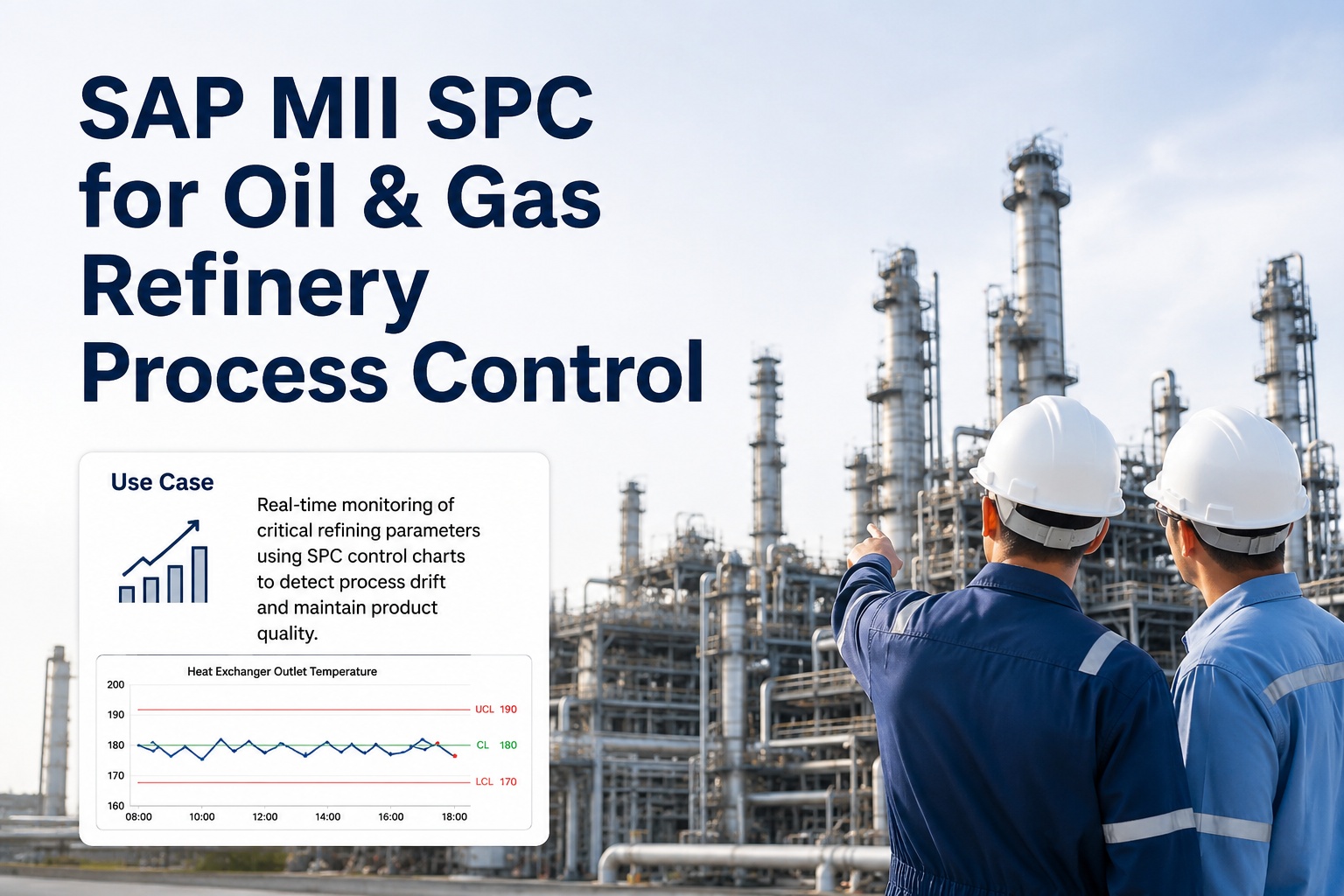
A refinery hydrotreater drifts in slow motion — H2/HC ratio creeps, riser temperature climbs, sulfur edges toward the spec ceiling — and SAP MII SPC says nothing because no single point breaches 3σ. By the time the analyzer trips, you have lost catalyst life and blended downward. With SAP MII mainstream support ending December 2027, every refinery operator built on it needs the same answer: AI-native SPC running all eight Western Electric rules continuously on NVIDIA on-prem hardware, predicting the drift four shifts before the violation. Book a 30-minute refinery SPC walkthrough with our deployment engineers.
WESTERN ELECTRIC · Cp/Cpk · DRIFT DETECTION
SAP MII SPC Catches the Violation. AI-Native SPC Catches the Drift Four Shifts Earlier.
Refinery process control parameters drift slowly — H2/HC ratio, riser temperature, sulfur ppm, T95 distillation, vapor pressure. SAP MII SPC dashboards plot the charts but rarely run all eight Western Electric rules, refresh slowly, and never predict where the parameter is headed. AI-native SPC runs every rule continuously, recalculates Cp/Cpk/Pp/Ppk in real time, and surfaces predictive drift alerts hours to days ahead of the spec violation. All on NVIDIA on-prem hardware behind your firewall. Pilot in 6 to 12 weeks. Perpetual license. Source code included.
The Eight Western Electric Rules · What AI-Native SPC Evaluates on Every Point
Three NVIDIA hardware tiers — Jetson AGX Orin for analyzer + DCS ingestion, RTX PRO 6000 for the SPC engine, DGX Station GB300 for refinery AI models — sit inside your perimeter and run the entire platform behind the firewall. The Western Electric rules below are evaluated continuously on every new point, on every parameter. Schedule an architecture walkthrough with our refinery deployment engineers.
The Western Electric rules were defined in 1956. Most SAP MII SPC dashboards only run one of them — single point beyond 3σ — because evaluating all eight in real time across hundreds of refinery parameters is too computationally expensive for a traditional MII setup. The RTX SPC Engine evaluates all eight continuously. Here is what each rule catches in a refinery context. Talk to our refinery SPC support team about your specific process unit.
R1SINGLE POINT BEYOND 3σ
One point beyond a 3-sigma limit. Detects strong special causes — analyzer fault, sudden upset, instrument failure. The only rule SAP MII dashboards reliably catch.
REFINERY EXAMPLE Sulfur ppm analyzer reads 14.2 in a 10 ppm spec — instant alert.
R2TWO OF THREE BEYOND 2σ
Two of three consecutive points beyond 2σ on the same side. Indicates a developing special cause before it reaches 3σ — a directional shift starting.
REFINERY EXAMPLE Reformer octane edging up after catalyst regeneration — surfaces unit yield drift.
R3FOUR OF FIVE BEYOND 1σ
Four of five consecutive points beyond 1σ on the same side. Detects sustained shift in process average — the early signature of a slow drift.
REFINERY EXAMPLE Crude tower T95 distillation creeping above target — feed change not announced.
R4EIGHT CONSECUTIVE SAME SIDE
Eight or more consecutive points on one side of centerline. Detects shifted but stable processes — the silent killer that lives in spec but produces creeping defect rates.
REFINERY EXAMPLE Hydrotreater sulfur trending steadily upward across 4 shifts — catalyst aging signal.
R5-R8SUPPLEMENTARY RULES
Trends of 6+, alternating sequences of 14+, stratification patterns, and hugging-the-center patterns. Detect cyclic disturbances, control-loop tuning issues, and undocumented mixing changes.
REFINERY EXAMPLE FCC riser temp oscillating in alternating pattern — control loop tuning regression.
RULES CONTINUOUSLY EVALUATED BY THE RTX SPC ENGINE
All 8 · Every new point · Every parameter
The rules above are not the differentiator — every textbook has them. The differentiator is running all eight continuously against every refinery parameter, calculating Cp/Cpk/Pp/Ppk live, and surfacing AI-predicted drift before the rule trips. That is the architectural gap between SAP MII SPC and AI-native SPC. Book a 30-minute walkthrough where we run all 8 rules live against your DCS tag list.
Two Real Refinery Scenarios — How the On-Prem Stack Solves Them
Two real scenarios from refinery operators who replaced SAP MII SPC dashboards with the AI-native on-prem stack. Each shows the exact process-control gap and the hardware integration that closed it.
SCENARIO 01
"Our hydrotreater drifted toward the 10 ppm sulfur spec across four shifts. SAP MII SPC never alerted because no single point breached 3σ. By the time the analyzer hit 11.3 ppm we had blended down and lost catalyst life. How is this caught earlier?"
THE PROBLEM
Mid-Atlantic refinery diesel hydrotreater (HDS-2). Sulfur in product spec ceiling at 10 ppm ULSD. Across four shifts, sulfur drifted from 6.2 ppm baseline to 8.4 then 9.1 then 9.7. SAP MII SPC dashboard only ran Rule 1 — no single point breached the 3σ control limit because the process was drifting, not jumping. At shift 5, the on-stream analyzer read 11.3 ppm. Result: blend correction in the rundown tank, re-routing to off-spec tankage, catalyst campaign life shortened by 8%. Estimated cost of the missed drift: $340K in product giveaway plus an early regeneration.
HOW THE ON-PREM STACK SOLVES IT
The Analyzer Bridge (Jetson)
Connects to the on-stream sulfur analyzer + DCS tags for H2/HC ratio, reactor inlet temperature, recycle gas H2 purity, LHSV. Captures every reading with subgroup metadata in real time.
The SPC Engine (RTX)
Evaluates all 8 Western Electric rules every new point. Rule 4 (8 consecutive same side) triggers at shift 2. Rule 3 (4 of 5 beyond 1σ) triggers at shift 3. Rules fire 4 shifts before the spec violation.
AI Predictive Correction
Cross-parameter correlation surfaces the root cause — recycle gas H2 purity dropping. Recommends reactor inlet temp adjustment of +4°C and H2 makeup rate increase. Operator applies the change. Sulfur trend reverses.
THE RESULT
Drift caught at shift 2 instead of shift 5. $340K product giveaway avoided. Catalyst campaign extended 4 months.
SCENARIO 02
"Our FCC riser temperature oscillates in a regular alternating pattern. SAP MII flags nothing because every point is within control limits. But the conversion is varying by 2-3% from cycle to cycle. What surfaces this?"
THE PROBLEM
Gulf Coast refinery FCC unit. Riser top temperature oscillating in a 14-point alternating pattern between 998°F and 1004°F — well inside the 990-1010°F control limits. SAP MII SPC dashboard shows green. But FCC conversion is varying by 2-3% cycle to cycle, costing 280-340 BPD of gasoline make. Reliability engineer suspects a recently-tuned advanced control loop is fighting the master temperature controller. SAP MII cannot detect alternating-pattern non-randomness because it does not evaluate the supplementary Western Electric rules.
HOW THE ON-PREM STACK SOLVES IT
The Analyzer Bridge (Jetson)
Subscribes to PI tags for riser top temp, reactor pressure, regen catalyst temperature, feed rate, slide valve positions — every 5 seconds. Streams to the SPC Engine without flooding the network.
The SPC Engine (RTX)
Rule 6 (14 alternating points) fires within 2 hours. Cross-correlates with regen slide valve position — confirms the advanced control loop is the source. Reliability engineer dispatched to retune the loop.
Refinery AI Models (DGX)
Virtual metrology model predicts FCC conversion from DCS tags between physical lab samples — confirms 2.7% conversion loss attributable to the oscillation. ROI case documented for control-loop retune.
The most common questions refinery process-control engineers, reliability engineers, and operations managers ask when planning the SAP MII SPC to AI-native SPC migration. Talk to our refinery deployment support team.
Do we have to replace SAP MII immediately?
No. The AI-native SPC platform runs alongside SAP MII during the transition. Control charts, Western Electric rule evaluation, and Cp/Cpk/Pp/Ppk calculations move to the new platform on the RTX core. SAP MII continues to handle ERP integration and any custom transactions you are not ready to migrate yet. By December 2027 you complete the cutover, but you operate on the new platform from week 8 onward. No big-bang migration, no production risk window.
Will it work with our existing PI Historian, DCS, and on-stream analyzers?
Yes. The Jetson Analyzer Bridge connects to OSIsoft PI / AVEVA, Honeywell Experion, Yokogawa Centum, Emerson DeltaV, ABB 800xA, and Siemens PCS 7 DCS systems. Standard protocols supported: OPC-UA, OPC DA, Modbus TCP, MQTT, REST, and direct historian APIs. On-stream analyzers (sulfur, octane, distillation, vapor pressure, viscosity, flash point) integrate via OPC-UA or vendor-specific protocols. LIMS integration is bidirectional for lab confirmation samples.
How many Western Electric rules does the platform evaluate?
All eight, continuously, on every new data point, for every monitored parameter. Plus the Nelson rules (eight rules), Westgard rules (six rules for clinical/lab), AIAG rules, Duncan rules, Hughes rules, Juran rules, Gitlow rules — configurable per parameter and per process unit. The default refinery configuration runs the eight Western Electric rules; reliability engineers can enable additional rule sets per unit during the pilot configuration phase.
What chart types are supported beyond X-bar and R?
All major variable charts — X-bar/R, X-bar/S, individuals/MR (I-MR), moving average, EWMA (exponentially weighted moving average), CUSUM (cumulative sum), multivariate Hotelling T². All major attribute charts — p, np, c, u. Refinery operators typically use I-MR for analyzer data with low sampling rates, EWMA for slow-drifting parameters like catalyst-affected properties, and Hotelling T² for multivariate process monitoring across correlated parameters. Chart type per parameter is configurable.
How fast can we get a pilot live?
Eight to ten weeks from contract signature. Weeks 1-2 — site survey, one process unit selected for pilot (typically a hydrotreater or FCC), DCS/PI tag list confirmed, parameter prioritization. Weeks 3-4 — Jetson Analyzer Bridge deployed in the unit control room, OPC-UA mappings ported from SAP MII, baseline measurement starts. Weeks 5-6 — RTX SPC Engine live, all 8 Western Electric rules running, Cp/Cpk/Pp/Ppk dashboards configured for operators. Weeks 7-8 — virtual metrology models trained on 90 days of historical data, AI predictive alerts active. Weeks 9-10 — second unit onboarded.
Refinery Edition · 8 Rules + AI Drift · 8-Week Pilot
Catch the Drift on Saturday. Not the Violation on Tuesday.
Book a 30-minute call with our refinery deployment engineers. Walk through your hydrotreater, FCC, reformer, or crude unit. See AI-native SPC live against your DCS tags and on-stream analyzers. Pilot in 8 weeks. Buy it once, own it forever — no monthly fees, source code included.