Pharmaceutical manufacturers have built some of the most sophisticated SAP MII deployments in the industry — particularly around Statistical Process Control. Years of careful BLS transactions calculating control limits, i5 display templates rendering X-bar and R charts, KPIs computing Cpk and Ppk, alert rules firing on Western Electric and Nelson Rule violations. All of it runs production today and feeds 21 CFR Part 11 audit trails. With SAP MII reaching end of mainstream maintenance on December 31, 2027 (extended paid support to ~2030), every pharma plant running SPC in MII faces the same question — port reactive threshold-based SPC to a new platform, or upgrade to AI-native SPC that predicts process drift hours before it crosses a control limit. iFactory delivers AI-native SPC on a turnkey on-premise NVIDIA appliance or fully managed cloud — same control charts, same Cpk/Ppk, same audit trail format, plus LSTM-based drift prediction and multivariate anomaly detection that traditional SPC can't deliver.
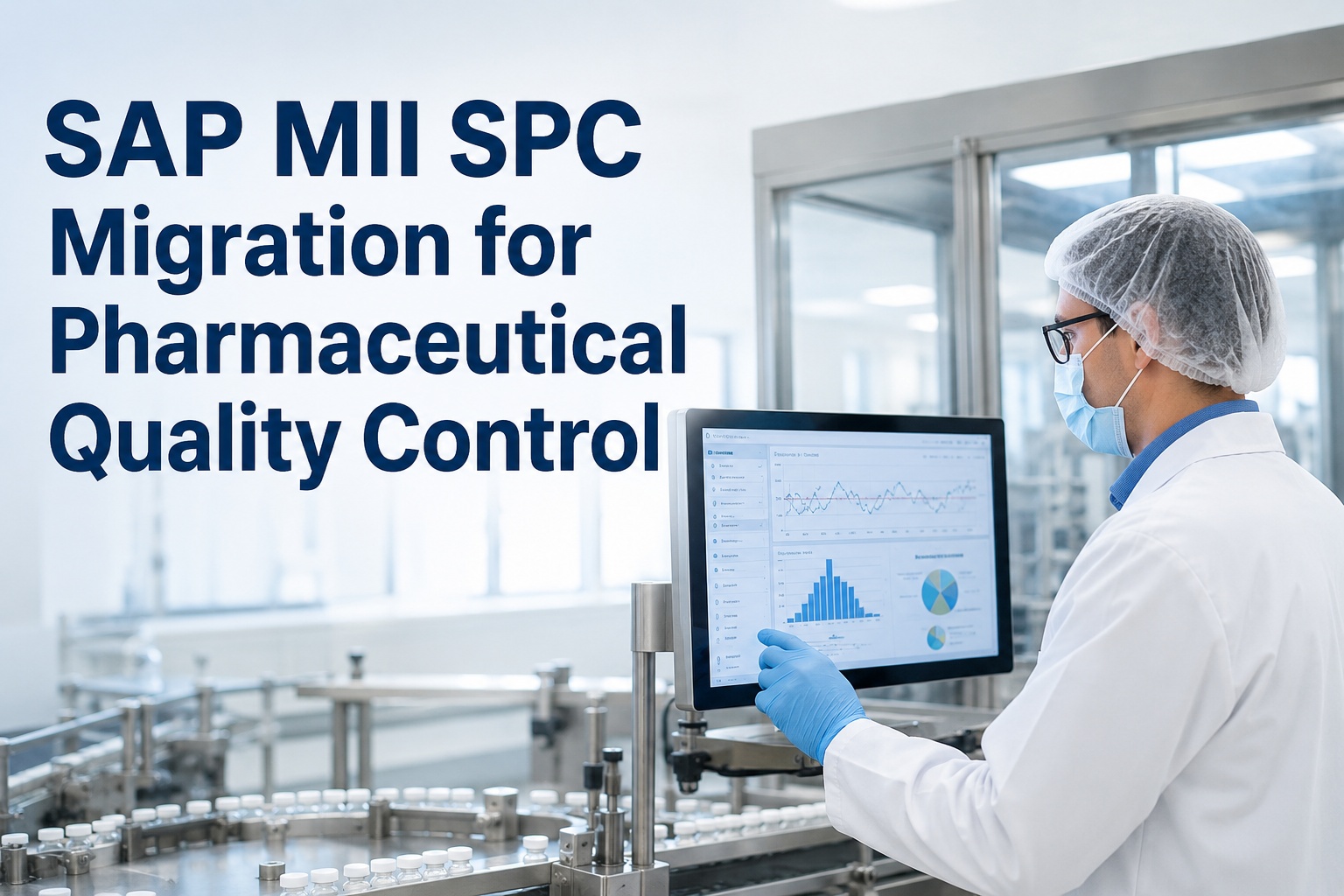
SAP MII SPC Migration for Pharmaceutical Quality Control
How regulated pharma plants migrate decades of SAP MII SPC content — control charts, Cpk/Ppk, Nelson Rules, alerts — to AI-native SPC with predictive drift detection, multivariate anomaly recognition, and full 21 CFR Part 11 audit trails preserved.
What SAP MII SPC Actually Does Today
SAP MII's SPC capability is built from several composable pieces — query templates pulling tag data from historians, BLS transactions calculating subgroup statistics, KPIs computing Cpk and Ppk indices, i5 display templates rendering X-bar/R/S/individual-MR charts, and notification rules firing on Western Electric or Nelson Rule violations. The output is a real-time SPC dashboard showing operators where their process sits versus statistical control limits.
This works — but only as a reactive system. By the time the alert fires, the process has already breached the limit. For pharma, that breach typically triggers batch hold, deviation investigation, root cause analysis, CAPA, and rework or reject. The cost per breach can run from tens of thousands of dollars for product loss alone, much more when batch genealogy and revalidation effort are included.
Curious how many control limit breaches your current SAP MII SPC catches only after-the-fact? Request a retrospective SPC audit from iFactory support — we'll analyze 90 days of your historian data and identify subtle drift patterns that occurred 2–6 hours before each control limit breach, returned within 5 business days.
AI-Native SPC — Predictive Detection
The same physical process is monitored by AI-native SPC, but with an LSTM time-series model running alongside the traditional control chart. The LSTM learns the normal process signature and forecasts the next 60–360 minutes of values. When the forecast distribution starts trending toward a control limit — but well before the limit is actually crossed — a predictive alert fires with confidence score and recommended action.
Traditional SPC vs AI-Native SPC — Side by Side
Both systems use the same underlying process data and the same statistical foundations (control limits, capability indices, Western Electric and Nelson Rules). What changes is what happens around the control chart — prediction, multivariate awareness, root-cause guidance, and how operators are alerted.
Reactive, univariate, threshold-based
- Detection mode — after control limit is crossed
- Lead time — 0 (alert fires at breach)
- Variable scope — univariate; one tag at a time
- Pattern rules — Western Electric / Nelson Rules only
- Root cause — none; operator investigates
- Forecast capability — none
- Drift sensitivity — low; small trends invisible
- Alert volume — high; many false positives during ramp / setup
Predictive, multivariate, context-aware
- Detection mode — hours before control limit crossing
- Lead time — 2–6 hours typical (model-dependent)
- Variable scope — multivariate; correlated tags evaluated together
- Pattern rules — Nelson Rules + LSTM forecast + autoencoder anomaly
- Root cause — suggested via vector RAG over historical incidents
- Forecast capability — 60–360 min ahead with confidence band
- Drift sensitivity — high; subtle trends caught early
- Alert volume — filtered; confidence fusion suppresses noise
Want to see what AI-native SPC would catch on your current process tags? Schedule a 30-minute SPC walkthrough — bring 30 days of your bioreactor, fill weight, or tablet press tags, and the iFactory team will run them through the LSTM + autoencoder layer live to show predicted vs reactive detection on real incidents.
Four Pharma SPC Applications — With AI Enhancement
SAP MII SPC has been deployed across the full pharma manufacturing stack — upstream bioreactors, formulation, tablet manufacturing, fill/finish, packaging. Each application has specific AI-native enhancements that traditional SPC can't deliver.
Bioreactor Process Monitoring
SAP MII SPC today — X-bar/R charts on pH, DO, OD, temperature, foam, agitation rate. Alerts when any single tag breaches limits.
Tablet Manufacturing Quality
SAP MII SPC today — Control charts on tablet weight, hardness, thickness, friability. Cpk/Ppk capability indices per batch.
Fill / Finish Line Control
SAP MII SPC today — Fill weight charts, capping torque, visual inspection rejects. Subgroup statistics per filling run.
Aseptic Environment Monitoring
SAP MII SPC today — Viable counts, particle counts (0.5µ/5µ), differential pressure, air changes per hour, environmental classifications.
21 CFR Part 11 & GxP — Validation Preserved Through Migration
Migrating SPC in a regulated pharma environment isn't just a technical task — it's a validation event. Every SPC application that contributes to batch record decisions sits inside the validated state, and any platform change requires revalidation against the same regulatory framework. Here's the practical approach for keeping compliance intact.
Audit trail continuity is non-negotiable
FDA requires that electronic records used in batch decisions be tamper-evident, attributable, and retained for the full regulatory window. iFactory's migration approach preserves audit trail format and content — every SPC event (subgroup creation, control limit calculation, alert firing, operator acknowledgment) is logged with the same fields the validated MII system used.
- Per-event timestamp, user ID, action type, and digital signature (where applicable)
- Tamper-evident logging via cryptographic hash chain
- Retention aligned with batch record retention policy (typically minimum 7 years for finished pharma)
- Audit log export in formats compatible with existing eQMS systems
Computer System Validation (CSV) approach
iFactory's AI-native SPC layer is delivered with documentation supporting GAMP 5 risk-based validation. The platform itself is validated by iFactory; the configured application (control charts, limits, alert rules, AI models) is validated by the customer using a standard IQ/OQ/PQ cycle.
- Installation Qualification (IQ) documentation pre-built for the appliance and cloud deployments
- Operational Qualification (OQ) test scripts for SPC chart accuracy, Cpk/Ppk calculation, alert behavior
- Performance Qualification (PQ) approach for AI model performance over time
- Change control framework for model retraining, alert threshold updates
Need the validation deliverables list before you can even scope a pharma SPC migration? Request the iFactory pharma SPC validation package — full CSV documentation summary, IQ/OQ/PQ test script templates, audit trail format specifications, and the GAMP 5 risk-assessment framework, returned within 5 business days.
Migration Approach — Five Practical Steps
SPC content inventory and classification
Catalog every SPC chart, every control limit calculation, every alert rule, every Cpk/Ppk KPI. Classify by validation status (validated batch-decision-critical vs supporting analytical) and by criticality tier. This drives the migration sequence and validation approach.
Parallel-deploy iFactory alongside existing MII SPC
Stand up iFactory's SPC layer on the same historian tags MII SPC currently uses. Both systems compute charts, capability indices, and alerts in parallel — same input data, same statistical methods, same alert rules. No production change yet.
Validate equivalence chart-by-chart
For each SPC chart, demonstrate that iFactory's calculations match MII's outputs within validation tolerance. Subgroup statistics, control limit values, Cpk/Ppk results, alert triggers — all matched at the data level. Document the equivalence per validation policy.
Layer AI capabilities without disturbing validated state
Once equivalence is documented, layer the AI capabilities (LSTM forecast, multivariate anomaly, root cause suggestion) on top as advisory information. Advisory alerts don't replace the validated SPC alerts — they augment them. This avoids triggering full revalidation.
Cutover and retire MII SPC wave by wave
After full equivalence is validated and AI advisory layer is operationally trusted, retire MII SPC charts in waves grouped by validation scope. Each wave gets its own change control package. SAP MII can continue running other (non-SPC) functions through 2030 extended support if needed.
Building a wave plan for your pharma SPC migration takes about 90 minutes with iFactory's pharma migration engineers. Schedule a pharma SPC wave planning session and you'll leave with a sequenced 6-month migration roadmap covering equivalence-validation milestones, AI-layer rollout, and SAP MII SPC retirement waves — fully aligned to your validation framework.
Two Real Pharma SPC Migration Outcomes
API manufacturer running MII SPC on 12 bioreactors, validated 21 CFR Part 11
A monoclonal antibody manufacturer running SAP MII SPC since 2014 across 12 bioreactors. Control charts on pH, DO, OD, glucose, lactate, temperature, foam. Years of validated alert rules. Cloud not permitted for production data under current validation policy.
Solid-dose manufacturer with extensive MII SPC for tablet weight, hardness, friability
A generic pharmaceutical manufacturer with 8 tablet presses across two production buildings. SAP MII SPC running weight, hardness, thickness, friability charts. Cpk targets per product family. Western Electric Rule alerts driving operator interventions.
Neither scenario matches your specific pharma application? Send your SPC content summary to iFactory pharma support and the team will return a customised scenario walkthrough — equivalence validation approach, AI enhancement opportunities, and wave plan with concrete validation milestones — typically within 3 business days.
iFactory's Pharma SPC Platform — On-Premise or Cloud
iFactory's pharma SPC capability is the same on both deployment models — same control charts, same Cpk/Ppk, same AI prediction layer, same validation documentation. The choice between on-premise appliance and cloud depends entirely on your data residency rules and validation policy.
iFactory On-Premise Appliance Default for pharma — air-gap and GxP-friendly
- Pre-configured NVIDIA AI server — racked, software-loaded, GAMP 5 documented.
- Validated network deployment — fits inside the pharma site's validated boundary.
- All process data stays on-premise — no cloud round-trip for production.
- Sub-50ms inference — real-time SPC at the line.
iFactory Cloud For multi-site fleets where validation policy allows
- Fully managed — no rack, no facility requirements.
- SOC 2 Type II, ISO 27001, GxP-aligned with region-locked data residency.
- Fleet-wide SPC benchmarking across multi-site deployments.
- Fastest deployment — first site live in 2–4 weeks.
Pharma SPC migration is too important to do twice. Plan it right the first time.
iFactory's 60-minute pharma SPC assessment maps your current MII SPC content, evaluates the equivalence validation approach, recommends AI enhancement opportunities by application, and outputs a wave-by-wave migration roadmap aligned to your validation framework. On-premise or cloud, your call.
Frequently Asked Questions
Does iFactory's AI-native SPC replace traditional SPC, or supplement it?
Depends on validation choice. The most common pharma pattern is "AI as advisory layer, traditional SPC as decision-of-record." iFactory's AI prediction operates upstream of the validated control chart, giving operators earlier warning while the validated SPC remains the official decision-of-record for batch dispositions. Full replacement is possible but requires complete revalidation of the AI-layer alerts — a longer path.
How does iFactory preserve 21 CFR Part 11 compliance through migration?
Three elements — audit trail format compatibility with the existing eQMS, tamper-evident event logging via cryptographic hash chain, and validated computer system documentation following GAMP 5 risk-based approach. iFactory provides IQ/OQ/PQ test script templates, change control framework, and migration-specific equivalence-validation documentation.
What's the typical AI drift detection lead time?
2–6 hours is the typical range across pharma applications, with significant variation by process. Bioreactor multivariate drift averages 3.8 hours lead time in our customer base. Tablet press mechanical wear averages 6–10 hours. Fill/finish nozzle drift averages 1–3 hours. The lead time depends on process dynamics, the AI model architecture, and the volume of historical training data.
Do I have to retrain operators on a new SPC interface?
iFactory's SPC interface is designed to feel familiar to operators trained on MII's i5 display templates — same X-bar/R/S chart conventions, same Cpk/Ppk display, same Nelson Rule call-outs. The AI advisory layer appears as an additional panel rather than replacing the chart. Typical operator orientation is 30 minutes per shift; full familiarity within one week.
Do I have to buy NVIDIA servers separately?
No. iFactory's on-premise appliance ships fully loaded — pre-configured NVIDIA AI server, software pre-installed, network gear, cabling, edge devices. You provide rack space inside the validated network boundary, line power, and Ethernet. Full GAMP 5 IQ documentation is included.
What if our pharma SPC includes custom calculations we built in BLS?
Custom BLS calculations (special control limit derivations, industry-specific capability indices, custom Western Electric Rule variants) are ported to iFactory's open workflow engine, which accepts Python or TypeScript service code. The validated calculation behavior is preserved exactly; the underlying platform changes. Equivalence is documented per validation policy.
Can iFactory's SPC work alongside SAP DM Cloud during a longer migration?
Yes. For pharma plants migrating slowly to SAP DM Cloud, iFactory typically handles the AI-native SPC layer while SAP DM Cloud handles other MES execution. iFactory connects to SAP S/4HANA directly for production order and batch context. The architecture lets you adopt AI SPC value immediately without waiting for the full MES migration.
The 2027 deadline is a forcing function. Use it to upgrade, not just rebuild.
Every pharma plant migrating SAP MII SPC will spend the validation effort anyway. The question is whether you end up with the same reactive SPC on a new platform, or AI-native SPC that predicts drift hours before the breach. iFactory's pharma SPC assessment makes the answer concrete — on-premise appliance or fully managed cloud.