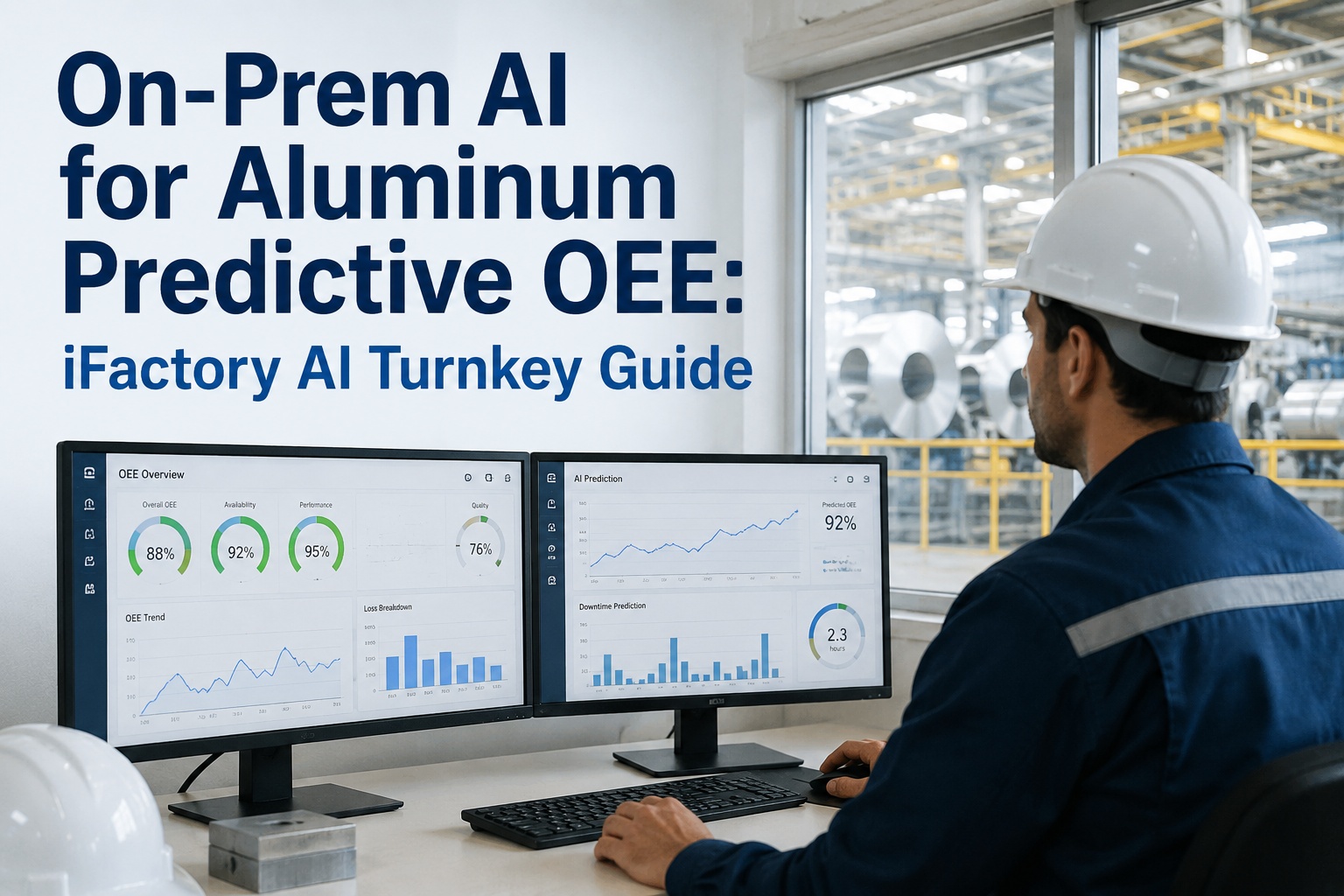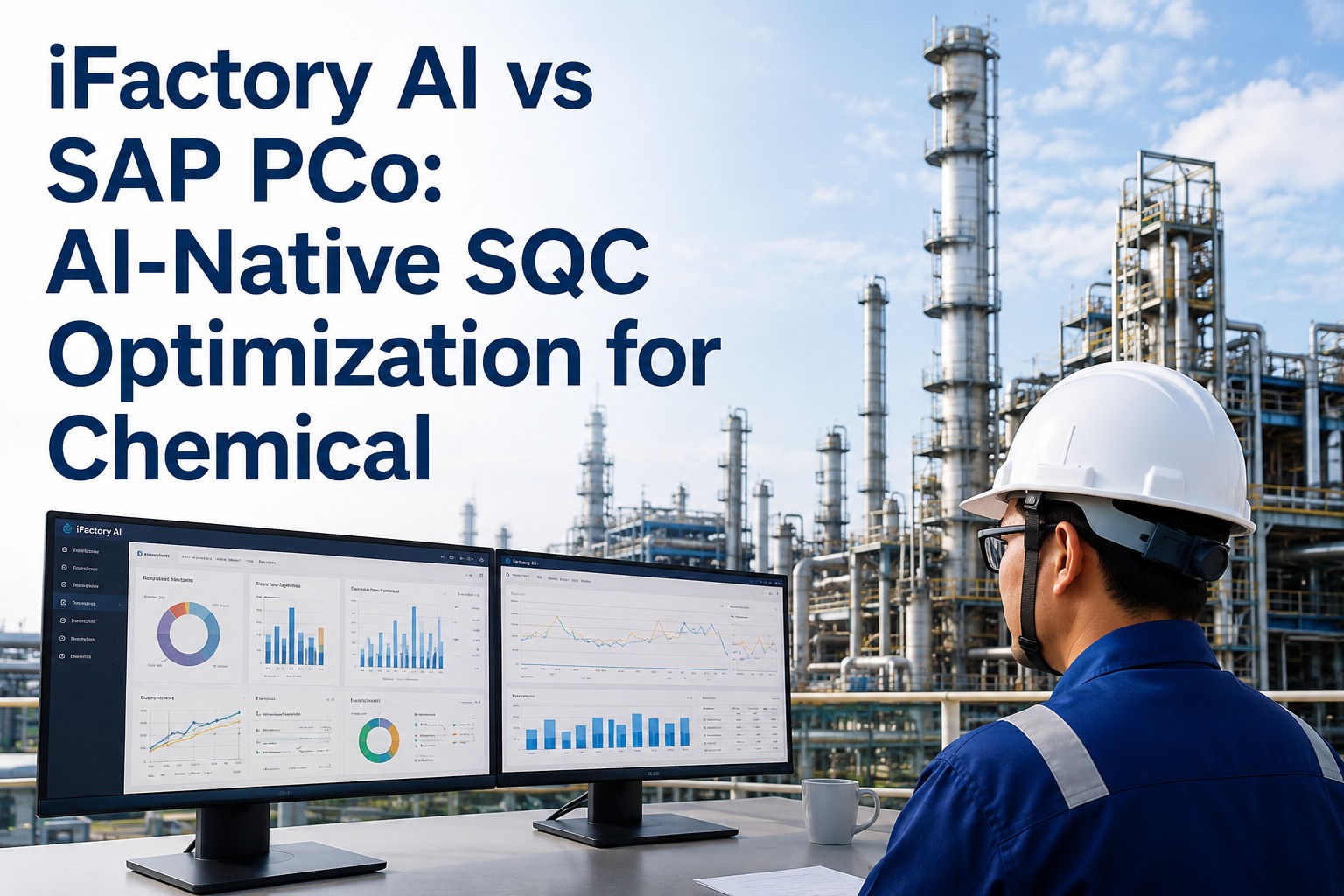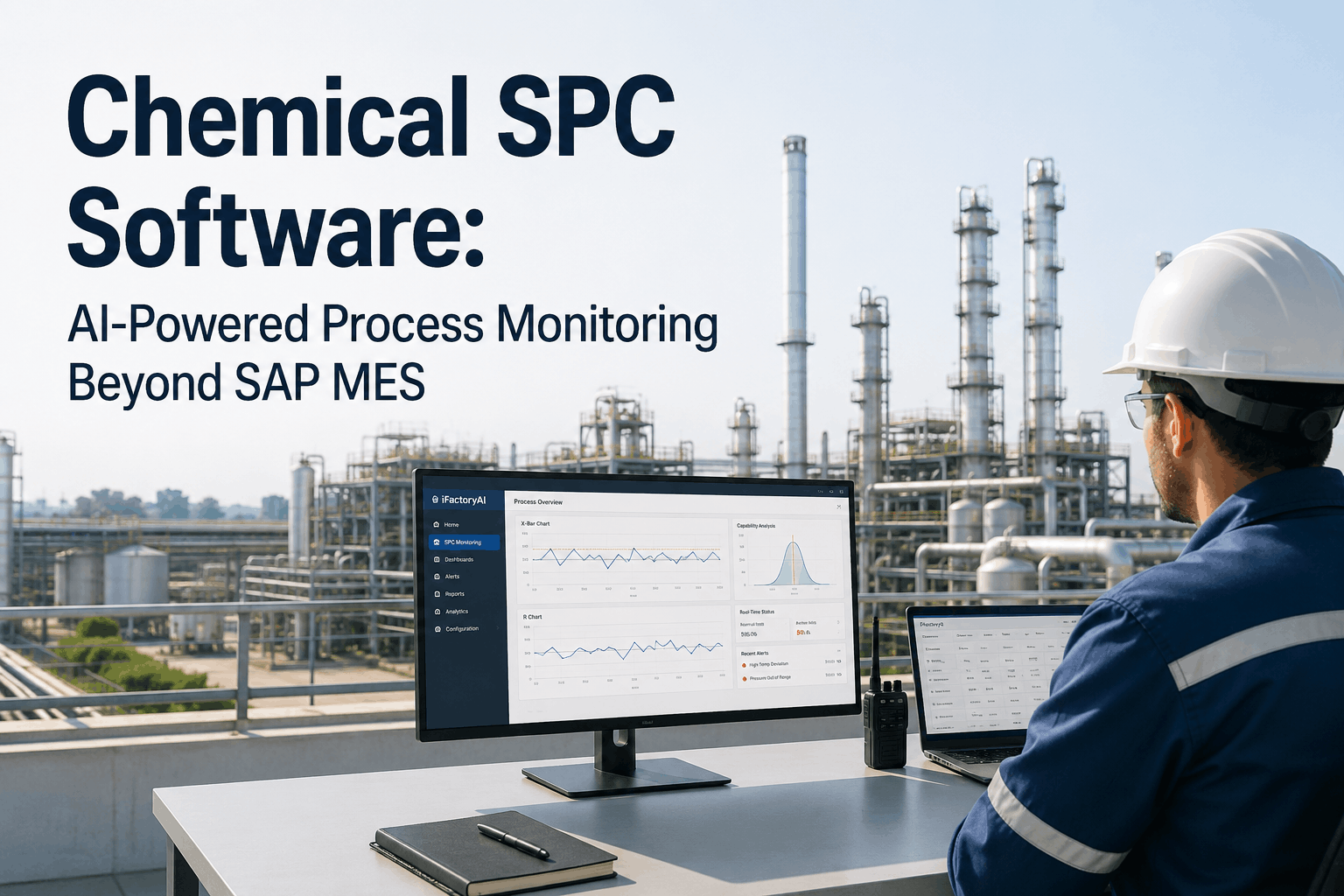
Chemical manufacturing is one of the most data-rich industries in the world — reactor temperatures, pressures, flow rates, compositions, viscosities, conductivities, all streaming continuously from PLC and SCADA into historian databases and into SAP MII or SAP xMII for SPC monitoring. And it's one of the most data-underused, because the SPC paradigm those platforms enforce hasn't fundamentally changed in twenty years. Static control limits, single-parameter charts, manual root cause analysis after every deviation, audit prep that consumes weeks. Meanwhile SAP MII / ME mainstream maintenance ends in 2027, the official replacement (SAP DMC) is cloud-only, and the AI-native alternative has matured into a turnkey product that delivers what chemical operators actually need on day one. iFactory AI for chemical SPC monitoring combines three capabilities into one on-prem appliance: predictive SPC that catches drift hours before traditional control limits would fire, AI Vision Inspection for solids, particulates, color, and packaging quality, and Autonomous RCA that identifies root cause from multivariate process data in minutes instead of days. Plus an Industrial GenAI Copilot trained on your plant SOPs, recipes, and PSM procedures. The whole stack ships pre-configured on a NVIDIA appliance — racked, software-loaded, ready to plug in — with deployment in 6–12 weeks. The same platform is also available as fully managed cloud for chemical plants with hybrid IT strategies. This is the chemical operator's turnkey guide to what AI-native manufacturing actually delivers.
On-Prem AI for Chemical SPC Monitoring: iFactory AI Turnkey Guide
The chemical operator's guide to AI-native SPC monitoring — predictive SPC catching drift hours ahead, AI Vision Inspection for solids and packaging, Autonomous RCA cutting investigation from days to minutes, Industrial GenAI Copilots, plus PSM / REACH / OSHA compliance built in. Pre-configured NVIDIA appliance, live in 6–12 weeks.
The Three iFactory AI Capabilities That Replace SAP MII for Chemical SPC
SAP MII / xMII handles SPC monitoring as a chart-and-alert platform — static control limits, single-parameter charts, single-event alerts. That paradigm doesn't capture what AI-native manufacturing can deliver today. iFactory AI replaces it with three integrated capabilities running on the same on-prem appliance, sharing data, models, and audit trail.
Predictive SPC
LSTM forecasting + autoencoder anomaly detection + Nelson Rules automation. Catches reactor temperature, pressure, pH, composition, and viscosity drift 2–6 hours before traditional control limits fire.
AI Vision Inspection
CNN-based visual inspection for chemical solids (powders, pellets, crystals), color/clarity verification, packaging quality, label verification, and contamination detection.
Autonomous RCA
AI correlates multivariate process data across the upstream cascade to identify the root cause of any deviation event — and recommends corrective actions, with confidence scores.
Autonomous RCA — From Event to Root Cause in Minutes
This is the most transformational capability for chemical operators, and the least understood. Traditional root cause analysis after a quality deviation, batch failure, or process upset consumes days or weeks of operator and engineering time — pulling data from historian, building hypotheses, running fishbone analyses, walking the cause chain backward. Autonomous RCA collapses the same investigation into minutes by letting AI do the multivariate correlation, identify the most likely causal chain, surface the supporting evidence, and recommend the corrective action.
Days of manual investigation
- Operator captures event, opens deviation
- QA pulls historian data manually
- Engineering builds hypotheses, runs fishbone
- Multiple meetings to converge on cause
- Corrective action documented manually
- Audit trail built piece-by-piece
Minutes from event to action
- Event detected automatically from process data
- AI runs multivariate correlation in seconds
- Top 3 root causes surfaced with confidence scores
- Recommended corrective action with SOP reference
- Operator approves; audit trail built automatically
- Outcome verified; model learns from result
Want to see Autonomous RCA running on a representative chemical deviation event? Schedule the AI Manufacturing Transformation Workshop — sessions include a live RCA demonstration using a process upset scenario tailored to your reactor type, batch chemistry, or continuous operation. Sessions available this week.
Industrial GenAI Copilots — Built for Chemical Operators
An operator AI assistant that speaks chemical-plant language
The iFactory Copilot is trained on chemical process data, PSM frameworks, OSHA HAZCOM, REACH/CLP regulatory requirements, and your plant-specific SOPs and batch records. Operators ask natural-language questions and get answers backed by real-time process data, historical events, and the autonomous RCA engine.
Process explanation in plain language
Multivariate trends explained in natural language with evidence chain.
PSM & safety procedure lookup
Instant access to MOC procedures, JSAs, LOTO requirements, and emergency response steps.
Batch record assistance
Helps document deviations, complete batch records, and locate historical batch data for comparison.
Multi-language operator support
Native Spanish, Portuguese, Mandarin, French, Hindi, Arabic, German — same Copilot, same plant data.
Three Migration Paths from SAP MII — Quick Take
Like every industry running SAP MII / xMII, chemical plants have a 2027 deadline approaching. Here's the high-level summary; the AI Manufacturing Transformation Workshop sizes your specific decision.
Stay on MII
Extended maintenance, diminishing vendor support, accumulating risk. PSM regulatory pressure continues to rise around legacy systems.
SAP DMC
Cloud-only re-architecture. Same SPC paradigm. WAN dependency creates concerns for chemical plants in remote locations or with intermittent connectivity.
iFactory AI
AI-native on-prem or cloud. Predictive SPC + AI Vision + Autonomous RCA + GenAI Copilot. Turnkey deployment, leapfrog modernization.
Want a sized chemical-specific migration analysis comparing all three paths? Schedule the AI Manufacturing Transformation Workshop — iFactory's chemical team will model your specific cost, timeline, and capability outcomes with your plant size, current MII footprint, and process portfolio. Sessions available this week.
Six Chemical Verticals Where iFactory AI Delivers Fastest
Specialty Chemicals
Predictive SPC on reactor temp / pressure / pH / composition · Autonomous RCA on batch deviations · GenAI Copilot for SOP lookup during changeovers.
Polymers & Plastics
Molecular weight prediction · melt flow index forecasting · AI Vision on pellet uniformity and color · extrusion drift detection.
Petrochemicals
Continuous process drift detection · column performance monitoring · Autonomous RCA on quality excursions · PSM evidence build automatically.
Fine Chemicals & APIs
Predictive SPC on critical quality attributes · AI Vision on crystalline solids · ICH Q7 evidence with continuous process verification.
Agrochemicals
Formulation consistency forecasting · particle size distribution monitoring · REACH/CLP evidence automation · seasonal demand alignment.
Inorganic & Industrial Gases
Purity prediction from upstream signals · continuous SPC on multiple grades · Autonomous RCA on contamination events · cylinder traceability.
Want a vertical-specific analysis for your chemical operation? Send your top SPC use cases and current MII footprint to iFactory support and the chemical team will return a vertical-tuned ROI analysis with predictive coverage map and 12-month roadmap — typically within 3 business days, no obligation.
PSM, REACH, OSHA & ICH Q7 — Built Into the Platform
Pre-built workflows for the major chemical-industry compliance frameworks
- OSHA PSM (29 CFR 1910.119) — process safety management
- EPA Risk Management Program (40 CFR Part 68)
- REACH / CLP — EU substance registration and labeling
- Responsible Care framework — chemistry industry standards
- ICH Q7 — GMP for active pharma ingredients (where applicable)
- ISO 9001 + ISO 14001 — quality and environmental management
- 21 CFR Part 11 — electronic records (where applicable)
- Customer-specific quality requirements (CSR) reporting
Unlike SAP MII or SAP DMC where compliance workflows require custom configuration or third-party integrations, iFactory AI ships with these frameworks pre-built and tunable to your specific plant operations. Chemical plants typically save 4–8 months of configuration effort during migration because the compliance layer is already aligned to chemical-industry regulatory practice.
Two Real Chemical Plant Migration Outcomes
Mid-size specialty chemicals producer with chronic batch deviations and slow RCA
A specialty chemicals manufacturer running 14 batch reactors producing custom synthesis products. Quality deviations occurred 8–14 times per month. Each RCA investigation consumed 4–10 days of operator, QA, and engineering time. Annual RCA labor cost exceeded $850K. SAP MII handled SPC monitoring but not autonomous RCA.
Polymer manufacturer with SAP xMII facing 2027 modernization decision
A regional polymer manufacturer running SAP xMII for SPC on extrusion, pelletizing, and packaging lines. SAP DMC quote came in at $3.6M over 20 months. AI Vision Inspection was a separate vendor quote adding $1.2M. Combined modernization cost approaching $5M with cloud-only deployment requirement.
Neither scenario matches your situation? Send your current SAP MII footprint and process portfolio to iFactory support and the chemical team will return a customised migration analysis with three-path comparison, projected ROI, and 12-month roadmap — typically within 3 business days, no obligation.
iFactory's Chemical Deployment — On-Premise or Cloud
Same AI-native platform on either deployment model. Same Predictive SPC, same AI Vision Inspection, same Autonomous RCA, same Industrial GenAI Copilot. The deployment choice depends on your IT strategy, data residency, and multi-plant approach.
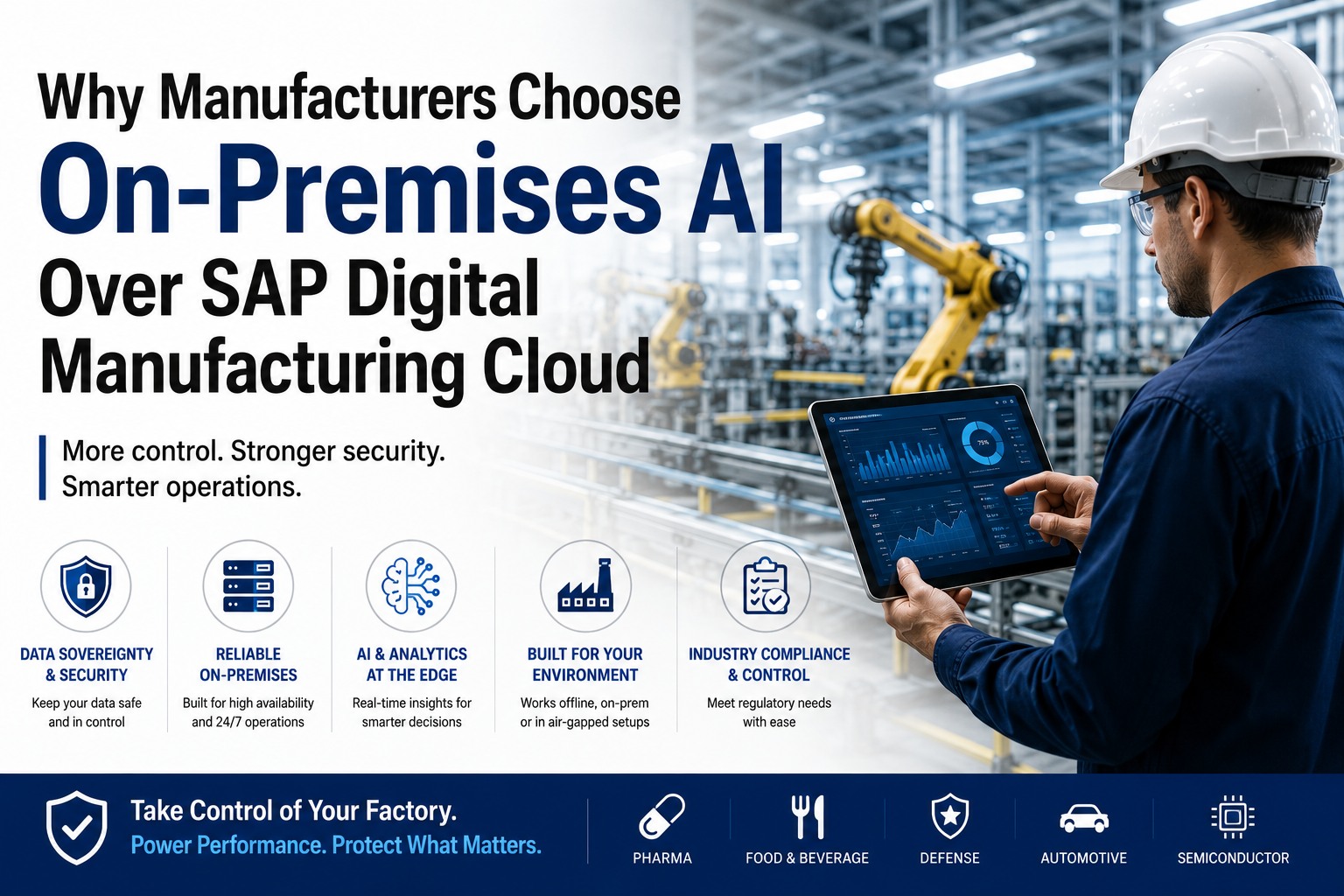
iFactory On-Premise Appliance Default for chemical plants with PSM, IP protection, or WAN concerns
- Pre-configured NVIDIA AI server — racked, software-loaded, ready to plug in.
- 24×7 monitoring — continuous AI coverage across all reactors and lines.
- All process and recipe IP stays inside the plant — protects formulations.
- Works during WAN outages — operations continue uninterrupted.
iFactory Cloud For multi-plant chemical operations and central operations teams
- Fully managed — no rack, no facility requirements.
- Same AI-native trio — Predictive SPC, AI Vision, Autonomous RCA.
- Cross-plant benchmarking across all chemical plants in one tenant.
- Fastest deployment — first plant live in 2–4 weeks.
This is what AI-native chemical manufacturing actually means.
Not a SPC chart with an AI plugin. Three integrated capabilities — Predictive SPC catching drift hours ahead, AI Vision Inspection at every line, Autonomous RCA running in minutes instead of days — plus an Industrial GenAI Copilot trained on your plant SOPs. All running on a pre-configured NVIDIA appliance, live in 6–12 weeks. The AI Manufacturing Transformation Workshop is the fastest way to see what this looks like on your chemical operation.
Frequently Asked Questions
How accurate is Autonomous RCA for chemical process deviations?
For mature deployments (90+ days of training data on your specific plant), Autonomous RCA correctly identifies the root cause in the top-1 hypothesis 78–88% of the time, and in the top-3 hypotheses 92–96% of the time. Confidence scoring means low-confidence cases route to engineering review rather than auto-recommending. Accuracy continues to improve over time as the AI learns from operator-verified outcomes.
Does the AI Vision Inspection work for chemical solids and packaging?
Yes — both. CNN models pre-trained on chemical defect taxonomies handle powders, pellets, crystals, granules, color/clarity assessment, packaging integrity, label verification, and contamination detection. The vision models fine-tune on your specific products during the 6–12 week deployment. Detection accuracy typically runs 99% or better for the most common chemical visual defects.
How does iFactory AI integrate with our DCS / SCADA / Historian?
The platform integrates with major chemical-industry DCS (Honeywell Experion, Emerson DeltaV, Yokogawa CENTUM, Siemens PCS 7), SCADA (Wonderware, FactoryTalk, Ignition), and historians (PI, Aspen IP.21, GE Proficy) via OPC UA, OPC DA, MQTT, and direct historian connectors. The deployment team handles integration during the 6–12 week installation. Operators continue using existing HMIs.
What about Process Safety Management (PSM) compliance?
iFactory ships with OSHA PSM (29 CFR 1910.119) workflows pre-built — Management of Change (MOC) records, Pre-Startup Safety Reviews (PSSR), Process Hazard Analyses (PHA) integration, mechanical integrity tracking, and incident investigation evidence. The Autonomous RCA capability supports PSM incident investigation requirements by producing a verifiable causal chain with supporting evidence. PSM auditors typically appreciate the deeper traceability.
Do I have to buy NVIDIA servers separately?
No. iFactory's on-premise appliance ships fully loaded — pre-configured NVIDIA AI server, software pre-installed, network gear, cabling, industrial cameras for vision inspection, edge devices for line-side inference. You provide rack space, line power, Ethernet, and DCS/SCADA integration points. The deployment team handles all installation and configuration. For cloud, no hardware investment at all.
Can we migrate one reactor or line first before going plant-wide?
Yes — and it's the recommended approach. Start with one reactor, one line, or one process area where modernization pressure is highest. Validate the AI capabilities, prove the operator workflow, build confidence with the Autonomous RCA accuracy. Then expand in 2–4 week waves. Full chemical plant migration for an 8–14 reactor or multi-line operation typically completes in 3–4 months.
What does the Transformation Workshop actually cover?
The half-day workshop covers — current-state SAP MII assessment with your team, three-path migration comparison sized to your operation, ROI modeling with your cost inputs, live iFactory platform walkthrough with chemical use cases, Autonomous RCA demonstration on a representative deviation event, GenAI Copilot demonstration, and 12-month deployment roadmap. Outcome is a concrete migration recommendation. Suitable for operations leaders, IT, QA, EHS, and finance representatives.
Predictive SPC + AI Vision + Autonomous RCA + GenAI Copilot. One appliance. 6–12 weeks.
The SAP MII deadline is fixed at 2027. The migration path isn't. iFactory AI delivers chemical SPC monitoring as it should work in 2026 — predictive instead of reactive, autonomous instead of manual, integrated instead of siloed. The Transformation Workshop is the fastest way to see what AI-native chemical manufacturing actually looks like on your operations. Sessions available this week.