For steel manufacturers running SPC and quality analytics on SAP MII / xMII with the SAP Plant Connectivity (PCo) middleware carrying data up from the mill floor, the limitations are now visible in operational economics rather than just in technology. Steel processes move fast — strip and plate roll at hundreds of meters per minute, casters pour continuously, EAF and BOS shops cycle on tight tap-to-tap times — and every minute of process drift translates into yield loss, off-grade product, or downstream rework that the OEM scorecard does not forgive. SAP PCo is the data on-ramp that brought sensor and gauge data from the rolling mill, the caster, and the meltshop into the xMII application layer for SPC charts and dashboards. It works, but it works in an architecture that was built for descriptive monitoring rather than AI-powered process intervention. Steel-grade-tier quality demands cannot be reliably hit by reading dashboards after the fact. Modernization off SAP PCo means more than swapping the middleware — it means moving to an AI-native architecture that delivers multivariate SPC, predictive quality analytics, real-time production visibility, and process optimization on top of the same plant-floor data sources. iFactory AI is the AI-native steel manufacturing platform purpose-built for this migration — pre-configured NVIDIA appliance running steel-industry SPC models on-premise, replacing SAP PCo and the xMII SPC workload with a single architecture that does what the steel quality discipline actually requires in 2026. This page is the steel operations and IT team's migration guide from SAP PCo to iFactory AI — the architecture, the mill-floor coverage, the real-time visibility, and how the migration actually works.
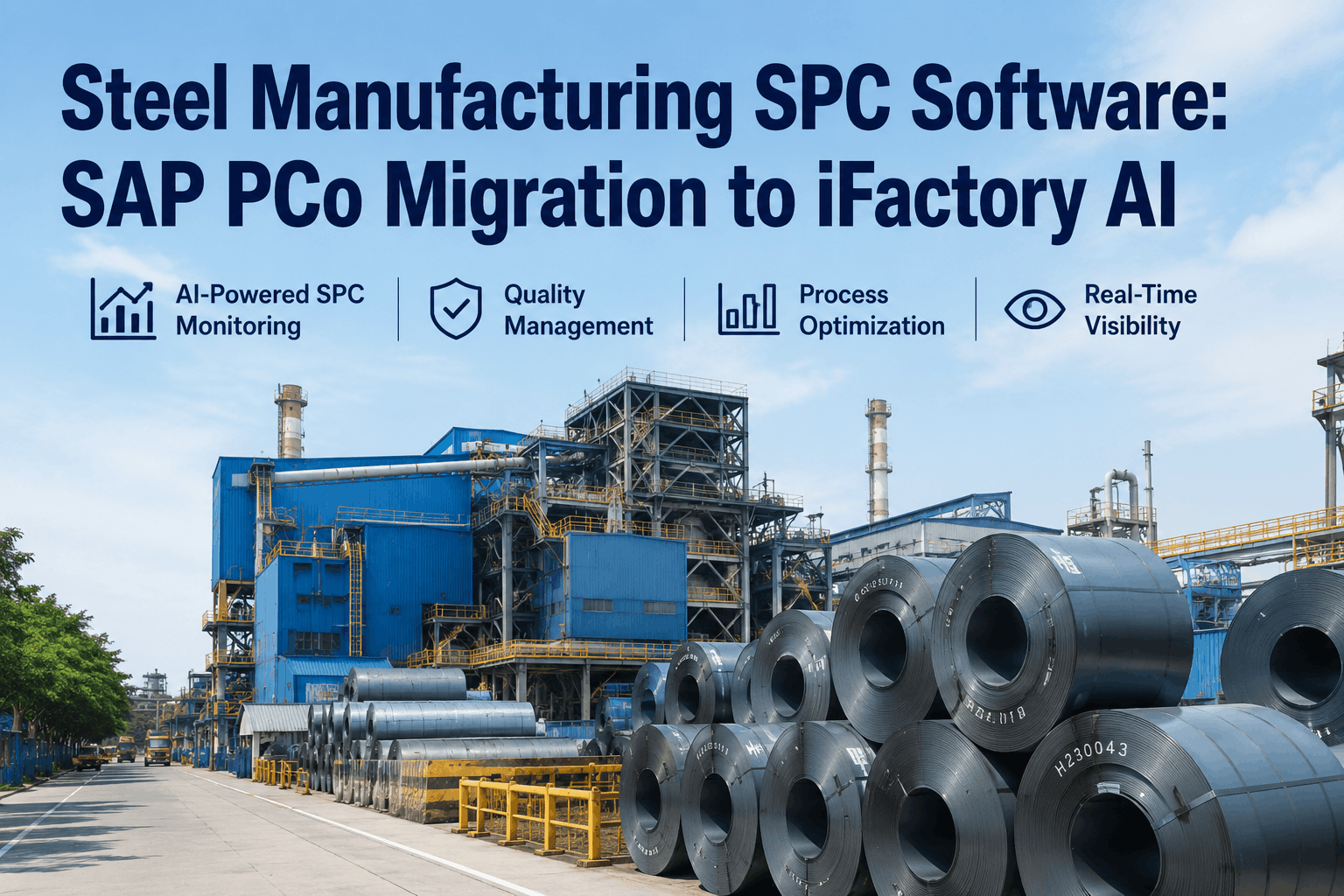
Steel Manufacturing SPC Software: SAP PCo Migration to iFactory AI
The steel operations and IT team's migration guide — from SAP PCo + xMII descriptive SPC to AI-powered SPC monitoring, quality analytics, process optimization, and real-time production visibility on a pre-configured NVIDIA appliance. On-prem deployment, 6–12 week migration, IATF 16949-equivalent steel quality evidence preserved.
SAP PCo Architecture vs iFactory AI for Steel Manufacturing
The SAP PCo + xMII architecture in a steel mill has been the standard for years — PCo collects from gauges, scanners, mill stand sensors, caster signals, and the meltshop layer, then forwards data upward to xMII for SPC charts, OEE views, and quality dashboards. The architecture works for descriptive reporting, but everything beyond descriptive — multivariate SPC, predictive quality, real-time process optimization, edge AI — has to be bolted on with separate tools. iFactory replaces the PCo middleware and adds the AI-native layer in a single architectural move.
The architectural pattern is consistent with what works in heavy industry — the mill-floor L1/L2 control architecture is not touched. PLCs, gauges, scanners, mill stand sensors, caster signals stay in place. The iFactory integration layer replaces SAP PCo as the data on-ramp, speaking the same protocols (OPC UA, MQTT, PLC fieldbus). The AI-native SPC engine replaces the xMII SPC workload with multivariate SPC, predictive quality, and process optimization that can actually catch issues at line speed.
Want this architecture mapped to your specific steel mill setup? Schedule the AI Manufacturing Transformation Workshop — iFactory's steel team will diagram your current SAP PCo + xMII configuration and the modernized equivalent across all your mill stations. Sessions available this week.
AI-Powered SPC & Quality Coverage Across the Steel Mill
The steel migration extends across the entire production chain — meltshop through finishing — because steel quality is determined sequentially across every step. The mill-floor coverage map below shows the typical deployment scope for integrated steel operations and the SPC/quality capability that iFactory adds at each station.
The cross-mill correlation is the structural value of having a unified platform across stations. A chemistry drift in the meltshop today shows up as a mechanical property issue in cold rolling tomorrow — on the SAP PCo + xMII pattern, this connection has to be reconstructed manually from separate dashboards days later. On iFactory's unified layer, the correlation is captured continuously and the predictive model surfaces the downstream risk while the upstream operation is still adjustable.
Want station-level coverage mapped for your specific steel mill chain? Send your mill configuration and current SAP PCo + xMII setup to iFactory support and the steel team will return a tailored coverage proposal — typically within 3 business days, no obligation.
Real-Time Production Visibility — What Actually Changes
From end-of-shift reports to live, predictive shop-floor visibility
The descriptive xMII pattern produces visibility after the fact — coil quality reports at end of strip, heat reports at end of cast, shift dashboards at end of shift. Real-time production visibility on iFactory is structurally different: the same dashboards the operations team relies on are now live, with predictive overlays showing where quality or capability risk is forming hours ahead of the descriptive report.
The shift is on every row of the table — from descriptive to predictive, from manual investigation to automatic correlation, from static dashboards to natural-language plant queries. None of these changes require new mill-floor instrumentation. They come from the AI-native layer added above the existing data sources that PCo was already collecting.
Three Migration Paths for Steel SPC Modernization
Stay on PCo + xMII
Extended SAP maintenance with univariate SPC, descriptive dashboards. Off-grade catches stay late. OEM scorecard gap widens.
SAP DMC (Cloud)
Cloud modernization. WAN-bound latency unsuited for mill-speed decisions. Cloud lock-in. OpEx-growing AI compute charges.
iFactory AI On-Prem
AI-native multivariate SPC, predictive quality, real-time visibility. NVIDIA appliance on-prem, sub-50ms edge inference. 6–12 weeks.
Six Steel Operations Where AI-Powered SPC Pays Back Fastest
Hot Strip Mill
Multivariate SPC across stand-by-stand profile, finishing temperature, exit gauge, and crown control. Catches quality risk before coiling.
Cold Rolling & Tandem
Closed-loop gauge and flatness control with adaptive setpoints per coil. Surface defect prediction from upstream conditions.
Continuous Caster
Multivariate caster monitoring with breakout prediction, mold level control, and internal defect risk modeling per slab/bloom.
EAF / BOS Meltshop
Heat chemistry prediction, tap-to-tap optimization, energy consumption modeling. Cross-heat learning improves consistency.
Annealing & Mechanical
Mechanical property prediction (YS, UTS, elongation) from process state. Reduces mechanical-property-driven rejections.
Surface & Visual Inspection
Edge-deployed AI vision on surface inspection systems. Defect classification with higher accuracy than rule-based systems.
Want operation-specific projections for your steel mill? Send your mill configuration and current SAP PCo + xMII state to iFactory support and the steel team will return a customised projection with 12-month roadmap — typically within 3 business days, no obligation.
Steel Quality Standards & Customer Compliance — Native to the Platform
Pre-built workflows for steel quality and OEM customer requirements
- IATF 16949 — automotive steel customer requirement
- ISO 9001 — quality management systems
- API 5L / 5CT — line pipe and casing specifications
- ASTM specifications — by product family
- Process Capability (Cpk / Ppk) — automated
- Mill Test Certificates (MTC) — continuous evidence
- Customer-specific specifications (CSRs)
- EAF / BOS / continuous casting standards
The compliance evidence becomes a byproduct of running multivariate SPC and predictive quality continuously — not a separate workstream the team maintains. Mill Test Certificates assemble from the unified audit log. Customer scorecards reflect the actual capability improvement. Auditors typically respond favorably to the stronger evidence base.
Two Real Steel SAP PCo Migration Outcomes
Integrated steel mill replacing SAP PCo + xMII across hot strip and downstream finishing
An integrated steel mill operating EAF, continuous casting, hot strip mill, and downstream finishing lines maintained SAP PCo as the data on-ramp and SAP xMII for SPC charts and quality reporting. Univariate SPC was the standard pattern; off-grade product was caught at end-of-coil rather than during the rolling pass; cross-station correlation (meltshop chemistry to downstream mechanical properties) required manual investigation across systems. The operations team needed multivariate, predictive, and unified across the chain.
EAF mini-mill producing long products with chemistry-driven quality variability
A mini-mill operating EAF, ladle metallurgy, continuous casting, and long-product rolling lines for construction-grade and special-bar-quality (SBQ) steel ran SAP PCo + xMII with descriptive SPC. Heat-to-heat chemistry variability drove inconsistent mechanical properties downstream, with periodic off-spec batches that hurt SBQ customer scorecards. The operations team needed predictive chemistry-to-property modeling and real-time visibility across the chain.
Neither scenario matches your operation? Send your steel segment, mill configuration, and current SAP PCo + xMII state to iFactory support and the steel team will return a customised migration analysis with 12-month roadmap — typically within 3 business days, no obligation.
iFactory's Steel Deployment — On-Premise or Cloud
Same AI-native platform on either deployment model. On-prem is the recommended default for steel operations given line-speed inference latency requirements (strip and plate move fast), process IP sovereignty, and the OpEx-cap that on-prem CapEx provides for high-volume continuous operations.
iFactory On-Premise Appliance Recommended for steel mills · sub-50ms edge inference for strip/plate
- Pre-configured NVIDIA AI server — pre-loaded steel SPC models, racked, ready.
- <50ms edge inference — mill-speed quality decisions.
- SAP PCo alternative — integration layer takes over the data on-ramp.
- L1/L2 control untouched — no rip-and-replace of mill-floor architecture.
iFactory Cloud For multi-plant steel groups with central governance
- Fully managed — no rack, no facility requirements.
- Same SPC engine — full capability available.
- Portfolio-level benchmarking across mills.
- Fastest deployment — first plant live in 2–4 weeks.
SAP PCo was the data on-ramp. iFactory is the data on-ramp plus the AI-native layer above it.
Multivariate SPC, predictive quality, real-time production visibility, and process optimization — on a pre-configured NVIDIA appliance, on-prem, sub-50ms edge inference, 6–12 week migration from SAP PCo + xMII. The L1/L2 control architecture stays untouched. The AI Manufacturing Transformation Workshop sizes the migration for your specific steel mill.
FAQ: Steel SAP PCo Migration & AI-Powered SPC
How does iFactory replace SAP Plant Connectivity (PCo) for a steel mill?
iFactory's integration layer takes over the SAP PCo role as the data on-ramp from the mill floor — speaking OPC UA, MQTT, and PLC fieldbus protocols (PROFINET, EtherNet/IP, Modbus) natively, with the same tag mapping and routing capabilities PCo provided, plus the AI-native layer added on top. Existing PCo configurations and tag mappings are imported during deployment so the migration carries them across. The mill-floor L1/L2 control architecture is not touched. Book a demo to see PCo replacement on your specific mill stack.
Does iFactory work with our existing L2 process automation system?
Yes. iFactory integrates with the existing L2 process automation (Siemens VAI, Primetals, ABB, Danieli, GE) by consuming the same data streams those systems produce — setpoints, actuals, measurements, recipes — and adding AI-native intelligence on top. The L2 automation continues to perform its closed-loop control role; iFactory adds the multivariate SPC, predictive quality, and process optimization layer above it. Customers typically describe this as "L2 stays in place, iFactory replaces L3 SPC and adds AI."
What about our existing SAP MII / xMII SPC dashboards — do operators lose their familiar interface?
No. The migration plan covers dashboard parity validation during the parallel-run phase. Operators get equivalent and improved dashboards on iFactory, plus AI-native capabilities the xMII layer never delivered (predictive trends, contribution plots, GenAI plant queries). The familiar SPC chart interface remains available as a view in the new platform. Operators typically describe the experience as the same dashboard with much more useful underlying data.
How does cross-station correlation actually work?
iFactory maintains a unified data model across the entire mill chain — meltshop heats are linked to caster slabs, slabs to hot bands, hot bands to cold-rolled coils, coils to finishing operations. The predictive models then correlate upstream process state with downstream quality outcomes across the chain. When a chemistry drift in the meltshop creates a higher mechanical-property risk five steps downstream, the platform surfaces this connection automatically rather than waiting for the manual investigation that SAP PCo + xMII required.
Is IATF 16949 evidence preserved or strengthened through the migration?
Strengthened. Every multivariate SPC decision and predictive quality event is logged as an auditable record with inferred state, decision rationale, and outcome — producing a richer process capability record than SAP PCo + xMII descriptive monitoring ever delivered. Mill Test Certificates assemble from continuous data rather than periodic sampling. Cpk and Ppk evidence accumulates continuously. IATF auditors typically respond favorably to the stronger evidence base.
Do I have to buy NVIDIA servers separately?
No. iFactory's on-premise appliance ships fully loaded — pre-configured NVIDIA AI server, steel industry SPC models pre-installed, network gear, cabling, edge devices for mill-floor integration, integration adapters for SAP MII / xMII / ERP, L2 process automation, plant historians (PI), LIMS, and major DCS / PLC platforms. You provide rack space, line power, Ethernet, and integration points. The deployment team handles installation and configuration across the 6–12 week window.
What does the AI Manufacturing Transformation Workshop cover for steel?
The half-day workshop covers — current-state SAP PCo + xMII assessment for your steel mill, station-by-station coverage walkthrough (meltshop, caster, hot strip, cold rolling, annealing, finishing), MSPC demonstration on representative mill data, predictive quality projection across the chain, three-path migration comparison with cost and timeline projections, IATF 16949 evidence preservation approach, and ROI projection. Outcome is a concrete migration plan suitable for steel operations, process engineering, quality, IT/OT, and finance.
Replace SAP PCo. Get multivariate SPC and predictive quality on top.
The steel migration is not a middleware swap — it is the AI-native architectural upgrade that comes with it. Multivariate SPC across the chain, predictive quality with hours-ahead intervention windows, real-time production visibility, on-prem NVIDIA appliance, IATF 16949 evidence strengthened, 6–12 week deployment. The Workshop is the fastest way to size the migration — sessions available this week.