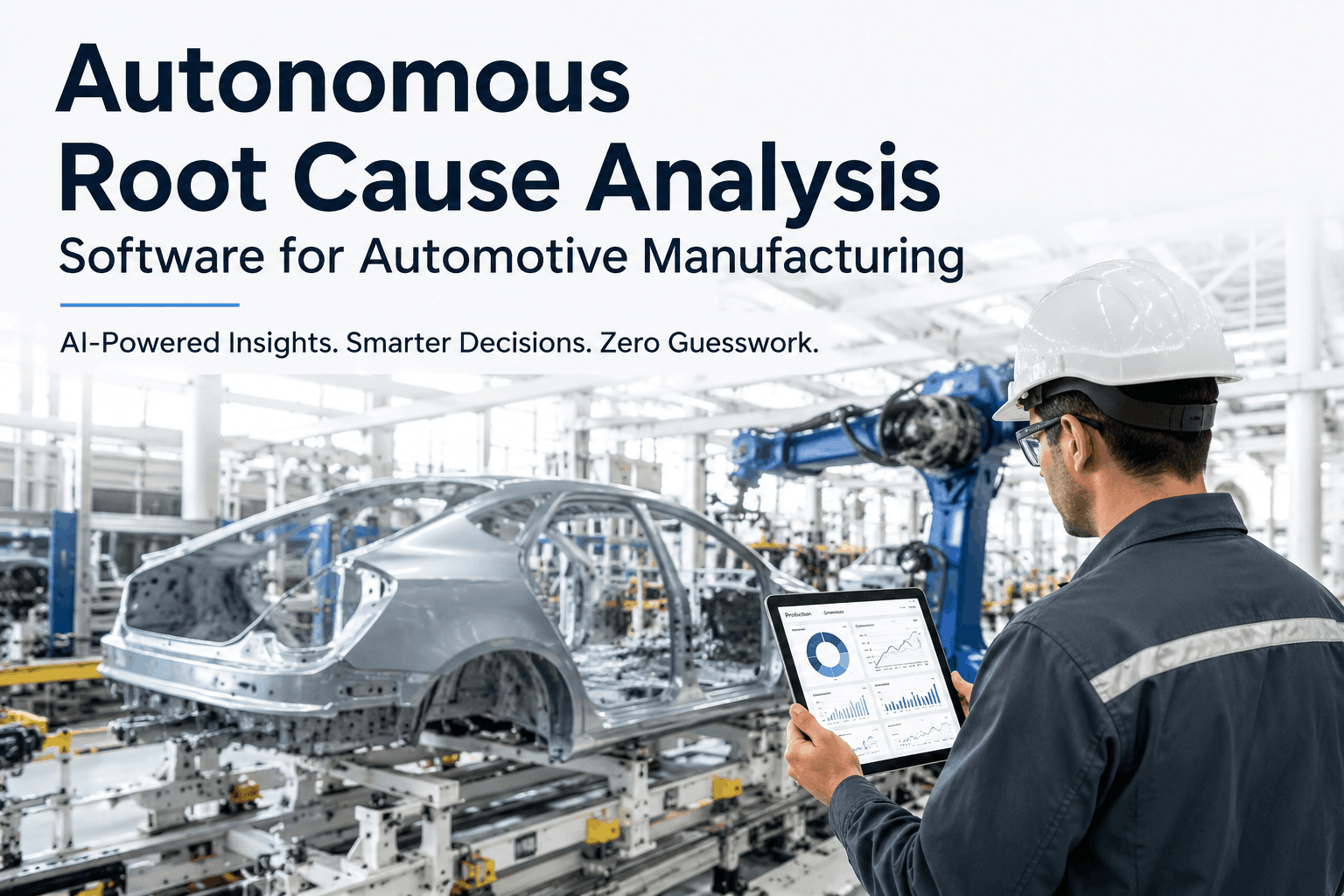
Root cause analysis is the workstream that quietly eats the most quality-engineering hours in any automotive operation. A weld station drifts, a torque distribution shifts, a paint defect rate climbs, a leak test fail-rate ticks up — and the next two or three days disappear into the manual investigation that determines what changed and why. Engineers pull data from MES, MII, PLC historians, vision systems,torque controllers, and inspection records, manually correlate timelines, run fishbones, request additional process traces, and eventually narrow the cause down enough to justify a corrective action. By then the production loss has already happened, the customer scorecard has already moved, and the next investigation is already queued up. Autonomous Root Cause Analysis software fundamentally changes this workstream — rather than humans pulling data and correlating manually, an AI engine continuously builds the causal model across all the same data sources and surfaces ranked causal candidates within seconds of a quality or process event. iFactory AI is the AI-native autonomous RCA platform purpose-built for automotive manufacturing — pre-configured NVIDIA appliance running automotive-industry causal models on-premise, replacing days-to-weeks of manual investigation with seconds-to-minutes of autonomous causal attribution, while strengthening PPAP, supporting the manufacturing digital twin, and operating as a SAP DMC alternative. This page is the automotive quality engineering and operations team's guide to autonomous root cause analysis software — the capability, the architecture, the PPAP integration, and how the platform actually deploys in an automotive plant.
Autonomous Root Cause Analysis Software for Automotive Manufacturing
The automotive quality and manufacturing engineering team's guide to autonomous RCA — AI-powered causal investigation that replaces days of manual analysis with seconds of attributed causes. Predictive quality insights, real-time shop floor intelligence, PPAP automation, on-prem deployment. 6–12 week migration as SAP DMC alternative.
Manual RCA vs Autonomous RCA — The Workstream That Actually Changes
The structural difference between manual root cause analysis and autonomous RCA is not the tooling — it is who does the investigation. In the manual model, quality engineers and process engineers spend days pulling data, building timelines, running correlations, and confirming hypotheses, with the answer arriving long after the production loss has happened. In the autonomous model, the AI engine continuously maintains the causal model across the same data sources and surfaces ranked causal candidates within seconds of an event. The comparison below shows where the time actually goes today, and what changes.
Every row of the comparison represents a category where quality engineering time disappears today and is recovered after migration. Detection collapses from "hours after the event" to "seconds after the drift begins." Data gathering disappears entirely because the data is already unified in the platform. Correlation moves from manual fishbone investigation to automatic causal ranking. Hypothesis testing becomes engineer validation of an already-assembled evidence package rather than a multi-day iteration cycle.
Want this workflow compared against your specific automotive RCA process? Schedule the AI Manufacturing Transformation Workshop — iFactory's automotive team will walk through your current RCA cycle and demonstrate autonomous RCA on representative production scenarios. Sessions available this week.
The Autonomous RCA Architecture — How the AI Engine Actually Works
Autonomous RCA is not a black box "AI" overlay on top of dashboards. It is a layered architecture that ingests data from across the shop floor, builds and maintains a continuous causal model, and surfaces ranked attributions when events occur. The architecture below shows how the engine actually composes from data sources through to engineer-ready RCA evidence.
The architectural pattern is the structural reason autonomous RCA actually delivers on the promise. The unified data layer eliminates the "pull data from six systems" step. The causal inference engine eliminates the "manually correlate timelines" step. The output layer eliminates the "assemble evidence for PPAP / 8D / customer report" step. Each of these steps is a multi-hour-to-multi-day engineering effort today. After migration, all three happen in seconds-to-minutes, with engineer validation taking the remaining time.
PPAP Automation Through Autonomous RCA
How autonomous RCA strengthens PPAP and IATF 16949 evidence
Production Part Approval Process is a mandatory automotive customer requirement, and the evidence underlying PPAP submissions is exactly the kind of process data autonomous RCA captures continuously. Rather than assembling PPAP evidence reactively before a submission deadline, the platform maintains the underlying data and analysis continuously — making PPAP submissions, change-control documentation, and customer-driven RCA requests fast, well-documented, and audit-ready.
PPAP submissions become a structured pull from the continuous capture layer rather than a multi-week build-from-scratch effort. 8D corrective action reports inherit the autonomous RCA evidence package automatically. IATF 16949 audits encounter continuous Cpk and process capability records rather than periodic snapshots. Customer corrective action requests (CARs) get response times that improve the scorecard rather than hurting it.
Want PPAP automation walked through against your current submission process? Send your typical PPAP package structure and current submission workflow to iFactory support and the automotive team will return a customised automation projection — typically within 3 business days, no obligation.
Three Migration Paths for Autonomous RCA in Automotive
Stay on Manual RCA
Quality engineers continue spending 3–7 days per investigation. PPAP submissions remain reactive. Customer CAR turnaround stays slow.
SAP DMC (Cloud)
Cloud-based dashboards with manual investigation still required. Faster reports but no autonomous causal inference. Cloud lock-in.
iFactory Autonomous RCA
Genuine autonomous causal inference with ranked attributions. Pre-configured NVIDIA appliance, automotive models pre-loaded, on-prem, 6–12 weeks.
Six Automotive Operations Where Autonomous RCA Pays Back Fastest
Body-in-White Weld Defects
Weld defects traced automatically to specific robot, gun, electrode life, sheet positioning, or material lot. Highest-payback RCA category in BIW.
Assembly Torque & Sequence
Torque drift and sequence violations traced to operator, tool calibration, fastener lot, or station programming. Customer-spec misses prevented.
Paint Shop Defects
Paint defects traced to booth conditions, atomizer settings, film thickness drift, oven profile, or upstream surface preparation in seconds.
Stamping & Press Lines
Dimensional drift attributed to die wear, lubrication, blank holder force, material thickness variation, or press alignment automatically.
Powertrain Machining
Cpk drift on critical features attributed to tool wear, coolant condition, fixturing, or upstream material variation. PPAP evidence assembled.
EV Battery Operations
Cell-level quality variations traced to formation cycle, electrolyte fill, cell stacking, or upstream electrode coating in real time.
Want operation-specific projections for your automotive plant? Send your plant configuration, current RCA cycle times, and PPAP submission volume to iFactory support and the automotive team will return a customised projection — typically within 3 business days, no obligation.
IATF 16949 & Automotive Quality Standards — Native to the Platform
Pre-built workflows for automotive RCA, PPAP, and quality standards
- IATF 16949 — automotive QMS requirement
- PPAP — Production Part Approval Process (Levels 1–5)
- APQP — Advanced Product Quality Planning
- FMEA — design and process FMEA
- MSA — Measurement Systems Analysis
- Process Capability (Cpk / Ppk) — automated
- Control Plans — live, with autonomous RCA links
- 8D / CAR / customer-specific requirements (CSRs)
Autonomous RCA strengthens IATF 16949 evidence rather than weakening it. Every RCA event is logged with the full causal model, ranked attributions, evidence package, and engineer validation record. PPAP packages assemble from continuous data rather than reactive build-up. 8D reports inherit the causal investigation automatically. Auditors typically respond favorably to the richer evidence base.
Two Real Automotive Autonomous RCA Outcomes
OEM body-in-white shop with chronic weld defect investigation backlog
An OEM body-in-white shop producing three vehicle platforms ran a chronic backlog of weld defect investigations — each defect category requiring quality engineering time to pull data from MII, robot controllers, weld monitoring systems, and inspection records, build correlation timelines, hypothesize causes, and respond to OEM customer scorecards. Average investigation cycle was 5 days. The quality engineering team was constrained by RCA workload rather than driving improvement.
Tier-1 powertrain supplier with high PPAP submission volume and chronic RCA pressure
A tier-1 powertrain supplier producing engine, transmission, and EV component portfolios maintained high PPAP submission volume across multiple OEM customers. Each engineering change, deviation, or customer-driven RCA request triggered manual data assembly across SAP MII, dimensional inspection systems, and machining controller data. The quality team described PPAP submission as a "fire drill" workflow rather than a continuous capability.
Neither scenario matches your operation? Send your automotive segment, plant configuration, and current RCA / PPAP workflows to iFactory support and the automotive team will return a customised analysis with 12-month roadmap — typically within 3 business days, no obligation.
iFactory's Automotive Autonomous RCA Deployment
Same AI-native platform on either deployment model. On-prem is the recommended default for automotive autonomous RCA given sub-50ms inference latency for real-time causal attribution, process IP sovereignty, and the production-grade reliability automotive operations require.
iFactory On-Premise Appliance Recommended for automotive autonomous RCA · sub-50ms causal inference
- Pre-configured NVIDIA AI server — pre-loaded automotive RCA models, racked, ready.
- <50ms causal attribution — line-speed RCA at the moment of detection.
- SAP DMC alternative — full capability on-prem rather than cloud-bound.
- IATF 16949 evidence strengthened — continuous capture, audit-ready.
iFactory Cloud For multi-plant automotive groups with central governance
- Fully managed — no rack, no facility requirements.
- Same autonomous RCA engine — full capability available.
- Portfolio-level RCA benchmarking across plants.
- Fastest deployment — first plant live in 2–4 weeks.
Autonomous RCA is the workstream change. Manual investigation is not.
Days of investigation collapse to seconds of attributed causes. PPAP submissions become a structured pull from continuous capture rather than a reactive scramble. Quality engineering time gets recovered for actual improvement work. iFactory delivers it on a pre-configured NVIDIA appliance, on-prem, IATF 16949 strengthened, live in 6–12 weeks. The AI Manufacturing Transformation Workshop sizes the deployment for your specific automotive plant.
FAQ: Automotive Autonomous Root Cause Analysis Software
What does "autonomous RCA" actually mean in practical terms?
Autonomous RCA means the AI engine performs the data gathering, timeline construction, and causal attribution that quality engineers do manually today — without human triggering. When a quality event occurs, ranked causal candidates appear with confidence scores and supporting evidence. The engineer reviews, validates, and signs off on the corrective action rather than spending days building the analysis from scratch. The "autonomous" label distinguishes this from "AI-assisted" tools that still require manual investigation steps. Book a demo to see autonomous RCA on representative automotive scenarios.
How does iFactory's autonomous RCA handle the multi-source data problem?
The unified data layer is the structural answer. During deployment, iFactory integrates with MII, MES, PLCs, vision systems, torque controllers, weld monitoring, dimensional inspection, CMMS, and ERP — time-aligning and contextualizing all of it into one coherent model. By the time any RCA event occurs, the data is already unified. The "pull from six systems" workflow that absorbs hours of engineer time per investigation disappears entirely.
How does PPAP automation actually work through autonomous RCA?
The continuous capture layer holds Cpk, Ppk, MSA, control plan execution, dimensional records, and process capability evidence in audit-ready form. When a PPAP submission is needed (Level 2, Level 3, or Level 5), the package assembles from this continuous capture rather than being built from scratch under deadline. Engineering changes trigger the relevant PPAP elements automatically. Customer-driven RCA requests inherit the autonomous RCA evidence package. The result is PPAP cycle time reductions of 60–75% typical.
Is this a SAP DMC alternative or does it integrate with DMC?
iFactory positions as an AI-native alternative to SAP DMC for autonomous RCA, manufacturing intelligence, and shop floor analytics — running on-prem rather than cloud, with autonomous causal inference rather than descriptive dashboards. For operations already invested in DMC, iFactory can integrate as an autonomous RCA layer above DMC, or replace the workload entirely depending on the migration plan. Most automotive customers choose replacement to avoid the cloud lock-in and OpEx-growing AI compute charges DMC creates.
Does autonomous RCA support the manufacturing digital twin?
Yes — the unified data layer is structurally a digital twin of the manufacturing process. The causal inference engine adds causal structure to the twin, so the digital twin becomes not just a representation of process state but a model of how state variables affect each other. This is what makes counterfactual queries (what if we changed this parameter?) and root cause attribution work. The autonomous RCA capability and the manufacturing digital twin are the same underlying architecture.
Do I have to buy NVIDIA servers separately?
No. iFactory's on-premise appliance ships fully loaded — pre-configured NVIDIA AI server, automotive autonomous RCA models pre-installed, network gear, cabling, edge devices for line-side inference, integration adapters for SAP MII / xMII / DMC / ERP, MES, vision systems, robot controllers, and major plant systems. You provide rack space, line power, Ethernet, and integration points. The deployment team handles installation, validation, and configuration across the 6–12 week window.
What does the AI Manufacturing Transformation Workshop cover for autonomous RCA?
The half-day workshop covers — current-state RCA workflow assessment for your automotive plant, autonomous RCA demonstration on representative scenarios (BIW weld, assembly torque, paint, stamping, powertrain machining), PPAP automation walkthrough, three-path migration comparison with cost and timeline projections, IATF 16949 evidence approach, manufacturing digital twin alignment, SAP DMC comparison (if relevant), and ROI projection. Outcome is a concrete deployment plan suitable for quality engineering, manufacturing engineering, plant operations, IT/OT, and finance.
Replace days of manual investigation with seconds of attributed causes.
Autonomous root cause analysis, continuous PPAP capture, manufacturing digital twin, real-time shop floor intelligence — on a pre-configured NVIDIA appliance, on-prem, IATF 16949 strengthened, 6–12 week deployment as SAP DMC alternative. The AI-native autonomous RCA platform for automotive manufacturing in 2026. The Workshop is the fastest way to size the deployment — sessions available this week.