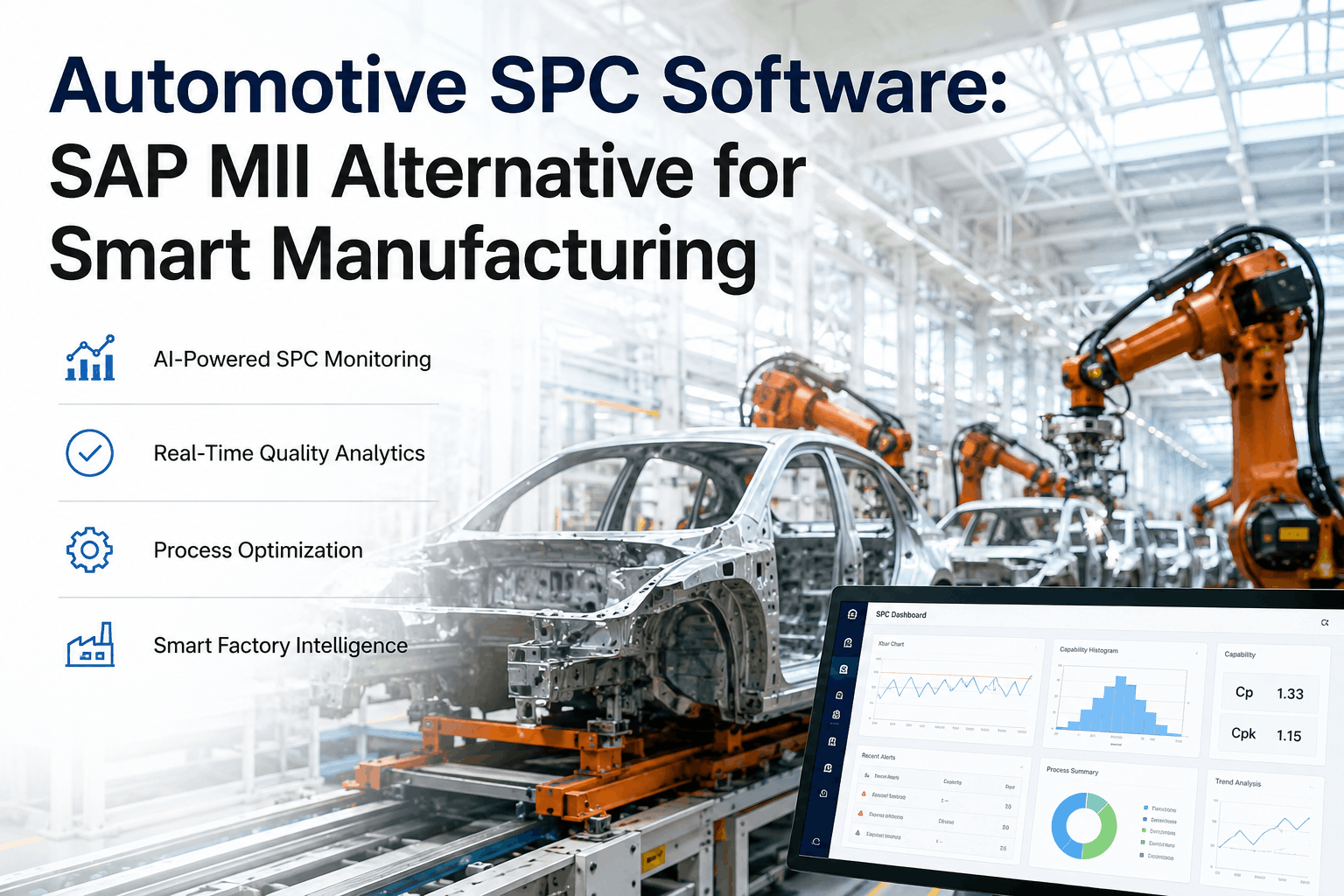
For automotive manufacturers running OEE on SAP MII / xMII / DMC in 2026, the gap between what the platform delivers and what shop-floor leadership needs has become impossible to ignore. SAP-based OEE is descriptive — it tells you availability, performance, and quality after the shift has finished, after a model-variant changeover has lost time, after a stamping die has worn past its capability band, after a body shop weld station has drifted, after the customer scorecard has slipped. Automotive production runs on tight model-variant cycles, sequence-driven assembly, tooling life that determines dimensional capability, and OEM scorecard pressure that does not give second chances. The mandate facing the automotive operations team is no longer whether to modernize OEE off SAP MII — it is how to move to genuinely predictive OEE that forecasts loss hours ahead and attributes cause automatically, rather than reporting it the next morning. iFactory AI is the AI-native predictive OEE platform purpose-built for this migration in automotive — pre-configured NVIDIA appliance running automotive-specific predictive OEE models on-premise, replacing SAP MII / xMII / DMC and the SAP PCo (Plant Connectivity) middleware, with sub-50ms edge inference, IATF 16949-strengthening compliance evidence, and 6–12 week deployment. This page is the automotive operations team's migration guide from SAP MII descriptive OEE to iFactory predictive OEE — the architecture, the capability difference, the automotive-specific OEE loss profile, and how the workload modernization actually works.
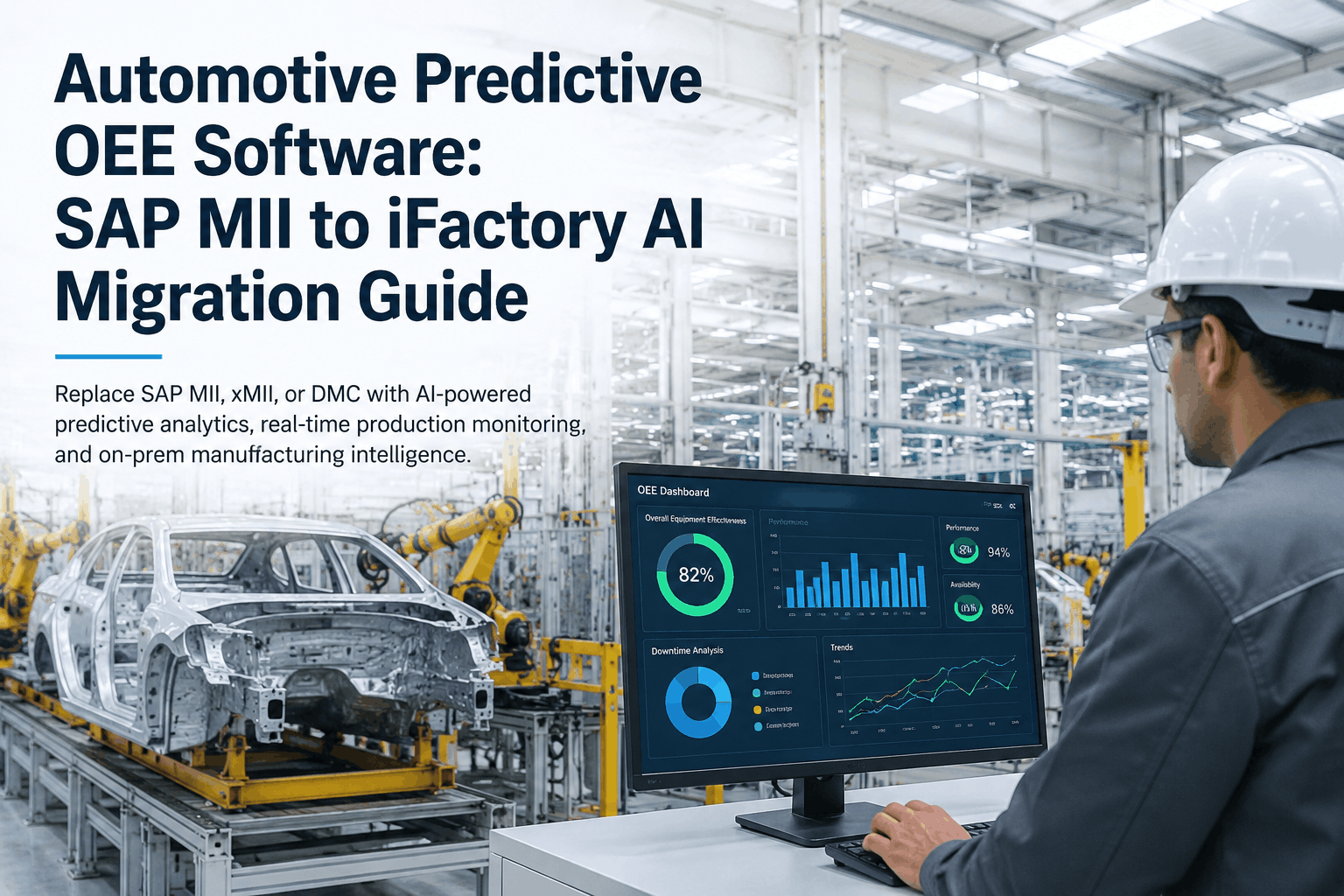
Automotive Predictive OEE Software: SAP MII to iFactory AI Migration Guide
The automotive operations team's migration guide — from SAP MII / xMII / DMC descriptive OEE to AI-native Predictive OEE on a pre-configured NVIDIA appliance. AI-powered predictive analytics, real-time production monitoring, on-prem manufacturing intelligence. 6–12 week deployment, IATF 16949 evidence strengthened.
The OEE Architecture: SAP MII Descriptive vs iFactory Predictive
The architectural difference between SAP MII OEE and iFactory Predictive OEE is not a feature gap — it is a different operating model for shop-floor performance. SAP MII observes and reports; iFactory predicts, attributes cause, and surfaces an intervention window before the loss materializes. The diagram below shows the two architectures side-by-side, with the workload boundaries the automotive migration plan has to address.
The automotive operations team's migration plan does not rip out the plant floor sources — PLCs, station controllers, sensors, vision systems, and tooling stay in place. What gets replaced is the SAP PCo middleware (replaced by iFactory integration layer) and the xMII OEE workload (replaced by the predictive OEE engine). The architectural shift is concentrated in the layer where the SAP stack was structurally limited.
Want this architecture mapped to your specific automotive plant OEE configuration? Schedule the AI Manufacturing Transformation Workshop — iFactory's automotive team will diagram your current SAP MII OEE workload and the modernized equivalent across all your shop floor stations. Sessions available this week.
Predictive OEE vs Descriptive OEE — The Capability Difference
"Predictive" is the marketing word that gets used loosely. The concrete difference is what predictive OEE delivers across each of the three OEE factors that automotive cares about: predictive availability forecasting, multivariate performance attribution, and quality risk prediction with intervention window. The model below shows the capability gain factor by factor.
The shift the automotive operations team is funding is on the right column of every row — auto cause attribution, multivariate root-cause analysis, predictive intervention windows. None of this is achievable on the SAP MII architecture without years of custom development; all of it ships pre-loaded on the iFactory appliance for automotive operations from day one.
The Automotive OEE Loss Profile — Where Predictive Pays Off
How OEE losses concentrate in automotive operations
Automotive operations have a distinctive OEE loss profile that differs structurally from F&B, semiconductor, or process industries. The losses concentrate in model-variant changeovers, tooling and die wear, micro-stops on assembly lines, unplanned equipment downtime, and quality losses on weld, paint, and assembly stations. Predictive OEE addresses each category with a specific capability rather than a generic "AI" overlay.
The top five categories account for roughly 85–90% of OEE losses in a typical automotive plant. Each maps to a distinct predictive capability — changeover prediction with historical sequencing patterns, condition-based equipment models, adaptive tool-offset control, micro-stop causal attribution, and predictive quality intervention. Migration to predictive OEE addresses the entire loss profile rather than improving one factor at the expense of another.
Want your specific automotive plant OEE loss profile mapped against predictive capability? Send your plant configuration and current OEE numbers to iFactory support and the automotive team will return a tailored predictive-OEE impact projection — typically within 3 business days, no obligation.
Multi-Station OEE Intelligence Across the Automotive Shop Floor
Automotive predictive OEE is not a single dashboard — it is multi-station intelligence spanning stamping, body, paint, assembly, powertrain, and EV battery production, with each station having its own OEE profile and its own predictive models. The orchestration view below shows how the modernized OEE architecture covers an automotive shop floor.
Three Migration Paths for Automotive OEE Modernization
Stay on MII / xMII
Extended SAP maintenance, descriptive OEE only. No predictive capability, no auto cause attribution. OEM scorecard gap widens.
SAP DMC (Cloud)
Cloud modernization. Faster dashboards but still descriptive OEE. WAN-bound · cloud lock-in · OpEx-growing AI compute.
iFactory Predictive OEE
True predictive OEE with auto cause attribution. Pre-configured NVIDIA appliance, automotive models pre-loaded, on-prem, 6–12 weeks.
Six Automotive Operations Where Predictive OEE Pays Back Fastest
Multi-Platform Body Shops
Changeover prediction with historical sequencing patterns reduces model-variant changeover-driven availability loss substantially. Highest payback in automotive OEE.
Stamping & Press Lines
Predictive die-wear modeling maintains dimensional capability across the die life. Maintenance scheduled before scrap rather than after.
Assembly Lines
Causal attribution turns aggregated micro-stop time into specific equipment causes. Targeted interventions become possible at the station level.
Powertrain Machining
Predictive maintenance on machining centers reduces unplanned equipment downtime — typically the largest single OEE category in older powertrain plants.
Quality-Constrained Plants
Predictive quality intervention on weld, paint, and torque stations cuts the quality factor of OEE. OEM scorecard movement follows.
EV Battery Operations
Cell-level OEE patterns differ from ICE manufacturing. Predictive models handle formation cycle variation and pack assembly defect prediction.
Want operation-specific projections for your automotive plant? Send your plant configuration and current OEE baseline to iFactory support and the automotive team will return a customised projection with 12-month roadmap — typically within 3 business days, no obligation.
IATF 16949 & Automotive Quality — Strengthened Through the Migration
Compliance workflows pre-built for automotive frameworks
- IATF 16949 — automotive QMS standard
- PPAP — Production Part Approval Process
- APQP — Advanced Product Quality Planning
- MSA — Measurement Systems Analysis
- Process Capability (Cpk / Ppk) — automated
- Control Plans — live with predictive evidence
- FMEA — design and process
- OEM customer-specific requirements (CSRs)
Predictive OEE produces stronger IATF 16949 evidence than descriptive OEE, not weaker. Every predictive intervention is logged as an auditable event with inferred state, decision rationale, and outcome. PPAP packages benefit from continuous Cpk evidence. Control plans become living documents updated by actual process behavior. Automotive auditors typically respond favorably to the richer evidence base.
Two Real Automotive Predictive OEE Migration Outcomes
OEM body-in-white shop producing three vehicle platforms with heavy model-variant changeovers
An OEM body shop producing three vehicle platforms across one large facility ran heavy model-variant changeover cycles — averaging six changeovers per shift across the BIW and downstream lines. SAP MII captured changeover times after the fact, but the operations team had no predictive sequencing capability and no causal attribution for micro-stops accumulating on the assembly side. OEE sat in the high-50s despite continuous improvement efforts.
Tier-1 powertrain supplier with aging equipment driving unplanned downtime losses
A tier-1 powertrain supplier produced engine and transmission components across 12 machining lines, many of which contained machining centers approaching 10+ years of service. Unplanned equipment downtime was the dominant OEE loss category. Periodic preventive maintenance was scheduled, but actual failures continued to occur between maintenance windows. The operations team needed predictive maintenance that could anticipate failures rather than respond to them.
Neither scenario matches your operation? Send your automotive segment, plant configuration, and current OEE baseline to iFactory support and the automotive team will return a customised migration analysis with 12-month roadmap — typically within 3 business days, no obligation.
iFactory's Automotive Predictive OEE Deployment
Same AI-native platform on either deployment model. On-prem is recommended for automotive predictive OEE given line-speed latency requirements for sub-50ms edge inference, process IP sovereignty, and the production-grade reliability automotive operations require.
iFactory On-Premise Appliance Recommended for automotive predictive OEE · sub-50ms edge inference
- Pre-configured NVIDIA AI server — pre-loaded automotive OEE models, racked, ready.
- <50ms edge inference — line-speed predictive OEE decisions.
- SAP PCo alternative — integration layer takes over the data on-ramp.
- IATF 16949 evidence strengthened — continuous predictive records.
iFactory Cloud For multi-plant automotive groups with central governance
- Fully managed — no rack, no facility requirements.
- Same predictive OEE engine — full capability available.
- Portfolio-level OEE benchmarking across plants.
- Fastest deployment — first plant live in 2–4 weeks.
Predictive OEE is the migration. Descriptive dashboards are not.
SAP MII descriptive OEE was always going to be lagging. The automotive operations team's mandate is to move to genuinely predictive OEE with auto cause attribution, hours-ahead forecasting, and the production-grade reliability automotive requires. iFactory delivers it on a pre-configured NVIDIA appliance, on-prem, IATF 16949 evidence strengthened, live in 6–12 weeks. The AI Manufacturing Transformation Workshop sizes the migration for your specific automotive plant.
FAQ: Automotive Predictive OEE Migration from SAP MII
What makes iFactory predictive OEE different from SAP MII OEE dashboards?
Three structural differences. First, auto cause attribution — micro-stops and downtime are linked to specific equipment causes rather than aggregated into categories. Second, hours-ahead forecasting — OEE risk is predicted before it materializes, giving an intervention window descriptive OEE never provides. Third, automotive-specific models — changeover prediction, tool-offset adaptive control, equipment condition models, and predictive quality intervention are pre-loaded rather than custom-built. Book a demo to see predictive OEE on representative automotive scenarios.
How does iFactory replace SAP Plant Connectivity (PCo) as the data on-ramp?
iFactory's integration layer replaces SAP PCo as the on-ramp from plant floor sources — speaking OPC UA, MQTT, and PLC fieldbus protocols natively (PROFINET, EtherNet/IP, Modbus), with the same tag-mapping and routing capabilities PCo provided, plus direct AI consumption of the data. Existing PCo configurations are imported during deployment so tag mappings carry across. The migration is workload-by-workload rather than rip-and-replace.
How long until we see measurable OEE improvement post-migration?
Most automotive plants see measurable OEE improvement within the first 8–12 weeks post-cutover, with full year-one improvement typically in the +9 to +15 point range depending on starting baseline and loss profile. The fastest gains come from changeover prediction (in multi-platform plants) and predictive maintenance (in equipment-downtime-heavy plants). The slower gains come from quality factor intervention and tool-offset adaptive control as models tune on plant-specific data over the first 60–90 days.
Is IATF 16949 evidence preserved or strengthened through the migration?
Strengthened. Every predictive intervention the platform makes is logged as an auditable event with inferred process state, decision rationale, action taken, and verified outcome — producing a richer process capability record than SAP descriptive monitoring ever delivered. PPAP packages benefit from continuous Cpk evidence rather than periodic sampling. Control plans become living documents that reflect actual predictive behavior. Auditors typically respond favorably to the stronger evidence base.
Can we run iFactory predictive OEE alongside SAP MII during migration?
Yes — and it is the recommended migration pattern. iFactory stands up in parallel to SAP MII, runs in shadow mode validating parity with current OEE numbers, then becomes primary at cutover. SAP MII can remain as fallback during a defined stabilization period. The automotive operations and IT teams retain full sequencing control and rollback path at every step.
Do I have to buy NVIDIA servers separately?
No. iFactory's on-premise appliance ships fully loaded — pre-configured NVIDIA AI server, automotive predictive OEE models pre-installed, network gear, cabling, edge devices for line-side inference, integration adapters for SAP MII / xMII / ERP and major plant systems. You provide rack space, line power, Ethernet, and integration points. The deployment team handles installation, validation, and configuration across the 6–12 week window. For cloud, no hardware investment.
What does the AI Manufacturing Transformation Workshop cover for automotive OEE?
The half-day workshop covers — current-state SAP MII OEE assessment, predictive vs descriptive capability walkthrough on your plant's loss profile, automotive OEE model demonstration (changeover, equipment, tooling, micro-stop attribution, predictive quality), three-path migration comparison with cost and timeline projections, multi-station OEE architecture, IATF 16949 evidence approach, and ROI projection. Outcome is a concrete migration plan suitable for plant operations, controls engineering, quality, IT/OT, and finance.
Move from descriptive OEE to genuinely predictive OEE. The automotive migration is overdue.
Hours-ahead OEE forecasting, auto cause attribution, automotive-specific models for changeover and tooling, predictive quality and maintenance — all on a pre-configured NVIDIA appliance, on-prem, IATF 16949 strengthened, 6–12 week migration. The SAP MII / xMII / DMC replacement purpose-built for automotive predictive OEE. The Workshop is the fastest way to size the migration — sessions available this week.