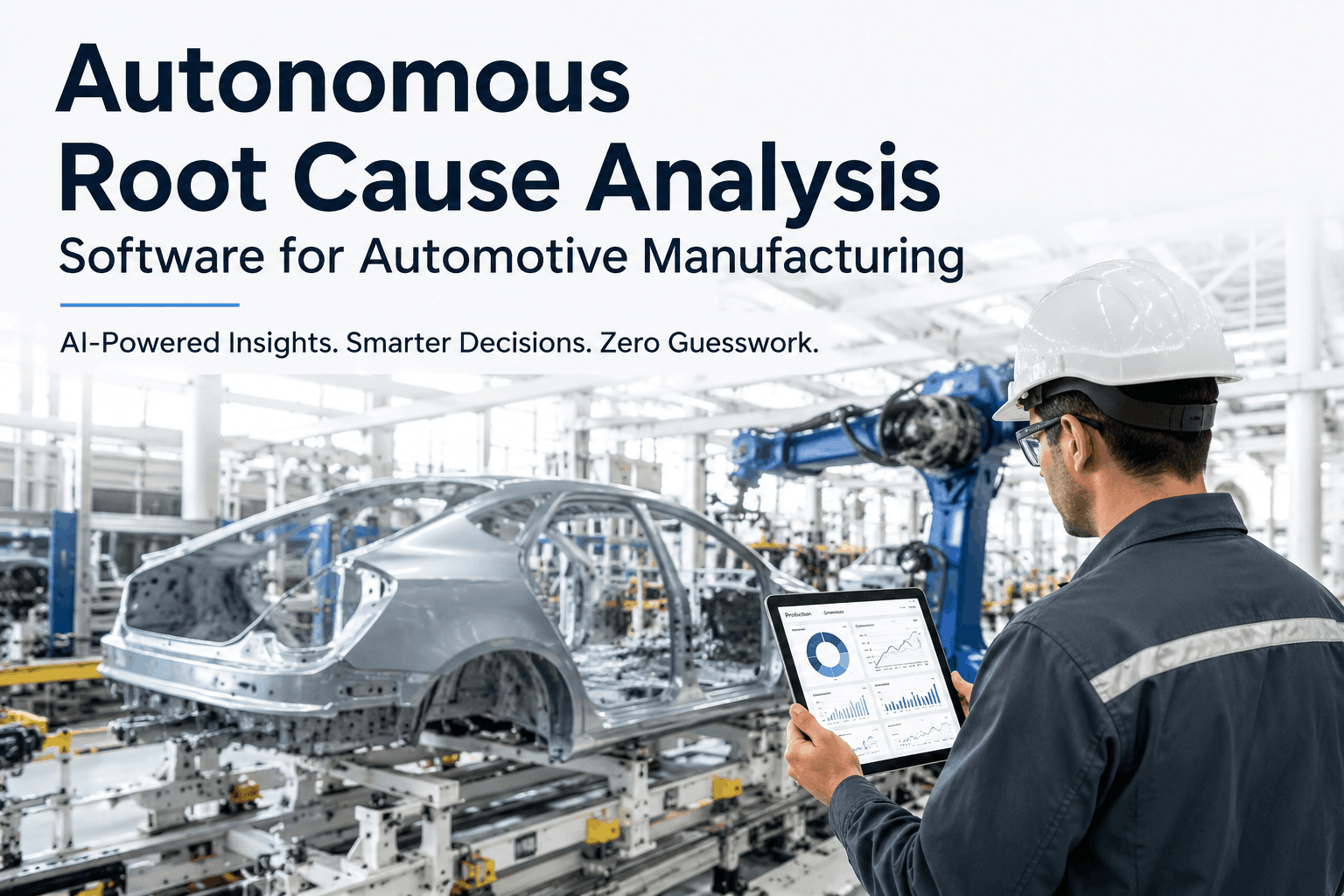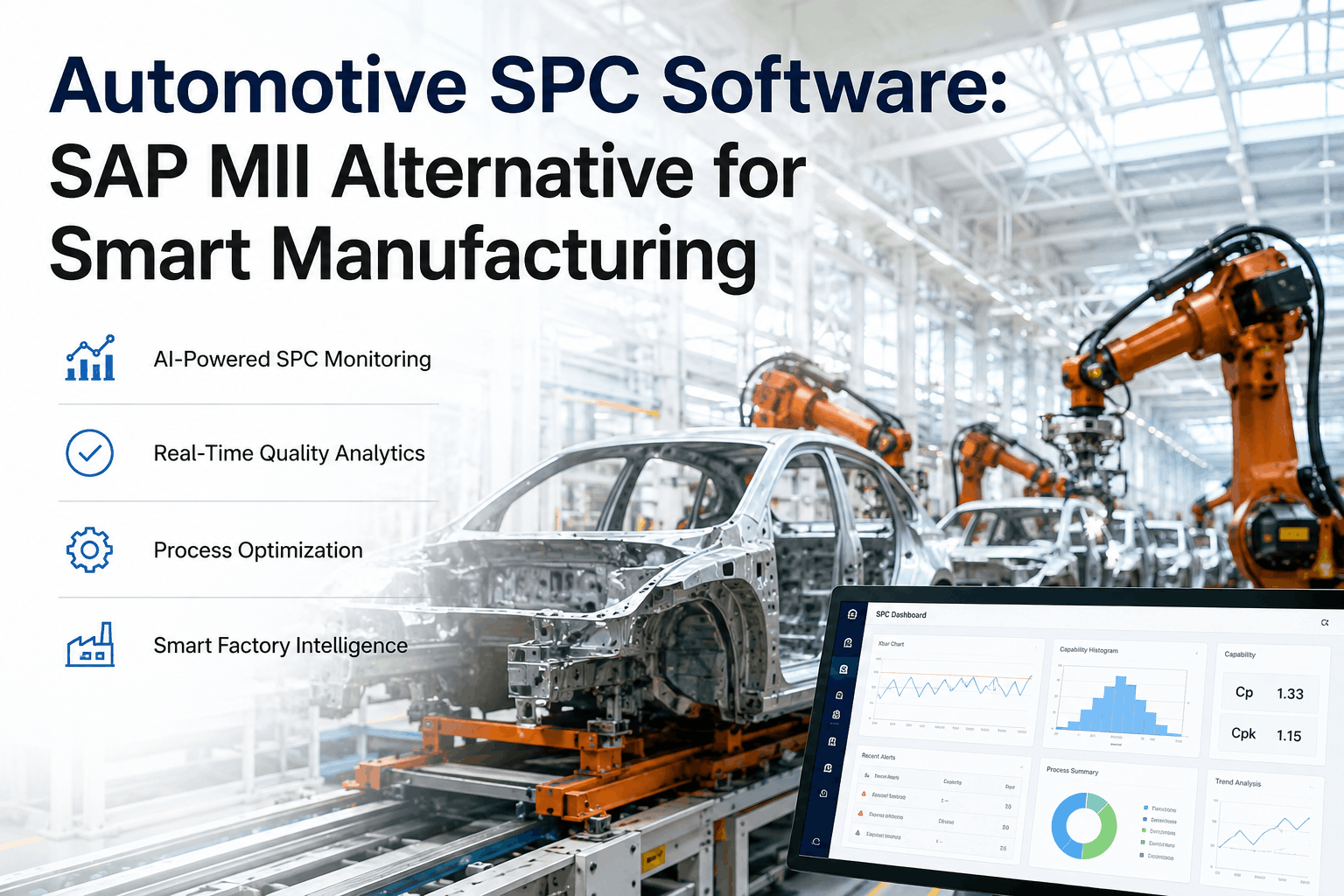
Senior automotive evaluators looking at SAP MII alternatives in 2026 are not running a like-for-like search. The smart manufacturing capability bar has moved decisively, and the platform-evaluation framework has moved with it. AI-powered SPC has become the baseline for automotive quality control rather than a nice-to-have. Autonomous quality analytics has replaced the engineering-hours-per-investigation workstream that consumed the legacy SPC era. Predictive process optimization has become the operational expectation rather than the future state. Real-time production intelligence has moved from static dashboards to GenAI-powered shop-floor queries. And the entire stack now has to run with sub-50ms edge inference at line speed, IATF 16949-strengthening evidence assembly, multi-plant standardization for automotive groups operating across regions, and the on-prem architecture that keeps process IP inside the plant boundary rather than the cloud lock-in that SAP DMC or other cloud-bound alternatives create. iFactory AI is the AI-native automotive manufacturing platform purpose-built as the modern SAP MII / SAP xMII / SAP DMC alternative — pre-configured NVIDIA appliance running pre-loaded automotive models on-premise, delivering AI-powered SPC, quality analytics, process optimization, real-time production intelligence, and smart manufacturing intelligence on a single platform engineered to the automotive evaluator's decision framework. This page is the senior automotive evaluator's guide to choosing a modern SAP alternative for smart manufacturing — the capability matrix across all three SAP alternatives, the evaluator decision drivers, the Industry 4.0 architecture, and how the platform actually evaluates against the criteria that drive senior automotive platform decisions.
Automotive SPC Software: SAP MII Alternative for Smart Manufacturing
The senior automotive evaluator's guide to a modern SAP alternative — AI-powered SPC, quality analytics, process optimization, and real-time production intelligence on a single platform purpose-built for Industry 4.0 smart manufacturing in automotive. SAP MII, SAP DMC, SAP xMII replacement. On-prem deployment, 6–12 week migration.
Evaluator's Matrix — iFactory AI vs SAP MII / xMII / DMC
Pharma evaluators score against SAP MII; automotive evaluators score against the full SAP automotive manufacturing stack — MII (on-prem MII), xMII (the legacy variant in many plants), and DMC (the cloud-bound modernization path). The matrix below scores all four options across the seven capability dimensions that drive senior automotive evaluation decisions in 2026.
The summary row drives the evaluation conclusion. A modern automotive platform either has all seven capabilities native — running on the same data, the same audit log, the same operational envelope — or it does not. SAP MII / xMII covers basic SPC and reporting; SAP DMC adds cloud-modernized dashboards but inherits cloud lock-in and slow deployment timelines. iFactory delivers all seven capabilities on one on-prem platform with sub-50ms edge inference and 6–12 week deployment timelines.
Want this matrix walked through against your specific automotive evaluation framework? Schedule the AI Manufacturing Transformation Workshop — iFactory's automotive team will score the platform against your evaluation criteria and demonstrate each capability on representative data. Sessions available this week.
Automotive Evaluator's Decision Drivers
Senior automotive evaluators do not score platforms purely on capability — they score on the operational decision drivers that determine total cost of ownership, deployment risk, multi-plant standardization, and long-term operational flexibility. The driver model below shows what actually weighs in an automotive SAP alternative evaluation, and how iFactory scores against each.
The six drivers above show up explicitly in automotive platform RFP responses, evaluator scorecards, and steering committee decisions across OEMs and tier-1 suppliers. iFactory's positioning was designed against this evaluation framework from inception rather than retrofitted into it, which is why the alignment is structural.
Automotive Smart Manufacturing & Industry 4.0 Architecture
Where iFactory sits in the automotive Industry 4.0 architecture
Smart manufacturing for automotive in 2026 is structurally layered — physical assets at the bottom, edge AI just above them, the AI-native intelligence layer above edge, and enterprise integration at the top. iFactory occupies the AI-native intelligence layer in this architecture, sitting above the existing L1/L2 control architecture (PLCs, robots, vision, dimensional inspection) and integrating with the ERP / S/4 stack at the top. The architecture below shows the placement and the integration points that matter for an automotive smart factory deployment.
The layered architecture is the structural reason iFactory deploys without disrupting existing automotive plant investments. Layer 1 physical assets and Layer 2 data integration replace SAP PCo as the data on-ramp but leave PLC and robot control untouched. Layer 3 edge AI adds line-speed inference where it is needed. Layer 4 (iFactory) is the AI-native intelligence layer where SAP MII / xMII workloads get replaced. Layer 5 enterprise integration with SAP S/4 / ERP stays intact via standard adapters.
Five AI-Native Capabilities for Automotive Smart Manufacturing
AI-Powered SPC
Multivariate adaptive SPC with predictive drift detection
Quality Analytics
Autonomous RCA · PPAP automation · 8D evidence
Process Optimization
AI-driven real-time parameter optimization
Real-Time Intel
Live dashboards · GenAI plant queries · predictive alerts
Smart Mfg / I4.0
Edge AI · digital twin · cross-plant standardization
Three Migration Paths for Automotive Smart Manufacturing
Stay on SAP MII / xMII
Extended SAP maintenance with descriptive SPC. AI capability remains bolt-on point solutions. Smart manufacturing gap widens.
SAP DMC (Cloud)
Cloud-bound platform. WAN-bound latency unsuited for line-speed AI. Process IP exits plant. 18–30 month deployment.
iFactory AI On-Prem
Modern SAP alternative engineered for smart manufacturing. On-prem, 6–12 weeks. All 7 capability dimensions native on one platform.
Six Automotive Operations Where the Migration Pays Back Fastest
Multi-Platform Body Shops
Changeover prediction, weld quality monitoring, and autonomous RCA on weld defects deliver the highest payback in BIW operations.
Assembly Lines
Causal attribution turns aggregated micro-stop time into specific equipment causes. Torque drift and sequence violation prevention.
Stamping & Press Lines
Predictive die-wear modeling maintains dimensional capability across the die life. Maintenance scheduled before scrap rather than after.
Powertrain & Machining
Predictive maintenance reduces unplanned equipment downtime. PPAP submissions assemble continuously from process data.
EV Battery Operations
Cell-level OEE patterns differ from ICE manufacturing. AI-native models handle formation cycle variation and pack defect prediction.
Multi-Plant OEM / Tier-1
Identical platform across plants with portfolio-level benchmarking. Customer-specific evidence packages automated per plant.
Want operation-specific projections for your automotive operation? Send your plant configuration and current SAP state to iFactory support and the automotive team will return a customised projection with 12-month roadmap — typically within 3 business days, no obligation.
IATF 16949 & Automotive Quality Standards — Native to the Platform
Pre-built workflows for automotive frameworks
- IATF 16949 — automotive QMS requirement
- PPAP — Production Part Approval Process
- APQP — Advanced Product Quality Planning
- MSA — Measurement Systems Analysis
- Process Capability (Cpk / Ppk) — automated
- Control Plans — live with predictive evidence
- FMEA — design and process
- OEM customer-specific requirements (CSRs)
The compliance frameworks are configured into the relevant iFactory workflows during deployment. PPAP packages benefit from continuous Cpk evidence. Control plans become living documents updated by actual process behavior. Automotive auditors typically respond favorably to the richer evidence base produced by the platform.
Two Real Automotive Smart Manufacturing Outcomes
Automotive OEM standardizing smart manufacturing across multiple regional plants
An automotive OEM operating multiple regional plants across two continents ran a digital transformation initiative to consolidate SPC, quality analytics, and process optimization onto a single AI-native platform. Plants had inherited a mix of SAP MII, SAP xMII, and various legacy point solutions over years of acquisitions. The senior leadership team mandated platform standardization with smart manufacturing capability uplift — measured against an Industry 4.0 maturity framework — within an aggressive timeline.
Tier-1 automotive supplier rolling out smart factory across powertrain & EV component plants
A tier-1 automotive supplier producing engine, transmission, and EV battery components ran a smart factory program targeting OEE improvement, quality scorecard movement, and IATF 16949 strengthening across plants serving multiple OEM customers. The legacy SAP MII landscape provided descriptive SPC but no AI capability, and the supplier had been losing scorecard ground to competitors investing in smart manufacturing.
Neither scenario matches your operation? Send your automotive segment, plant configuration, and current SAP state to iFactory support and the automotive team will return a customised analysis with 12-month roadmap — typically within 3 business days, no obligation.
iFactory's Automotive Deployment — On-Premise or Cloud
Same AI-native platform on either deployment model. On-prem is the recommended default for automotive smart manufacturing given sub-50ms line-speed inference requirements, process IP sovereignty, and the production-grade reliability automotive operations require.
iFactory On-Premise Appliance Recommended for automotive · sub-50ms edge inference at line speed
- Pre-configured NVIDIA AI server — pre-loaded automotive models, racked, ready.
- <50ms edge inference — line-speed AI decisions.
- SAP MII / xMII / DMC alternative — full smart manufacturing capability.
- IATF 16949 evidence strengthened — continuous predictive records.
iFactory Cloud For multi-plant automotive groups with central governance
- Fully managed — no rack, no facility requirements.
- Same smart manufacturing capability — full platform available.
- Portfolio-level benchmarking across plants.
- Fastest deployment — first plant live in 2–4 weeks.
The modern SAP MII / xMII / DMC alternative for automotive smart manufacturing.
AI-powered SPC, autonomous quality analytics, predictive process optimization, real-time manufacturing intelligence, and Industry 4.0 architecture — on a pre-configured NVIDIA appliance with on-prem deployment that keeps process IP inside the plant and 6–12 week deployment timelines. The AI Manufacturing Transformation Workshop sizes the alternative for your automotive operation.
FAQ: Automotive Smart Manufacturing & SAP Alternative Evaluation
How does iFactory compare to SAP MII, SAP xMII, and SAP DMC for automotive?
The three SAP automotive platforms occupy different positions. SAP MII and SAP xMII are on-prem descriptive SPC and reporting platforms; both are limited to univariate SPC and lack AI-native capability. SAP DMC is the cloud-modernized successor, with faster dashboards but the same fundamental descriptive limitations plus cloud lock-in and WAN-bound latency unsuited for line-speed AI decisions. iFactory delivers all the capabilities that all three SAP platforms lack — multivariate SPC, autonomous RCA, predictive process optimization, real-time GenAI intelligence, edge AI inference — on a single on-prem platform with 6–12 week deployment. Book a demo to walk through scoring against your specific evaluation criteria.
How does iFactory integrate with our existing SAP S/4 HANA / ERP investment?
iFactory replaces the SAP MII / xMII / DMC manufacturing intelligence layer but integrates natively with SAP S/4 / ERP for production orders, BOM, material master, financial reporting, and downstream business processes. The S/4 investment stays intact. The integration adapters are configured during deployment with standard interface patterns. Most automotive customers keep their ERP investment unchanged and only modernize the manufacturing intelligence layer above it.
What does Industry 4.0 / smart manufacturing actually mean in iFactory's architecture?
Industry 4.0 / smart manufacturing in iFactory's architecture means five concrete capabilities that work together — edge AI inference at line speed for closed-loop quality and process intervention; an AI-native intelligence layer that performs multivariate analysis across all data sources; predictive process optimization that adjusts parameters before deviations form; manufacturing digital twin that supports counterfactual reasoning and root cause analysis; and GenAI copilots that let operators query plant state in natural language. All five run on the same platform with the same audit log.
How does multi-plant standardization work across automotive OEMs and tier-1s?
The platform deploys identically across plants — on-premise appliances at full-production sites, iFactory Cloud at smaller sites for cost efficiency. The standardized tooling accelerates best-practice transfer between plants because the SPC charts, OEE intelligence, autonomous RCA workflows, and PPAP evidence assembly all look the same. Portfolio-level benchmarking is supported natively. Customer-specific evidence packages assemble automatically per OEM customer requirements across the portfolio.
Is IATF 16949 audit posture preserved or strengthened through the migration?
Strengthened. Every predictive intervention the platform makes is logged as an auditable event with inferred process state, decision rationale, action taken, and verified outcome — producing a richer process capability record than SAP descriptive monitoring ever delivered. PPAP packages benefit from continuous Cpk evidence. Control plans become living documents reflecting actual predictive behavior. Auditors typically respond favorably to the stronger evidence base.
Do I have to buy NVIDIA servers separately?
No. iFactory's on-premise appliance ships fully loaded — pre-configured NVIDIA AI server, automotive AI models pre-installed, network gear, cabling, edge devices for line-side inference, integration adapters for SAP MII / xMII / DMC / ERP, MES, vision systems, robot controllers, and major plant systems. You provide rack space, line power, Ethernet, and integration points. The deployment team handles installation, validation, and configuration across the 6–12 week window.
What does the AI Manufacturing Transformation Workshop cover for automotive smart manufacturing?
The half-day workshop covers — current-state SAP MII / xMII / DMC assessment for your automotive operation, scoring against your specific evaluation framework on the seven capability dimensions, Industry 4.0 / smart manufacturing architecture walkthrough, edge AI deployment review, three-path migration comparison with cost and timeline projections, IATF 16949 / PPAP evidence approach, multi-plant standardization plan if relevant, and ROI projection. Outcome is a structured evaluation document suitable for steering committee review by CIO, COO, Head of Manufacturing IT, and Head of Digital Transformation.
Seven capabilities. One AI-native platform. The modern SAP alternative for automotive smart manufacturing.
AI-powered SPC, autonomous quality analytics, predictive process optimization, real-time manufacturing intelligence, Industry 4.0 architecture, sub-50ms edge inference, multi-plant standardization — on a pre-configured NVIDIA appliance, on-prem, IATF 16949 strengthened, 6–12 week migration. The Workshop is the fastest way to score the alternative against your evaluation framework — sessions available this week.