Aluminum manufacturing operations sit in a different quality reality than most other heavy industries. Alloy chemistry has to be controlled in tight tolerance bands across hundreds of grades, DC casters can develop porosity, hot tears, and inclusions that propagate through downstream rolling, hot and cold mills produce surface defects whose causes span the upstream chain, and the customers (beverage can makers, automotive OEMs, aerospace primes) operate scorecards that do not give second chances. Statistical Process Control in aluminum has historically meant univariate charts running on individual gauges and properties — useful for descriptive reporting but structurally unable to predict the multivariate quality risk that actually drives off-grade production. The modern aluminum operations team needs more than charts. It needs AI-powered SPC, predictive quality analytics that connect chemistry to mechanical properties through casting and rolling, real-time process stability monitoring, and the on-prem deployment that keeps alloy IP and recipe data inside the plant boundary where it belongs. iFactory AI is the AI-native aluminum manufacturing platform purpose-built for this — pre-configured NVIDIA appliance running pre-loaded aluminum-industry models on-premise, delivering advanced SPC, predictive quality analytics, process stability, and operational efficiency across the entire aluminum chain from cast house through finishing. This guide is the aluminum operations and quality leadership team's reference for AI-powered SPC and quality analytics — the chain-wide coverage, the capability set, the predictive quality model, and how the platform actually deploys in an aluminum operation.
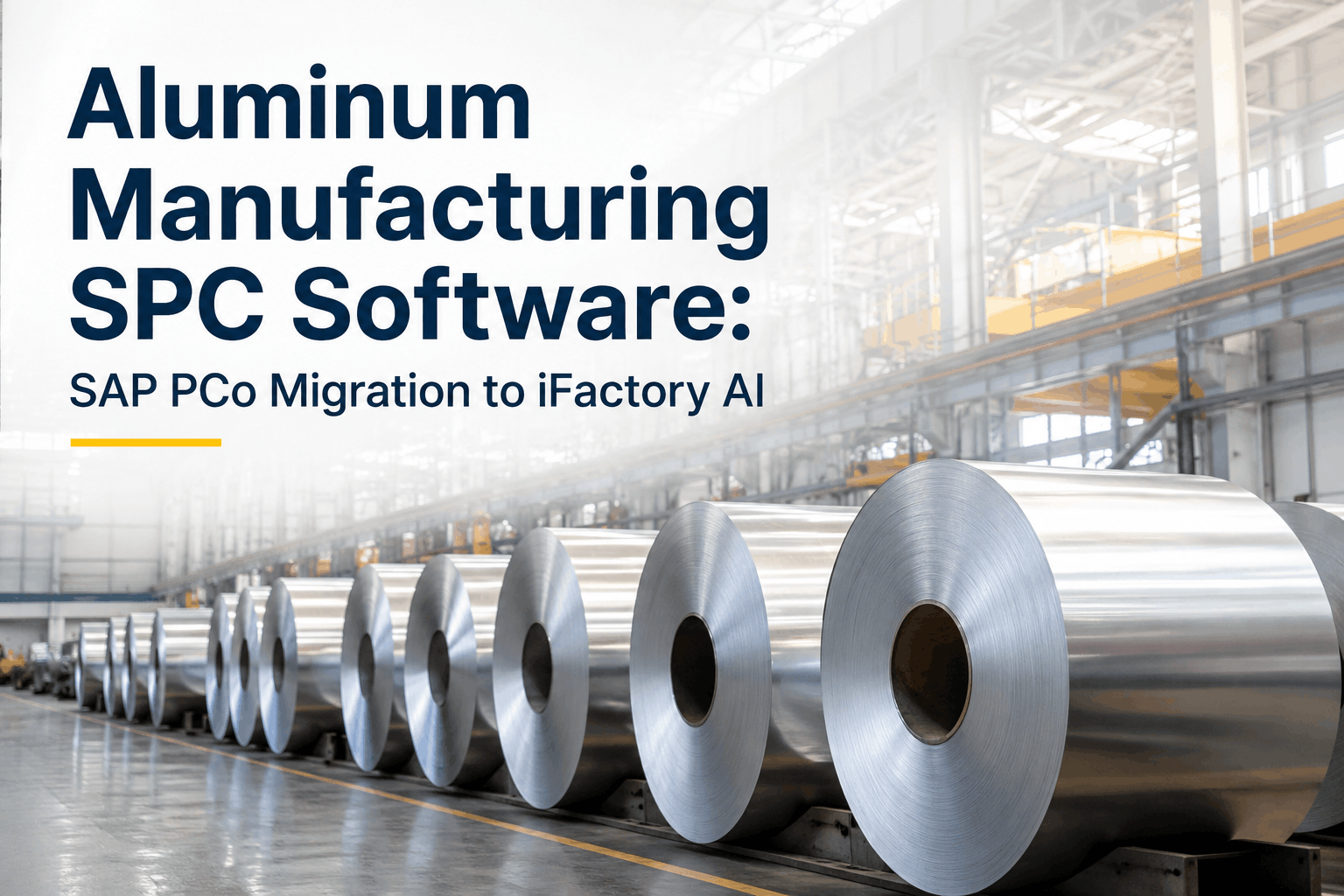
Aluminum Manufacturing SPC Software & Quality Analytics Guide
The aluminum operations and quality leadership team's guide to AI-powered SPC and quality analytics — advanced SPC monitoring, predictive quality analytics, process stability, and operational efficiency across cast house, rolling, and finishing. On-prem intelligence on a pre-configured NVIDIA appliance, 6–12 week deployment.
The Aluminum Manufacturing Chain — AI-Powered SPC at Every Stage
Aluminum quality is determined sequentially across every station in the production chain. Chemistry set in the cast house determines mechanical properties downstream. Casting defects propagate through hot rolling and cold rolling. Surface conditions developed during rolling persist into finishing and customer evaluation. AI-powered SPC and quality analytics has to extend across the entire chain — not just the rolling line or just the cast house. The coverage map below shows the typical deployment footprint for an integrated aluminum operation.
The cross-chain correlation is what an aluminum operation actually needs. An alloy chemistry adjustment in the cast house this week shows up as a mechanical property issue two weeks downstream — by which point the connection has been lost on traditional descriptive systems. On the iFactory unified layer, the chemistry-to-property model captures the link continuously and the predictive intervention happens at the cast-house stage where adjustment is still possible.
Want this coverage mapped for your specific aluminum operation? Schedule the AI Manufacturing Transformation Workshop — iFactory's aluminum team will diagram your current cast house, rolling, and finishing setup with the modernized SPC coverage layered on top. Sessions available this week.
Aluminum Quality Challenges — and How AI-Powered SPC Addresses Each
Aluminum has a recognizable set of quality challenges that show up across operations regardless of product mix — porosity and inclusions in casting, surface defects in rolling, mechanical property variability, and chemistry drift. Each challenge maps to a specific AI capability that traditional descriptive SPC cannot reliably address.
The mapping is what makes the platform value concrete. Each common aluminum quality challenge — porosity, hot tears, inclusions, surface defects, mechanical property variability, chemistry drift — has a specific AI capability addressing it. None of these are bolt-on tools; they all run on the same unified platform sharing the same data and the same audit trail.
Five AI-Native Capabilities for Aluminum Manufacturing
Multivariate SPC
Adaptive control across the alloy and process variable set
Predictive Quality
Chemistry-to-property and casting-to-rolling propagation models
Process Stability
Real-time stability metrics across cast, rolling, anneal
Operational Efficiency
OEE intelligence with cause attribution and prediction
Compliance Evidence
IATF/ASTM/AMS records continuous and audit-ready
The Predictive Quality Chain — Chemistry to Mechanical Properties
From cast-house chemistry to finished-product mechanical properties
Aluminum quality is shaped at every step from cast house through finishing. Chemistry set at alloying determines the mechanical property envelope; DC casting parameters determine the defect baseline; rolling conditions determine surface and dimensional outcomes; thermal processing determines final properties. Predictive quality models connect these stages mathematically so a downstream property outcome can be forecast from upstream process state hours ahead of release testing.
The predictive chain gives the operations team something descriptive SPC never delivered — a forecast of what the finished product is going to look like, with enough time to actually adjust upstream parameters. The chemistry stage is the highest-leverage intervention point in aluminum because its effects propagate the furthest downstream.
Want the predictive quality chain modeled for your specific aluminum products? Send your alloy mix, product specifications, and current quality measurement points to iFactory support and the aluminum team will return a tailored predictive quality assessment — typically within 3 business days, no obligation.
Six Aluminum Operations Where AI-Powered SPC Pays Back Fastest
Can Sheet Production
High-volume tight-spec operations with major customer scorecards. Predictive gauge and surface intervention reduces customer-spec misses substantially.
Automotive Body Sheet
Mechanical property control across automotive grades. OEM scorecard movement on dimensional capability and surface quality.
Aerospace Alloys
Tight chemistry control with predictive property modeling. AMS compliance evidence continuous. High-margin grades benefit most.
DC Cast House
Multivariate cast monitoring catches porosity, hot tears, and inclusion risk before propagation. Cooling profile optimization.
Hot & Cold Mills
Closed-loop gauge and flatness with adaptive setpoints. Surface defect prediction from upstream cast and rolling conditions.
Annealing & Thermal
Mechanical property prediction from chemistry and thermal profile. Reduces mechanical-property-driven rejections.
Want operation-specific projections for your aluminum operation? Send your aluminum segment, product mix, and current SPC configuration to iFactory support and the aluminum team will return a customised projection with 12-month roadmap — typically within 3 business days, no obligation.
Aluminum Industry Compliance & Customer Standards — Native to the Platform
Pre-built workflows for aluminum quality and customer requirements
- IATF 16949 — automotive aluminum customer requirement
- AMS specifications — aerospace material standards
- ASTM B-series — aluminum specifications
- EN AW alloy designations — European designation system
- ISO 9001 — quality management systems
- Process Capability (Cpk / Ppk) — automated
- Mill Test Certificates (MTC) — continuous evidence
- Customer-specific specifications (CSRs) — can & auto
The compliance evidence becomes a byproduct of running multivariate SPC and predictive quality continuously — not a separate workstream the team maintains. Mill Test Certificates assemble from the unified audit log. Cpk and Ppk evidence accumulates. Beverage-can-makers' scorecards reflect the actual quality consistency improvement. Auditors typically respond favorably to the stronger evidence base.
Two Real Aluminum SPC & Quality Analytics Outcomes
Can sheet aluminum producer supplying beverage major customers
A can sheet producer operating cast house through cold rolling and coating maintained traditional univariate SPC across gauges, flatness, and surface inspection systems. Beverage-major customer scorecards penalized any inconsistency in formability, surface, or coating compatibility. Chemistry-to-property drift caused periodic batch rejections. The operations team needed multivariate SPC across the chain and predictive intervention at chemistry rather than at final inspection.
Automotive body sheet producer with structural and closure-grade portfolio
An automotive body sheet producer serving multiple OEM platforms ran SAP MES with descriptive SPC across rolling and annealing lines. OEM scorecards on dimensional capability and mechanical property consistency were under pressure. Anneal-line property variability led to periodic batch sorting and rework. The operations team needed predictive mechanical property modeling from chemistry and thermal profile, plus real-time intervention at the cold mill and anneal stages.
Neither scenario matches your operation? Send your aluminum segment, plant configuration, and current SPC state to iFactory support and the aluminum team will return a customised deployment analysis with 12-month roadmap — typically within 3 business days, no obligation.
iFactory's Aluminum Deployment — On-Premise or Cloud
Same AI-native platform on either deployment model. On-prem is the recommended default for aluminum operations given alloy IP and recipe data sovereignty (aluminum producers compete heavily on proprietary alloy formulations), line-speed inference latency requirements, and the OpEx-cap that on-prem CapEx provides for high-volume continuous operations.
iFactory On-Premise Appliance Recommended for aluminum · alloy IP and recipe data stay on-site
- Pre-configured NVIDIA AI server — pre-loaded aluminum SPC models, racked, ready.
- <50ms edge inference — mill-speed quality decisions.
- Alloy IP stays in plant — proprietary formulations protected.
- Existing SAP / MES / DCS coexist — no rip-and-replace.
iFactory Cloud For multi-plant aluminum groups with central governance
- Fully managed — no rack, no facility requirements.
- Same SPC engine — full capability available.
- Portfolio-level benchmarking across plants.
- Fastest deployment — first plant live in 2–4 weeks.
Multivariate SPC. Predictive quality. Process stability. On-prem intelligence for aluminum.
The AI-native aluminum manufacturing platform — multivariate SPC across cast, rolling, anneal, and finishing, chemistry-to-mechanical-property prediction, continuous compliance evidence, on a pre-configured NVIDIA appliance with on-prem deployment that keeps alloy IP in the plant. Live in 6–12 weeks. The AI Manufacturing Transformation Workshop sizes the deployment for your specific aluminum operation.
FAQ: Aluminum Manufacturing SPC & Quality Analytics
How does iFactory's SPC handle aluminum's specific multivariate quality challenges?
Aluminum quality is multivariate by physics — alloy composition, casting parameters, rolling conditions, and thermal processing are all correlated through the underlying metallurgy. iFactory's multivariate SPC models the relationship structure across these variables rather than treating each as an independent chart. Porosity, hot tears, inclusions, surface streaking, and mechanical property variability all become predictable from upstream process state with intervention windows of hours to days. Book a demo to see multivariate SPC on representative aluminum scenarios.
Does iFactory's predictive quality model actually work for aluminum chemistry-to-property prediction?
Yes — and chemistry-to-property is one of the highest-leverage predictive applications in aluminum manufacturing. The models learn the mapping from alloy composition through casting, homogenization, rolling, and thermal processing to finished mechanical properties (YS, UTS, elongation, formability, hardness). Tuning happens on plant-specific data during the first 60–90 days. Once tuned, the model predicts property outcomes from chemistry with enough lead time to adjust before downstream processing locks the result in.
What about our existing SAP MES / SAP MII for aluminum production tracking?
iFactory adds the AI-native SPC and quality analytics layer above your existing SAP MES / MII. The MES retains production order management, materials, scheduling, and ERP integration. iFactory replaces the SPC and quality monitoring workload with multivariate, predictive, real-time capability. The integration runs through iFactory's adapter layer for SAP MES / MII / xMII so the existing investment stays in place. Most aluminum plants deploy iFactory alongside their MES rather than replacing it.
How does iFactory integrate with our existing DCS, L2, and inspection systems?
iFactory integrates natively with major DCS platforms, L2 process automation (Primetals, Siemens, ABB, GE), plant historians (OSIsoft PI, AspenTech), LIMS, condition monitoring systems, and existing surface inspection cameras. The integration is read-only from L1/L2 control — the existing closed-loop control architecture is not touched. AI vision on the cold mill or coating line can be deployed as an additional layer with edge inference, complementing existing inspection systems rather than replacing them.
How does on-prem deployment protect our alloy IP and recipe data?
The on-prem NVIDIA appliance runs the full SPC, predictive quality, and process stability engine locally — no inference call needs to leave the plant. Alloy compositions, recipe data, customer specifications, and process IP stay inside the plant boundary. The platform is also free from cloud connectivity dependencies (operations continue during WAN outages) and from OpEx-growing AI compute charges. Cloud deployment is available where the operational profile supports it, but for aluminum operations the on-prem default is recommended for alloy IP sovereignty.
Do I have to buy NVIDIA servers separately?
No. iFactory's on-premise appliance ships fully loaded — pre-configured NVIDIA AI server, aluminum-industry SPC and quality analytics models pre-installed, network gear, cabling, edge devices for cast house and mill-floor integration, integration adapters for SAP MES / MII / xMII / ERP, L2 process automation, plant historians (PI), CMS, and major DCS / PLC platforms. You provide rack space, line power, Ethernet, and integration points. The deployment team handles installation, validation, and configuration across the 6–12 week window.
What does the AI Manufacturing Transformation Workshop cover for aluminum?
The half-day workshop covers — current-state SPC assessment for your aluminum operation, multivariate SPC walkthrough on your alloy and process variables, chain-wide coverage demonstration (cast house through finishing), predictive quality model assessment for your specific products, customer compliance requirements (IATF / AMS / ASTM / CSRs), on-prem vs cloud deployment architecture review, and ROI projection. Outcome is a concrete deployment plan suitable for aluminum operations, quality leadership, IT/OT, and finance.
Aluminum quality is multivariate. Aluminum SPC should be too.
AI-powered multivariate SPC, predictive chemistry-to-property modeling, real-time process stability, and continuous compliance evidence — on a pre-configured NVIDIA appliance with on-prem deployment that keeps alloy IP inside the plant. The AI-native platform for aluminum manufacturing in 2026. The Workshop is the fastest way to size the deployment for your operation — sessions available this week.