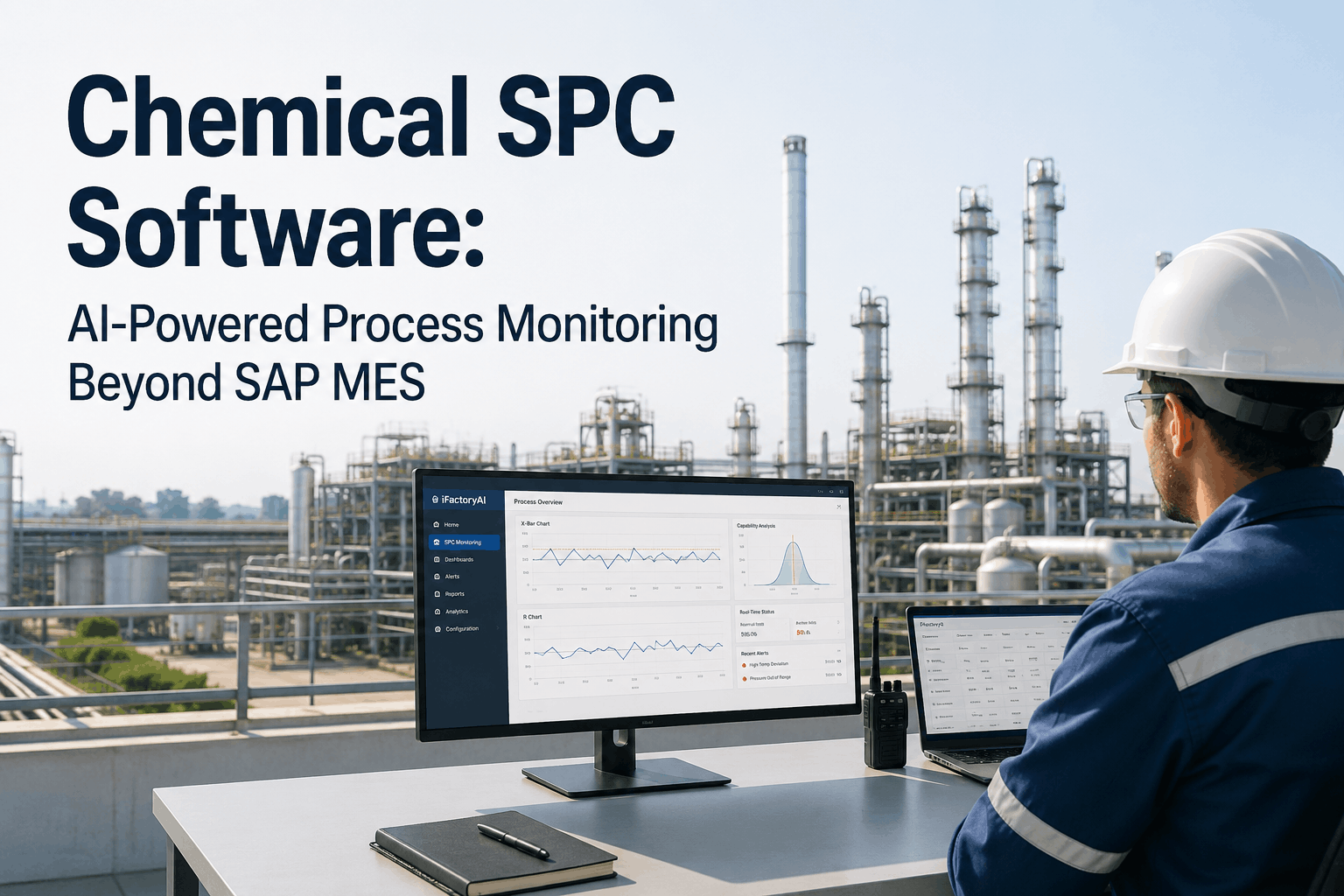
For chemical manufacturing operations running SPC on SAP MES, SAP MII, or xMII, the limitation that quickly becomes apparent is that the underlying SPC pattern was built for discrete manufacturing — one product, one measurement, one chart at a time. Chemical processes do not behave this way. A reactor temperature, a distillation column pressure, a polymerization feed rate, a blending ratio, and a catalyst activity reading are all correlated. A drift in one variable affects three others. The actual process state lives in the multivariate relationship between the variables, not in any single chart. Univariate SPC on this kind of process catches the late-stage symptom rather than the early-stage cause, generates false alarms when correlated variables move together, and misses real drift hidden inside the relationship structure. The chemical industry needs Multivariate Statistical Process Control (MSPC), and it needs the AI-native process monitoring layer that comes with predictive quality intervention, real-time intelligence, and on-prem deployment that does not depend on cloud connectivity. iFactory AI is the AI-powered chemical process monitoring platform purpose-built for this — pre-configured NVIDIA appliance running pre-loaded chemical industry MSPC models on-premise, replacing SAP MES SPC capability with the multivariate, predictive, real-time architecture chemical processes actually need. This page is the chemical operations team's guide to AI-powered SPC and process monitoring beyond SAP MES — the multivariate capability difference, the process coverage, the predictive quality gates across multi-step processes, and how the migration actually works.
Chemical SPC Software: AI-Powered Process Monitoring Beyond SAP MES
The chemical operations team's guide to AI-powered process monitoring — advanced multivariate SPC, process optimization, predictive quality management, and real-time production intelligence on a pre-configured NVIDIA appliance. On-prem deployment without cloud dependency, 6–12 week migration from SAP MES.
Univariate vs Multivariate SPC — The Chemical Process Reality
The core technical argument for AI-powered chemical SPC beyond SAP MES is the dimensionality of chemical processes. A typical chemical reactor has temperature, pressure, flow, concentration, pH, catalyst loading, residence time, and product quality variables — all correlated in the underlying process physics. SAP MES applies univariate SPC patterns to each of these in isolation, which fundamentally cannot capture what is actually happening. Multivariate SPC sees the relationship structure that defines the process state.
The "contribution plot" point is the practical breakthrough for chemical operations teams. When a multivariate alert fires, iFactory automatically surfaces which variable (or small set of variables) is the source of the relationship drift. Engineers move from "something is off across these eight charts" to "the catalyst feed is drifting and pulling reactor temperature with it" within seconds rather than hours of investigation.
Want this multivariate approach demonstrated on your specific chemical process? Schedule the AI Manufacturing Transformation Workshop — iFactory's chemical team will run MSPC on representative data from your operation and show what the platform catches that univariate SPC misses. Sessions available this week.
Chemical Process Monitoring Coverage
Advanced AI-powered SPC is not limited to one reactor or one column. The same platform extends across the chemical operation — reactor monitoring, distillation column control, polymerization process, blending, and end-product quality all running through one MSPC engine sharing context. The coverage map below shows the typical chemical-plant deployment scope.
The unification matters. A reactor temperature drift that shows up downstream as a distillation column composition shift is automatically correlated across the two process domains because they share the same monitoring layer. Cross-domain causality that would require manual investigation across separate SAP MES dashboards becomes visible in seconds on the iFactory architecture.
Predictive Quality Across Multi-Step Chemical Processes
Predicting end-product quality from upstream process state
Chemical processes are sequential — what happens in the reactor determines what arrives at distillation, which determines what enters blending, which determines whether the end product meets customer spec. Multi-step predictive quality estimates end-product CQAs from upstream process state, surfacing quality risk hours ahead and at process gates where intervention is still possible.
The practical value of multi-step predictive quality is the intervention window. When end-product impurity is predicted from reactor state to exceed customer spec by 30 ppm in 4 hours, the operations team has time to adjust feed ratios, distillation parameters, or downstream blending — preventing the deviation rather than discovering it at release testing. This is structurally what SAP MES descriptive SPC could never deliver, regardless of implementation effort.
Want predictive quality projected for your specific chemical process flow? Send your process configuration and CQA list to iFactory support and the chemical team will return a multi-step predictive quality assessment — typically within 3 business days, no obligation.
Three Migration Paths for Chemical Process Monitoring
Stay on SAP MES
Extended SAP maintenance with univariate SPC. False alarms continue, late-stage symptoms remain the only signal. Process IP risk persists.
Cloud MSPC Tool
Standalone cloud MSPC platform. Cloud dependency · process IP exits plant · WAN latency for real-time decisions · vendor lock-in.
iFactory AI On-Prem
AI-native multivariate SPC, predictive quality, real-time intelligence. NVIDIA appliance on-prem, no cloud dependency. 6–12 weeks.
Six Chemical Operations Where AI-Powered SPC Pays Back Fastest
Specialty Chemicals
Multi-step predictive quality is highest payback for specialty chemical operations with tight customer spec windows. Intervention before release becomes routine.
Polymerization
Polymer MW distribution and viscosity prediction from reactor state. Closed-loop optimization of feed and temperature profile.
Distillation Operations
Multivariate control across column pressure, reflux, trays, and feed composition. Purity inferential models replace lab-only verification.
Reactor Operations
Reaction kinetics monitoring with catalyst aging models. Selectivity drift caught before yield loss compounds. Predictive catalyst change timing.
Blending & Finishing
Multi-stream blending with predictive composition control. Customer-spec compliance evidence assembled continuously. Tank-to-truck traceability.
Predictive Maintenance
Condition-based monitoring of rotating equipment, heat exchanger fouling, and pump cavitation. Predicts failures days ahead of trip.
Want operation-specific projections for your chemical plant? Send your chemical segment, process flow, and current SAP MES state to iFactory support and the chemical team will return a customised projection with 12-month roadmap — typically within 3 business days, no obligation.
Chemical Industry Compliance & Process Safety — Native to the Platform
Pre-built workflows for chemical regulatory and process safety frameworks
- REACH — EU chemical registration & evaluation
- OSHA PSM — Process Safety Management (29 CFR 1910.119)
- EPA RMP — Risk Management Plan compliance
- ISO 9001 — quality management systems
- ISO 14001 — environmental management
- Responsible Care — chemical industry framework
- HAZOP / LOPA — process hazard analysis
- Customer-specific specifications (CSRs)
The compliance and process safety workflows live alongside the SPC and process monitoring capability rather than as separate workstreams. Every alert, every predicted deviation, every operator response is logged with full audit traceability — strengthening rather than disrupting the regulatory posture. OSHA PSM-relevant events surface automatically, REACH evidence accumulates continuously, and ISO 9001 process capability records assemble as the SPC engine operates.
Two Real Chemical Process Monitoring Outcomes
Specialty chemical manufacturer with tight customer specs across multi-step batch processes
A specialty chemical manufacturer producing high-value intermediates for downstream customers ran SAP MES with univariate SPC across each process step. False alarm rates were high — operators investigated 8–12 false alerts per shift on average, eroding response trust. Real process drift was caught late, after the deviation had already propagated through downstream steps. Customer-spec misses required rework or yield loss on roughly 4% of batches.
Petrochemical operation with continuous polymer production and grade-transition pressure
A petrochemical operation produced multiple polymer grades on continuous lines with frequent grade transitions. SAP MES tracked process data but had no multivariate state inference and no predictive intervention. Grade transitions generated significant off-spec product before the new grade stabilized. Heat exchanger fouling on the cooling side caused periodic unplanned trips. The operations team needed advanced SPC plus predictive maintenance on the rotating equipment.
Neither scenario matches your operation? Send your chemical segment, process flow, and current SAP MES state to iFactory support and the chemical team will return a customised migration analysis with 12-month roadmap — typically within 3 business days, no obligation.
iFactory's Chemical Deployment — On-Prem Without Cloud Dependency
The chemical industry has particularly strong reasons to favor on-prem AI deployment — process IP and recipe sovereignty, line-speed latency for predictive intervention, operational independence during WAN outages, and the OpEx-cap that on-prem CapEx provides. Cloud is available where the trade-off makes sense for the operation; on-prem is the default recommendation.
iFactory On-Premise Appliance Recommended for chemical · no cloud dependency · process IP stays on-site
- Pre-configured NVIDIA AI server — pre-loaded chemical MSPC models, racked, ready.
- <50ms edge inference — predictive intervention at process speed.
- Process & recipe IP stays in plant — sovereignty preserved.
- Independent of WAN outages — runs continuously regardless of cloud connectivity.
iFactory Cloud For multi-site chemical operations with central governance
- Fully managed — no rack, no facility requirements.
- Same MSPC engine — full capability available.
- Multi-site benchmarking across the portfolio.
- Fastest deployment — first plant live in 2–4 weeks.
Univariate SPC was built for discrete manufacturing. Chemical processes need multivariate.
AI-powered multivariate SPC, predictive quality across multi-step processes, real-time intelligence, and predictive maintenance — on a pre-configured NVIDIA appliance, on-prem, no cloud dependency, 6–12 week migration. The AI-native chemical process monitoring platform beyond SAP MES. The AI Manufacturing Transformation Workshop sizes the migration for your specific chemical operation.
FAQ: AI-Powered Chemical SPC & Process Monitoring
Why does chemical SPC need multivariate models specifically?
Chemical processes are inherently multivariate — reactor temperature, pressure, flow, feed composition, catalyst activity, and product quality are all correlated through the underlying process physics. Univariate SPC charts treat each variable as independent, which is structurally incorrect. The result is high false alarm rates (correlated variables trigger multiple charts on one event), late-stage symptom detection rather than early-stage cause detection, and no ability to identify which variable is the actual source of a drift. MSPC sees the relationship structure and surfaces source variables automatically. Book a demo to see MSPC on representative chemical scenarios.
What does "without cloud dependency" mean in practice?
The on-prem NVIDIA appliance runs the full multivariate SPC, predictive quality, and process monitoring engine locally — no inference call needs to leave the plant. Process IP and recipe data stay inside the plant boundary. WAN outages, ISP issues, and cloud provider incidents do not affect operations. The platform is also free from OpEx-growing AI compute charges that scale with usage. Cloud deployment is available where it fits the operational profile, but for chemical processes the on-prem default is recommended for IP sovereignty and operational independence reasons.
How does iFactory integrate with our existing DCS and historian?
iFactory integrates natively with major DCS platforms (Honeywell, Emerson, Yokogawa, ABB) and plant historians (OSIsoft PI, AspenTech IP.21, GE Proficy), as well as LIMS systems for lab data and OPC UA for general plant connectivity. The integration pulls process data continuously into the multivariate models with proper handling of time synchronization, tag mapping, and quality flagging. The DCS and historian remain in place; iFactory adds the AI-native monitoring layer above them rather than replacing the underlying control architecture.
How does iFactory handle our existing SAP MES alongside the migration?
iFactory replaces the SPC and process monitoring functionality of SAP MES, but the broader MES functions (production order management, materials, scheduling, ERP integration) typically remain on the SAP stack. The migration runs in parallel — iFactory stands up alongside SAP MES, runs in shadow mode validating against current SPC numbers, then becomes primary for SPC and process monitoring at cutover. SAP MES retains the production order and ERP integration role. The migration is workload-scoped rather than monolithic.
What about process safety — OSHA PSM, HAZOP, LOPA?
iFactory's monitoring layer integrates with the process safety architecture rather than competing with it. Safety PLCs, SIS (Safety Instrumented Systems), and interlocks remain the authoritative safety layer — iFactory does not touch them. The platform contributes by surfacing early warning of conditions that could approach safety-relevant trips, supporting HAZOP and LOPA studies with continuous process state evidence, and producing OSHA PSM-relevant audit records continuously. The safety architecture is strengthened by the additional observability without any change to the underlying safety logic.
Do I have to buy NVIDIA servers separately?
No. iFactory's on-premise appliance ships fully loaded — pre-configured NVIDIA AI server, chemical industry MSPC models pre-installed, network gear, cabling, edge devices for DCS and historian integration, integration adapters for SAP MES / xMII / ERP, plant historians, LIMS, and major DCS / PLC platforms. You provide rack space, line power, Ethernet, and integration points. The deployment team handles installation, validation, and configuration across the 6–12 week window.
What does the AI Manufacturing Transformation Workshop cover for chemical?
The half-day workshop covers — current-state SAP MES SPC assessment for your chemical operation, univariate vs multivariate SPC walkthrough on your process variables, MSPC demonstration on representative data (reactor, distillation, polymerization, blending, end quality), multi-step predictive quality assessment, three-path migration comparison with cost and timeline projections, on-prem vs cloud deployment architecture review, process safety integration approach, and ROI projection. Outcome is a concrete migration plan suitable for chemical operations, process engineering, QA/QC, IT/OT, regulatory, and finance.
Multivariate SPC. Multi-step predictive quality. On-prem without cloud dependency.
The AI-native chemical process monitoring platform that goes beyond SAP MES — multivariate SPC across 50–500+ correlated variables, predictive quality across multi-step processes, process IP that stays in the plant, on-prem deployment on a pre-configured NVIDIA appliance, 6–12 week migration. The Workshop is the fastest way to size the migration for your chemical operation — sessions available this week.