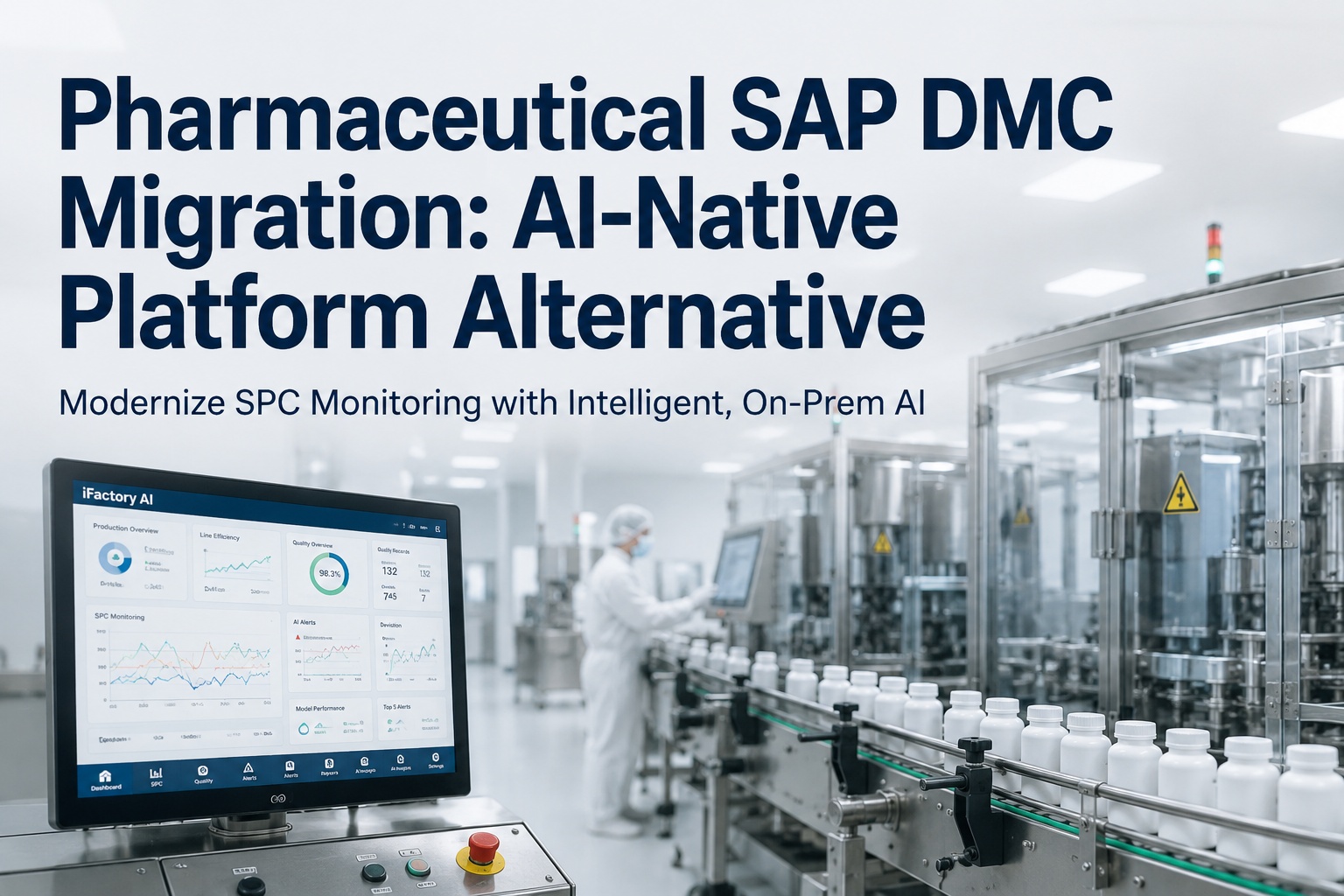
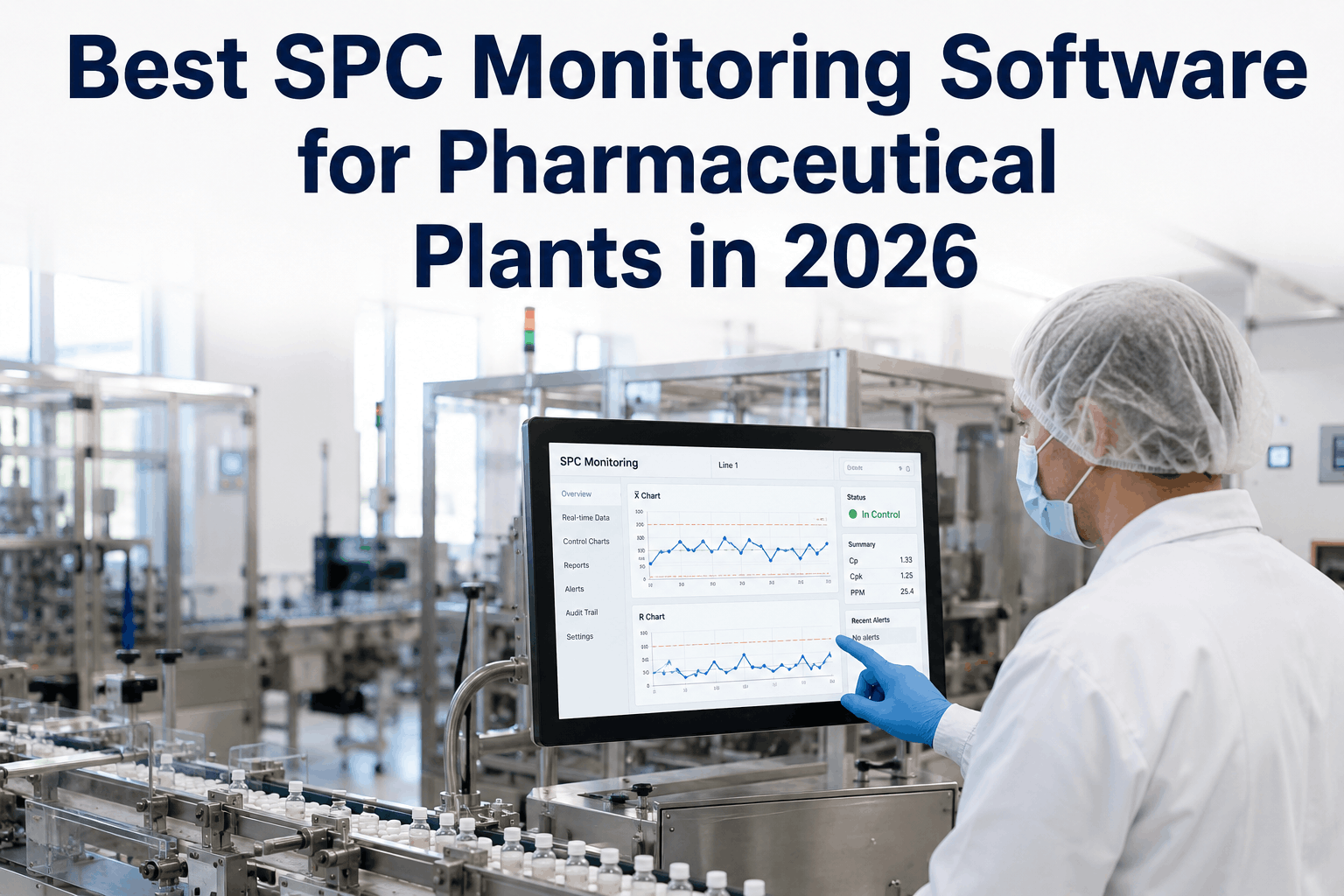
If you are responsible for the technical migration off SAP MII in a pharmaceutical manufacturing plant, you face a set of constraints other industries do not — every step of the migration has to be GxP-aware, every system change has to flow through a controlled validation lifecycle, every record has to maintain 21 CFR Part 11 integrity through and after the cutover, and the inspection posture has to improve rather than be disrupted by the platform change. These constraints are why so many pharma operations have remained on SAP MII / xMII / DMC despite the platform's well-documented limitations for AI-powered SPC monitoring, predictive batch quality, modern process analytics, electronic batch records, and real-time manufacturing intelligence. The constraints are real — but they are not a reason to stay. They are the reason the migration has to be planned correctly. iFactory AI is the AI-native pharmaceutical manufacturing platform purpose-built for this migration — pre-configured NVIDIA appliance running pre-loaded pharma AI models on-premise, with GAMP 5-aligned validation documentation, 21 CFR Part 11-compliant audit logging from day one, and a 4-phase GxP-validated migration approach that keeps inspection readiness intact through cutover. This page is the practical guide to how pharmaceutical plants replace SAP MII with iFactory AI in 2026 — the capability comparison, the validated migration playbook, the Electronic Batch Records architecture, and what changes for each pharma function from SPC engineering through QA release.
How to Replace SAP MII in Pharmaceutical Plants with iFactory AI
The pharma operations and IT team's practical guide to replacing SAP MII with iFactory AI — improving SPC monitoring, GMP compliance, batch quality, process analytics, and real-time manufacturing intelligence across the plant. GAMP 5-aligned validation, 21 CFR Part 11-compliant audit logging, 6–12 week deployment.
iFactory AI vs SAP MII / xMII — Pharma Capability Comparison
The five capabilities below are what a pharma manufacturing plant actually needs from its manufacturing intelligence platform — and they are precisely the areas where SAP MII / xMII delivers descriptive, after-the-fact functionality rather than the AI-native capability the regulatory environment now expects. The comparison shows what each platform actually delivers across the pharma-specific capability dimensions that matter for FDA, EMA, and inspection readiness.
Each row represents a different operational reality after the migration. Adaptive multivariate SPC catches drift that univariate charts miss. Continuous compliance evidence improves the inspection posture rather than reconstructing it under deadline pressure. Predictive batch quality enables intervention before deviations form rather than after. AI-native process analytics surface multivariate patterns that retrospective xMII reports never could. Real-time intelligence with AI copilots gives the floor team an interface to plant data that xMII dashboards never delivered.
Want this capability comparison scored against your specific pharma operation? Schedule the AI Manufacturing Transformation Workshop — iFactory's pharma team will benchmark each capability against your current SAP MII state and demonstrate on representative data. Sessions available this week.
Five AI-Native Pharma Capabilities on One Platform
SPC Monitoring
Adaptive multivariate SPC with predictive drift detection
GMP Compliance
21 CFR Part 11 native · ALCOA+ throughout · Annex 11
Batch Quality
Predictive CQA monitoring with in-batch intervention
Process Analytics
PAT-integrated MSPC and AI-native trend analysis
Real-Time Intelligence
Live dashboards · GenAI plant queries · predictive alerts
The 4-Phase GxP-Validated Migration Playbook
A pharma migration is not a technical exercise — it is a controlled change with validation deliverables at every gate. The playbook below is how the SAP MII replacement actually runs in pharma, with each phase having its own deliverables, validation activities, and inspection-ready evidence. The pattern is workload-by-workload within an overall validated program.
The validation gate at the end of each phase is what makes the migration inspection-ready. The Validation Master Plan (VMP) approved at the end of Phase 1 defines the entire change. IQ/OQ/PQ qualification at the end of Phase 2 establishes the appliance as fit for GxP purpose. Parity verification at the end of Phase 3 demonstrates the new system reproduces the validated behavior. Cutover at Phase 4 is governed by formal change control with a documented rollback path. Inspections that occur during or after migration encounter improved documentation rather than disrupted records.
Want this 4-phase playbook scoped to your specific pharma plant? Send your current SAP MII state and validation framework to iFactory support and the pharma team will return a customised migration plan with sized validation effort — typically within 3 business days, no obligation.
Electronic Batch Records & 21 CFR Part 11 Architecture
How Electronic Batch Records work in the iFactory architecture
Electronic Batch Records are not a bolt-on to the AI platform — they are an output of the same continuous data and audit logging that drives the AI capabilities. Every process value, every operator action, every system decision, every deviation, every CQA reading is captured in the same 21 CFR Part 11-compliant audit log that produces the EBR. The architecture below shows how the EBR comes together from production through release.
The EBR is not a separate workstream the team has to maintain — it assembles continuously from the same audit log that drives the rest of the platform. Batch close-out becomes a structured review of the assembled record rather than days of consolidation work. APQR data accumulates throughout the year. Inspection evidence sits ready, exportable on demand. The compliance posture improves materially through the migration.
Three Migration Paths for Pharmaceutical Plants
Stay on MII / xMII
Extended SAP maintenance. Descriptive functionality persists. AI capability gap widens. Inspection posture stagnates.
SAP DMC (Cloud)
Cloud modernization. Heavy GxP cloud validation burden. Recipe and CQA IP exits validated boundary. Cloud lock-in compounds.
iFactory AI On-Prem
GAMP 5-validated platform with 21 CFR Part 11-native audit logging. NVIDIA appliance on-prem. Five capabilities. 6–12 weeks.
Six Pharma Operations Where the Migration Pays Back Fastest
Oral Solid Dosage (OSD)
NIR-driven SPC, blend uniformity prediction, compression force monitoring. EBR assembly from compression to coating to packaging.
Sterile & Biologics
Predictive CQA monitoring across upstream and downstream. Cleanroom environmental tracking. Deviation prevention in-batch.
API Manufacturing
Multivariate SPC across reaction parameters. Impurity profile prediction. Yield optimization via process analytics.
QC / QA Operations
Continuous APQR data assembly. Deviation trending and CAPA effectiveness analysis. Inspection evidence ready on demand.
Cleanroom Operations
Particulate, viable, HVAC, and differential pressure monitoring with excursion prediction. Reduces deviation triggers.
Packaging & Serialization
Unit-level serialization with continuous traceability. Vision inspection for label, fill, and seal integrity on packaging lines.
Want operation-specific projections for your pharma plant? Send your manufacturing footprint and current SAP MII state to iFactory support and the pharma team will return a customised projection with 12-month roadmap — typically within 3 business days, no obligation.
Pharma Regulatory & Compliance — Native to the Platform
Pre-built workflows for the pharmaceutical regulatory frameworks
- 21 CFR Part 11 — electronic records & signatures
- EU Annex 11 — computerised systems
- GAMP 5 — risk-based validation methodology
- ICH Q8 / Q9 / Q10 / Q12 — QbD & lifecycle
- FDA PAT Guidance — Process Analytical Technology
- ICH Q13 — continuous manufacturing
- Data integrity — ALCOA+ throughout
- Serialization — DSCSA & EU FMD support
The compliance frameworks are configured into the relevant iFactory workflows during deployment. The validation documentation iFactory ships supports your IQ/OQ/PQ activities. The audit log is 21 CFR Part 11-compliant from day one with full ALCOA+ data integrity. Inspections find improved documentation continuity after migration rather than disrupted records — that is the core promise of the GxP-validated migration approach.
Two Real Pharma SAP MII Replacement Outcomes
OSD manufacturer replacing SAP MII across SPC, batch quality, EBR, and analytics
A mid-large OSD manufacturer running multiple high-volume product lines maintained SAP MII for SPC monitoring, batch tracking, and process reporting. The platform produced descriptive evidence but no predictive intervention, batch release relied on manual data consolidation from multiple sources, and APQR was reconstructed annually. The senior leadership team mandated replacement with an AI-native platform covering SPC, batch quality, process analytics, and EBR on one validated stack.
Biologics & sterile manufacturer with heavy GMP and EBR requirements
A biologics manufacturer producing monoclonal antibodies and sterile injectables maintained SAP MII alongside multiple point solutions for EBR, cleanroom monitoring, and quality investigation. Inspection preparation took weeks per audit cycle. Deviation rates in fill-finish were tracked but not reduced. The QA team needed a unified platform that improved both the inspection posture and the underlying deviation prevention capability.
Neither scenario matches your operation? Send your pharma segment, plant configuration, and current SAP MII state to iFactory support and the pharma team will return a customised migration analysis with 12-month roadmap — typically within 3 business days, no obligation.
iFactory's Pharma Deployment — On-Premise or Cloud
Same AI-native platform on either deployment model. On-prem is the recommended default for pharmaceutical manufacturing given the GxP boundary considerations, recipe and CQA IP sovereignty, and edge-inference latency for closed-loop process control. Cloud is available for multi-site pharma operations consolidating central governance.
iFactory On-Premise Appliance Recommended for pharma · GxP-validated boundary contained
- Pre-configured NVIDIA AI server — pre-loaded pharma models, racked, GAMP 5 validation ready.
- 21 CFR Part 11 native — audit logging from day one.
- Recipe & CQA IP stays on-site — sovereignty preserved.
- 4-phase migration with rollback at every gate.
iFactory Cloud For multi-site pharma operations with central governance
- Fully managed — no rack, no facility requirements.
- Same five capabilities — full validated platform.
- Multi-site APQR consolidation across plants.
- Fastest deployment — first plant live in 2–4 weeks.
Replace SAP MII without disrupting inspection readiness. The pharma migration is GxP-validated end-to-end.
SPC monitoring, GMP compliance, batch quality, process analytics, real-time intelligence — five capabilities on a pre-configured NVIDIA appliance with GAMP 5-aligned validation, 21 CFR Part 11-native audit logging, and a 4-phase migration that improves inspection documentation rather than disrupting it. Live in 6–12 weeks. The AI Manufacturing Transformation Workshop sizes the migration for your specific pharma plant.
FAQ: Replacing SAP MII in Pharmaceutical Plants
How does the GxP validation actually work during the SAP MII replacement?
The 4-phase playbook builds validation into every step — Plan & Validate (workload inventory, GAMP 5 risk classification, URS, VMP); Deploy & Qualify (IQ/OQ/PQ on the iFactory appliance and interfaces); Parallel Run (parity validation between SAP MII and iFactory under change control); Cutover & Sustain (formal cutover with documented rollback path and periodic review program). Each phase has a validation gate that must close before the next phase begins. Book a demo to walk through the validation approach for your plant.
Is iFactory's audit logging actually 21 CFR Part 11-compliant?
Yes. Every record in the iFactory audit log is captured with full ALCOA+ data integrity — Attributable (linked to the user/system that created it), Legible (human and machine-readable), Contemporaneous (timestamped at creation), Original (preserved), Accurate (verified), Complete (no gaps), Consistent, Enduring (retained per retention policy), and Available (exportable on demand). E-signatures, change control, time synchronization, and access control are configured during deployment. The platform is delivered with validation documentation supporting your 21 CFR Part 11 compliance position.
What happens to our existing Electronic Batch Records during migration?
Historical EBRs from the SAP MII / xMII period are preserved per your retention policy — they remain accessible in their original validated form. New EBRs after cutover assemble continuously from the unified iFactory audit log. The parallel-run phase typically generates EBRs from both systems with cross-validation before cutover to confirm completeness. The EBR template, batch sections, and review workflow are configured to match your current process during Phase 1 of the migration.
How does iFactory affect our inspection readiness during and after migration?
Inspection readiness improves rather than being disrupted. During migration, the parallel-run phase means both systems hold complete records — any inspection during this period sees more documentation rather than less. After cutover, the iFactory audit log produces inspection evidence continuously, exportable on demand, with completeness and traceability typically better than the SAP MII state. Customers who have undergone FDA or EMA inspections during the migration report auditors commenting positively on the documentation continuity.
Can we keep SAP S/4 / ERP while replacing SAP MII with iFactory?
Yes — and it is the typical pattern. iFactory replaces the manufacturing intelligence layer (SAP MII / xMII / DMC / PCo) but integrates natively with SAP S/4 / ERP for production orders, BOM, material master, financial reporting, and downstream business processes. The S/4 investment stays intact. The integration adapters are configured during Phase 2 of the migration and validated as part of the IQ/OQ/PQ activities.
Do I have to buy NVIDIA servers separately?
No. iFactory's on-premise appliance ships fully loaded — pre-configured NVIDIA AI server, pharma AI models pre-installed, network gear, cabling, edge devices for PAT and PLC integration, integration adapters for SAP MII / xMII / ERP, LIMS, plant historians, and major DCS / PLC platforms, plus the GAMP 5 validation documentation supporting your IQ/OQ/PQ activities. You provide rack space, line power, Ethernet, and integration points. The deployment team handles installation, validation, and configuration across the 6–12 week window.
What does the AI Manufacturing Transformation Workshop cover for pharma?
The half-day workshop covers — current-state SAP MII / xMII assessment for your pharma operation, capability comparison across SPC, GMP, batch quality, process analytics, and real-time intelligence, 4-phase GxP-validated migration walkthrough scoped to your plant, GAMP 5 validation effort sizing, EBR and 21 CFR Part 11 architecture review, three-path migration comparison with cost and timeline projections, and ROI projection. Outcome is a concrete migration plan suitable for pharma operations, QA/QC, IT/OT, regulatory, and finance.
Five capabilities. One GAMP 5-validated platform. The pharma SAP MII replacement that improves inspection readiness.
Adaptive SPC, native GMP compliance, predictive batch quality, AI process analytics, real-time intelligence — on a pre-configured NVIDIA appliance with 21 CFR Part 11-native audit logging and 4-phase validated migration. The practical SAP MII replacement for pharmaceutical plants in 2026. The Workshop is the fastest way to size the migration — sessions available this week.