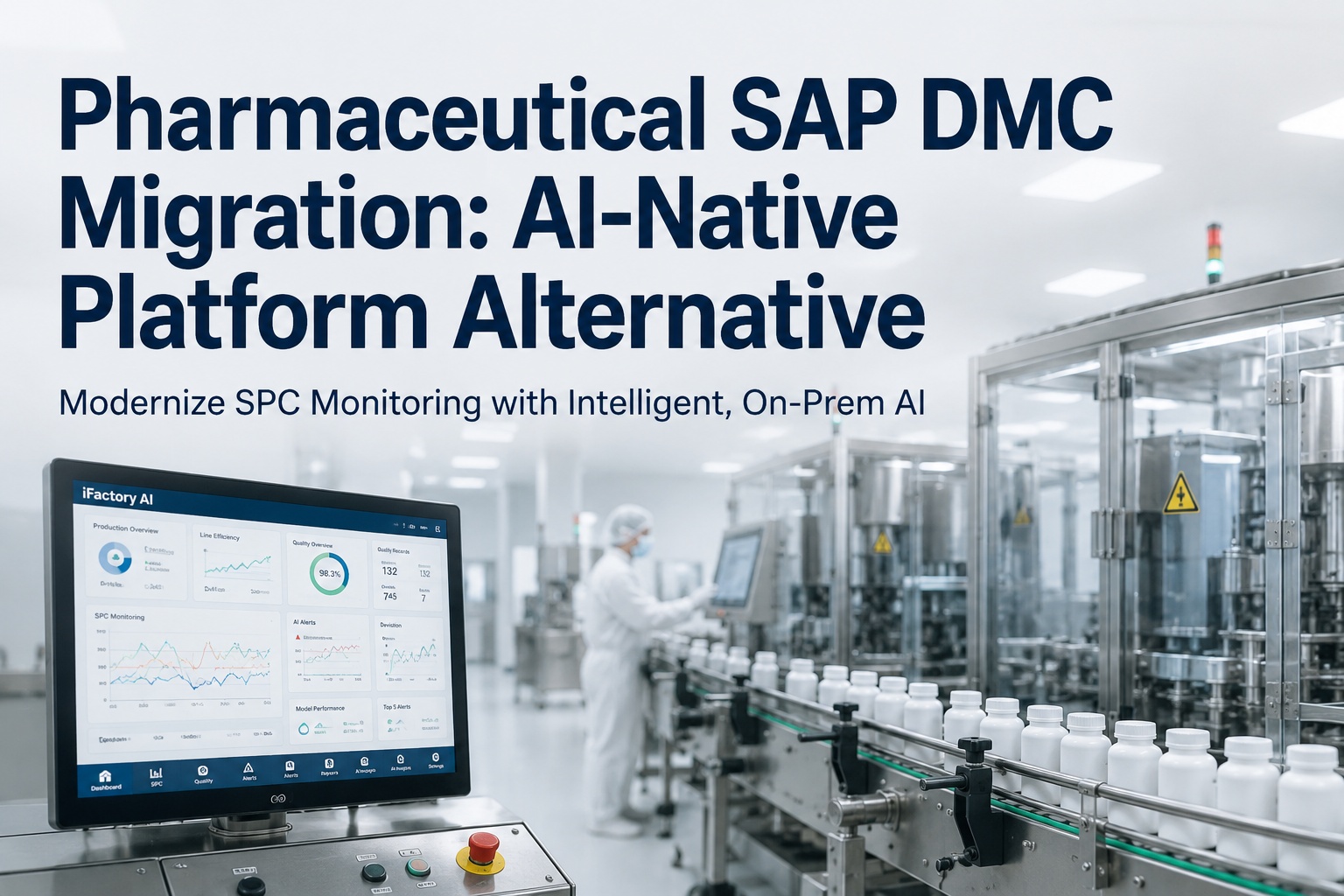
The pharmaceutical operator's daily experience with SAP MII / xMII is well-documented across every plant running the platform — the SPC monitoring works, but it works the way SPC worked in the 1990s, with rule-based charts, manual visual inspection, and after-the-fact deviation paperwork. What's changed in pharmaceutical operations is everything around the platform — the regulatory pressure (EU Annex 1, FDA inspection patterns), the customer expectation, the product complexity, the throughput demand, and most importantly the available AI capabilities. AI Vision Inspection alone is now mature enough to deliver 99.7% accuracy on pharma defect classes that traditional rule-based vision systems and manual inspection cannot reliably catch. Combined with adaptive SPC limits, autonomous root-cause analytics, and predictive excursion warning, AI-native SPC monitoring delivers operator-level outcomes that SAP MII / xMII simply cannot match. iFactory AI delivers this on a pre-configured NVIDIA appliance running on-premise inside the GAMP 5-validated boundary — replacing SAP MII, SAP xMII, and SAP DMC with an AI-native platform purpose-built for the demands of modern pharma operations, deploying in 6–12 weeks. This page is the pharma operator's guide to going Beyond SAP xMII with AI Vision Inspection at the center of the SPC monitoring stack, what changes in daily operator work, and how the migration economics actually pencil out for pharmaceutical plants.
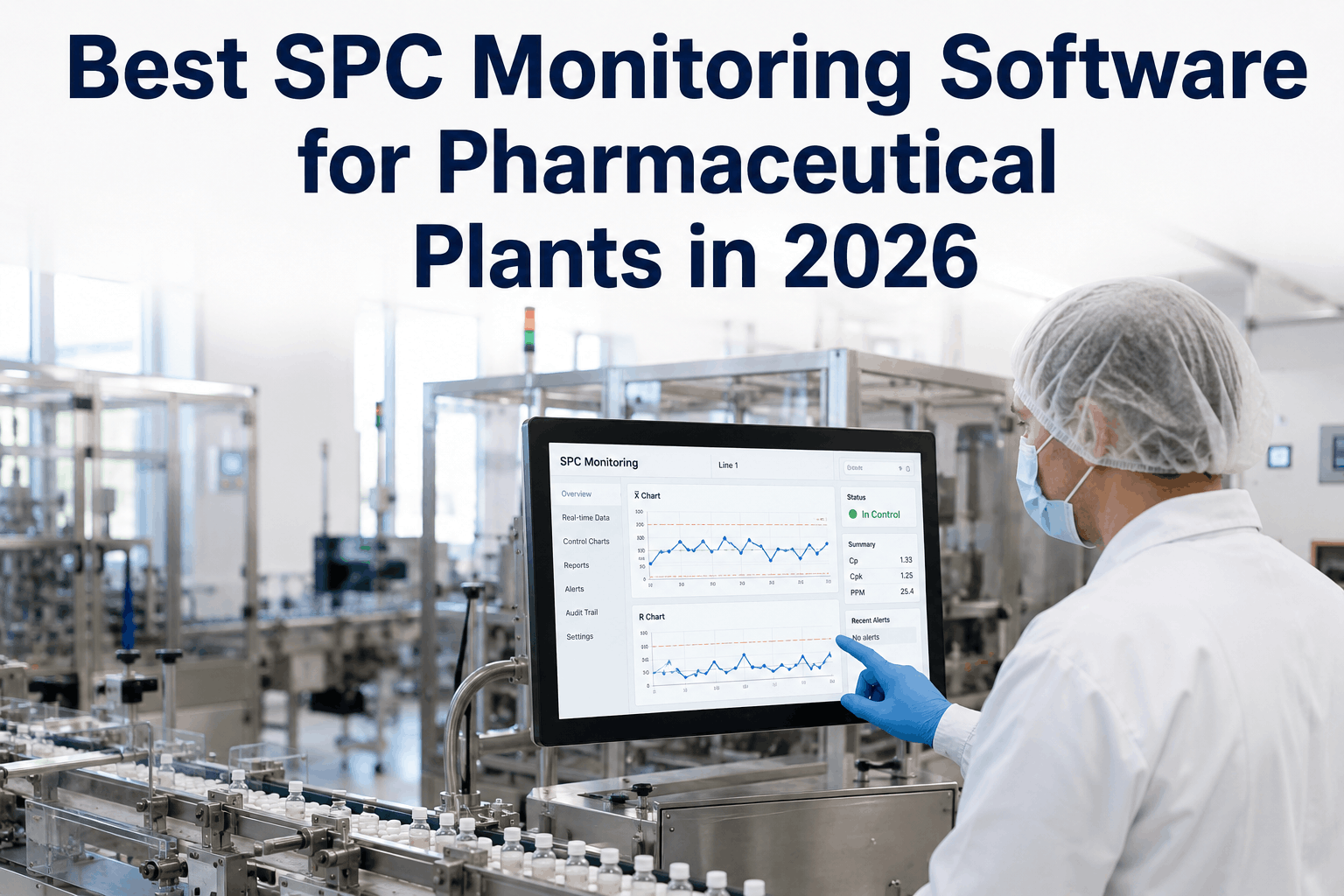
Best SPC Monitoring Software for Pharmaceutical Plants in 2026
The pharma operator's guide to going Beyond SAP xMII with AI-native SPC monitoring — AI Vision Inspection at 99.7% accuracy, adaptive control limits, autonomous root-cause analytics, predictive excursion warnings 4–24 hours ahead. Pre-configured NVIDIA appliance, GAMP 5 pre-validated, on-prem with no cloud lock-in. Ready in 12 weeks.
What "Beyond SAP xMII" Actually Means for Pharma Operators
The xMII operator workflow has barely changed in 15 years — the system records what already happened, surfaces deviations after they've occurred, and asks the operator to investigate root causes and complete paperwork. AI-native SPC monitoring with AI Vision Inspection changes the workflow fundamentally. Operators see predictions before excursions occur, get pre-computed RCA hints, spend dramatically less time on routine inspection paperwork, and direct their judgment toward decisions that benefit from human expertise. The breakdown below shows what the operator day actually looks like before and after.
The 12-hour shift sees a fundamental reallocation of operator attention. Manual inspection drops from 3.5 hours to roughly 50 minutes — AI Vision handles the routine inspection burden, and operators verify the small percentage of edge cases the AI flags as ambiguous. Deviation paperwork drops 80%+ because the Compliance Layer assembles evidence continuously. RCA investigation effort drops from 2.1 hours to operator approval of pre-computed root-cause hypotheses. The recovered time goes back to substantive production oversight, process improvement, and the operator decisions that genuinely benefit from human judgment.
Want to see the operator-day reallocation projected for your specific pharma operation? Schedule the AI Manufacturing Transformation Workshop — iFactory's pharma team will model your current SAP xMII operator workflow and project post-migration time reallocation. Sessions available this week.
AI Vision Inspection — What It Catches in Pharma
AI Vision Inspection isn't a single capability — it's a portfolio of trained models covering different pharma defect categories. The platform ships with industry-pretrained models covering common defect classes across dosage forms, then fine-tunes on your specific products during deployment. The capability showcase below shows the eight most operationally impactful AI Vision categories for pharmaceutical operations.
Particulate Detection
Visible & sub-visible particulates in injectables, parenterals
99.8%Vial Integrity
Cracks, scratches, bottom defects, glass quality
99.6%Closure Integrity
CCIT visual, cap position, crimp quality
99.7%Fill Level Verification
Volume, meniscus, headspace measurement
99.9%Tablet Visual Quality
Cracks, chips, color variation, coating defects
99.7%Label & Code Reading
Label position, code legibility, serialization
99.5%Lyophilization Quality
Cake appearance, collapse, meltback
99.4%Cleanroom Monitoring
Personnel compliance, gowning, behavior
99.3%Each category runs as an independent model with its own training data and accuracy profile. The deployment team activates only the categories relevant to your specific dosage forms and packaging formats — sterile injectable operations might use particulate, vial integrity, closure, fill level, and lyophilization; oral solid dosage operations might use tablet visual quality, label/code, and cleanroom monitoring. The platform's modular architecture means you pay for capability you actually use.
Three Migration Paths from SAP xMII for Pharmaceutical Operations
Stay on xMII
Extended maintenance, rule-based SQC paradigm continues. No AI Vision, no adaptive limits, no predictive excursion warning. Operator workflow unchanged.
SAP DMC (Cloud-Only)
Cloud migration with descriptive analytics upgrade. Validated GxP boundary disrupted. No AI Vision Inspection. Re-validation effort substantial.
iFactory AI On-Prem
AI Vision Inspection at 99.7% accuracy. Adaptive limits. Autonomous RCA. GxP boundary preserved. GAMP 5 Category 4 pre-validated.
Operator + AI Vision + SPC — How the Stack Integrates
How the three components work together in real-time
AI Vision Inspection doesn't operate in isolation — it integrates with SPC Monitoring and operator decision-making in a continuous workflow. The pipeline below shows what happens when a defect signature emerges, how AI Vision and SPC correlate evidence, and how the operator interacts with the integrated stack.
Want to see the integrated AI Vision + SPC + Operator workflow demonstrated on your pharma operation? Schedule the AI Manufacturing Transformation Workshop — sessions include live demonstration on your representative dosage forms and packaging formats. Sessions available this week.
Six Pharma Operations Where AI Vision + SPC Monitoring Pay Back Fastest
Sterile Injectable Filling
AI Vision catches particulates, vial defects, closure issues, fill level drift inline. Adaptive SPC on environmental, fill weight, lyo profile.
Tablet Manufacturing & Coating
AI Vision verifies tablet appearance, color, coating quality. Adaptive limits on weight, hardness, thickness. Multi-product self-learning.
Biologic Fill/Finish
AI Vision on lyo cake quality, fill weight, closure. Predictive SPC anticipates excursions on high-value batches. Critical for biologic operations.
API Manufacturing
Predictive SPC across multi-step API process. AI Vision on crystalline product appearance. Adaptive limits per API family.
Visual Inspection Stations
AI Vision replaces fatigue-prone manual visual inspection with 99.7% accurate automated detection. Operator becomes verifier of edge cases only.
Cleanroom Operations
AI Vision monitors gowning compliance, personnel behavior, environmental controls. Continuous Annex 1 evidence assembly without operator burden.
Want application-specific projections for your pharma operation? Send your dosage forms, line configurations, and current SAP xMII state to iFactory support and the pharma team will return a customised migration projection with 12-month roadmap — typically within 3 business days, no obligation.
GAMP 5, 21 CFR Part 11, EU Annex 1 & ALCOA+ — Built In
Pre-validated workflows for pharma SPC monitoring frameworks
- 21 CFR Part 11 — electronic records and signatures
- EU Annex 11 — computerized systems validation
- EU Annex 1 — sterile medicinal products (2022 revision)
- GAMP 5 Category 4 — pre-validated IQ/OQ/PQ artifacts
- ICH Q7/Q9/Q10 — quality risk management framework
- ALCOA+ — all 9 attributes enforced at record creation
- USP <790> — visible particulates in injections
- USP <1207> — container closure integrity testing
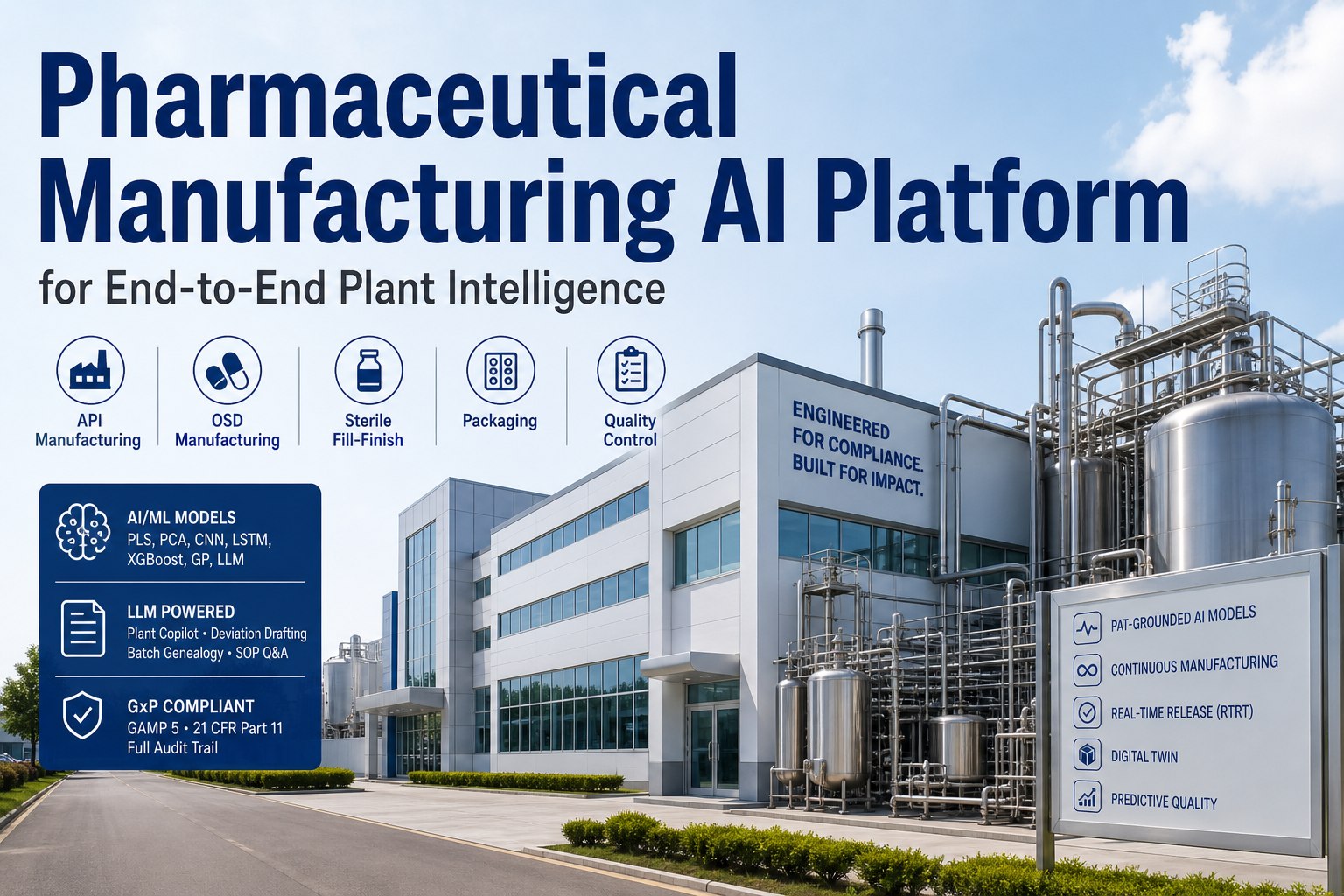
The on-prem deployment preserves the existing validated GxP boundary — no cloud migration disruption, no boundary re-validation effort. Every AI Vision classification and every SPC decision is captured as a 21 CFR Part 11 record with full audit trail. Operators retain complete authority to accept, modify, or override AI recommendations; every action is logged contemporaneously and attributable to the specific operator.
Two Real Pharma Operator Outcomes
Sterile injectable operation with chronic particulate-related batch holds and manual inspection burden
A sterile injectable manufacturer running 4 vial filling lines and 2 ampoule lines with high-value parenteral products. Manual visible particulate inspection consumed approximately 7 FTE of operator effort across shifts. Particulate-related batch holds averaged 12–18 per year with average hold cost of $1.8M. SAP xMII captured environmental monitoring data but couldn't reduce the manual inspection burden or anticipate particulate excursions.
Oral solid dosage facility with high-volume coating operation and chronic visual quality issues
A multi-product oral solid dosage facility producing 24 SKUs across coated and uncoated tablets. Visual inspection of finished tablets consumed 5 FTE per shift across two-shift operations. Coating defects (color variation, surface roughness, chips) drove deviation reports at 14–18% rate. SAP xMII handled SPC monitoring but couldn't catch visual defects that required appearance-based judgment.
Neither scenario matches your operation? Send your dosage forms, plant footprint, and current SAP xMII state to iFactory support and the pharma team will return a customised migration analysis with 12-month roadmap — typically within 3 business days, no obligation.
iFactory's Pharma Deployment — On-Premise or Cloud
Same AI-native platform on either deployment model. Same AI Vision Inspection, adaptive SPC, autonomous RCA, GAMP 5 pre-validation. For pharmaceutical operations specifically, on-prem is the strongly recommended default because of validated GxP boundary preservation requirements and the cloud lock-in risks called out by industry analysts.
iFactory On-Premise Appliance Strong default for pharma operations preserving validated GxP state
- Pre-configured NVIDIA AI server — racked, software-loaded, ready to plug in.
- Validated GxP boundary preserved — minimal CSV effort.
- <50ms edge inference — keeps up with high-speed pharma lines.
- No cloud lock-in — recipes, vision models, predictions stay in plant.
iFactory Cloud For multi-site pharma operations with central QA oversight
- Fully managed — no rack, no facility requirements.
- Same AI Vision + SPC stack — adaptive limits, autonomous RCA, GAMP 5.
- Cross-site benchmarking on visual defect rates and SPC patterns.
- Fastest deployment — first site live in 2–4 weeks.
SAP xMII was the right SPC tool for a previous era. AI Vision + AI-native SPC is what comes next.
AI Vision Inspection at 99.7% accuracy, adaptive SPC limits, autonomous root-cause analytics, predictive excursion warning — running together on a pre-configured NVIDIA appliance inside your GAMP 5-validated boundary. The operator day shifts from 81% reactive paperwork to 73% substantive production oversight. The AI Manufacturing Transformation Workshop sizes the migration concretely for your pharma operation.
Frequently Asked Questions
How is AI Vision Inspection different from traditional rule-based pharma vision systems?
Traditional rule-based vision uses defined thresholds for known defect patterns — it works well for well-defined defects but misses novel patterns and produces high false-positive rates on edge cases. AI Vision uses CNN-based deep learning trained on thousands of defect examples across pharma contexts, achieving 99.7% accuracy with under 3% false positives. It adapts across products without reprogramming, learns continuously from operator-verified outcomes, and handles defect patterns the rule-based system would miss entirely.
What about GAMP 5 validation for the AI Vision models?
iFactory ships as GAMP 5 Category 4 configurable product with IQ, OQ, PQ artifacts pre-built for both the AI Vision and SPC components. During deployment, models are fine-tuned on plant-specific data and the validation is extended accordingly. AI Vision classifications are captured as 21 CFR Part 11 records with full audit trail. Model updates follow change-control procedures with re-validation evidence. Inspections receive full transparency into how models were trained and how they evolve.
Does AI Vision replace the operator entirely?
No. AI Vision handles routine inspection work — particulate detection, defect classification, label verification — that's high-volume and fatigue-prone for human operators. Operators retain authority over edge cases, ambiguous classifications, and quality decisions. The result is operators spend less time on repetitive inspection and more time on substantive production oversight. Headcount typically stays the same; operator role and satisfaction improve significantly.
How long does the AI Vision system take to learn new SKUs?
For SKUs in product families the model already recognizes (different strength or fill volume of existing tablet/vial format), AI Vision often performs at production-quality accuracy on day one. For genuinely novel SKUs (new dosage form, packaging format), fine-tuning typically requires 2–4 weeks of accumulated data to reach 99%+ accuracy. The platform supports gradual deployment — start with the most operationally impactful SKUs, then expand.
Do I have to buy NVIDIA servers separately?
No. iFactory's on-premise appliance ships fully loaded — pre-configured NVIDIA AI server, software pre-installed, network gear, cabling, industrial cameras for line inspection, edge devices for line-side inference. You provide rack space, line power, Ethernet, and PLC integration points. The deployment team handles installation, GAMP 5 validation, and configuration. For cloud, no hardware investment at all.
Can we deploy on one production line first before plant-wide?
Yes — and it's the recommended approach. Start with the line where manual inspection burden is highest or quality risk is most acute (typically sterile injectable filling or high-volume tablet coating). Validate the AI Vision accuracy and SPC monitoring performance. Then expand line-by-line in 2–4 week waves. Full plant deployment for a typical 6–12 line pharma operation completes in 4–6 months.
What does the AI Manufacturing Transformation Workshop cover?
The half-day workshop covers — current-state SAP xMII assessment, AI Vision Inspection demonstration on your representative defect categories, adaptive SPC paradigm walkthrough, three-path migration comparison sized to your operation, GAMP 5 validation timeline, operator workflow transformation analysis, ROI projection. Outcome is a concrete migration plan. Suitable for operators, plant leadership, QA, IT, validation, and finance representatives.
Beyond SAP xMII means beyond reactive inspection paperwork. AI Vision and AI-native SPC make it operational reality.
The operator day reshapes from 81% reactive paperwork to 73% substantive production work. AI Vision catches what manual inspection misses. Adaptive SPC anticipates what static limits can't see. Autonomous RCA pre-computes investigation in minutes. All running on a pre-configured NVIDIA appliance inside your GAMP 5-validated boundary, live in 6–12 weeks. The Workshop is the fastest way to size the migration for your specific pharma operation — sessions available this week.