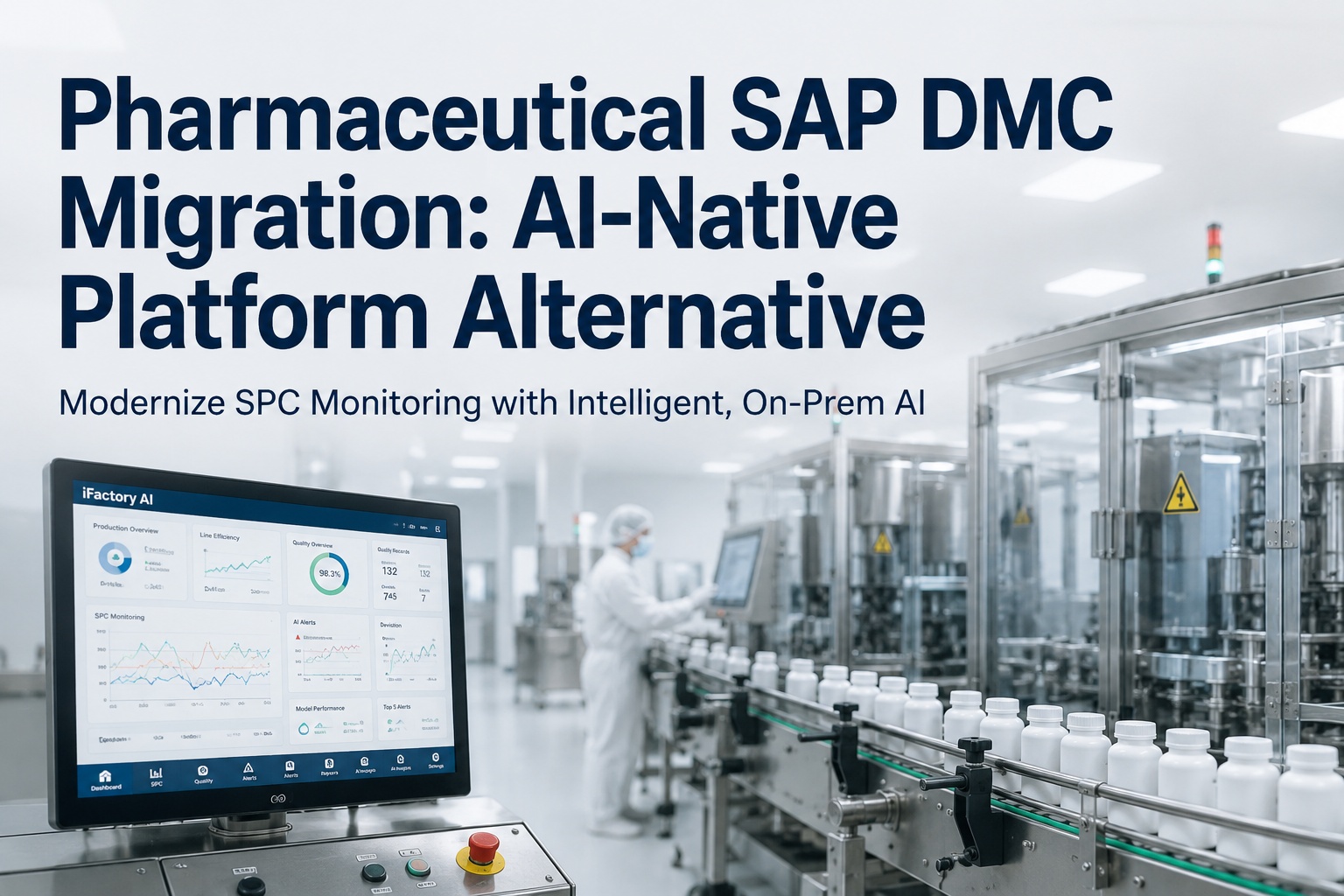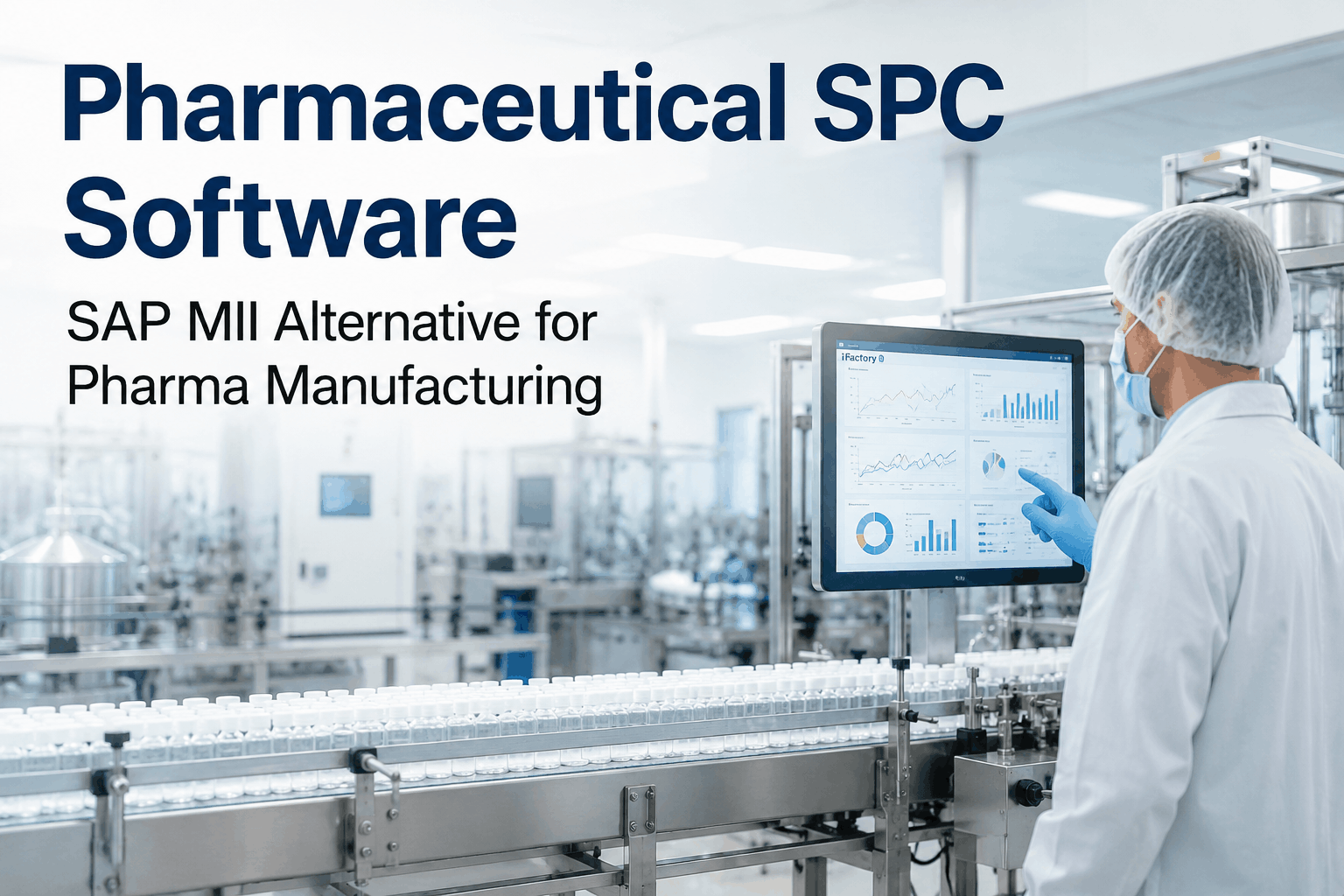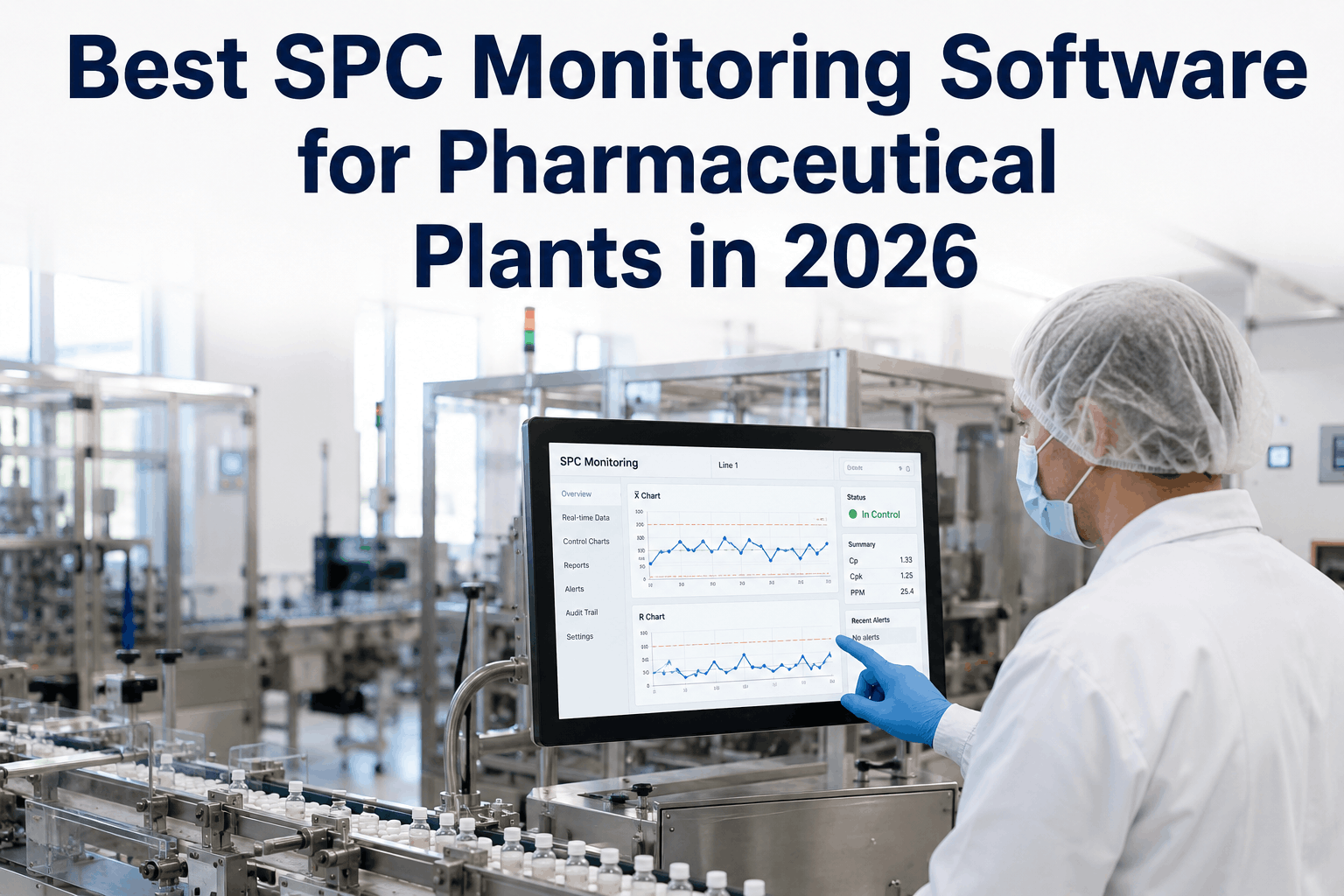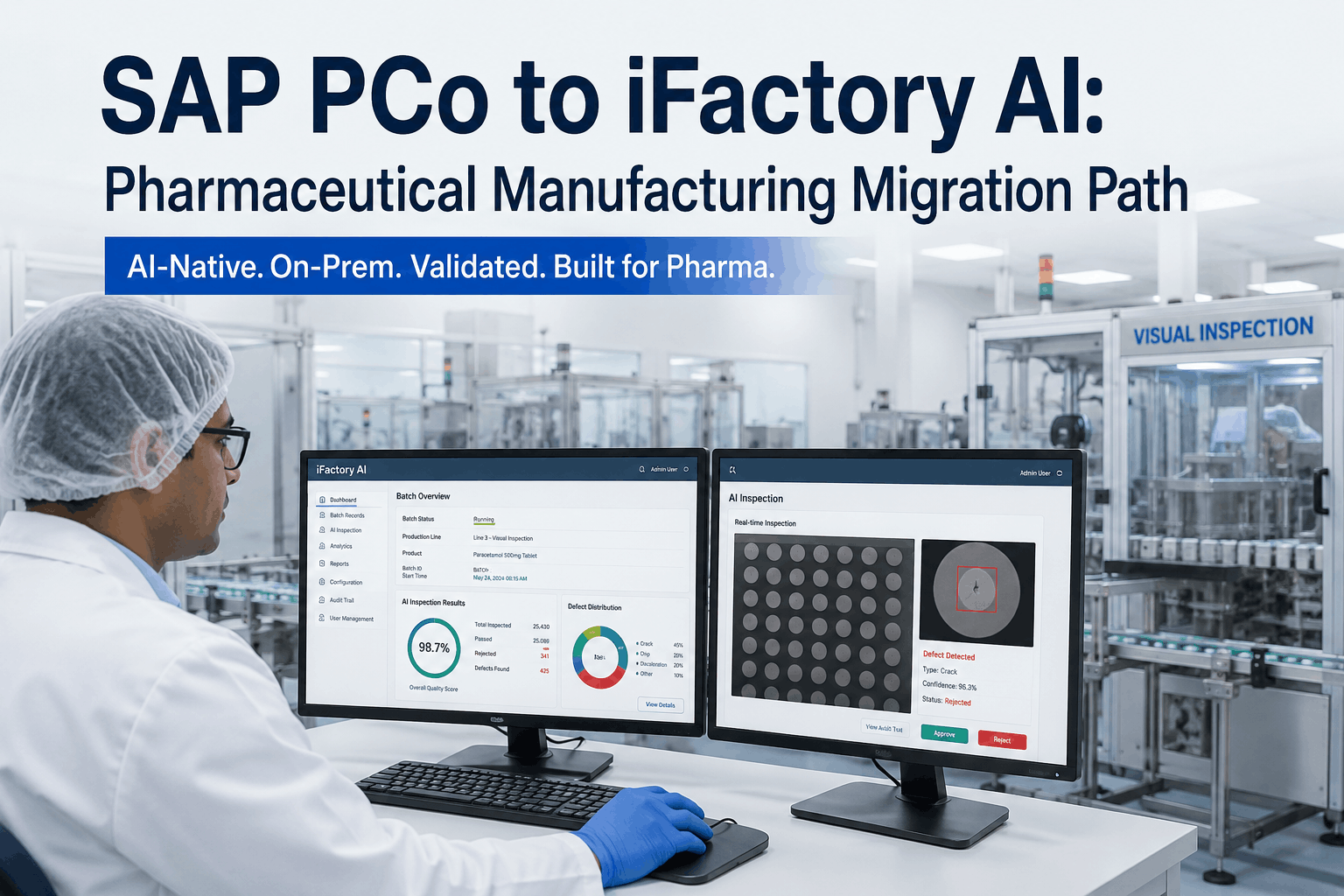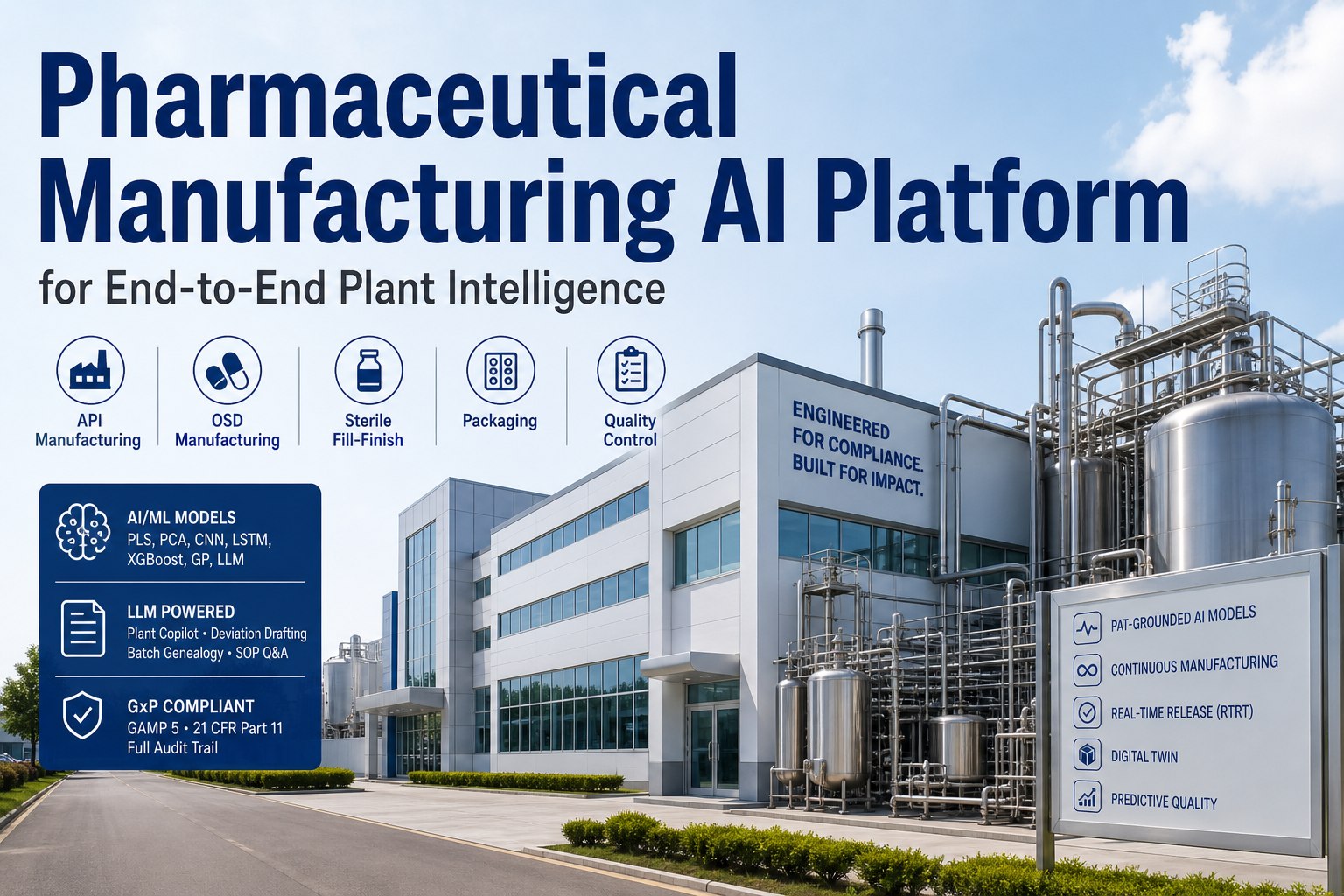
Pharmaceutical manufacturing is the most regulated, instrument-dense, and quality-paranoid factory floor on earth — and it's exactly where AI delivers the highest payoff. From API synthesis reactors to OSD tablet lines, from sterile fill-finish isolators to packaging serialization and QC labs, every step generates orders of magnitude more data than any other industry — and almost none of it gets used in real time. The iFactory AI Pharmaceutical Manufacturing Platform changes that. Built on NVIDIA GB300 with PAT-grounded models, fine-tuned plant LLMs, and a GAMP 5 / 21 CFR Part 11 compliant data spine, it spans every layer of pharma operations — without compromising audit trails, electronic signatures, or your validated state.
Pharmaceutical Manufacturing AI Platform — End-to-End Plant Intelligence
Join the iFactory pharma team for a live walk-through of a GxP-validated AI platform deployed across API, OSD, sterile fill-finish, packaging, and QC. PAT-grounded models, plant LLM operator copilot, NVIDIA GB300 inside the fence, GAMP 5 categorized, 21 CFR Part 11 audit-ready — built on 1,000+ enterprise implementations.
Why Generic Industrial AI Fails Inside a Pharma Plant
A pharma factory is not a steel mill with cleaner floors. Every batch carries genealogy back to API lots. Every electronic record needs an audit trail. Every model touching CQAs is a regulated computerized system. Drop a generic AI tool into a GMP environment and you'll spend 18 months on validation — or fail your next inspection. Schedule a 30-minute readiness review and we'll map your modalities to the right model stack and validation path.
Every model retrain, every parameter shift triggers re-validation. Without lifecycle-aware MLOps, AI dies in the qualification phase.
API yields, batch genealogy, and deviation logs can't traverse a public cloud. Sovereignty isn't a preference — it's the regulator's expectation.
OOS investigations, CAPA workflows, and batch release reviews drag for weeks because data lives in 12 disconnected systems.
NIR, Raman, and UV probes generate spectra by the gigabyte. Without chemometric AI in the loop, they sit as offline reference data.
One Platform Across Every Modality You Operate
Whether you run small-molecule API, biologics upstream/downstream, oral solid dose, sterile fill-finish, or high-speed packaging — the iFactory pharma platform deploys a unified model layer with modality-specific AI heads.
- Reactor endpoint detection via Raman + NIR
- Crystallization PSD prediction (PLS + CNN)
- Yield optimization with Gaussian Process
- Solvent recovery efficiency tracking
- Blend uniformity via NIR chemometrics
- Tablet hardness & weight CNN inspection
- Coater spray rate predictive control
- Granulation endpoint detection (LSTM)
- Vial defect detection (cracks, particles, fill)
- Isolator EM trend prediction
- Lyophilization cycle modeling
- Container closure integrity (CCI) AI
- Print & OCR verification on every unit
- Track-and-trace anomaly detection
- Carton/leaflet pairing AI
- Line-clearance vision compliance
- HPLC peak deconvolution AI
- OOS / OOT auto-classification
- Stability data trend forecasting
- Microbial colony counting CV
- HVAC differential pressure monitoring
- WFI / pure steam quality prediction
- Environmental excursion forecasting
- Compressed gas dew-point trending
PAT-Grounded AI — Seven Model Families, One Validated Pipeline
Pharma doesn't need one giant black-box model. It needs the right model for each Critical Quality Attribute — explainable, traceable, and revalidatable. Our stack covers seven families, each chosen because regulators recognize the math behind them.
GAMP 5, 21 CFR Part 11 & EU Annex 11/22 — Built In, Not Bolted On
Regulators globally are converging on AI-specific requirements. The European Commission's draft Annex 22 (expected final in 2026) sets explicit rules for AI model selection, training, validation, and continuous monitoring in GMP environments. We architected the platform to land on the right side of that line from day one. Talk to our compliance support team for a validation plan template specific to your dosage forms.
Platform classified as configured product, not custom code. Validation effort scales with risk — not the entire codebase.
Audit trails on every AI prediction, electronic signatures on model deployment, role-based access, time-stamped events.
Cloud, cybersecurity, and AI/ML provisions covered — model selection, training data lineage, continuous monitoring built in.
Attributable, Legible, Contemporaneous, Original, Accurate — Complete, Consistent, Enduring, Available. Wired into the data spine.
QbD design space, quality risk management, PQS, and analytical procedure development woven into the model lifecycle.
URS, FS, DS, IQ, OQ, PQ templates pre-mapped. Traceability matrix auto-generated. Saves 6–9 months of CSV effort.
Your Operator Copilot — Trained On Your Plant, Not the Internet
A Llama 3.1 70B foundation model fine-tuned on your SOPs, batch records, deviation history, OOS reports, change controls, and OEM manuals. It runs on a GB300 NVL72 inside your facility — nothing leaves the plant network. Operators query in plain language; QA gets deviation drafts in seconds; investigators trace batch genealogy across decades.
Likely root cause — Lactose lot LCT-4421 moisture 4.8% (spec ≤4.5%).
Last 3 batches with this lot showed +90s endpoint shift.
Recommended: extend impeller dwell by 60s, monitor power curve.
Linked CAPA — CAPA-2024-318 (recurring nozzle blockage)
Similar deviations — 4 in last 18 months on Line 3
Draft narrative ready for QA review · audit trail logged
2 batches currently in EU distribution
0 deviations linked to this API lot to date
Stability data — within trend, no excursion
PCA T² chart shows shift starting June 14
Suggested action — tighten water amount band ±2%
Design space recommendation queued for QbD review
How the Platform Sits Inside Your GxP Network
A pharma plant has tighter network rules than most banks. Our deployment respects every one of them — physical OT/IT separation, validated data flows, and AI compute isolated behind the GMP firewall. Schedule an architecture walkthrough with our deployment engineers.
What You Actually Run on Day 90
Six high-impact workloads that pay back the platform inside the first year — measured against deviation reduction, batch release time, and yield improvement.
NIR + Raman PAT data flows through PLS models to predict assay, content uniformity, and dissolution in real time. Batches release at line-end — no 3-day QC lab wait.
CNN models on Jetson Orin inspect every vial, ampoule, and tablet at line speed — particles, cracks, fill level, container closure integrity. Zero-escape deployment.
Plant LLM drafts deviations from raw events, links similar past CAPAs, and surfaces probable root causes. QA reviews and approves — investigation cycle collapses.
Vibration, motor current, and temperature signals feed XGBoost + LSTM models. Lyo condensers, autoclave gaskets, and tablet press tooling — failures predicted 7–14 days ahead.
For continuous OSD or API trains — multivariate PCA monitoring, RTD-based diversion logic, and digital twin scenario testing keep the line in design space.
Plant LLM answers regulator questions in seconds. "Show me every batch using API lot X." "Trace deviation D-2241 across products." Audit prep collapses from weeks to hours.
The Compute Stack — Sized to Your Pharma Footprint
Pharma plants don't all need a GB300 NVL72. We size the compute to your modality count, line speeds, and PAT density. A typical multi-product OSD + sterile site lands on a tiered stack — Jetson at the edge, H200 for training, GB300 for the plant LLM and twin.
- Mounted at vision stations
- CNN inference <30ms
- Air-cooled · IP65 enclosures
- One per inspection line
- Chemometric model training
- PCA / PLS / LSTM workloads
- Standard rack — 14 kW
- 2–4 nodes per facility
- Plant LLM inference (70B)
- Digital twin simulation
- Liquid-cooled · 120 kW
- One rack per multi-site enterprise
Generic AI vs Pharma-Specific AI Platforms
The difference is not raw model accuracy — it's whether the platform survives a regulatory inspection on day 1.
| Capability | Generic Industrial AI | Cloud LLM Vendor | iFactory Pharma AI |
|---|---|---|---|
| GAMP 5 categorization | Custom (Cat 5) | Cat 5 + cloud risk | Configured (Cat 4) |
| 21 CFR Part 11 audit trail | Manual layer | Often missing | Native |
| EU Annex 11 / 22 alignment | Partial | Cloud-flagged | Built in |
| Data sovereignty | Mixed | Cloud-only | On-prem GB300 |
| PAT chemometrics (PLS/PCA) | No | No | Yes |
| Plant LLM on SOPs / EBRs | No | Generic only | Fine-tuned on your data |
| Batch genealogy queries | No | Limited | Yes — full lineage |
| Validation documentation | You write it | You write it | Templates included |
| Deployment time | 9–18 months | Quick — but un-validated | 14–18 weeks GMP |
From Kickoff to Validated Production in 18 Weeks
A GxP-validated AI deployment is not a software install. It's a coordinated qualification project — but we've productized it. Reach out to support for a tailored timeline against your modalities.
What Pharma Quality & IT Leaders Ask First
Yes. The platform is GAMP 5 Category 4 (configured product), comes with URS/FS/DS/IQ/OQ/PQ templates, and ships with a model lifecycle manager that triggers revalidation automatically when CPPs, raw material specs, or model versions change.
Fine-tuned on your data — SOPs, batch records, deviations, OOS, OEM manuals, change controls. Training runs on-prem on your H200/GB300 infrastructure. Nothing transmits to public APIs. The base model is Llama 3.1 70B, open-weight, fully auditable.
Annex 22 (draft 2025, expected final 2026) requires controlled model selection, training data lineage, validation, and continuous monitoring. The platform logs all four natively — model registry, training data hashes, validation evidence, and drift monitoring with auto-alerts.
Most customers do. A typical sequence is OSD visual inspection → blend uniformity NIR → deviation copilot → sterile fill-finish CCI → continuous manufacturing twin. Each phase reuses the same validated data spine.
Built by People Who've Survived FDA Inspections
Most AI vendors learned about pharma from a deck. We learned it from running deployments inside operating GMP facilities — where every model is a controlled artifact and every prediction has a paper trail.
Get a Validation-Ready AI Plan for Your Plant
Thirty minutes with our pharma deployment engineers. Bring your modalities, current PAT footprint, and validation policy. We'll map exactly which model families fit your CQAs, what compliance evidence we generate, and how the platform lands inside your validated state — without a re-qualification storm.