Steel operators have lived with a fundamental mismatch between their process and their SPC system for decades. Legacy SPC — the rule-based statistical process control built into SAP MII / xMII and similar platforms — assumes a stable process with consistent variability, applying fixed control limits that flag deviations from a static norm. But steelmaking is the opposite of stable. Every heat is different — scrap charge composition varies, ore quality shifts, alloy additions differ by grade, tap temperatures range, caster conditions change, and the same rolling mill produces dozens of grades with fundamentally different property targets in a single shift. Applying static SPC limits across that reality produces two failure modes that every steel operator knows intimately: false alarms that fire constantly during normal grade transitions, and missed signals where genuine quality drift hides inside limits set too wide to be useful. The operator learns to mentally compensate, mentally tracking which alarms matter for which grade — institutional knowledge that walks out the door at retirement. This is the end of legacy SPC. Self-Learning Quality Systems replace static limits with models that continuously learn each grade's normal behavior, each heat's expected trajectory, and each process unit's signature — adapting automatically rather than requiring manual interpretation. iFactory AI delivers this on a pre-configured NVIDIA appliance running on-premise inside the steel plant, replacing SAP MII, SAP xMII, and SAP DMC with an AI-native platform purpose-built for the realities of steel operations, deployed in 6–12 weeks. This page is the steel operator's guide to the end of legacy SPC, what self-learning quality systems actually deliver, and how the migration works.
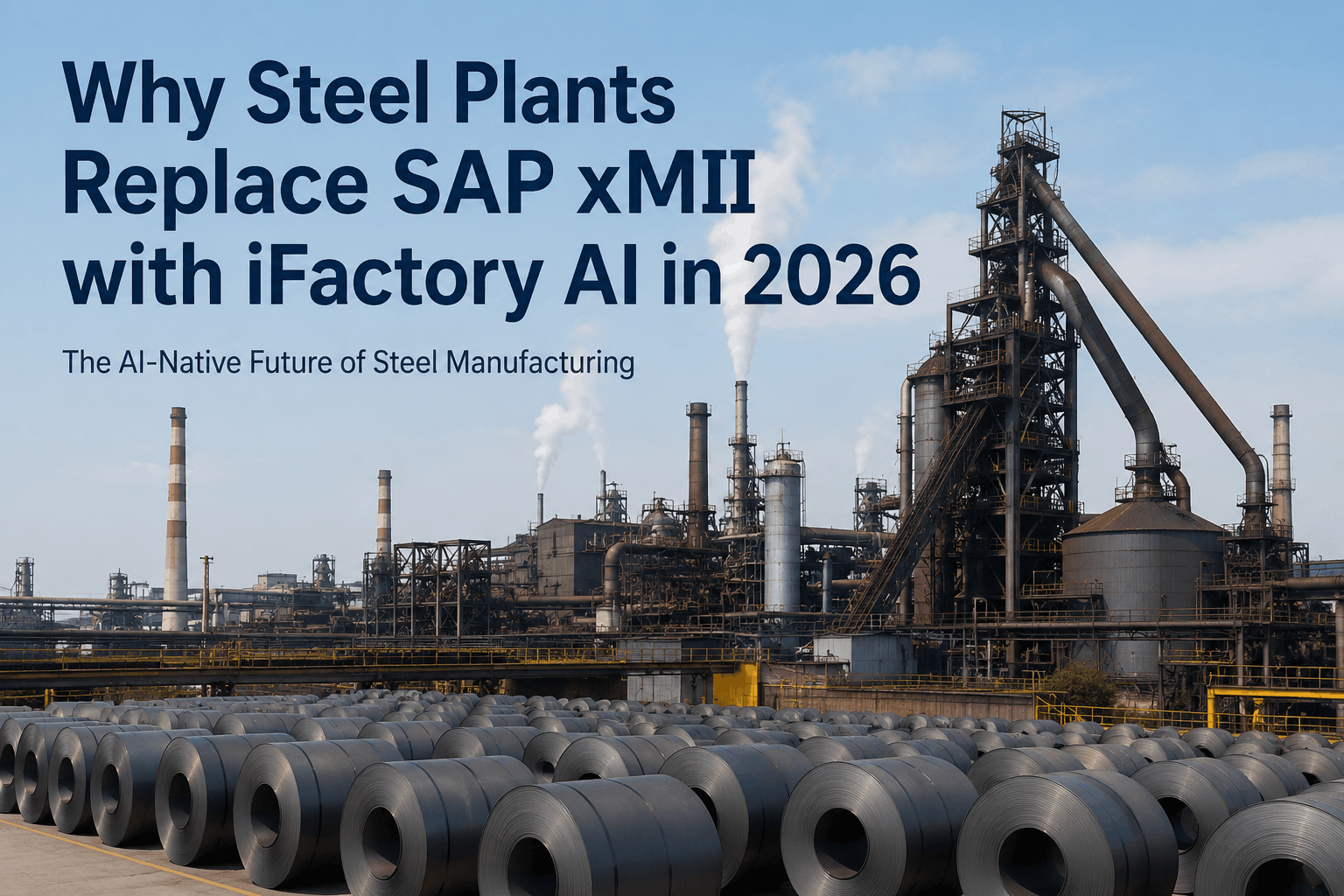
Why Steel Plants Replace SAP xMII with iFactory AI in 2026
The steel operator's guide to the end of legacy SPC — self-learning quality systems that learn each grade, each heat, each process unit and adapt automatically · false alarms cut 60–80% · genuine quality drift caught early. The AI-native alternative to SAP xMII. Pre-configured NVIDIA appliance, on-prem, predictive analytics, live in 6–12 weeks.
Why Legacy SPC Fails in Steel Manufacturing
The core problem isn't that legacy SPC is poorly implemented — it's that the underlying assumption (a stable process with consistent variability) doesn't hold in steelmaking. Steel processes are inherently multi-grade, multi-heat, and condition-variable. The visualization below shows the fundamental mismatch between what legacy SPC assumes and what steel operations actually look like, and why self-learning is the resolution.
The contrast is the whole argument for ending legacy SPC in steel. Static limits must be set wide enough to accommodate every grade, which makes them fire false alarms on legitimately different grades while simultaneously being too loose to catch real drift within any single grade. Self-learning limits maintain a correctly-tight band for each grade automatically — eliminating the false alarms that desensitize operators while surfacing the genuine quality drift that static limits hide. The operator stops mentally compensating and starts trusting the system.
Want to see self-learning SPC applied to your specific steel grades and chemistry parameters? Schedule the AI Manufacturing Transformation Workshop — iFactory's steel team will analyze your grade portfolio and demonstrate self-learning limits on your actual process data. Sessions available this week.
Self-Learning Quality Systems — How They Learn Steel Grades
Self-learning quality systems aren't pre-programmed with steel grade specifications — they learn each grade's actual behavior from the plant's own process history, then continuously refine that understanding as more heats run. This means the system gets more accurate over time and adapts to changes in feedstock, equipment condition, and process drift without manual reconfiguration. The cycle below shows how the system learns and adapts across steel grades and heats.
The self-learning property is what makes this fundamentally different from configurable SPC. A configurable system requires an engineer to define limits for each grade — a static snapshot that ages as conditions change. A self-learning system derives the limits from actual behavior and keeps them current automatically. For steel operations running dozens of grades with constantly shifting feedstock, this is the difference between a system that degrades over time and one that improves. Critically, the institutional knowledge that previously lived in senior operators' heads becomes captured in the models — persistent across retirements and shifts.
Want to understand how self-learning quality systems would capture your plant's grade knowledge? Send your grade portfolio and current SAP xMII state to iFactory support and the steel team will return a tailored self-learning assessment — typically within 3 business days, no obligation.
Self-Learning SPC Across the Steel Production Chain
Where self-learning quality systems deliver across the steelmaking chain
Steel quality is determined across the entire production chain — from ironmaking through finishing — with each stage contributing to final product quality. Self-learning quality systems operate across all stages, with the unique ability to correlate quality outcomes back to upstream causes. The chain below shows where the platform applies across integrated and mini-mill steel operations.
Want to see cross-chain quality correlation on your steel operation? Schedule the AI Manufacturing Transformation Workshop — sessions include live demonstration of how self-learning quality systems trace defects to upstream causes across your specific production chain. Sessions available this week.
Three Migration Paths from SAP xMII for Steel
Stay on xMII
Extended maintenance, legacy static-limit SPC continues. No self-learning, no predictive quality. False alarm fatigue and missed drift unchanged.
SAP DMC (Cloud-Only)
Cloud migration with descriptive analytics. No genuine self-learning quality. Latency-bound. Cloud lock-in concern for steel operations.
iFactory AI On-Prem
Self-learning quality systems. Adaptive limits per grade. Cross-chain correlation. Predictive quality. No cloud lock-in. 6–12 week delivery.
Six Steel Operations Where Self-Learning SPC Pays Back Fastest
Steelmaking Chemistry
Self-learning limits per grade on carbon, manganese, sulfur, phosphorus. Predicts chemistry trajectory. Reduces reblows and grade misses.
Continuous Casting
Multivariate SPC on mold level stability, secondary cooling, casting speed. Predicts breakouts and surface defects. Self-learning per steel grade.
Hot Strip Mill
Self-learning gauge and profile control per grade. Finishing temperature SPC. Predicts dimensional drift. Critical for prime yield.
Cold Rolling
Adaptive thickness and flatness limits per product. Surface quality monitoring. Self-learning across the wide cold-rolled grade range.
Galvanizing & Coating
Self-learning coating weight control per product spec. Predicts adhesion and coating defects. Adaptive across coating lines and grades.
Mechanical Properties
Predictive property models per grade. Correlates properties to upstream chemistry and processing. Reduces property-related rejections.
Want application-specific projections for your steel operation? Send your steel segment, process units, and quality baselines to iFactory support and the steel team will return a customised projection with 12-month roadmap — typically within 3 business days, no obligation.
ISO, ASTM, EN & Automotive Steel Standards — Built In
Pre-built workflows for steel manufacturing frameworks
- ISO 9001 — quality management system
- IATF 16949 — automotive steel supply
- ASTM steel standards — grade specifications
- EN 10025 / 10204 — European steel standards
- API 5L / 5CT — line pipe and casing grades
- Mill test certificates — automated generation
- Heat traceability — full chain genealogy
- Prime yield & downgrade reporting — automated
The platform captures grade specifications, mechanical property results, chemistry analyses, and full heat genealogy continuously. Mill test certificates (MTCs) are generated automatically with complete traceability. For steel producers serving automotive, energy, and construction customers, the compliance evidence and heat traceability chain are assembled in real-time rather than reconstructed for audits.
Two Real Steel Operator Outcomes
Integrated steel producer with hot strip mill quality and prime yield challenges
An integrated steel plant operating blast furnace, BOF, continuous casting, and a hot strip mill producing 60+ grades. Legacy SPC on SAP xMII generated constant false alarms during grade transitions, and operators had learned to largely ignore them — meaning genuine quality drift sometimes went unaddressed until downgrade. Prime yield sat below benchmark, and the knowledge of which alarms mattered lived in a handful of senior operators nearing retirement.
EAF mini-mill producing specialty and high-strength steel grades with tight property windows
An EAF mini-mill producing specialty and advanced high-strength steel (AHSS) grades for automotive customers with tight mechanical property windows. Scrap charge variability made chemistry and property control challenging, and property-related rejections ran high. SAP MII captured the data but static limits couldn't adapt to the grade-to-grade and heat-to-heat variability inherent in specialty steelmaking.
Neither scenario matches your operation? Send your steel segment, process configuration, and current SAP xMII state to iFactory support and the steel team will return a customised migration analysis with 12-month roadmap — typically within 3 business days, no obligation.
iFactory's Steel Deployment — On-Premise or Cloud
Same AI-native platform on either deployment model. Same self-learning quality systems, adaptive limits, predictive quality, cross-chain correlation. For steel operations, on-prem is recommended for latency at process speed, data sovereignty, and operational independence during WAN outages — with cloud available for multi-plant steel groups.
iFactory On-Premise Appliance Recommended for steel plants · no cloud lock-in
- Pre-configured NVIDIA AI server — racked, software-loaded, ready to plug in.
- <50ms edge inference — keeps up with caster and rolling mill speed.
- Self-learning runs locally — model refinement continuous.
- Works during WAN outages — quality systems continue operational.
iFactory Cloud For multi-plant steel groups with central governance
- Fully managed — no rack, no facility requirements.
- Same AI capabilities — self-learning quality, adaptive limits.
- Cross-plant benchmarking on yield and quality patterns.
- Fastest deployment — first plant live in 2–4 weeks.
Legacy SPC was built for stable processes. Steel was never stable. Self-learning is the resolution.
Self-learning quality systems that learn each grade, each heat, each process unit — adapting automatically rather than requiring manual interpretation. False alarms cut 60–80%, prime yield up 3–6%, genuine quality drift caught early. Running on a pre-configured NVIDIA appliance inside your steel plant, no cloud lock-in, live in 6–12 weeks. The AI Manufacturing Transformation Workshop sizes the migration concretely for your operation.
FAQ: Steel Self-Learning SPC & SAP xMII Migration
How is self-learning SPC different from configurable SPC limits?
Configurable SPC requires an engineer to manually define control limits for each grade — a static snapshot that ages as feedstock, equipment, and conditions change. Self-learning SPC derives the limits from your plant's actual process behavior and keeps them current automatically as more heats run. For steel operations with dozens of grades and constantly shifting scrap or ore quality, this is the difference between a system that degrades over time and one that improves. Book a demo to see self-learning limits on your grades.
How does the system handle our wide range of steel grades?
The self-learning models maintain a distinct learned signature for each grade — its normal chemistry ranges, property targets, and process behavior. When a grade change occurs, the system detects it automatically and applies the correct adaptive limits for that grade. There's no manual reconfiguration per grade change. The more heats of each grade that run, the more accurate the models become. Plants running 60+ grades see this as the single biggest improvement over legacy SPC.
Can it correlate final product defects back to upstream causes?
Yes — cross-chain correlation is one of the strongest capabilities. Because the self-learning quality layer spans the entire production chain (ironmaking through finishing), it can trace a surface defect found at finishing back to its origin in the caster or steelmaking. This collapses root-cause investigation from days of manual cross-referencing to minutes, and enables upstream correction that prevents recurrence.
How does it integrate with our Level 2 systems and historians?
iFactory integrates natively with steel plant systems — Level 1/Level 2 automation, process historians (OSIsoft PI and similar), laboratory information systems (LIMS) for chemistry and property data, and SAP MII / xMII / ERP for production context. The self-learning models draw from these existing systems rather than replacing them. The deployment team configures specific integrations during the 6–12 week installation.
Do I have to buy NVIDIA servers separately?
No. iFactory's on-premise appliance ships fully loaded — pre-configured NVIDIA AI server, software pre-installed, network gear, cabling, edge devices for line-side inference, and integration adapters for steel plant systems. You provide rack space, line power, Ethernet, and Level 2/historian/LIMS integration points. The deployment team handles all installation and configuration. For cloud, no hardware investment at all.
Can we deploy on one process unit first before plant-wide?
Yes — and it's the recommended approach. Start with the unit where quality cost or false alarm fatigue is highest (typically continuous casting or hot strip mill). Validate the self-learning performance on that unit. Then expand unit-by-unit, with cross-chain correlation unifying as each stage comes online. Full plant deployment for a typical integrated steel operation completes in 4–6 months with self-learning quality active across the chain progressively.
What does the AI Manufacturing Transformation Workshop cover?
The half-day workshop covers — current-state SAP xMII assessment with focus on legacy SPC limitations, self-learning quality systems demonstration on your representative steel grades, cross-chain correlation walkthrough, three-path migration comparison with cost/timeline projections, steel standards alignment, deployment roadmap, and ROI projection on prime yield and quality cost. Outcome is a concrete migration plan. Suitable for operators, plant leadership, quality/metallurgy, IT, and finance representatives.
End the false alarms. Catch the real drift. Capture the grade knowledge before it retires.
Self-learning quality systems that learn each steel grade and adapt automatically — running on a pre-configured NVIDIA appliance inside your plant. False alarms cut 60–80%, prime yield up 3–6%, cross-chain defect correlation in minutes. The AI-native alternative to SAP xMII. On-prem, predictive analytics, live in 6–12 weeks. The Workshop is the fastest way to size the migration for your specific operation — sessions available this week.