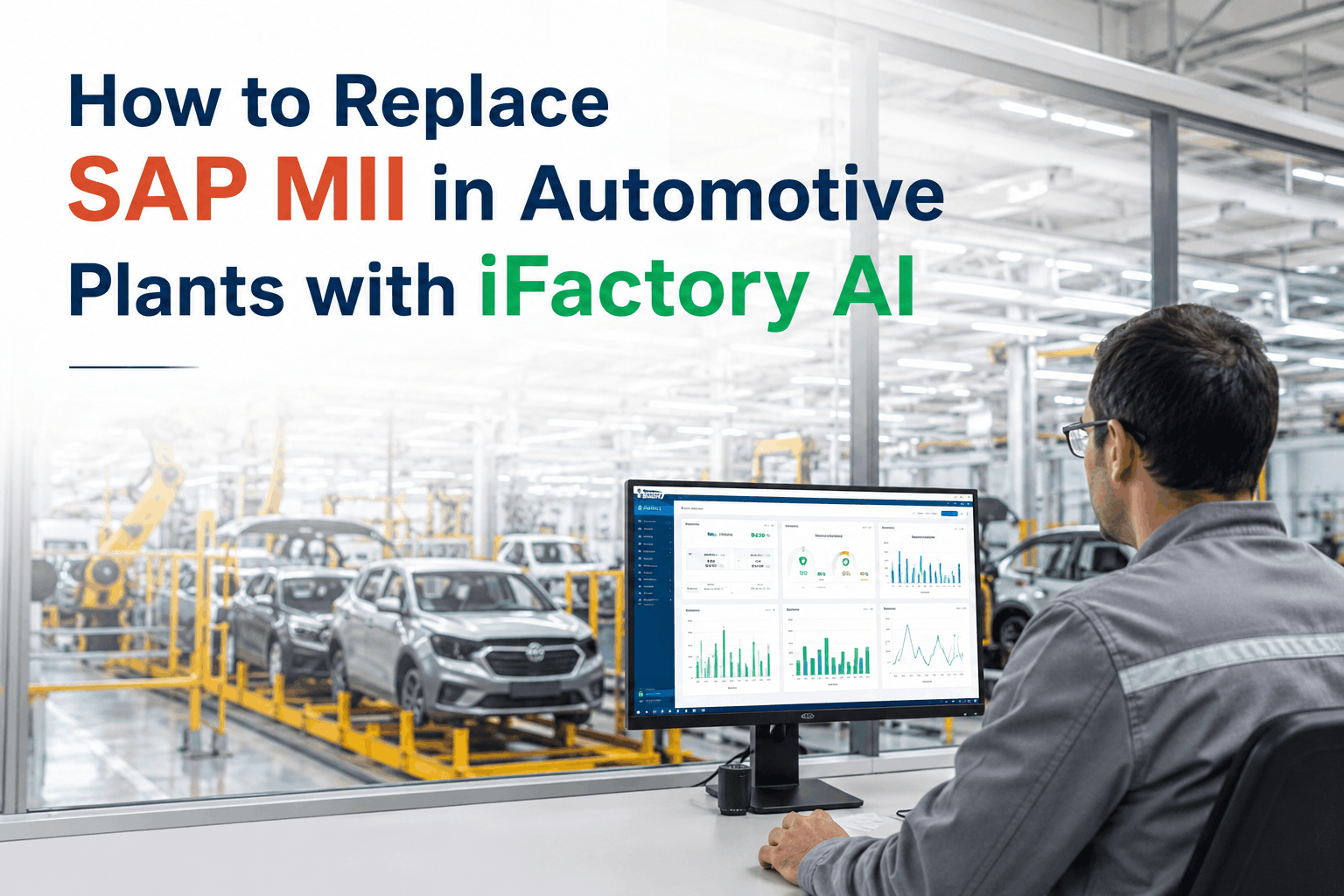
For the automotive plant IT, OT, and SAP teams who actually maintain the technical stack, modernization off SAP MII / xMII rarely happens as a single decision — it happens workload by workload. The SAP Plant Connectivity (PCo) middleware that connects PLCs and OPC UA sources to the SAP layer, the xMII applications running SPC monitoring and dashboards, the custom transactions handling quality data collection, the PPAP automation built up over years, the OEE reporting consolidated across stamping, body, paint, and assembly — each of these is a distinct workload with its own integration, its own users, and its own migration considerations. A successful modernization treats them that way: as a structured workload inventory to be migrated in sequence, not as a monolithic rip-and-replace that risks production. iFactory AI is the AI-native replacement platform purpose-built for this technical migration in automotive — pre-configured NVIDIA appliance, pre-loaded automotive AI models, integration adapters for SAP MII/xMII/ERP and Plant Connectivity sources, and a workload-by-workload migration pattern that keeps existing operations stable while moving each xMII workload to its modernized AI-native equivalent. This page is the automotive SAP team's technical playbook for modernizing SAP PCo and xMII workloads — the inventory, the mapping, the migration phases, and how the cutover actually works.
How to Replace SAP MII in Automotive Plants with iFactory AI
The automotive SAP team's technical playbook for modernizing SAP PCo and xMII workloads — the workload inventory, the AI-native replacement mapping, the 3-phase migration pattern, and how IATF 16949 and PPAP compliance carry through. AI-native platform beats SAP MII on speed, cost, and accuracy. Live in 6–12 weeks.
The SAP PCo + xMII Workload Inventory in an Automotive Plant
Before any migration, the workload inventory has to be clear. In a typical automotive plant, the SAP Plant Connectivity layer carries data from the plant floor — PLCs, OPC UA sources, sensors, station controllers — up to a portfolio of xMII applications that have grown organically over years. The inventory below is a representative mapping of the workloads that live on SAP PCo + xMII in an automotive operation.
Most automotive plants run 8–12 distinct workloads on this stack. The number matters because it directly drives the migration scope — each workload has a current owner, a current user base, and a current set of dependencies that have to be carried through the migration. The first step in any modernization is producing this inventory for your specific plant. The second step is mapping each workload to its AI-native replacement.
Want this workload inventory built for your specific automotive plant? Schedule the AI Manufacturing Transformation Workshop — iFactory's automotive technical team will catalog your SAP PCo and xMII workload portfolio and map each to its modernized replacement. Sessions available this week.
Workload-by-Workload Mapping to iFactory AI
The migration becomes tractable when each SAP workload maps cleanly to a modernized iFactory equivalent. The mapping below covers the typical automotive xMII portfolio and shows what each workload becomes after modernization — not just a functional replacement, but an AI-native upgrade that delivers capability the SAP layer never had.
| SAP xMII Workload | iFactory AI Replacement | AI-Native Upgrade |
|---|---|---|
| SPC Monitoring (static limits) | Adaptive SPC with self-learning limits | False alarms cut 60–80%, genuine drift caught earlier |
| Quality Data Collection / PPAP | AI-native quality platform with auto PPAP | PPAP package assembly hours, not weeks |
| OEE Reporting | Predictive OEE with cause attribution | Forecast OEE risk, not just report it |
| Production Tracking / VIN trace | Full lot genealogy on iFactory platform | Faster recall scoping, cross-line correlation |
| Plant Dashboards | AI-native dashboards + GenAI copilots | Natural-language plant queries answered live |
| Maintenance Notifications | Predictive maintenance with condition models | Predict failures hours-to-days ahead |
| Andon & Line Status | Real-time line intelligence with edge inference | Sub-50ms response, predictive downtime alerts |
| Custom xMII Transactions | Configured iFactory workflows + APIs | Faster to change, lower maintenance burden |
| Plant Connectivity (PCo) | iFactory integration layer (OPC UA, MQTT, PLC) | Native AI consumption of plant data |
Scroll horizontally on mobile to view the full mapping.
The critical point is that nothing in the existing SAP portfolio is left without a modernized equivalent — every workload has a clear destination. This is what makes a workload-by-workload migration safe to plan and execute.
The 3-Phase Migration Pattern
The pattern that lets you migrate without disrupting automotive production
The migration runs in three phases per workload. Production continues uninterrupted because the old SAP workload stays operational until its iFactory replacement has been validated in parallel — then the cutover happens cleanly with the old workload as a fallback for a defined stabilization period.
This pattern repeats per workload — SPC first, then dashboards, then OEE, then quality data, in whatever sequence matches the plant's priorities. The total program duration depends on the workload count, but the per-workload pattern stays constant: stand up, run in parallel, validate, cut over. The SAP team retains full control of the sequencing and the rollback path at every step.
Want the migration phased for your specific xMII portfolio? Send your SAP workload inventory and integration list to iFactory support and the technical team will return a phased migration plan with sequencing recommendations — typically within 3 business days, no obligation.
Six Automotive xMII Workloads Where Migration Pays Back Fastest
Stamping & Press Lines
High-frequency dimensional measurement with adaptive SPC. Predict die wear and dimensional drift before scrap. Replaces static-limit xMII SPC.
Body Shop & Weld
Multivariate SPC on weld current, force, time, resistance. AI vision augments weld inspection. Replaces single-variable xMII charts.
Paint Shop
AI vision for paint defect detection. SPC on booth conditions and process variables. Replaces manual paint inspection workflows.
Powertrain & Engine
Process capability monitoring across machining lines. Predictive SPC catches drift early. Replaces periodic Cpk reporting.
EV Battery Manufacturing
Cell-level quality monitoring, formation cycle SPC, pack assembly defect detection. Workloads SAP xMII never had robust patterns for.
PPAP Automation
PPAP package assembly from live process and measurement data. Replaces manual document compilation. Compliance evidence ready.
Three Paths for Modernizing SAP PCo + xMII Workloads
Stay on PCo / xMII
Extended SAP maintenance, no AI capability. Workloads continue but technical debt accumulates. Eventual forced migration.
SAP DMC (Cloud)
Cloud-only modernization of xMII workloads. WAN-bound for line-speed decisions. Cloud lock-in. OpEx-growing AI compute.
iFactory AI On-Prem
Workload-by-workload migration to AI-native equivalents. NVIDIA appliance, pre-loaded automotive models. No cloud lock-in. 6–12 weeks.
IATF 16949, PPAP & Automotive Quality — Preserved Through the Migration
Compliance workflows pre-built for automotive frameworks
- IATF 16949 — automotive QMS standard
- PPAP — Production Part Approval Process
- APQP — Advanced Product Quality Planning
- MSA — Measurement Systems Analysis
- Process Capability (Cpk / Ppk) — automated
- Control Plans — live, dynamic
- FMEA — design and process
- OEM customer-specific requirements (CSRs)
Each compliance framework is configured into the relevant iFactory workflow during the migration. PPAP packages are assembled from live process data. Control plans become living documents updated as process knowledge evolves. The audit posture improves through the migration rather than being disrupted by it — automotive auditors see better evidence on iFactory than the SAP xMII state delivered.
Two Real Automotive SAP Workload Modernization Outcomes
Tier-1 automotive supplier with 5 plants and a heavy SAP PCo + xMII footprint
A tier-1 automotive supplier producing powertrain and chassis components for major OEMs ran a portfolio of 10–12 xMII workloads per plant across 5 plants, with significant custom transactions accumulated over a decade. The SAP team needed a modernization path that preserved IATF 16949 evidence, kept production stable during migration, and delivered AI capability the SAP stack could not.
Automotive OEM adding EV battery production to a legacy SAP xMII environment
An automotive OEM was adding a new EV battery production line to a plant whose SAP MII/xMII landscape was built for ICE powertrain workloads. The existing SAP patterns did not extend cleanly to cell-level quality monitoring, formation cycle SPC, and pack assembly inspection. Rather than custom-extending xMII, the SAP team migrated the new EV workloads directly onto iFactory and bridged with the existing SAP xMII estate during the transition.
Neither scenario matches your operation? Send your SAP PCo / xMII workload inventory and plant configuration to iFactory support and the automotive technical team will return a customised migration analysis — typically within 3 business days, no obligation.
iFactory's Automotive Deployment — On-Premise or Cloud
Same AI-native platform on either deployment model. On-prem is recommended for automotive given line-speed latency for stamping, body, paint, and assembly SPC, plus data sovereignty for design/process IP. Cloud is available for multi-plant supplier groups consolidating workload modernization centrally.
iFactory On-Premise Appliance Recommended for automotive plants · sub-50ms inference
- Pre-configured NVIDIA AI server — pre-loaded automotive models, racked, ready.
- <50ms edge inference — line-speed SPC and AI vision decisions.
- Process & design IP stays in plant — sovereignty preserved.
- Workload-by-workload migration — preserves SAP team control.
iFactory Cloud For multi-plant automotive supplier groups
- Fully managed — no rack, no facility requirements.
- Same AI capability — all automotive models available.
- Portfolio-level governance across plants and brands.
- Fastest deployment — first plant live in 2–4 weeks.
Modernize the workloads, not just the platform. Workload-by-workload, with full SAP team control.
iFactory's automotive technical team plans the migration around your existing SAP PCo + xMII portfolio — one workload at a time, with parallel-run validation and a clean cutover per workload. AI-native upgrade delivered on a pre-configured NVIDIA appliance, IATF 16949 evidence preserved, live in 6–12 weeks. The Workshop sizes the migration for your specific plant.
FAQ: Modernizing SAP PCo & xMII Workloads in Automotive
How does iFactory replace SAP Plant Connectivity (PCo) specifically?
iFactory's integration layer replaces SAP PCo as the data on-ramp from the plant floor — speaking OPC UA, MQTT, and PLC fieldbus protocols (PROFINET, EtherNet/IP, Modbus) natively, with the same tag-mapping and destination-routing capabilities you have today, plus direct AI consumption of the data that PCo could only forward. Existing PCo configurations are imported during the deployment, so tag mappings carry across. Book a demo to see PCo workload replacement on your specific stack.
Do we have to migrate all xMII workloads at once, or can we go piecewise?
Piecewise, by design. The workload-by-workload pattern is the entire point of the approach — each workload runs through stand-up, parallel-run, and cutover independently, with the SAP team controlling sequencing. Most automotive plants migrate the highest-value workloads first (typically SPC and PPAP) and continue at their own pace. The existing SAP xMII estate keeps running for un-migrated workloads as long as needed.
What happens to our custom xMII transactions and BLS scripts?
Custom xMII transactions are inventoried during the migration analysis, then mapped to configured iFactory workflows or API integrations. The configurable approach typically replaces custom xMII transactions with workflows that are faster to change and lower-maintenance than BLS scripts. Where a custom transaction encodes business logic that needs to be preserved exactly, that logic carries across to the iFactory configuration during the parallel-run phase, with parity validation before cutover.
How is IATF 16949 audit evidence preserved through the migration?
Audit evidence improves rather than being disrupted. iFactory captures continuous evidence for control plans, process capability (Cpk/Ppk), measurement systems analysis, PPAP packages, and change control — typically with better completeness than the manual or semi-automated xMII patterns delivered. During the parallel-run phase, both systems produce evidence; after cutover, iFactory becomes the primary, with the SAP record preserved for historical compliance per your retention policy.
Can we keep using SAP S/4 / ERP while moving xMII workloads to iFactory?
Yes — this is the typical pattern. iFactory replaces the xMII application layer and the PCo middleware, but integrates natively with SAP S/4 / ERP for production orders, BOM, materials, and financial reporting. The xMII modernization happens without forcing an S/4 change, and the upward data flow to ERP is preserved through the iFactory integration adapters.
Do I have to buy NVIDIA servers separately?
No. iFactory's on-premise appliance ships fully loaded — pre-configured NVIDIA AI server, automotive AI models pre-installed, network gear, cabling, edge devices for line-side inference, and integration adapters for SAP MII/xMII/ERP, PLCs, OPC UA, MQTT, and major plant systems. You provide rack space, line power, Ethernet, and integration points. The deployment team handles installation and configuration across the 6–12 week window.
What does the AI Manufacturing Transformation Workshop cover for automotive?
The half-day workshop covers — current-state SAP PCo + xMII workload inventory mapping, workload-by-workload replacement plan with sequencing recommendations, 3-phase migration walkthrough, IATF 16949 and PPAP evidence preservation, automotive AI model demonstration (stamping, body, paint, powertrain, EV battery), three-path cost/timeline comparison, and ROI projection. Outcome is a concrete migration plan suitable for SAP technical leads, plant operations, quality, IT/OT, and finance.
Workload-by-workload. Parallel-run. Clean cutover. SAP team in control throughout.
The technical migration playbook for SAP PCo + xMII modernization in automotive — every workload mapped, sequenced, validated, and cut over with full rollback path. AI-native capability the SAP stack never delivered, IATF 16949 and PPAP evidence preserved, on-prem NVIDIA appliance, live in 6–12 weeks. The Workshop is the fastest way to size the migration — sessions available this week.