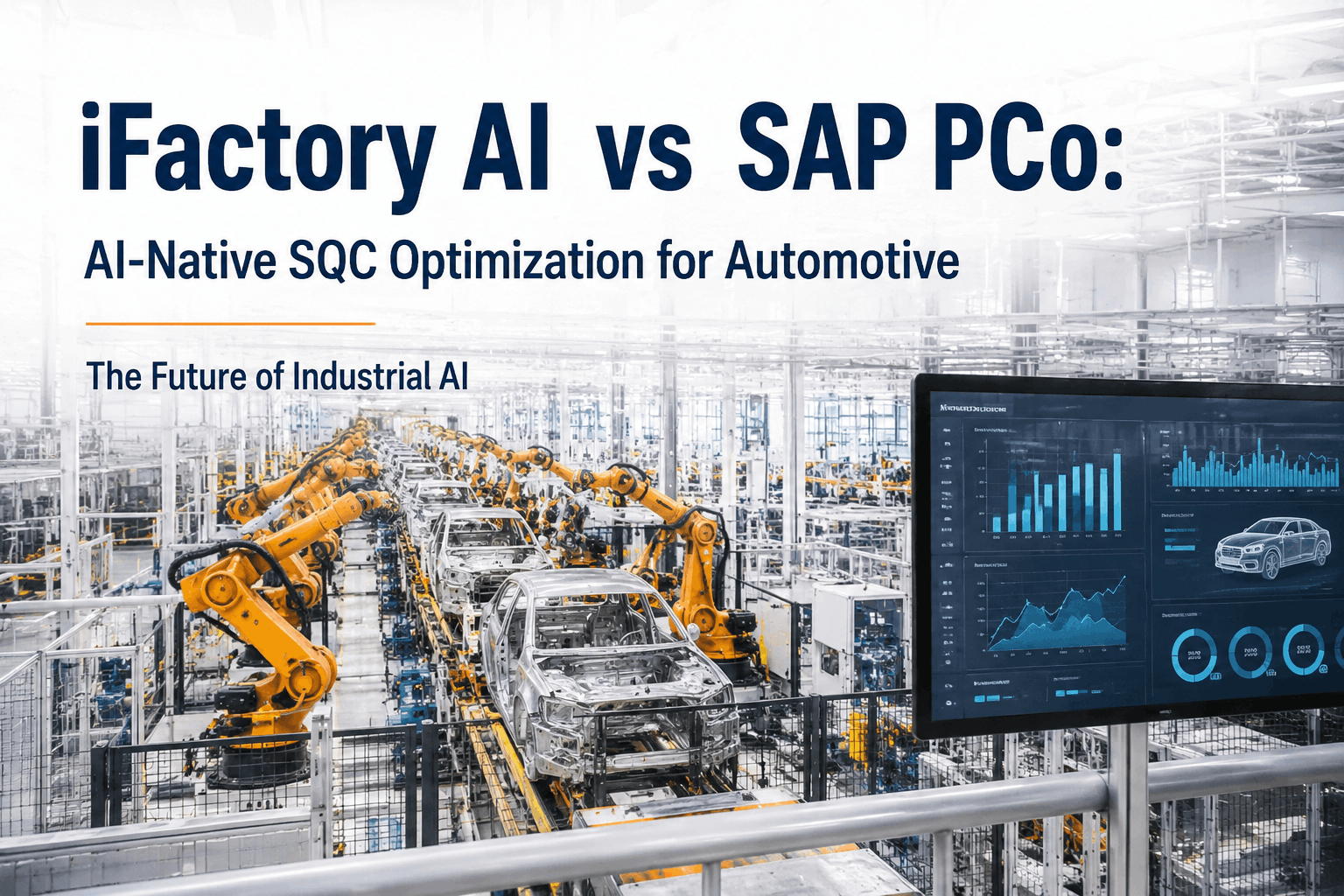
Automotive operators using SAP PCo and SAP MII / xMII for SQC live with a structural problem the platform's architecture cannot solve — static control limits applied across products that have fundamentally different process variability profiles. A multi-product line running brake calipers in the morning and steering knuckles in the afternoon gets the same control envelope for both, despite the products having different material chemistries, different geometries, different optimal process windows. Operators learn to interpret which alarms matter and which don't, mentally compensating for the platform's inability to adapt. The cost shows up in three places — Cpk numbers that meet IATF 16949 minimums but miss what's operationally achievable, false alarms that desensitize operators to real drift signatures, and OEM customer scorecards that consistently rank the plant below the achievable quality level. The AI-Native Manufacturing Revolution that's reshaping automotive operations changes this fundamentally. Adaptive SPC Limits tune automatically across model variant, shift, supplier lot, ambient conditions, and equipment state — giving operators the right control envelope at every moment rather than averaged compromise limits. Cpk improvements of 0.4–0.8 are typical across product portfolios within 12 months, false alarms drop 60–80%, and customer scorecards move from yellow to green. iFactory AI delivers this on a pre-configured NVIDIA appliance running on-premise inside the plant — replacing SAP MII, xMII, PCo, and DMC with an AI-native platform purpose-built for automotive operations, live in 6–12 weeks. This page is the automotive operator's guide to SQC Optimization through Adaptive SPC Limits, the AI-Native Manufacturing Revolution that makes it operationally real, and the migration path from SAP PCo / DMC to on-prem AI.
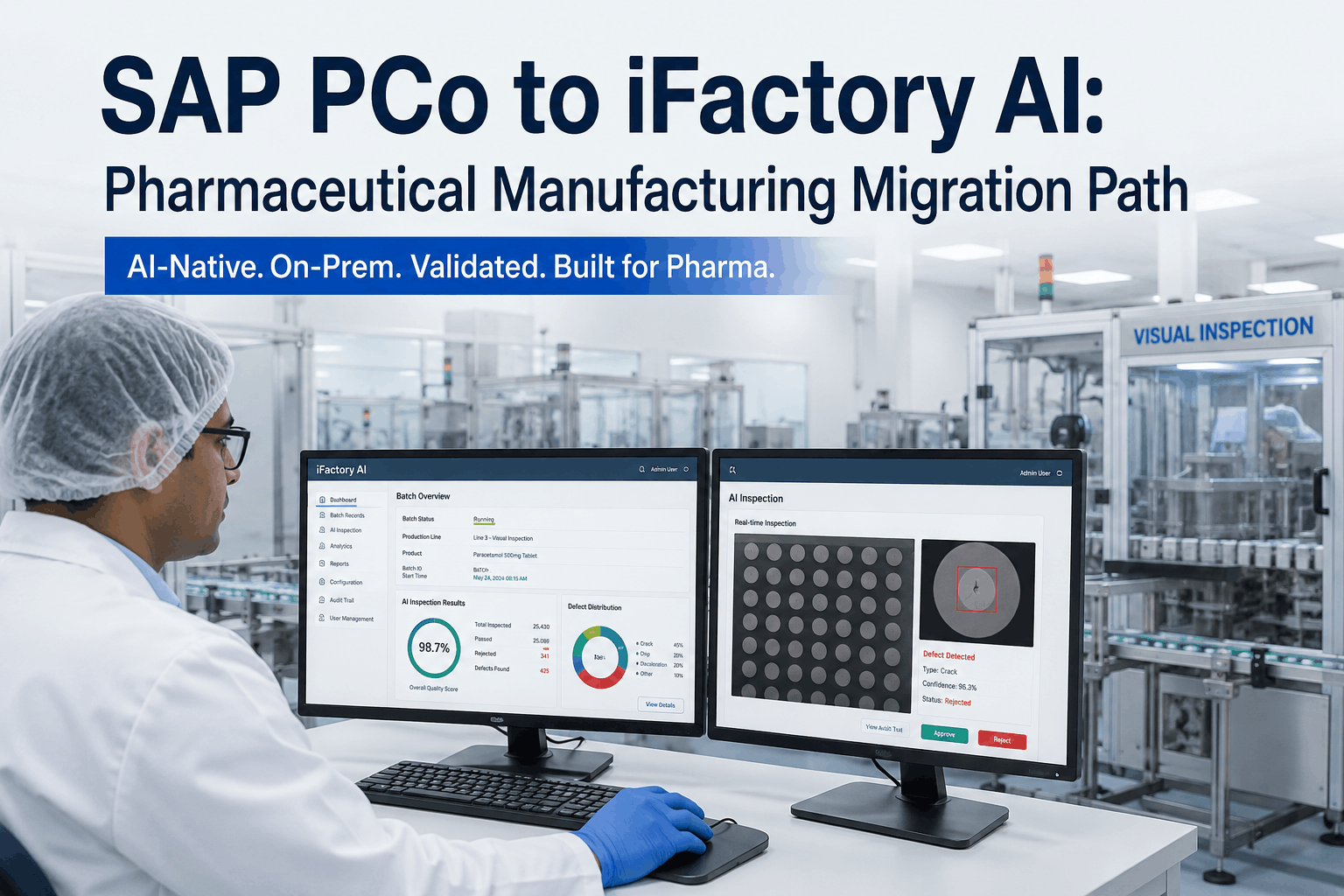
SAP PCo to iFactory AI: Automotive Manufacturing Migration Path
The automotive operator's guide to SQC Optimization through Adaptive SPC Limits — limits tune automatically per model variant, shift, supplier lot, ambient conditions · Cpk improvements 0.4–0.8 typical · false alarms −60–80%. The AI-Native alternative to SAP PCo / DMC. Pre-configured NVIDIA appliance, on-prem with no cloud lock-in, live in 6–12 weeks.
The Five Layers of the AI-Native Manufacturing Revolution
"AI-Native Manufacturing Revolution" sounds like marketing language until you map what it actually means in operational architecture. The phrase refers to a specific five-layer transformation of how data flows from physical plant to operator decisions — replacing the disconnected, descriptive, after-the-fact SAP MII / PCo architecture with an integrated, predictive, anticipatory AI stack. Every layer matters for SQC Optimization to work; missing any one of them means the AI capability above can't deliver its operational value.
Each layer either exists or doesn't in the current SAP PCo / xMII / MII architecture. Layers 1 and 2 (physical plant, basic data acquisition) are present. Layer 3 (contextual fusion) is partial — context is captured but not used for adaptive decision-making. Layer 4 (AI models) is mostly absent. Layer 5 (Operator Action Intelligence) is replaced by manual operator interpretation. The AI-Native Manufacturing Revolution means upgrading all five layers simultaneously rather than incrementally improving any single layer.
Want to see the 5-layer revolution mapped to your specific automotive operation? Schedule the AI Manufacturing Transformation Workshop — iFactory's automotive team will audit your current SAP PCo / MII architecture layer-by-layer and project the post-migration stack. Sessions available this week.
Adaptive SPC Limits — How They Tune Across Automotive Conditions
Adaptive SPC Limits aren't a single feature — they're a continuous capability that recognizes the difference between normal variation under specific conditions and genuine drift signature. The matrix below shows the four primary condition dimensions across which iFactory's adaptive limits tune in automotive operations. Each dimension represents a different category of variability that static limits cannot accommodate.
Model Variant
Same line running multiple OEM models. Each variant has distinct process windows.
Shift & Time-of-Day
Shift-effect compensation. Equipment temperature, operator experience, line warm-up.
Supplier Lot
Inbound material variation. Different steel lots, plastic resin batches, casting batches.
Equipment State
Tool wear, electrode degradation, fixture drift over the cycle.
The four dimensions combine multiplicatively. A line running 5 model variants across 3 shifts with 4 active supplier lots and 6 equipment states has 360 distinct condition combinations — and traditional SQC applies the same control limits to all of them. Adaptive SPC Limits maintain a learned envelope for each combination, with the operator seeing the right envelope at every moment. False alarms drop dramatically; real drift signatures surface clearly.
Cpk Improvement — The Operational Outcome of SQC Optimization
What SQC Optimization actually delivers
Cpk is the standard automotive measure of process capability — the ratio of specification tolerance to process variation. IATF 16949 requires Cpk ≥1.33 for critical-to-quality characteristics; OEM customer specs frequently demand 1.67 or higher. Adaptive SPC Limits deliver Cpk improvements of 0.4–0.8 typical across product portfolios within 12 months. The visualization below shows what this actually looks like across a typical multi-product automotive operation.
Want a Cpk improvement projection across your specific automotive product portfolio? Schedule the AI Manufacturing Transformation Workshop — iFactory's automotive team will analyze your current Cpk distribution and project the adaptive limit gain across product families. Sessions available this week.
Three Migration Paths from SAP PCo / DMC for Automotive
Stay on PCo / xMII
Extended maintenance, static limits paradigm continues. No adaptive limits, no Cpk improvement, no false alarm reduction. Operator interpretation overhead unchanged.
SAP DMC (Cloud-Only)
Cloud migration with descriptive analytics. No genuine adaptive limits. Cloud lock-in concern for automotive operations. Re-validation effort substantial.
iFactory AI On-Prem
Adaptive SPC Limits across all 4 dimensions. Cpk improvements 0.4–0.8 typical. IATF 16949 aligned. No cloud lock-in. 5-layer revolution stack.
Six Automotive Operations Where Adaptive SPC Limits Pay Back Fastest
Stamping Operations
Adaptive limits per panel/material lot/die wear state. Springback variation accounted for. Tonnage drift caught hours before scrap signatures emerge.
Powertrain Machining
Tool wear-aware limits per machining center, material batch. Dimensional accuracy maintained across longer tool life. Cpk improvements substantial.
Welding Operations
Electrode wear-aware, material lot-aware limits per gun. False alarms drop dramatically. Real weld quality drift caught early.
Body-in-White Assembly
Adaptive limits handle ambient temperature effects on dimensional measurement. Shift effects captured. Critical-to-quality fit and finish maintained.
Paint & Finish
Adaptive limits compensate for ambient humidity, paint lot, booth state. Color delta-E maintained tightly across changing conditions.
Final Assembly Stations
Torque signatures adapted per joint type, fastener lot, ambient. Misalignment caught early. Stations meet OEM customer scorecard targets consistently.
Want application-specific Cpk projections for your automotive operation? Send your automotive segment, product portfolio, and current Cpk baseline to iFactory support and the automotive team will return a customised projection with 12-month roadmap — typically within 3 business days, no obligation.
IATF 16949, AIAG SPC & Customer-Specific Requirements — Built In
Pre-built workflows for automotive quality frameworks
- IATF 16949 — automotive quality management system
- ISO 9001 — quality management system foundation
- AIAG SPC Manual — Western Electric & Nelson Rules
- PPAP — Production Part Approval Process automation
- APQP — Advanced Product Quality Planning
- FMEA — Failure Mode Effects Analysis integration
- MSA — Measurement System Analysis
- Customer Specific Requirements — Ford, GM, FCA, VW, Toyota, BMW
Adaptive SPC Limit decisions are captured with full audit trail aligned to AIAG SPC manual conventions. Customer-Specific Requirements (CSRs) for major OEMs are pre-mapped — Ford Q1, GM BIQS, FCA STAR, VW Formel Q, Toyota TPS Quality Manual all supported natively. PPAP submissions are streamlined; APQP workflows are templated; FMEA and Control Plan integration is automatic.
Two Real Automotive Operator Outcomes
Powertrain manufacturer producing engines, transmissions, and driveline components
A Tier 1 powertrain supplier operating 8 machining lines producing engine blocks, cylinder heads, transmission cases, and driveline components for 4 OEM customers. Cpk averaged 1.18 across the product portfolio — meeting IATF minimums but missing achievable targets. SAP PCo and MII captured operational data but applied static control limits, generating high false alarm rates that desensitized operators to real drift signatures.
Tier 1 body components supplier with stamping and assembly for multiple OEMs
A Tier 1 body components supplier producing stampings and BIW sub-assemblies for 3 OEM customers across 6 production lines. Multi-OEM portfolio meant different specifications, different control limit requirements, and frequent line changeovers. Cpk averaged 1.31 — barely above IATF minimum. Customer audits from one OEM consistently flagged process variability concerns. Operators struggled with false alarm fatigue.
Neither scenario matches your operation? Send your automotive segment, product portfolio, and current SAP PCo / MII state to iFactory support and the automotive team will return a customised migration analysis with 12-month roadmap — typically within 3 business days, no obligation.
iFactory's Automotive Deployment — On-Premise or Cloud
Same AI-native platform on either deployment model. Same Adaptive SPC Limits, multivariate detection, autonomous RCA. For automotive operations specifically, on-prem is strongly recommended because of latency requirements at production speed, customer data sovereignty (OEM IP), and the "no cloud lock-in" architectural advantage.
iFactory On-Premise Appliance Strong default for automotive plants · no cloud lock-in
- Pre-configured NVIDIA AI server — racked, software-loaded, ready to plug in.
- <50ms edge inference — keeps up with high-speed automotive lines.
- Adaptive limits run locally — model tuning continuous.
- OEM IP stays in plant — recipes and process data not exposed.
iFactory Cloud For multi-plant OEMs with established cloud governance
- Fully managed — no rack, no facility requirements.
- Same adaptive SPC stack — 4 dimensions of limit tuning.
- Cross-plant Cpk benchmarking across multi-site operations.
- Fastest deployment — first plant live in 2–4 weeks.
SQC Optimization isn't a feature upgrade. It's a paradigm change for the operator.
Adaptive SPC Limits running across model variant, shift, supplier lot, and equipment state — on a pre-configured NVIDIA appliance inside your plant. Cpk improvements of 0.4–0.8 typical, false alarms cut 60–80%, customer scorecards moving from yellow to green. The AI-Native Manufacturing Revolution is operationally real. The AI Manufacturing Transformation Workshop sizes the migration concretely for your automotive operation.
Frequently Asked Questions
How are adaptive limits validated under IATF 16949?
Adaptive SPC Limits are captured with full audit trail showing how each limit was derived, what conditions triggered the adaptation, and what the operator-approved baseline was. The audit trail aligns with AIAG SPC manual conventions — Western Electric Rules and Nelson Rules are preserved as additional detection layers. IATF auditors receive transparent documentation of how limits evolve, the validation rationale, and the change control process. Many customers find adaptive limit documentation actually strengthens IATF audit response.
What's the difference between adaptive limits and the multivariate detection in your other automotive page?
Adaptive Limits and Multivariate Detection are complementary capabilities. Adaptive Limits handle the variability across known conditions (model variant, shift, lot, equipment state) — keeping the right control envelope at every moment. Multivariate Detection catches drift signatures that span multiple parameters which any single-parameter limit would miss. The iFactory platform delivers both; this page focuses on Adaptive Limits because operators see the daily impact most directly through them.
What does "SAP PCo replacement" actually mean technically?
SAP PCo (Plant Connectivity) handles plant-floor data acquisition — protocol conversion between PLCs/sensors and SAP MES. iFactory's Data Acquisition layer provides equivalent functionality with native support for OPC UA, MQTT, Modbus, EtherNet/IP, and direct PLC connections (Siemens S7, Rockwell ControlLogix, Mitsubishi, Schneider). The platform consolidates PCo function with the AI capability stack rather than maintaining them as separate licenses and integration layers.
How do adaptive limits handle Customer Specific Requirements from different OEMs?
Each OEM's customer-specific requirements (Ford Q1, GM BIQS, FCA STAR, VW Formel Q, Toyota, BMW, Mercedes) are pre-mapped in iFactory's compliance framework. Adaptive limits respect the more conservative OEM requirements when limits are derived. For multi-OEM plants, the system maintains separate compliance contexts per customer — same physical line can serve different OEM specs with appropriate limit envelopes for each.
Do I have to buy NVIDIA servers separately?
No. iFactory's on-premise appliance ships fully loaded — pre-configured NVIDIA AI server, software pre-installed, network gear, cabling, edge devices for line-side inference, industrial cameras where needed for AI Vision. You provide rack space, line power, Ethernet, and PLC integration points. The deployment team handles all installation and configuration. For cloud, no hardware investment at all.
Can we deploy on one production line first?
Yes — and it's the recommended approach. Start with the line where Cpk variability is highest or customer scorecard impact is most acute. Validate the Adaptive SPC Limit performance and Cpk improvement on a single line. Then expand line-by-line in 2–4 week waves. Full plant deployment for a typical 8–14 line automotive operation completes in 4–6 months end-to-end with adaptive limits active across the plant from month 4.
What does the AI Manufacturing Transformation Workshop cover?
The half-day workshop covers — current-state SAP PCo / MII / xMII assessment with focus on static-limit limitations, 5-layer revolution stack walkthrough specific to your plant, Adaptive SPC Limits demonstration on your representative automotive scenarios, Cpk improvement projection, three-path migration comparison with cost/timeline projections, IATF 16949 alignment, deployment roadmap. Outcome is a concrete migration plan. Suitable for operators, plant leadership, QA, IT, and finance representatives.
SAP PCo and static SQC were the right tools for a previous era of automotive operations. Adaptive SPC Limits are what comes next.
Cpk improvements of 0.4–0.8 across product portfolio. False alarms cut 60–80%. Customer scorecards moving from yellow to green. The AI-Native Manufacturing Revolution running on a pre-configured NVIDIA appliance inside your plant, no cloud lock-in, IATF 16949 aligned, live in 6–12 weeks. The Workshop is the fastest way to size the migration for your specific operation — sessions available this week.