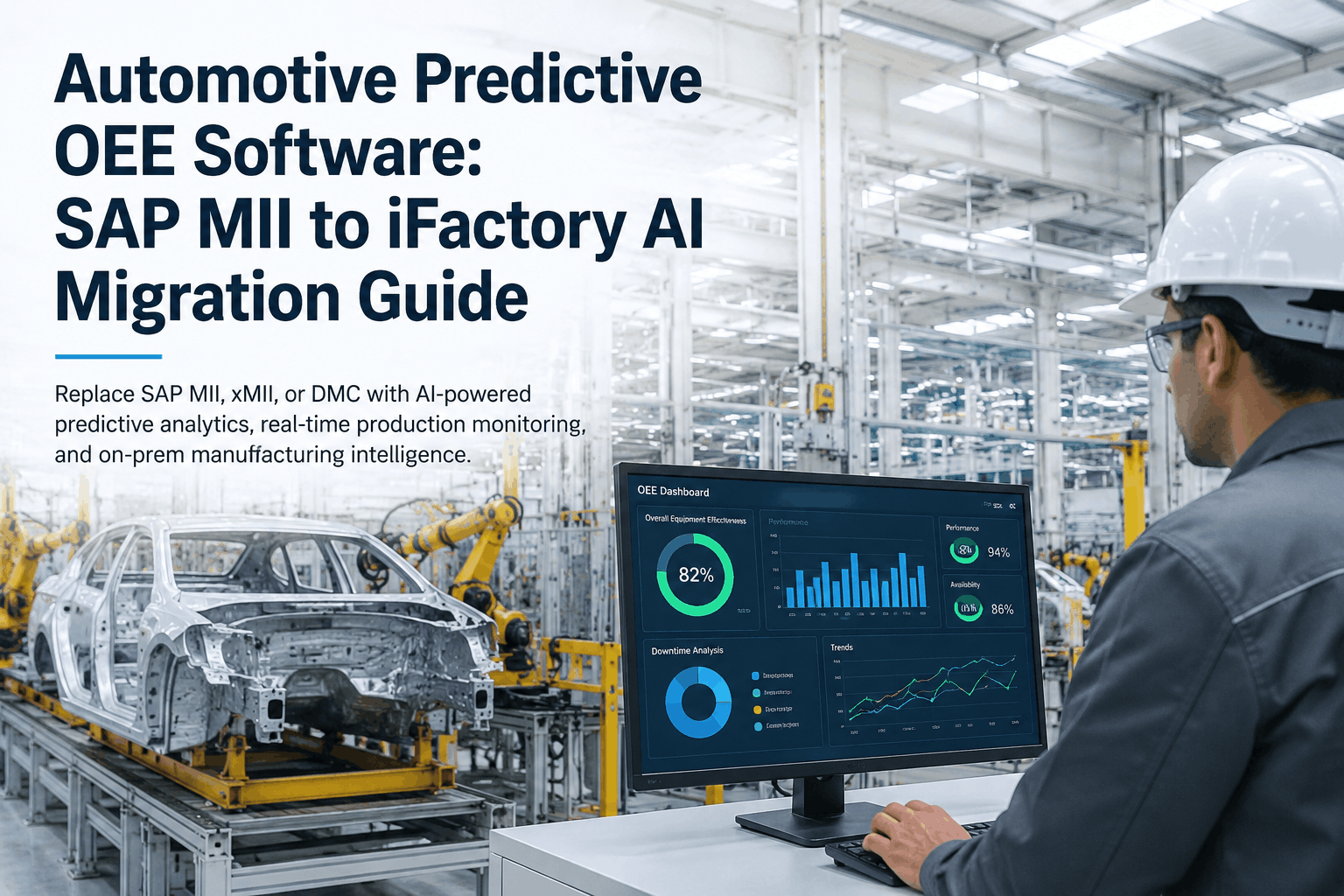
Automotive manufacturing is at an inflection point. EV programs are scaling on the same brownfield lines that produce ICE volume. IATF 16949 audits are tightening under the 2025 Rules 6th Edition. PPAP cycles compress from months to weeks as OEM launch cadences accelerate. Battery-cell quality is now a vehicle-safety issue, not a supplier issue. And the platform that automotive executives have leaned on for shop-floor intelligence — SAP MII and xMII — is on a fixed end-of-life path, with mainstream maintenance ending December 2027 and the cloud-only successor (SAP DMC) requiring an 18–24 month migration program before it delivers anything new. Executives running automotive operations have a choice: spend $3–6M moving SQC from one static-SPC platform to another, or leapfrog to AI-native manufacturing intelligence — Predictive SPC that catches drift hours before control limits fire, AI Vision for weld and surface quality, Autonomous RCA for PPAP-grade investigations, and an Industrial GenAI Copilot trained on automotive core tools (APQP, FMEA, MSA, SPC, PPAP). Live in 6–12 weeks on a pre-configured NVIDIA appliance. Cloud option for multi-plant operators. This is the future-of-industrial-AI executive brief for automotive plants planning the SAP xMII migration.
iFactory AI vs SAP PCo: AI-Native SQC Optimization for Automotive
The manufacturing executive's guide to leapfrogging SAP xMII — Predictive SPC catching drift hours ahead, AI Vision for weld & surface defects, Autonomous RCA for PPAP investigations, Industrial GenAI Copilot on IATF 16949 + automotive core tools. Pre-configured NVIDIA appliance. Live in 6–12 weeks.
The Decade Ahead — A Timeline of Industrial AI in Automotive
The shift from rule-based MES to AI-native manufacturing intelligence isn't a future promise — it's already underway across BMW Debrecen, Stellantis platforms, and EV battery plants in Asia. The strategic question for executives is whether your plant migrates from SAP xMII into this future, or sideways into another static-SPC platform.
Rule-based MES era
SAP MII / xMII connects shop floor to ERP. Static SPC charts. Rule-based vision. Manual RCA. Quality as downstream checkpoint.
AI inflection point
SAP MII feature freeze. AI Vision matures. Predictive SPC proven at scale. EV programs demand real-time quality. The decision window opens.
SAP MII mainstream EoL
December 2027 — mainstream maintenance ends. Extended support to 2030 at premium. AI-native plants pull ahead on cost-per-vehicle.
Autonomous quality
Closed-loop control. Predictive PPAP. Self-healing lines. Industrial Copilots on every workstation. Quality embedded, not inspected.
The Executive Math — Why "Future of Industrial AI" Is a 2026 Decision
For a manufacturing executive, the SAP xMII migration question rarely lives in IT. It lives in three operating metrics that the board tracks every quarter — cost per vehicle, first-pass yield, and PPAP cycle time. Static-SPC platforms (SAP xMII today, SAP DMC tomorrow) hold these flat. AI-native SQC moves them.
Cost Per Vehicle
Quality-related scrap, rework, and warranty consume 2.4–4.1% of vehicle cost on a typical OEM line. Predictive SPC catching drift 2–6 hours early cuts the scrap/rework portion by 35–50%.
First-Pass Yield
Static SPC catches deviations only at control-limit breach — usually after the bad part is made. Predictive SPC flags drift while it's still correctable, lifting FPY 4–9 percentage points on body-in-white and powertrain.
PPAP Cycle Time
Manual PPAP packages take 12–18 weeks. Autonomous RCA + automated evidence chain in iFactory generates IATF-grade documentation in real time, cutting the packaging step from weeks to days.
Want these three metrics modeled with your specific plant's cost-per-vehicle, FPY baseline, and PPAP volume? Schedule a Demo — workshop sessions include live ROI modeling with your inputs. Sessions available this week.
Predictive SPC — The Core AI Capability for Automotive SQC
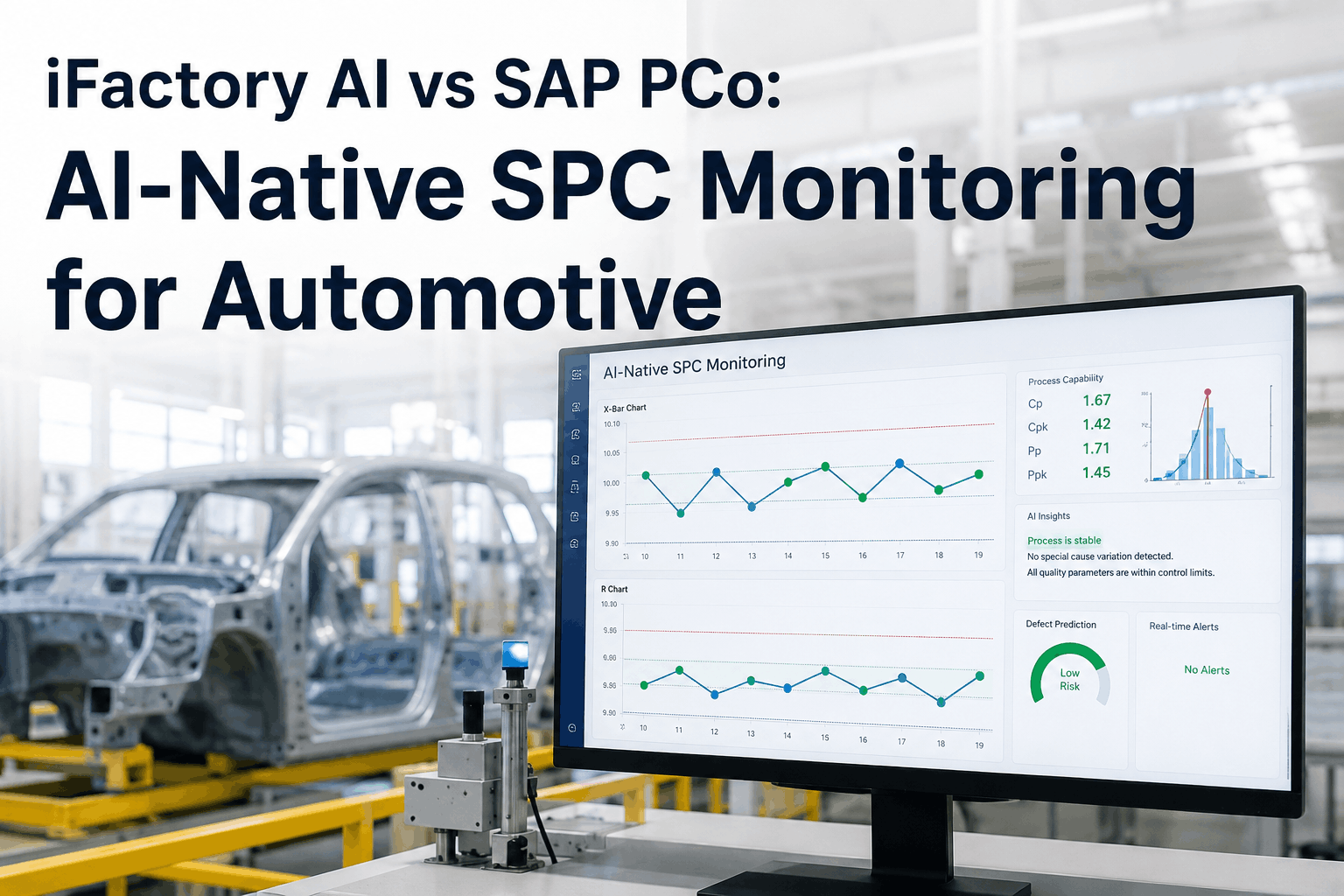
Static control limits are how SQC worked in 2004. Predictive SPC is how it works in 2026. The difference isn't a tighter chart — it's a different time horizon. Predictive SPC uses LSTM forecasting on multivariate process data to identify the trajectory toward a control-limit breach before it occurs. On a body-in-white line, that means catching weld-current drift while the next 40 spot welds can still be corrected. On a powertrain machining cell, it means catching tool wear progression before the dimensional deviation hits CMM.
The static MII limit fires only when the deviation has already crossed the line — typically when 60–120 bad parts are already in process. Predictive SPC's LSTM forecast band identifies the drift trajectory hours earlier, while the line is still inside spec but heading out.
The Four AI-Native Capabilities Replacing SAP xMII
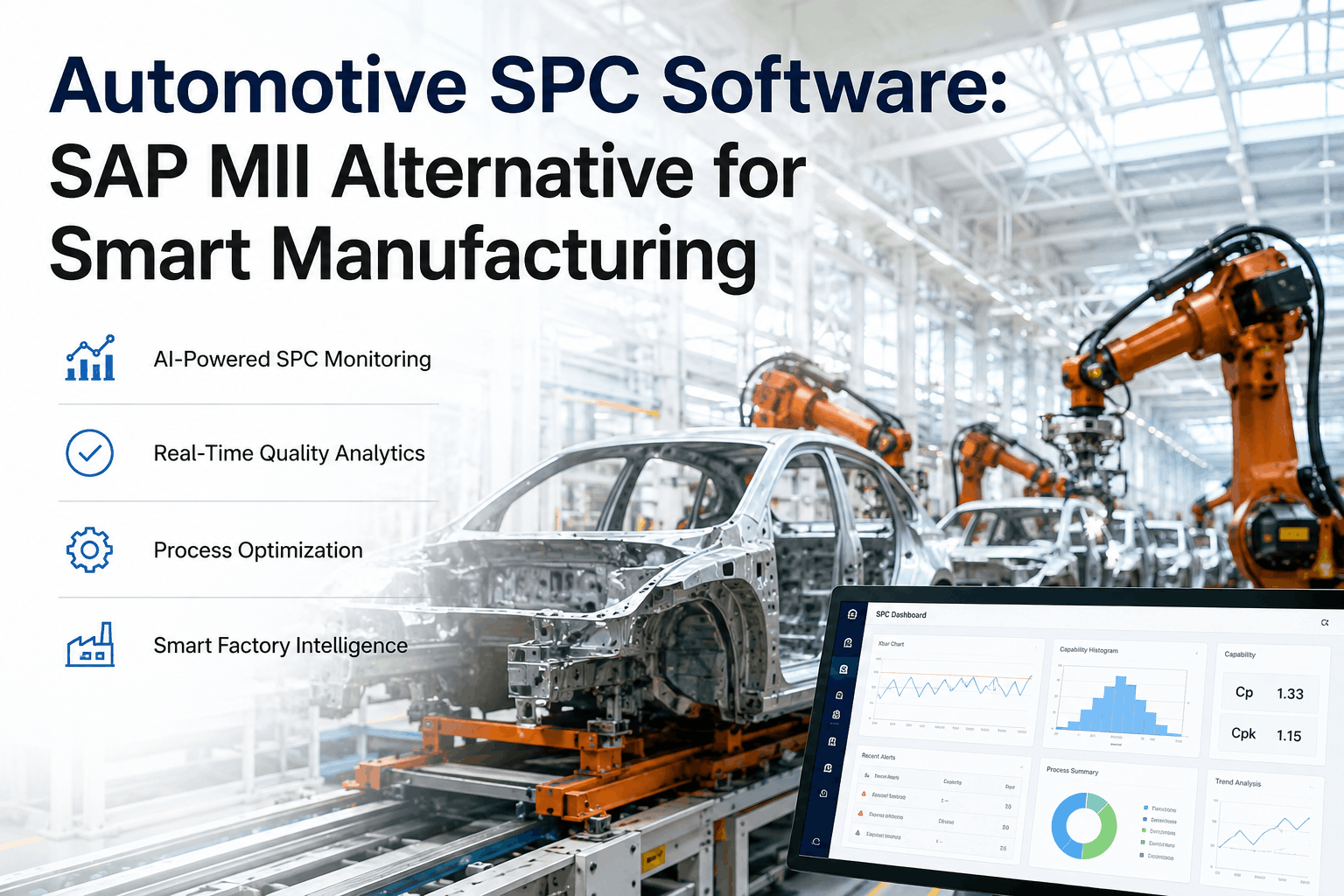
Predictive SPC is the centerpiece. The same iFactory NVIDIA appliance carries three more capabilities that automotive plants need but SAP xMII either doesn't have natively or treats as bolt-ons. Together they replace the xMII / DMC stack with one integrated AI-native platform.
Predictive SPC
LSTM forecasting + autoencoder anomaly detection + Nelson Rules automation. Catches weld-current, dimensional, torque, and press-force drift 2–6 hours before traditional control limits fire.
AI Vision Inspection
CNN-based detection for weld quality, paint defects, body-in-white surface, EV cell anomalies, label verification, gap-and-flush. Runs at line speed on industrial cameras.
Autonomous RCA
When a part fails CMM or a vehicle is held for rework, AI correlates upstream process data to identify root cause in minutes — with IATF-grade evidence chain ready for PPAP packaging.
Industrial GenAI Copilot
Trained on IATF 16949, APQP, FMEA, MSA, SPC, PPAP frameworks plus your plant's control plans and customer-specific requirements. Available to every operator and quality engineer.
Five Automotive Use Cases — Where Predictive SPC Pays Off Fastest
Body-in-White Welding
Weld-current and electrode-wear drift forecast hours before bad welds. Predictive SPC plus AI Vision on weld nuggets cuts rework on BIW by 28–42%.
EV Battery Assembly
Cell formation, electrolyte fill, tab-weld quality — predictive monitoring on every CTQ. AI Vision detects cell anomalies invisible to rule-based systems.
Powertrain Machining
Bore diameters, runout, surface finish, tool-wear forecasting. Predictive SPC catches tool degradation 4–8 hours before dimensional drift hits CMM.
Stamping & Press Lines
Press-force, die wear, lubrication monitoring. Predictive SPC plus AI Vision catches splits, wrinkles, and surface anomalies in real time.
Paint & Surface
Booth conditions, application thickness, color delta-E. Predictive SPC tracks drift toward defect zones; AI Vision catches paint anomalies pre-bake.
Final Assembly & Torque
Torque-tool drift, fastener seating, gap-and-flush. Predictive SPC plus tool-by-tool monitoring eliminates torque-recall risk pre-shipment.
Want a use-case-specific analysis for your plant's highest-pain area? Talk to Support with your top three SQC pain points and the automotive team will return a focused analysis — typically within 3 business days, no obligation.
IATF 16949 Compliance — Built Into the Platform
Pre-built workflows for the five core tools every automotive QMS audit requires
Three Migration Paths — Executive Comparison
Stay on SAP xMII
SAP DMC Migration
iFactory AI Leapfrog
Two Real Automotive Plant Outcomes
Tier-1 powertrain supplier with chronic CMM rejects and slow PPAP cycles
A North American Tier-1 supplier running SAP xMII across four powertrain machining cells producing engine blocks, crankshafts, and transmission housings. CMM reject rate consistently 6–9% requiring rework. PPAP cycle averaging 16 weeks per new part. IATF audit findings around SPC data integrity recurring. SAP DMC quote came in at $3.4M over 22 months.
EV battery plant facing safety-critical quality stakes and supply pressure
A regional EV battery plant ramping cell production for two OEM customers. Cell formation defects causing 4.2% scrap and intermittent field-failure concern. Manual quality inspection adding 18 seconds per cell. SAP xMII handled SPC but couldn't keep up with formation-cycle data volumes. AI Vision was a separate vendor quote at $1.6M.
Want a scenario sized to your operation? Talk to Support with your SAP xMII footprint and IATF context, and the automotive team will return a customized comparison with three-path ROI — typically within 3 business days, no obligation.
Industrial GenAI Copilot — On Every Workstation, Every Shift
Trained on IATF 16949, automotive core tools, your control plans, and customer-specific requirements
Quality engineer prompt
Operator prompt
PPAP package generation
Multi-language plant floor
Deployment — On-Prem Appliance or Managed Cloud
iFactory On-Premise Appliance
- Pre-configured NVIDIA AI server — racked, software-loaded, vision cameras and edge gear included.
- Plug and run — rack space, line power, Ethernet, integration to your MES / historian. iFactory team handles the rest.
- Operates during WAN outages — line SQC and AI stay live even if corporate network is down.
- Customer IP and process recipes stay inside the plant — protects PPAP data and OEM specs.
iFactory Cloud
- Fully managed — no rack, no facility requirements.
- Same four AI capabilities — Predictive SPC, AI Vision, Autonomous RCA, GenAI Copilot.
- Cross-plant benchmarking across every plant on one tenant.
- Fastest deployment — first plant live in 2–4 weeks.
The Future of Industrial AI Is a 2026 Decision.
SAP MII mainstream EoL is December 2027 — 18 months out. The companies leapfrogging from xMII to AI-native SQC during this window will define the next decade of automotive quality benchmarks. The Transformation Workshop is the fastest path to a concrete migration plan sized to your plant, your costs, and your IATF context.
Frequently Asked Questions
How does iFactory AI handle IATF 16949 Rules 6th Edition audit requirements?
The platform ships with IATF 16949 workflows pre-built, including the 2025 Rules 6th Edition updates around risk-based audit duration. Every quality event, deviation, control-plan revision, and PPAP cycle generates audit-grade evidence with full traceability. Customer-Specific Requirements (CSR) for major OEMs are configured during deployment. Audit closeout typically improves measurably within the first IATF surveillance audit post-deployment.
Can iFactory replace both SAP xMII and our separate AI Vision vendor?
Yes — and this consolidation often drives the strongest ROI case. Many automotive plants run SAP xMII for SPC plus a separate Cognex, Keyence, or ISRA Vision system at $1.2–2.4M for camera-based inspection. iFactory's CNN-based AI Vision Inspection runs on the same NVIDIA appliance as Predictive SPC, eliminating the dual-vendor cost and integrating defect events directly with SQC and PPAP workflows.
What does the deployment timeline look like for a 4-line OEM plant?
Typical deployment for a 4-line OEM plant is 10–14 weeks. Weeks 1–4 cover hardware shipment, networking, MES/historian integration, and data flow validation. Weeks 5–8 cover model training on your historical process data and AI Vision camera installation. Weeks 9–12 cover phased line cutover with operator training and validation. Single-line pilots can go live in 6–8 weeks for plants wanting to validate before scaling.
Do operators need to learn a new SQC interface?
No. Predictive SPC limits and AI Vision results display on existing HMI screens through familiar SPC chart formats. The difference is the limit lines now move with process context and the forecast band shows the predicted trajectory. The GenAI Copilot is available on tablet, workstation, or mobile — additive to the operator interface, not a replacement.
How does iFactory integrate with our existing MES, ERP, and PLM systems?
iFactory connects to common automotive-stack systems — SAP S/4HANA, Siemens Opcenter, Rockwell FactoryTalk, Wonderware, GE Proficy, PI, Aspen IP.21 — via OPC UA, OPC DA, MQTT, REST APIs, and direct historian connectors. Integration to PLM (Teamcenter, Windchill, Enovia) supports control-plan and FMEA syncing. Deployment is read-only by default — no production impact during installation.
Is iFactory suitable for EV battery and cell manufacturing specifically?
Yes. EV battery and cell production is one of the fastest-growing iFactory deployment areas. The platform handles cell formation cycles, electrolyte fill, tab-weld quality, electrode coating, calendaring, and pack assembly. AI Vision models are pre-trained on common cell defect taxonomies and fine-tune to your specific chemistry and form factor. The traceability layer meets EU Battery Passport requirements taking effect through 2027.
What does the AI Manufacturing Transformation Workshop actually deliver?
A half-day session covering current-state SAP xMII assessment, three-path migration comparison sized to your operation, ROI modeling with your cost-per-vehicle and FPY baseline, live iFactory platform walkthrough with automotive use cases, Predictive SPC demonstration on a representative powertrain or BIW scenario, GenAI Copilot demonstration, and 12-month deployment roadmap. Suitable for operations VPs, quality directors, IT leadership, and finance representatives.
SAP xMII migration is a 2026 decision. Make it the right one.
Predictive SPC, AI Vision, Autonomous RCA, GenAI Copilot — four AI capabilities, one NVIDIA appliance, 6–12 weeks deployment, IATF 16949 native. The Transformation Workshop is the fastest way to see what AI-native automotive SQC looks like on your plant, your lines, your customer specs.