Steel manufacturing pushes process control to its physical limits — caster molds running at 1,550°C, hot strip mills moving slab at over 1,000 m/min through seven finishing stands holding ±0.02 mm tolerance, EAF melt cycles where one tap-to-tap variation cascades through composition, temperature, and downstream yield. And it's where the limitations of traditional SPC become most expensive. SAP MII / xMII enforces static control limits set once per grade and rarely revisited — limits that don't know whether the slab in stand 4 is 30°C cooler than the previous coil, whether the work roll has 12 hours of campaign wear, or whether the customer order calls for tighter mechanical properties. Static limits in dynamic steel processes mean false alarms when conditions shift legitimately, and missed deviations when conditions drift into a danger zone the original limit didn't anticipate. iFactory AI's Adaptive SPC Limits is the AI-native answer — control limits that learn your grade portfolio, your campaign history, your seasonal variation, and your customer-specific quality requirements, then auto-tune themselves in real time. The same on-prem appliance also delivers AI Vision Inspection for surface defects, Autonomous RCA for coil-grade investigations, and an Industrial GenAI Copilot trained on your mill SOPs. Pre-configured NVIDIA appliance. Live in 6–12 weeks. Cloud option for multi-plant operators. This is what AI-native SPC monitoring looks like on a steel floor in 2026.
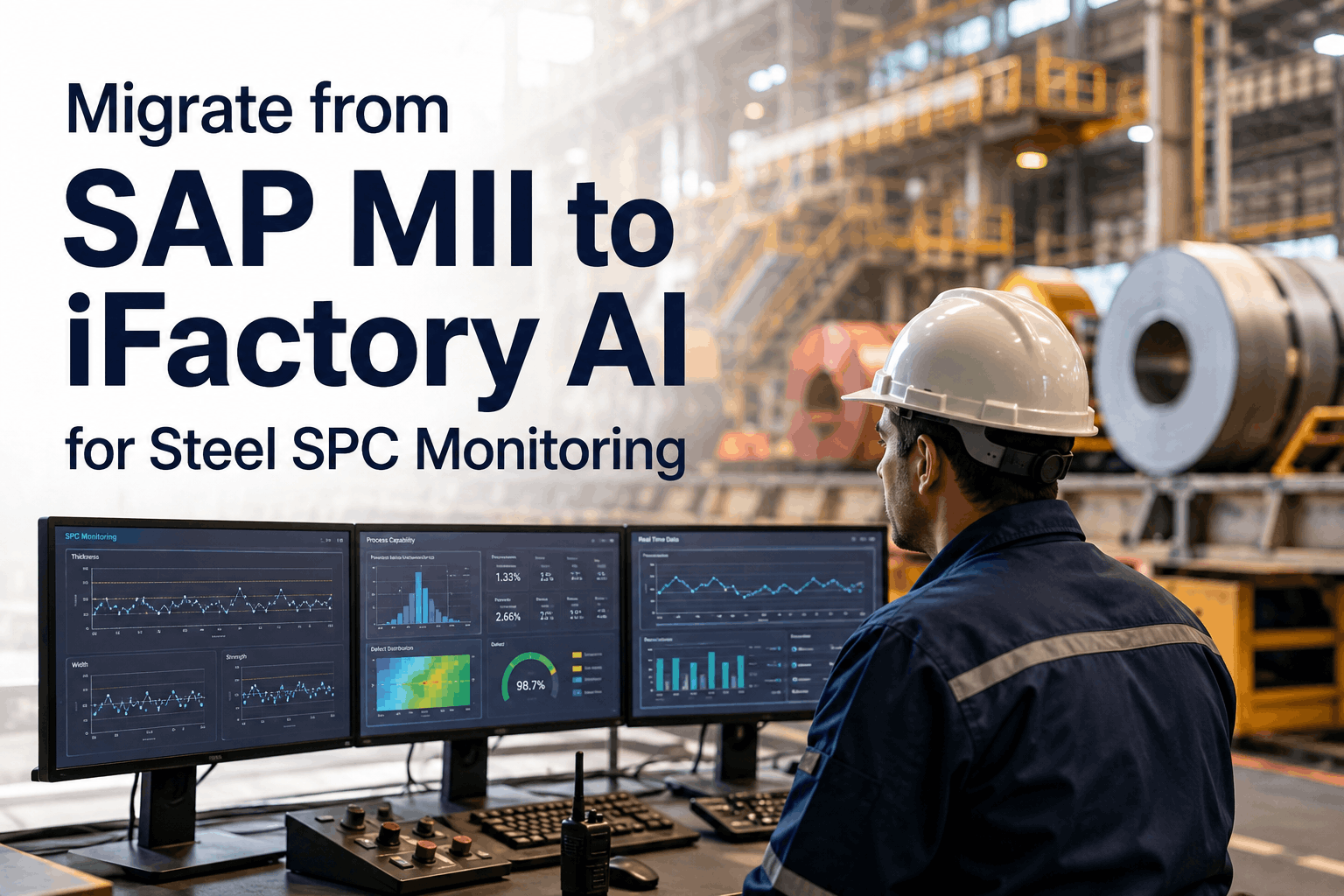
Migrate from SAP MII to iFactory AI for Steel SPC Monitoring
The steelmaker's guide to AI-native SPC monitoring — Adaptive Control Limits that auto-tune to grade, campaign, and customer spec; AI Vision for surface defects and edge quality; Autonomous RCA cutting coil-grade investigations from days to minutes; Industrial GenAI Copilot in operator language. Pre-configured NVIDIA appliance, live in 6–12 weeks.
The Static-Limit Problem — Why SAP xMII SPC Fails Modern Steel Operations
Steel production is the most dynamic continuous-process environment in heavy industry. Grade changes within a single shift. Campaign wear progressing through every coil. Slab reheat variation. Cooling-water temperature shifts by season. Customer orders calling for ±5 MPa yield strength on automotive grades, ±50 MPa on construction. SAP xMII handles SPC the way it was designed in 2004 — one control chart, one upper and lower limit, set per parameter, revisited quarterly or after a major incident. That paradigm has three structural failures in modern steel mills.
False alarms from grade transitions
When the mill shifts from low-carbon to micro-alloyed grade, every legitimate process change fires an alarm against the previous grade's limit. Operators learn to ignore alerts — the dangerous outcome.
Missed drift in campaign progression
Work roll wear, mold copper degradation, and refractory erosion shift the legitimate operating envelope over a campaign. Static limits stay where they were set on day one — and miss the slow drift toward off-grade product.
No memory of customer-specific spec
A mill making automotive HSLA at ±5 MPa and construction rebar at ±50 MPa needs different control envelopes per order. Static limits enforce neither tightly nor loosely — they enforce one compromise that fits neither.
Adaptive SPC Limits — Control Limits That Learn Your Mill
Adaptive SPC Limits is the centerpiece capability of iFactory AI for steel SPC monitoring. Instead of a single static envelope, the AI maintains a multi-dimensional model of what "normal" looks like for every combination of grade, campaign age, slab condition, customer spec, and seasonal variable. Limits auto-tune in real time. When the mill transitions to a new grade, limits shift to that grade's envelope within seconds. When campaign wear progresses, limits widen along the legitimate drift axis but tighten across the failure axis. When a tight-tolerance automotive order runs, limits clamp inward. When a forgiving construction order runs, they relax.
The static MII envelope (dashed) sits where it was set quarters ago — too wide for tight-grade transitions, too narrow when campaign wear shifts the legitimate baseline. The adaptive envelope (shaded) tracks grade, campaign, and customer spec in real time. False alarms drop. Real drift gets caught.
How Adaptive Limits Work — The Five-Layer Model
The adaptive limits engine isn't a single algorithm. It's a layered model that combines five separate AI components, each contributing one dimension of context to the live control envelope.
Grade-aware baseline
The AI maintains a separate statistical envelope for every grade in your portfolio — built from historical good-quality production, refreshed continuously. Limits shift to the new grade's envelope within seconds of a transition.
Campaign-progression model
Work-roll wear, mold copper aging, refractory erosion — every campaign has a known drift signature. The AI tracks where you are in the campaign and adjusts limits along the legitimate drift axis only.
Customer-spec clamp
When a tight-tolerance automotive HSLA order is running, limits clamp inward to that customer's spec. When forgiving construction rebar is running, limits relax. The AI reads from order management and adjusts live.
Seasonal & ambient compensation
Cooling water temperature shifts by season. Ambient humidity affects descaling. The AI models these slow variables separately so they don't show up as false drift in your process signals.
Multivariate anomaly detection
Beyond univariate limits — an autoencoder watches the joint behavior of dozens of parameters. Catches the deviations that look fine on every individual chart but represent a real upset in combination.
Want to see Adaptive Limits running against historical data from your own mill? Schedule the AI Manufacturing Transformation Workshop — sessions include a live replay of your last 30 days of process data with adaptive vs static limit comparison. Sessions available this week.
Three More Capabilities on the Same Appliance — Beyond Adaptive Limits
Adaptive Limits is the centerpiece. The same iFactory NVIDIA appliance also delivers three additional capabilities that SAP xMII either doesn't have or treats as add-ons. Together they replace the SAP xMII / SAP DMC stack with one integrated AI-native platform.
AI Vision Inspection
CNN-based detection for hot-band surface defects, edge cracks, cobble events, coil-end quality, scale patterns, and slab surface anomalies. Runs at line speed on industrial cameras placed at exit-pass, ROT, and coiler.
Autonomous RCA
When a coil downgrades or a slab fails QA, AI runs the multivariate investigation across the upstream cascade — caster, reheat furnace, descaler, every stand — and surfaces top-3 root cause hypotheses with confidence scores in minutes.
Industrial GenAI Copilot
Trained on your mill SOPs, grade catalogs, customer specs, and historian data. Operators ask "why is stand 5 force climbing on this coil" and get an evidence-linked answer with recommended corrective action — in English, Hindi, Spanish, or Mandarin.
Steel-Specific Use Cases — Where Adaptive Limits Pay Off Fastest
Continuous Caster — Mold Level & Friction Monitoring
Mold level oscillation, mold friction, taper consistency, casting speed — the four signals that predict breakout, sticker, and longitudinal cracks. Static limits treat all these the same regardless of grade peritectic sensitivity, slab width, and copper plate age. Adaptive Limits tracks each combination separately.
- Peritectic grades get tighter mold-level envelopes automatically
- Mold copper aging shifts friction baseline — adaptive follows
- Breakout-precursor signature catches multivariate drift 4–12 minutes early
Hot Strip Mill — Exit Temperature & Crown Control
Finishing-mill exit temperature, crown, profile, flatness — the four CTQs of hot band. Each grade has its own target window. Each customer order tightens or relaxes that window. Each work-roll campaign drifts the achievable envelope. Static SAP xMII charts can't hold all that.
- Customer-spec clamp pulls limits inward for tight automotive orders
- Roll-wear model widens limits along legitimate drift only
- Multivariate model catches profile-flatness coupling that single charts miss
EAF / BOF — Tap-to-Tap Composition Control
End-of-blow carbon, temperature, slag chemistry, tap-stream analysis. The heat-to-heat variation is enormous — different scrap mix, different hot metal chemistry, different oxygen blow profiles. Static limits flag every other heat. Adaptive Limits learns the legitimate variation envelope per scrap mix and per grade.
- Scrap-mix-aware limits stop the false-alarm flood
- Catches real composition drift that previously hid in the noise
- GenAI Copilot recommends trim-alloy adjustments based on similar historical heats
Have a specific mill area where SPC isn't working? Send your top three problem signals to iFactory support and the steel team will return a use-case-specific analysis with projected adaptive-limits impact — typically within 3 business days, no obligation.
Migration Paths from SAP xMII — Three Choices, Different Outcomes
SAP xMII mainstream maintenance ends in 2027 (extended to 2030 with paid premium support). Steel mills have a fixed deadline approaching. There are three paths forward — here's the strategic summary; the Transformation Workshop sizes your specific decision.
Stay on xMII
SAP DMC
iFactory AI
Two Real Steel Mill Migration Outcomes
Integrated 4 Mt/yr steelmaker with SAP xMII facing 2027 deadline
A regional integrated mill running SAP xMII for SPC across BOF, continuous casters, hot strip mill, and plate mill. Static-limit false-alarm rate had grown to ~280 alerts per shift across all lines — operators routinely ignored alarms. SAP DMC quote came in at $4.2M over 22 months, cloud-only with concerns about WAN reliability at the remote plant location.
EAF mini-mill producing rebar & merchant bar with chronic re-blow heats
A 1.2 Mt/yr EAF mini-mill running mixed scrap with high heat-to-heat composition variation. Re-blow rate consistently 18–22% — every fifth heat needed correction. SAP xMII SPC charts were ignored because the false-alarm rate made them unusable. Trim-alloy spend running $4.8M/year, well above industry benchmark.
Neither scenario fits your mill exactly? Send your current SAP xMII footprint and process portfolio to iFactory support and the steel team will return a customized migration analysis with three-path comparison and 12-month roadmap — typically within 3 business days, no obligation.
Deployment — On-Prem Appliance or Managed Cloud
Same AI-native platform. Same Adaptive Limits, AI Vision, Autonomous RCA, GenAI Copilot. The deployment choice depends on your IT strategy, plant connectivity, and multi-site approach.
iFactory On-Premise Appliance
- Pre-configured NVIDIA AI server — racked, software-loaded, network gear and edge cameras included.
- Plug and run — rack space, line power, Ethernet, integration to your Level 2 / Historian. iFactory team handles the rest.
- Operates during WAN outages — mill SPC and AI stay live even if corporate network is down.
- All grade IP, customer specs, and process recipes stay inside the plant — protects competitive position.
iFactory Cloud
- Fully managed — no rack, no facility requirements at the plant.
- Same AI capabilities — Adaptive Limits, AI Vision, RCA, Copilot — across every mill on one tenant.
- Cross-plant benchmarking — compare grade yield, false-alarm rates, RCA cycle time across plants.
- Fastest deployment — first plant live in 2–4 weeks.
Industrial GenAI Copilot — Trained on Your Mill, Your Grade Book, Your SOPs
Process question in plain language
Grade transition assistance
Multi-language operator support
Customer-spec lookup
Adaptive Limits, AI Vision, Autonomous RCA, GenAI Copilot — One Appliance, Six Weeks Out.
SAP xMII's static-limit paradigm doesn't match how modern steel mills actually run. The AI-native answer is here, it's turnkey, and the migration window before 2027 is open. The Transformation Workshop is the fastest way to see what Adaptive SPC Limits look like on your specific mill, your specific grade portfolio, your specific customer spec book.
Frequently Asked Questions
How much historical data does Adaptive Limits need to start working?
For mature accuracy on a mature mill, 12–18 months of historian data covering your grade portfolio gives the best results. The model becomes operationally useful at 90 days of live training during deployment. For new lines or new grades, the model bootstraps from physics-based priors and tightens as production data accumulates — typically reaching production-grade accuracy within 60–90 days.
Does iFactory integrate with our Level 2 system and historian?
Yes — directly. The platform connects to major steel-industry Level 2 systems (Siemens TIA / Simatic, Primetals, ABB Ability), historians (PI, Aspen IP.21, GE Proficy, Wonderware), and Level 1 PLCs via OPC UA, OPC DA, MQTT, Modbus, and direct historian connectors. Read-only by default — no production impact during installation. Operators continue using their existing HMIs and consoles.
Do operators have to learn a new SPC interface?
No. The adaptive limits are displayed on existing HMI screens through the same SPC chart formats operators already know. The difference is the limit lines now move with the process context. The GenAI Copilot is an additional capability available on tablet or workstation, not a replacement for the existing operator interface.
How is AI Vision deployed in a hot mill environment?
Industrial-grade cameras in cooled enclosures, positioned at exit pass, ROT, and coiler depending on mill type. iFactory's deployment team handles all camera installation, calibration, and environmental protection. Vision models are pre-trained on hot-band surface defects (scale patterns, edge cracks, cobble events, longitudinal defects) and fine-tune during the first 4–8 weeks of production deployment. Detection accuracy typically reaches 99%+ on the most common defect classes.
Do we have to buy NVIDIA hardware separately?
No. The on-premise appliance ships fully loaded — pre-configured NVIDIA AI server, software pre-installed, network gear, cabling, industrial cameras, and edge devices for line-side inference. You provide rack space, line power, Ethernet, and integration points to Level 2 / historian. The iFactory deployment team handles installation and configuration. For cloud, no hardware investment at all.
Can we migrate one line first before going mill-wide?
Yes — strongly recommended. Start with the highest-pain area: a specific HSM stand, a single caster strand, the EAF, or one rolling line. Validate Adaptive Limits accuracy, prove the operator workflow, build confidence with the AI Vision and Autonomous RCA. Then expand in 2–4 week waves. A full integrated-mill migration typically completes in 14–20 weeks across all lines.
What's the Transformation Workshop actually about?
A half-day session covering current-state SAP xMII assessment, three-path migration comparison sized to your operation, ROI modeling with your cost inputs, live iFactory platform walkthrough with steel use cases, Adaptive Limits demonstration on a representative grade-transition or campaign-wear scenario, GenAI Copilot demonstration, and 12-month deployment roadmap. The outcome is a concrete migration recommendation — suitable for operations leaders, IT, quality, and finance representatives.
Static control limits don't fit dynamic steel mills. AI-native control limits do.
The 2027 SAP xMII deadline is fixed. The migration path isn't. iFactory AI delivers steel SPC monitoring the way it should work in 2026 — adaptive instead of static, predictive instead of reactive, integrated instead of siloed. Workshop sessions available this week.