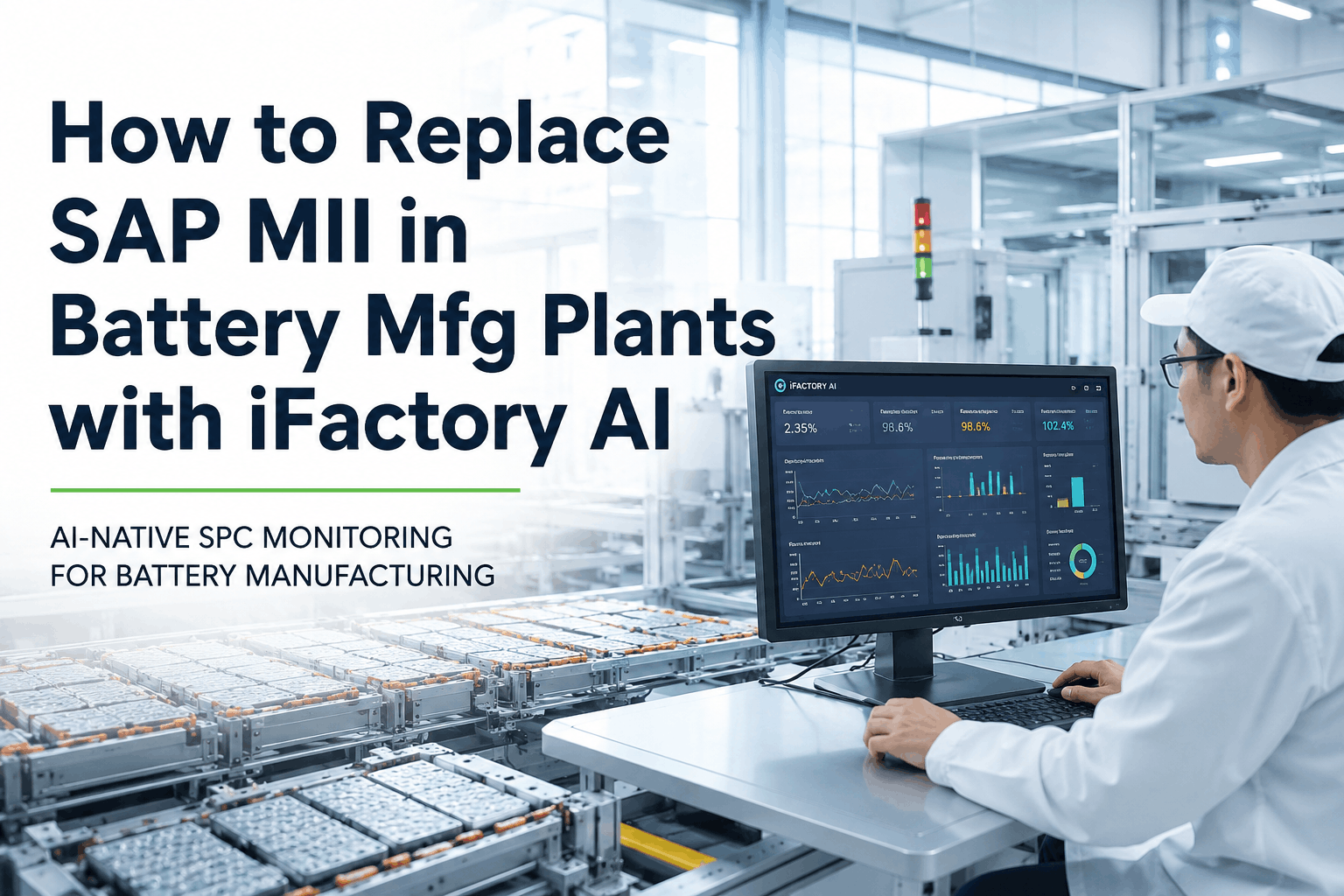
Walk into a modernized battery gigafactory and the floor looks the same as the SAP MII era one — same electrode coaters, same calenders, same formation cabinets, same sorting stations. What's changed is the layer of AI sitting on top of all of it. Every operator station has an Industrial GenAI Copilot trained on plant-specific battery process know-how, ready to answer questions in any of seven languages, accessing the live process data, the SOPs, the recipe library, and the last 18 months of batch records. Every parameter is monitored continuously by AI with adaptive control limits that tune to chemistry, equipment, and shift. Every defect detected by AI Vision is logged with full evidence. Every formation curve is analyzed and graded predictively. The operators aren't replaced — they're augmented. New operators ramp up in days rather than weeks. Experienced operators handle exception decisions and process improvement instead of manual chart review. Shift handovers complete in minutes rather than 30. This is what "inside the AI factory" actually looks like for battery manufacturing. iFactory AI delivers this on a pre-configured NVIDIA appliance running on-premise inside the gigafactory — replacing SAP MII / xMII / SAP PCo with an AI-native platform built for battery operations. Deployment is 6–12 weeks. The same platform is also available as fully managed cloud for cell makers with hybrid IT strategies. This page is the operator's guide to how the modern battery AI factory actually works.
How to Replace SAP MII in Battery Mfg Plants with iFactory AI
What modernization actually looks like inside the battery factory — Industrial GenAI Copilots at every operator station, AI Vision Inspection, adaptive SPC, predictive yield. SAP PCo and SAP MII alternative. Pre-configured NVIDIA appliance, 99.9% uptime, live in 6–12 weeks.
What "Inside the AI Factory" Actually Means for Battery Operations
The AI Factory isn't a separate facility — it's the same battery plant with a different operating system. Industrial GenAI Copilots at operator stations, AI Vision inspection across coating and assembly, adaptive SPC running on every parameter, predictive yield models forecasting formation outcomes. The visualization below shows how these AI layers interact across the typical gigafactory floor.
The Industrial GenAI Copilot — What Operators Actually Do With It
An AI assistant that speaks battery-plant language
The iFactory Copilot is trained on battery process data, your specific chemistry portfolio (NMC, LFP, NCA, LMO), plant-specific SOPs, formation recipes, and the last 18 months of batch records. Operators ask natural-language questions and get answers backed by real-time process data, AI Vision results, and adaptive SPC observations. Four representative operator scenarios from a typical shift.
Coating drift investigation
Operator notices coating weight trending high. Asks Copilot for likely cause.
Channel anomaly explanation
Channel 412 showing voltage anomaly mid-cycle. Operator wants to understand.
SOP and recipe lookup
New operator needs SOP for chemistry changeover. Asks Copilot in plain language.
Shift handover generation
Supervisor needs handover package for next shift. Copilot drafts it.
Want to see the Industrial GenAI Copilot running on a representative battery scenario from your plant? Schedule the AI Manufacturing Transformation Workshop — sessions include live Copilot demonstration tailored to your chemistry portfolio, form factor, and current SOPs. Sessions available this week.
Multi-Language Copilot — The Diverse Gigafactory Workforce
Gigafactory workforces span continents and languages. iFactory's GenAI Copilot operates natively in seven languages, accessing the same plant data, the same AI predictions, and the same SOPs in whichever language the operator prefers. The same question gets the same plant-specific answer — just translated to operator's language with appropriate localization.
Native operator response
"Channel 412 shows voltage divergence at 14% SoC — likely micro-short. Recommend isolation for inspection."
操作员母语响应
"412 通道在 14% SoC 处出现电压偏差 — 可能存在微短路。建议隔离检查。"
오퍼레이터 모국어 응답
"412 채널이 14% SoC에서 전압 편차를 보입니다 — 마이크로 쇼트 가능성. 검사를 위해 격리하십시오."
Respuesta en español
"Canal 412 muestra divergencia de voltaje al 14% SoC — probable micro-cortocircuito. Recomendar aislamiento para inspección."
Three Migration Paths from SAP MII / SAP PCo for Battery
Stay on MII / PCo
Extended maintenance, no Copilot path, no AI Vision, no predictive yield. Operator productivity stays flat while battery industry standards evolve.
SAP DMC (Cloud-Only)
Cloud migration with battery process IP exposure, latency at high production speeds, WAN dependency. Same operator workflow paradigm.
iFactory AI On-Prem
Industrial GenAI Copilot at every station + adaptive SPC + AI Vision + predictive yield. Operator productivity transformation in 6–12 weeks.
Want a sized battery-specific migration analysis comparing all three paths? Schedule the AI Manufacturing Transformation Workshop — iFactory's battery team will model your specific cost, timeline, and operator productivity outcomes with your plant size, current MII/PCo footprint, and chemistry portfolio. Sessions available this week.
Six Battery Operations Where the AI Factory Pays Back Fastest
Coating Operator Augmentation
Copilot explains coating weight or thickness drift in plain language with recommended adjustments. New operators get experienced-operator-level guidance from day one.
Formation Anomaly Response
Operator asks Copilot about any anomalous channel; gets historical pattern match, likely cause, recommended action — instead of digging through thousands of channels manually.
Chemistry Changeover Support
Copilot walks operators through chemistry changeovers — SOP retrieval, recipe parameters, MOC requirements, cleanup procedures. Reduces changeover errors.
Defect Classification Assistance
When AI Vision flags low-confidence cases, operator reviews with Copilot help — gets defect type explanation, historical similar cases, recommended disposition.
Shift Handover Automation
Copilot generates complete handover packages — batch status, AI predictions of imminent attention items, open deviations, maintenance queue. Handover drops from 30 min to under 10.
Process Improvement Coaching
Operators and supervisors ask Copilot for trend insights, pattern detection, similar-batch comparisons — Copilot finds answers across 18 months of plant data.
SAP PCo Integration & Migration Path
What iFactory delivers that SAP PCo doesn't
- Native OPC UA / MQTT / Modbus / direct PLC connectivity
- Battery equipment vendor integrations pre-built (Wuxi Lead, Honjo, Sovema, Maccor, Arbin)
- S88/S95 batch context model out of the box
- Real-time edge inference on plant connectivity data
- Industrial Knowledge Graph spanning equipment, materials, batches
- Built-in cybersecurity zone segmentation (IEC 62443)
- SAP S/4HANA + Oracle + Infor ERP connectors
- 99.9% platform uptime · works during WAN outages
For battery plants running SAP PCo alongside SAP MII / xMII, iFactory consolidates both functions onto a single AI-native platform — replacing PCo's plant connectivity layer with native integrations and adding the AI-native intelligence layer above it. No more separate licensing for plant connectivity and MES; no more integration gaps between the two.
Two Real Battery AI Factory Outcomes
Multi-shift NMC gigafactory with workforce ramp-up and language diversity challenges
An NMC cell gigafactory in North America with a workforce spanning English, Spanish, Mandarin, and Korean speakers. New operator ramp-up consumed 2–3 weeks of supervisor and training time. Process knowledge concentrated in 8–10 senior operators creating bottleneck risk. SAP MII handled data but provided no operator decision support.
Specialty cell manufacturer producing 6 distinct chemistries across same equipment
A specialty battery manufacturer producing NMC, LFP, NCA, LMO, and two custom chemistries on the same coating and assembly equipment. Chemistry changeovers averaged 8–12 hours of off-spec product and procedural confusion. SAP MII handled SPC but operators struggled to remember recipe details across 6 different chemistries. Error rate during changeovers averaged 4–8%.
Neither scenario matches your operation? Send your chemistry portfolio, workforce profile, and current SPC platform to iFactory support and the battery team will return a customised migration analysis with Copilot value projection and 12-month roadmap — typically within 3 business days, no obligation.
iFactory's Battery Manufacturing Deployment — On-Premise or Cloud
Same AI-native platform on either deployment model. Same Industrial GenAI Copilot, adaptive SPC, AI Vision, predictive yield. The deployment choice depends on chemistry IP sensitivity, gigafactory connectivity profile, and multi-plant approach.
iFactory On-Premise Appliance Default for battery manufacturers protecting chemistry IP
- Pre-configured NVIDIA AI server — racked, software-loaded, ready to plug in.
- Industrial Copilot context stays in plant — recipes, SOPs, batch history protected.
- <50ms inference — keeps up with high-speed coating and assembly.
- 99.9% uptime — operations resilient through WAN outages.
iFactory Cloud For multi-gigafactory operations with central oversight
- Fully managed — no rack, no facility requirements.
- Same AI Factory platform — Copilot, adaptive SPC, AI Vision, predictive yield.
- Cross-plant Copilot benchmarking across all gigafactories in one tenant.
- Fastest deployment — first plant live in 2–4 weeks.
The AI Factory isn't a future state. It's a deployment timeline.
Industrial GenAI Copilot at every operator station, adaptive SPC across every parameter, AI Vision on every line, predictive yield on every formation cycle. All running on a pre-configured NVIDIA appliance inside the gigafactory. Operator ramp-up accelerates from weeks to days. Process knowledge becomes accessible plant-wide. The AI Manufacturing Transformation Workshop sizes the deployment for your battery operation.
Frequently Asked Questions
Does the Copilot replace operators?
No. The Copilot augments operators by providing experienced-operator-level guidance to everyone on the floor, accelerating new-operator ramp, and freeing experienced operators to focus on exception decisions and process improvement instead of routine chart review and SOP lookup. Headcount typically stays the same; output and quality improve. Operators report higher job satisfaction because routine work shifts toward substantive work.
How does the Copilot learn our specific plant knowledge?
During the 6–12 week deployment, iFactory ingests plant SOPs, recipe library, equipment manuals, the last 12–18 months of batch records, deviation reports, and operator-supervisor knowledge captured through interviews. The Copilot is fine-tuned on this corpus and grounded in your real-time process data. It continues learning from every operator interaction and verified outcome thereafter.
How does the Copilot integrate with SAP PCo for plant connectivity?
iFactory provides native plant connectivity that can replace SAP PCo entirely — OPC UA, MQTT, Modbus, direct PLC connections, and battery-equipment-vendor-specific integrations pre-built. The single AI-native platform consolidates plant connectivity (PCo function) and SPC/MES intelligence (MII function) onto one stack. No more separate licensing or integration gaps.
Does the Copilot work in our operators' native languages?
Yes. Native operation in English, Mandarin, Korean, Spanish, French, German, and Hindi out of the box. Same plant knowledge, same AI predictions, same SOPs accessible in whichever language the operator prefers. Additional languages can be added during the deployment if needed for specific workforce composition. Localization includes industry-specific battery terminology, not just translation.
Do I have to buy NVIDIA servers separately?
No. iFactory's on-premise appliance ships fully loaded — pre-configured NVIDIA AI server, software pre-installed, network gear, cabling, industrial cameras for electrode and cell inspection, edge devices for line-side inference, operator station tablets if requested. You provide rack space, line power, Ethernet, and PLC/SCADA/MES integration points. For cloud, no hardware investment at all.
Can we migrate one production line first before going gigafactory-wide?
Yes — that's the recommended approach. Start with the line where Copilot and AI capabilities would deliver the highest impact (typically coating or formation given complexity and value). Validate the operator productivity gains, prove the Copilot accuracy, build confidence with the AI workflow. Then expand line-by-line in 2–4 week waves. Full gigafactory migration for a 10–20 line operation typically completes in 4–6 months end-to-end.
What does the AI Manufacturing Transformation Workshop cover?
The half-day workshop covers — current-state SAP MII / PCo assessment, AI Factory architecture walkthrough specific to your plant, live Industrial GenAI Copilot demonstration with your chemistry portfolio scenarios, three-path migration comparison sized to your operation, deployment roadmap with milestones, ROI projection. Outcome is a concrete migration recommendation. Suitable for operations leaders, IT, QA, and finance representatives.
The battery AI Factory is already operating. The question is whether yours is one of them.
Industrial GenAI Copilots at every operator station. AI Vision across every line. Adaptive SPC on every parameter. Predictive yield on every formation cycle. The technology exists, deploys in 6–12 weeks, and runs on a pre-configured NVIDIA appliance inside your gigafactory. The AI Manufacturing Transformation Workshop is the fastest way to see what this looks like specifically for your battery operation — sessions available this week.