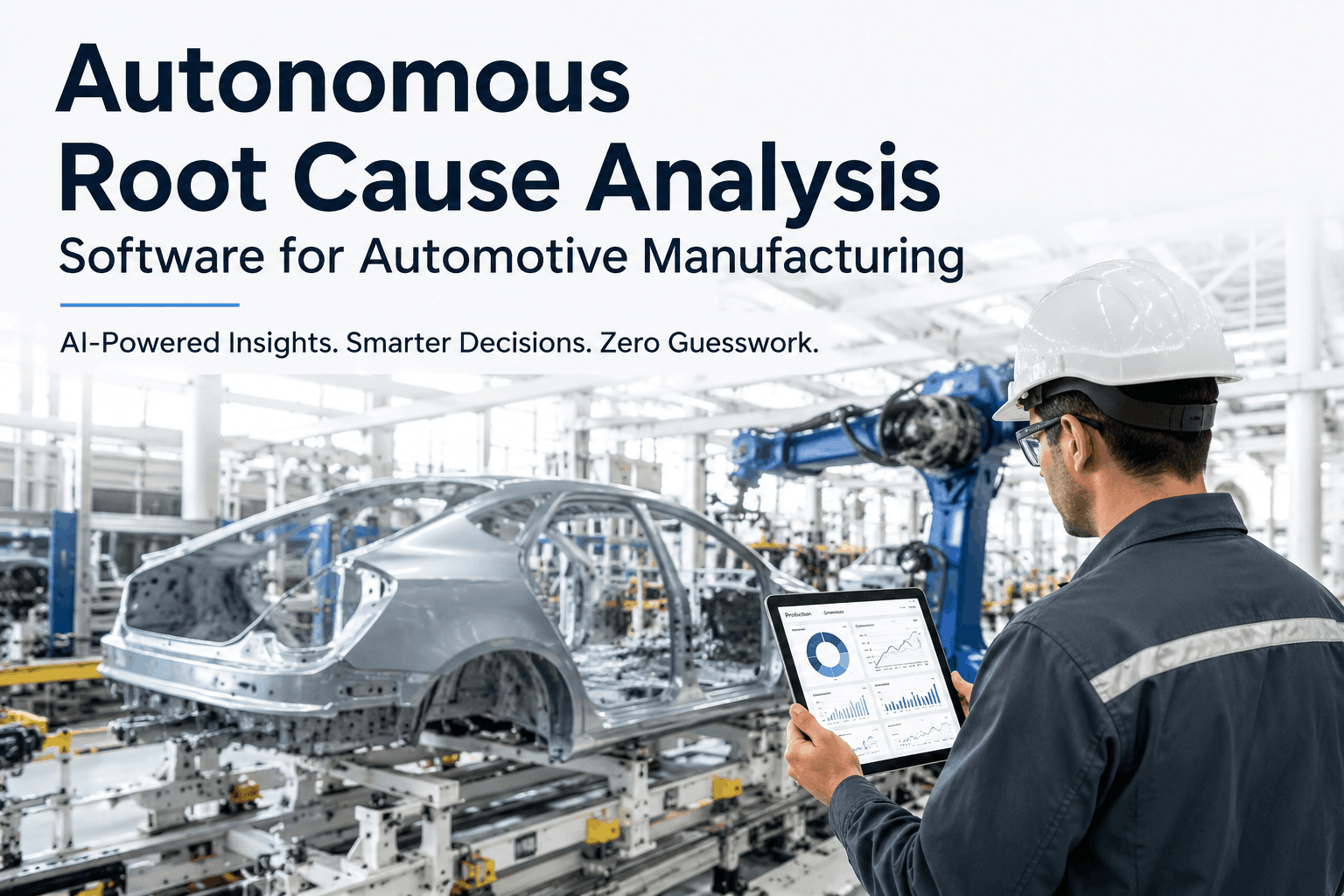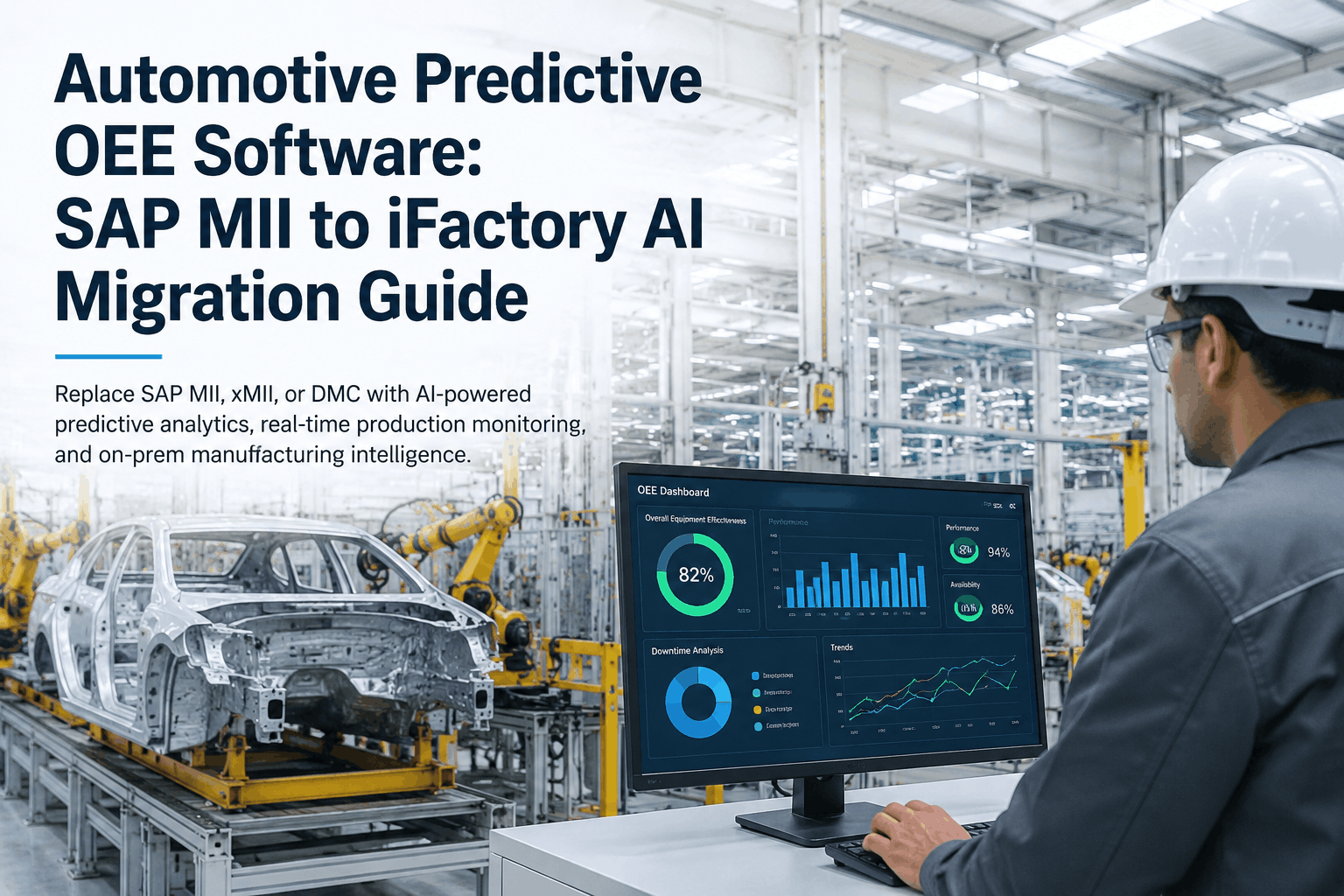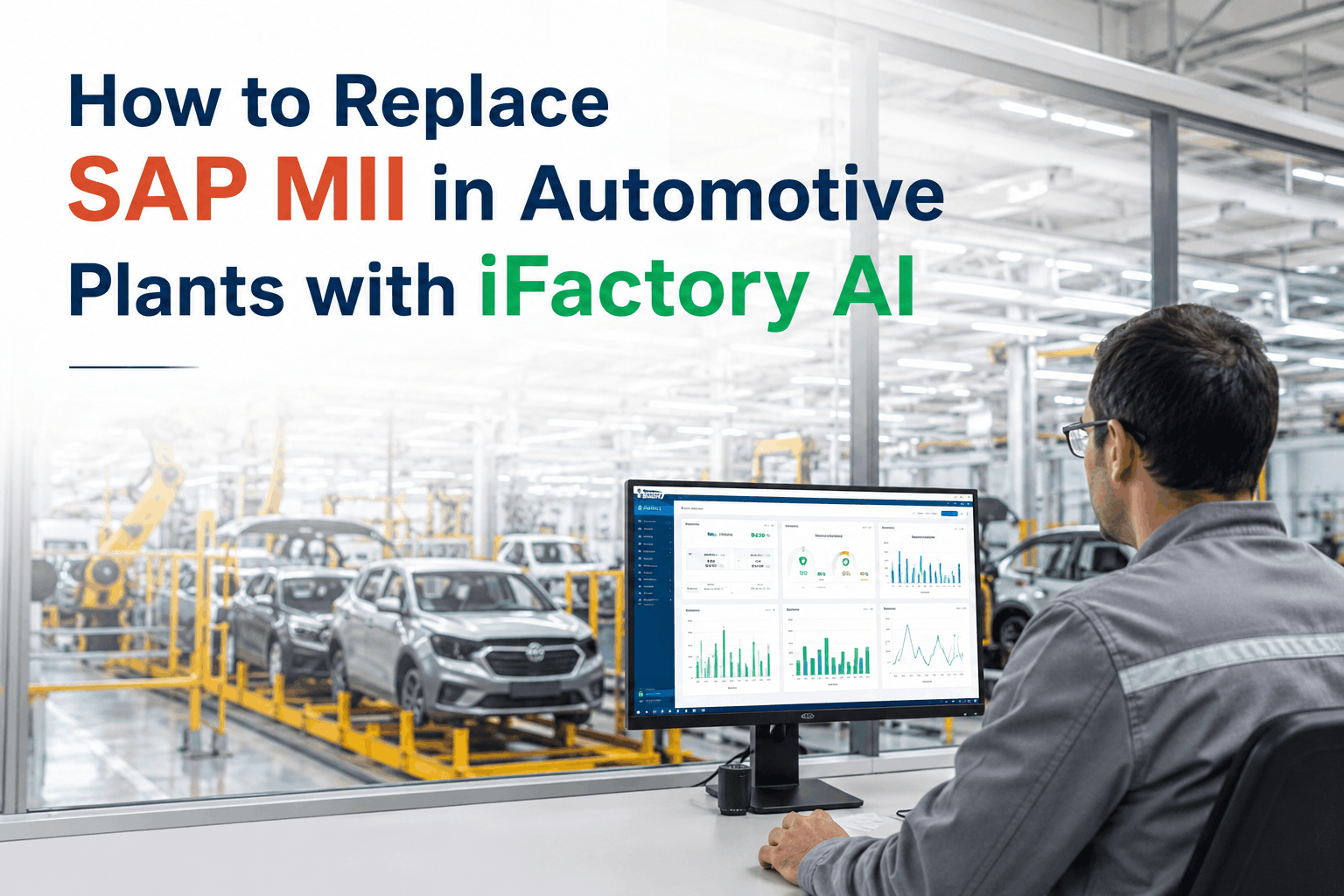
For automotive Quality Leaders, the SAP xMII modernization decision is not really about platform replacement — it's about the architecture choice underneath it. Cloud MES (SAP DMC) and on-prem AI-native platforms (iFactory AI) solve the same SAP MII 2027 deadline through fundamentally different architectures, and the difference matters more in automotive than in almost any other industry. IATF 16949 customer-specific requirements demand fast PPAP turnaround and audit-ready evidence at every plant; OEM scorecards penalize quality escapes ruthlessly; warranty cost prevention depends on catching drift before it ships; tier 1 supplier accountability requires data-rich quality investigations. Cloud MES architectures add latency budgets that don't fit automotive production speeds, expose proprietary process and customer data to off-prem residency, and depend on WAN reliability that 24×7 automotive plants can't tolerate. Edge AI on a pre-configured NVIDIA appliance keeps the validated quality envelope inside the plant, runs inference under 50ms, and supports the autonomous quality agent ecosystem that handles the routine work — SPC monitoring, defect investigation, supplier scorecard generation, audit evidence assembly, predictive warranty risk — while Quality Leaders provide oversight and exception decisions instead of manual data assembly. This page is the Quality Leader's strategic guide to why edge AI beats cloud MES for automotive SPC modernization, what autonomous quality agents actually do, and what the 6–12 week deployment looks like.
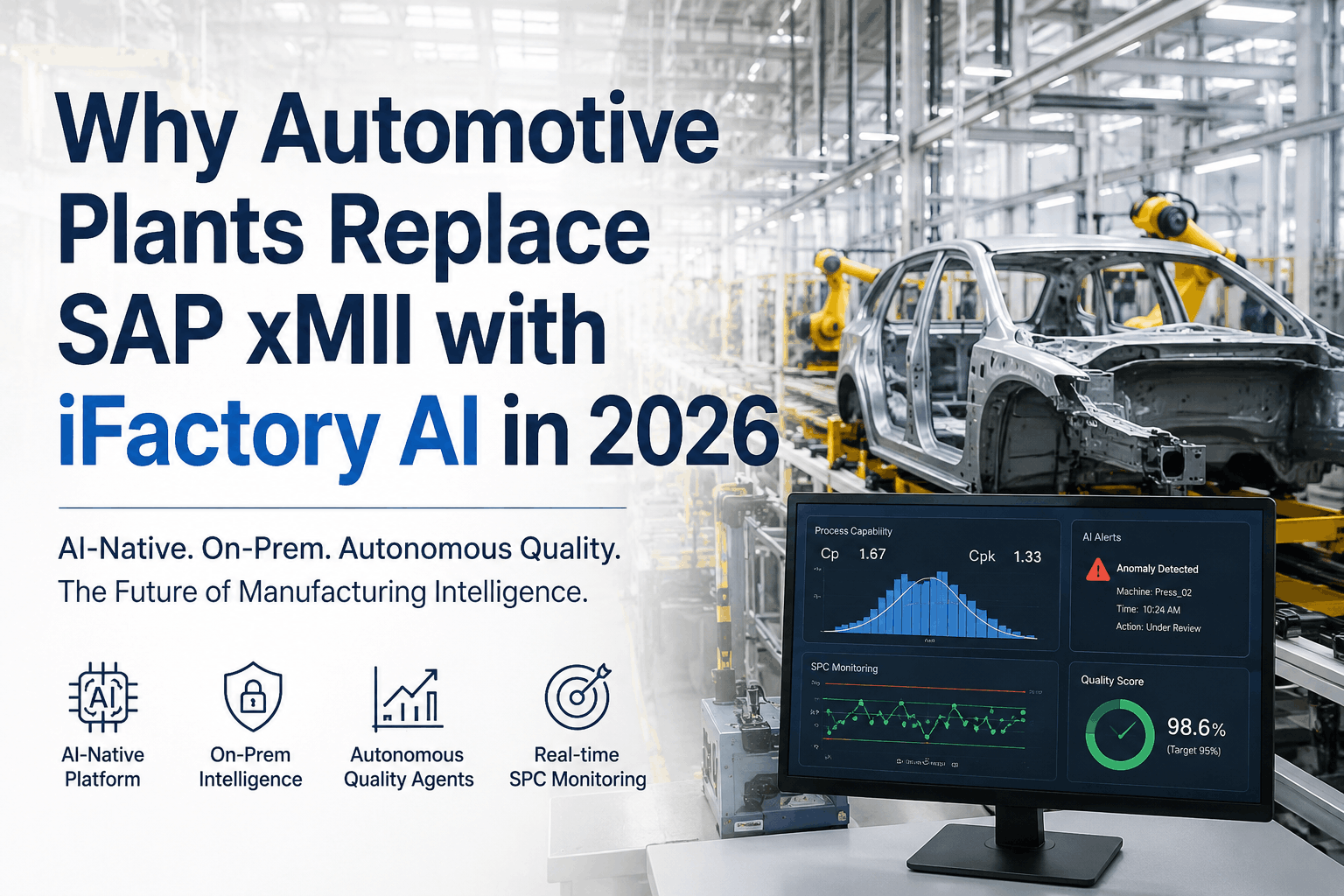
Why Automotive Plants Replace SAP xMII with iFactory AI in 2026
The Quality Leader's guide to edge AI vs cloud MES architecture for automotive SPC modernization — autonomous quality agents handling SPC, investigations, supplier scorecards, audit evidence, and warranty risk prevention. Pre-configured NVIDIA appliance, live in 6–12 weeks, IATF 16949 aligned out of the box.
Edge AI vs Cloud MES — The Architectural Choice That Determines Everything
SAP MII / xMII modernization gives Quality Leaders a forced architectural choice. SAP DMC moves the SPC layer to cloud-only deployment, inheriting all the trade-offs that cloud architecture brings to automotive operations — latency, IP exposure, WAN dependency. iFactory AI moves the SPC layer to AI-native edge deployment, preserving the validated plant boundary while adding capabilities cloud MES can't deliver: autonomous agents, sub-50ms inference, predictive warranty risk. The architecture difference shows up everywhere in the operations downstream.
The architectural difference compounds across every quality workflow. Cloud MES adds round-trip latency to every signal, makes process IP cross the plant boundary on every transaction, and creates WAN dependency that becomes operational fragility. Edge AI keeps inference local, keeps IP in the plant, and runs through WAN outages without operational impact. For automotive quality specifically, where customer audits and warranty exposure are continuous concerns, the edge architecture is the only one that fits.
Want a sized edge-vs-cloud comparison for your automotive operation? Schedule the AI Manufacturing Transformation Workshop — iFactory's automotive team will model your specific latency, IP exposure, WAN risk, and operational outcomes across the architectural alternatives. Sessions available this week.
Autonomous Quality Agents — The Five-Agent System for Automotive
"Autonomous quality agents" isn't marketing — each agent is an autonomous software entity with a defined quality workflow role, decision authority within its boundary, and a continuous learning loop. The five agents work as a coordinated system, sharing context through a unified quality knowledge graph. Quality Leaders manage outcomes; agents handle the routine work that historically consumed QA bandwidth.
SPC Agent
Adaptive control limits, multivariate monitoring across stamping, welding, paint, assembly.
Investigation Agent
Autonomous RCA when defect or excursion occurs · evidence chain built automatically.
Supplier Agent
Tracks incoming material quality, tier 2/3 supplier scorecards, lot trace.
Evidence Agent
Builds IATF 16949, PPAP, CSR audit packages continuously as activities occur.
Warranty Agent
Predicts warranty risk from process signatures · catches escapes before shipment.
Want to see all five autonomous quality agents running on a representative automotive scenario? Schedule the AI Manufacturing Transformation Workshop — sessions include live agent demonstration with stamping, body-in-white, paint, and assembly scenarios. Sessions available this week.
The Quality Leader Role — Manual Process vs Agent-Augmented
For automotive Quality Leaders specifically, the work itself changes when autonomous quality agents handle the routine layer. Today, Quality Leaders consume the majority of their time on manual data assembly, audit preparation, supplier escalation paperwork, and customer scorecard responses. With agent-augmented quality systems, the focus shifts to oversight, strategic supplier relationships, customer engagement, and warranty cost prevention.
Time spent on assembly
- Pulling SPC reports from xMII for weekly quality reviews
- Assembling PPAP submission packages manually for new programs
- Preparing for customer audits 1–3 weeks ahead
- Triaging deviation reports as they open across plants
- Responding to OEM customer scorecard inquiries reactively
- Tracking supplier quality issues across tier 2/3 in spreadsheets
- Reviewing CAPA documentation, often days after the event
- Manually correlating warranty claims to upstream process data
Time spent on decisions
- Reviewing SPC Agent flags and approving exception decisions
- Validating Evidence Agent PPAP packages before customer submission
- Approving Investigation Agent RCAs (or escalating to engineering)
- Strategic supplier relationship management — beyond escalations
- Proactive customer engagement before scorecard issues develop
- Cross-plant quality benchmarking and best-practice transfer
- Warranty cost-prevention program leadership
- Quality strategy development and resource prioritization
Three Migration Paths from SAP MII for Automotive Quality
Stay on MII / xMII
Extended maintenance, manual quality workflow continues, IATF audit prep stays manual. Customer scorecard pressure unchanged. No autonomous agents path.
SAP DMC (Cloud MES)
Cloud architecture inherits latency, IP exposure, WAN dependency. Same SPC paradigm — no autonomous agent capability. Full re-implementation effort.
iFactory AI Edge
Edge AI with five autonomous quality agents · IATF aligned · PPAP automation · supplier accountability · warranty prevention.
Six Automotive Quality Applications Where Agents Pay Back Fastest
Stamping Quality
SPC Agent on press tonnage, blank holder, die temperature · Investigation Agent for split / wrinkle / springback issues · AI Vision on panels.
Body-in-White Welding
SPC Agent on weld current, voltage, force, time · catches drift across hundreds of weld guns · AI Vision verifies weld nugget quality.
Paint & Finish Quality
SPC Agent on paint shop parameters (temperature, humidity, flow) · AI Vision catches dirt, runs, orange peel · predictive yield per booth.
Powertrain Machining
SPC Agent on machining parameters (spindle load, vibration, tool wear) · predictive yield · catches dimensional drift before final QC.
PPAP & CSR Automation
Evidence Agent builds PPAP packages, customer scorecard evidence, and IATF audit responses continuously · Quality Leader reviews rather than assembles.
Warranty Risk Prevention
Warranty Agent predicts warranty risk from process signatures · flags suspect units for additional inspection · catches escapes before shipment.
Want a quality-application-specific ROI projection for your automotive operation? Send your top SPC use cases, IATF certification scope, and current MII footprint to iFactory support and the automotive team will return a customised ROI map with 12-month roadmap — typically within 3 business days, no obligation.
IATF 16949, ISO 9001, CSR & PPAP — Built Into the Agents
Pre-built workflows for the major automotive quality frameworks
- IATF 16949 — automotive quality management system requirements
- ISO 9001 — quality management system foundation
- PPAP — Production Part Approval Process evidence assembly
- APQP — Advanced Product Quality Planning support
- FMEA — Failure Mode Effects Analysis integration
- MSA — Measurement System Analysis automation
- SPC per AIAG manual — full Western Electric and Nelson Rules
- Customer-Specific Requirements (CSRs) — Ford, GM, FCA, VW, Toyota
The Evidence Agent consolidates compliance evidence assembly across all these frameworks, building audit-ready packages continuously rather than retrospectively. Customer audit prep typically drops from 1–3 weeks of manual assembly to 2–4 hours of review and approval. PPAP submission for new programs accelerates from days of evidence preparation to hours of validation.
Two Real Automotive Quality Outcomes
Tier 1 automotive supplier with multiple OEM customers and high CSR/PPAP burden
A tier 1 automotive supplier producing complex assemblies for three OEMs (Ford, GM, VW) across two plants. Quality team consumed 35–45% of bandwidth on PPAP submissions, customer audit prep, and CSR scorecard responses. Audit prep for any single customer ate 1–2 weeks. SAP MII handled SPC data but provided no agent-augmented workflow.
Mid-volume engine manufacturer with elevated warranty cost on specific failure modes
A mid-volume automotive engine manufacturer producing 800K engines annually. Warranty cost ran $84M annually, with 40% attributable to identifiable process signatures that hindsight analysis could detect but front-line operations couldn't catch. SAP xMII captured the data but couldn't predict warranty risk from in-process signatures.
Neither scenario matches your operation? Send your customer mix, IATF scope, and SAP xMII footprint to iFactory support and the automotive team will return a customised migration analysis with quality outcome projections and 12-month roadmap — typically within 3 business days, no obligation.
iFactory's Automotive Deployment — On-Premise or Cloud
Same AI-native platform on either deployment model. Same five autonomous quality agents, same IATF 16949 framework alignment, same agent learning loop. For automotive specifically, on-prem edge is the strongly recommended default because of the architectural arguments above — but the cloud option is available for OEMs with established cloud governance frameworks that accommodate the trade-offs.
iFactory On-Premise Edge Strong default for automotive Quality Leaders
- Pre-configured NVIDIA AI server — racked, software-loaded, ready to plug in.
- <50ms edge inference — keeps up with stamping, weld guns, paint lines, assembly.
- Process IP and customer data stay in plant — protects competitive position.
- Works during WAN outages — 24×7 operations continue uninterrupted.
iFactory Cloud For multi-plant OEMs with established cloud governance
- Fully managed — no rack, no facility requirements.
- Same five quality agents — SPC, investigation, supplier, evidence, warranty.
- Cross-plant quality benchmarking across all sites in one tenant.
- Fastest deployment — first plant live in 2–4 weeks.
Architecture is the decision. Everything else follows from it.
Cloud MES inherits latency, IP exposure, and WAN dependency that don't fit automotive quality operations. Edge AI keeps inference local, IP protected, and operations resilient — and enables the autonomous quality agent ecosystem that consolidates the routine work Quality Leaders historically did manually. The AI Manufacturing Transformation Workshop sizes the migration for your specific automotive operation.
Frequently Asked Questions
Why is edge AI so much more important for automotive than other industries?
Three reasons specific to automotive quality. First, OEM customer scorecards penalize quality escapes ruthlessly and demand fast PPAP turnaround, both requiring low-latency edge inference. Second, IATF 16949 audit cycles and CSR-specific requirements create continuous audit-readiness pressure that on-prem evidence assembly handles better than cloud-resident records. Third, automotive production speeds (stamping cycles, weld guns, paint flow) don't tolerate cloud round-trip latency for in-process quality decisions.
What's the difference between the SPC Agent and the Investigation Agent?
The SPC Agent monitors parameters continuously and surfaces anomalies, predictions, and recommended adjustments — it owns the detection workflow. The Investigation Agent activates when a defect or excursion has occurred — it owns the root cause investigation workflow autonomously, building a complete causal chain with supporting evidence in 3–5 minutes versus days of manual investigation. The two agents work together — SPC Agent prevents what it can; Investigation Agent investigates what gets through.
How does the Warranty Agent actually predict warranty risk from in-process data?
LSTM models trained on 24–36 months of warranty claim data correlated to upstream process signatures learn which combinations of process parameters predict elevated warranty risk for specific failure modes. For mature deployments, the Warranty Agent flags 30–50% of warranty-causing units before shipment with manageable false-positive rates (typically under 8%). The learning loop continuously improves accuracy as more warranty data and corrective outcomes flow through.
Does iFactory integrate with OEM customer portals and PPAP systems?
Yes. iFactory provides connectors to major OEM customer portals (GM Supply Power, Ford SREA, Stellantis eSupplierConnect, VW Group Portal, Toyota TSDS) and PPAP submission systems. The Evidence Agent assembles PPAP packages in the OEM-specific format required and supports direct portal submission. The deployment team handles customer integration during the 6–12 week installation.
Do I have to buy NVIDIA servers separately?
No. iFactory's on-premise appliance ships fully loaded — pre-configured NVIDIA AI server, software pre-installed, network gear, cabling, industrial cameras for stamping/weld/paint inspection, edge devices for line-side inference. You provide rack space, line power, Ethernet, and PLC/SCADA/MES integration points. The deployment team handles all installation and configuration. For cloud, no hardware investment at all.
Can we deploy autonomous agents progressively rather than all at once?
Yes — agent activation is typically phased. Most automotive plants start with SPC Agent and Evidence Agent during weeks 4–6 of go-live (the highest-impact Quality Leader value), then add Investigation Agent (autonomous RCA) once supplier and operator confidence is established. Supplier Agent typically activates next as the scorecard framework. Warranty Agent runs in shadow mode from day one and gradually takes on shipment flagging authority. Full ecosystem operational by month 3.
What does the AI Manufacturing Transformation Workshop cover?
The half-day workshop covers — current-state SAP xMII assessment, edge AI vs cloud MES architectural analysis specific to your plant, autonomous quality agent demonstration with automotive scenarios, customer audit/PPAP impact analysis, three-path migration comparison, deployment roadmap with milestones, and ROI projection on quality outcomes and warranty cost. Outcome is a concrete migration recommendation. Suitable for Quality Leaders, operations, IT, finance, and customer-facing teams.
Quality Leaders manage outcomes. Autonomous agents handle the work.
The architecture you choose for SAP xMII modernization determines whether you spend the next decade on manual data assembly or on strategic quality leadership. Cloud MES inherits the manual paradigm with worse latency. Edge AI with autonomous quality agents transforms the role. The AI Manufacturing Transformation Workshop is the fastest way to see what this looks like specifically for your automotive operation — sessions available this week, on-premise NVIDIA appliance or fully managed cloud deployment.