For food and beverage Manufacturing Executives, the SAP xMII modernization decision lands at the board level for reasons that don't apply in other industries. F&B brands carry continuous brand exposure tied to product safety, retailer scorecards, customer recalls, and GFSI inspection outcomes — and the platform that runs SQC monitoring affects every one of those exposure vectors. Cloud-only MES architectures (SAP DMC and equivalents) introduce trade-offs that look like checkboxes in vendor evaluations but show up as P&L impact in operations: latency that doesn't fit high-speed filling and packaging, recipe IP exposure that customer audit teams now actively question, bandwidth budgets that high-volume vision inspection breaks, and operational fragility that 24×7 F&B plants can't tolerate. iFactory AI is the on-prem AI-native alternative purpose-built for F&B SQC optimization — AI Vision Inspection across filling, packaging, and product appearance; adaptive control limits tuning automatically to SKU, line, and shift; predictive yield models on every batch; running on a pre-configured NVIDIA appliance with deployment in 6–12 weeks. The same platform is also available as fully managed cloud for F&B companies with hybrid IT strategies that already accommodate the trade-offs. This page is the Manufacturing Executive's strategic guide to why cloud-only MES fails for F&B operations — and what works instead at scale.
Best SQC Optimization Software for Food & Beverage Plants in 2026
The F&B Manufacturing Executive's guide to why cloud-only MES fails for SQC optimization — and how iFactory AI's on-prem AI-native platform with AI Vision Inspection replaces SAP MII/xMII at multi-plant scale. Beats SAP DMC on speed, brand protection, audit readiness, and 3-year TCO. Pre-configured NVIDIA appliance, live in 6–12 weeks.
Why Cloud-Only MES Fails for F&B Manufacturing — Six Structural Reasons
Cloud MES sells well in vendor RFPs but breaks down in F&B operations across six predictable failure points that compound at multi-plant scale. Each one shows up in your P&L within the first year — sometimes as missed yield, sometimes as audit failures, sometimes as brand exposure events. The six are independent enough that solving one doesn't solve the others. They share a common root cause: cloud architecture wasn't designed for the speed, brand sensitivity, and operational continuity that F&B manufacturing requires.
Latency at Filling Speed
Beverage filling at 1000+ containers/min and high-speed packaging at 200+ packs/min generate inspection events faster than cloud round-trip can respond. Affected products ship before any alert returns.
Recipe & Formulation IP Exposure
F&B recipes, ingredient lists, and process parameters are strategic IP. Cloud tenants move this data off-prem where customer audit teams and competitor risk increasingly question residency.
Vision Inspection Bandwidth
High-resolution AI Vision on every container generates 50–150 GB of inspection data per shift per line. Multi-line F&B plants overwhelm typical WAN budgets, forcing aggressive downsampling.
24×7 Operational Fragility
F&B plants run 24×7×365 with thin margins. A WAN outage of 30 minutes that takes down cloud MES costs hundreds of thousands in lost production — and brand exposure if it causes scrapped batches.
Multi-Plant Cybersecurity Surface
F&B companies with 10–50 plants face expanded cybersecurity exposure with cloud-only tenants. Brand reputation tied to product safety makes the cyber surface area question existential, not technical.
GFSI / Retailer Audit Complications
SQF, BRC, FSSC 22000, and retailer customer audits increasingly scrutinize off-prem residency of food safety records. On-prem evidence assembly stays simpler and audit-defensible than cloud-resident records.
For F&B Manufacturing Executives, the SAP DMC migration path solves the 2027 SAP MII maintenance question but inherits these six structural problems. The on-prem AI-native path with iFactory solves the maintenance question without inheriting cloud's mismatches with F&B operations at scale.
Want a multi-plant F&B-specific analysis of the cloud failure points applied to your operation? Schedule the AI Manufacturing Transformation Workshop — iFactory's F&B team will assess your specific bandwidth, latency, IP protection, and audit posture against the three migration paths. Sessions available this week.
AI Vision Inspection — The Single Largest F&B Quality Capability of the Past Decade
What replaces manual inspection across F&B operations
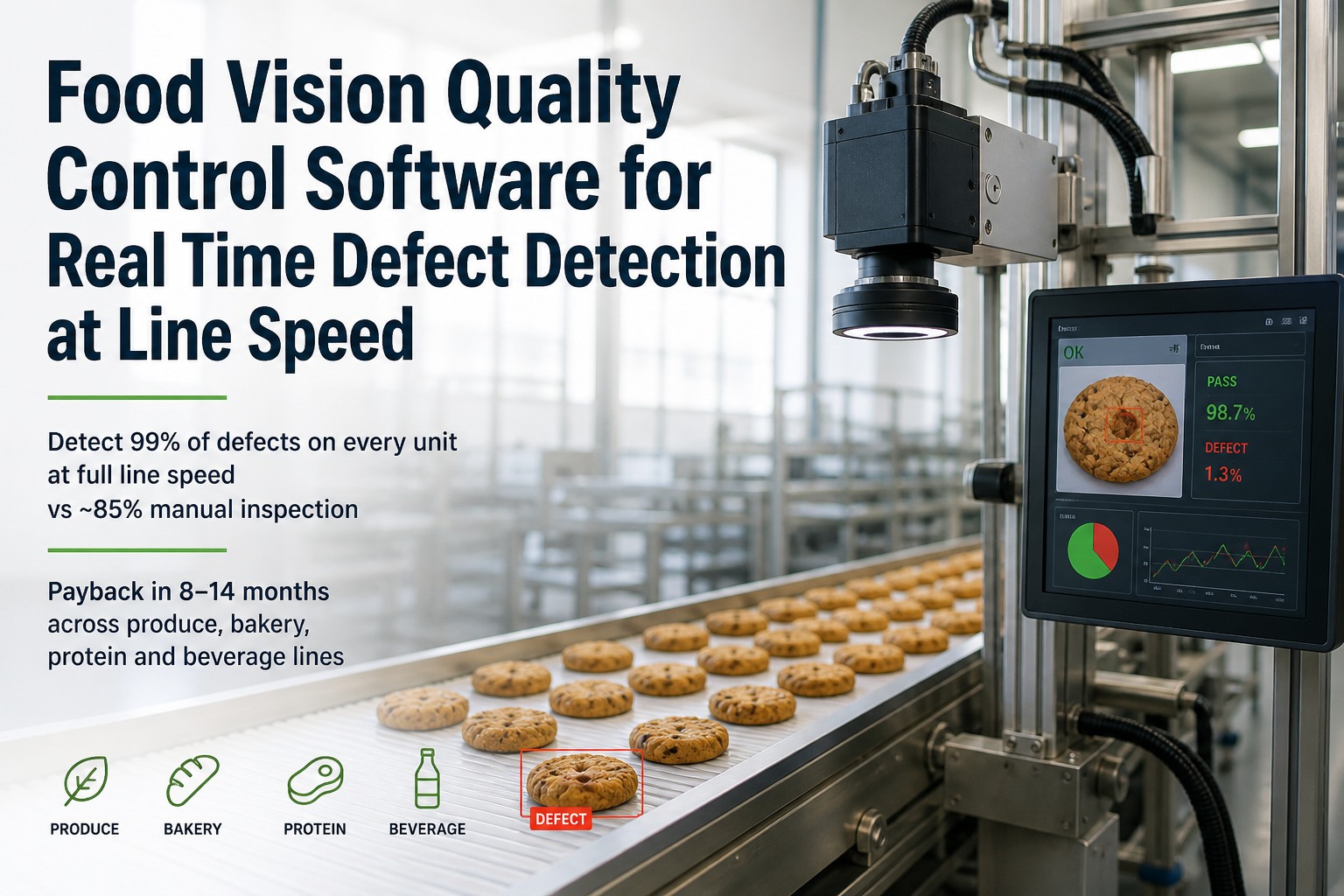
AI Vision Inspection has rewritten what's possible in F&B quality assurance. Bottles, cans, jars, blister packs, snack bags, frozen meal trays, fresh produce, baked goods — all inspectable inline at production speed with detection accuracy that exceeds manual inspection. iFactory's CNN-based vision models ship pre-trained on F&B defect taxonomies and fine-tune on your specific products during the 6–12 week deployment.
Container & Packaging Inspection
Bottle, can, jar, pouch, blister inspection — fill level, label verification, seal integrity, code readability, cap orientation.
Product Appearance Inspection
Snack chip uniformity, baked goods color/shape, frozen meal portion verification, fresh produce grading, confectionery defects.
Foreign Object Detection
X-ray + visual fusion detects metal, plastic, bone, glass, stones in product flow. Meets retailer customer FOD standards.
Beverage Clarity & Color
Spectral measurement of color, clarity, turbidity, foam in beverage filling. Catches batch-to-batch variation upstream.
Want to see AI Vision Inspection running on representative F&B products from your operation? Schedule the AI Manufacturing Transformation Workshop — sessions include live AI Vision demonstration matched to your product portfolio and packaging types. Sessions available this week.
The Executive Multi-Plant Dashboard — What You Actually See
For F&B Manufacturing Executives running 10–50 plants, the platform value isn't what individual operators see — it's what the executive layer sees across the network. iFactory rolls plant-level AI intelligence into an executive dashboard view showing yield, audit posture, brand-exposure events, and platform health across all sites in real-time.
Three Migration Paths from SAP MII for F&B Manufacturing
Stay on MII / xMII
Extended maintenance, accumulating brand-exposure risk, no AI Vision capability, no multi-plant executive dashboard. Continues working but doesn't move yield.
SAP DMC (Cloud-Only)
Cloud-only architecture inherits all six failure points listed above — latency, IP exposure, bandwidth, WAN dependency, cyber surface, audit complexity. Per-plant cost compounds at multi-plant scale.
iFactory AI On-Prem
AI Vision Inspection + adaptive SQC + predictive yield · on-prem appliance · network-wide executive dashboard · brand-protection-tuned out of box.
Want a sized F&B-specific multi-plant migration analysis comparing all three paths? Schedule the AI Manufacturing Transformation Workshop — iFactory's F&B team will model your specific cost, timeline, and brand-protection outcomes with your plant footprint, current MII state, and product portfolio. Sessions available this week.
Six F&B Operations Where AI Vision Inspection Delivers Fastest
Beverage Filling Lines
AI Vision verifies fill level, label position, cap integrity, code readability at 1000+ containers/min. Catches drift before retailer scorecard impact.
Packaging Quality
100% inspection of seal integrity, missing items, label alignment, serial/lot codes. Eliminates retailer return events and recalls.
Foreign Object Detection
X-ray + visual fusion catches contamination down to 1mm. Critical for brand protection — single foreign-object recall can cost $10M+.
Product Appearance
AI Vision grades color, shape, size, surface defects on baked goods, snacks, confectionery. Tighter quality distribution.
Portion & Weight Verification
Multi-component assembly verification — every portion checked for component presence, weight compliance, plate layout adherence.
Color & Clarity Monitoring
Spectral measurement of color delta-E, turbidity, foam. Catches batch-to-batch drift upstream of customer scorecard impact.
Want an application-specific projection for your F&B operations? Send your top SQC use cases and current MII footprint to iFactory support and the F&B team will return an application-tuned ROI analysis with 12-month roadmap — typically within 3 business days, no obligation.
HACCP, FSMA, GFSI & Retailer Customer Audits — Built In
Pre-built workflows for F&B compliance frameworks
- HACCP — Hazard Analysis Critical Control Point records
- FSMA — 21 CFR Part 117 Preventive Controls evidence
- GFSI standards — SQF, BRC, FSSC 22000 audit packages
- FDA Food Traceability Final Rule — lot trace forward/backward
- USDA inspection support — meat, poultry, egg products
- 21 CFR Part 11 — electronic records (where applicable)
- Retailer customer scorecard reporting — automated
- Allergen control + sanitation evidence — automated
The Evidence Layer consolidates compliance evidence assembly across all these frameworks, building audit-ready packages continuously rather than retrospectively. Customer audit prep typically drops from 1–4 weeks of manual assembly to 2–4 hours of review and approval per plant. Multi-plant audit posture becomes uniformly green rather than rotating crisis.
Two Real F&B Executive Migration Outcomes
Beverage company with 14 plants, retailer customer scorecard pressure, and recall risk concerns
A national beverage company operating 14 plants serving top-5 US retailers with stringent customer scorecards. SQC handled by SAP xMII with manual quality checks at filling stations. Two minor product quality events in prior 24 months created board-level brand protection conversations. Evaluating SAP DMC migration ($35M+ network estimate) versus AI-native alternative.
CPG snack and confectionery group with 22 plants and rotating GFSI/SQF audit pressure
A CPG snack and confectionery group operating 22 plants across multiple product lines. Audit prep consumed 2–3 weeks per plant per audit cycle (3+ cycles annually per plant). Total audit-prep labor cost across network exceeded $4.8M annually. SAP MII handled SPC; audit evidence assembled manually each cycle.
Neither scenario matches your situation? Send your plant footprint, customer mix, and current SAP MII state to iFactory support and the F&B team will return a customised network-wide analysis with brand-protection projection and 12-month roadmap — typically within 3 business days, no obligation.
iFactory's F&B Deployment — On-Premise or Cloud
Same AI-native platform on either deployment model. Same AI Vision Inspection, adaptive SQC, predictive yield, executive dashboard. For F&B specifically, on-prem is the strongly recommended default because of the six structural cloud failure points listed above — but the cloud option is available for F&B companies with established cloud governance frameworks that accommodate the trade-offs.
iFactory On-Premise Appliance Strong default for F&B Manufacturing Executives
- Pre-configured NVIDIA AI server — racked, software-loaded, ready to plug in.
- Recipe IP stays inside each plant — protects formulations from cloud exposure.
- <50ms edge inference — keeps up with high-speed filling and packaging.
- Works during WAN outages — 24×7 operations resilient.
iFactory Cloud For F&B companies with established cloud governance
- Fully managed — no rack, no facility requirements.
- Same AI Vision + SQC stack — yield, audit, executive dashboard.
- Cross-plant benchmarking across all F&B plants in one tenant.
- Fastest deployment — first plant live in 2–4 weeks.
F&B operations need the architecture, not just the analytics.
AI Vision Inspection, adaptive SQC, predictive yield, executive multi-plant dashboard — all running on a pre-configured NVIDIA appliance inside each F&B plant. Recipe IP stays inside the plant, inspection runs at line speed, audit evidence assembles continuously. The AI Manufacturing Transformation Workshop sizes the migration with concrete F&B-specific projections for your network.
Frequently Asked Questions
Why is on-prem more important for F&B than other industries?
Three reasons specific to F&B at scale. First, brand protection — F&B brands carry continuous exposure tied to product safety and recalls; cloud-resident records add audit complexity that on-prem doesn't. Second, recipe IP — F&B formulations are strategic IP that customer audit teams increasingly question off-prem residency for. Third, production speed — beverage filling and packaging speeds don't tolerate cloud round-trip latency for in-flight quality decisions.
How does AI Vision Inspection compare to traditional vision systems?
Traditional vision systems use rule-based detection — define a threshold, flag what's outside it. AI Vision uses CNN-based deep learning trained on thousands of defect examples, achieving 99.7% accuracy across 12+ defect classes per application versus typical rule-based systems at 85–92%. AI Vision also handles SKU changes without reprogramming and learns continuously from operator-verified outcomes.
How does this work for multi-plant F&B operations?
For multi-plant networks, the recommended approach is pilot at 1–3 plants (6–12 weeks each), then expand to remaining plants in waves with 2–4 weeks per plant. Plants 4+ benefit from templated workflows, validated models, and operator training materials developed during the pilot. Total program time for a 10–25 plant F&B network typically runs 6–14 months end-to-end with the executive dashboard live network-wide from week 12.
What about retailer customer audit requirements?
Major retailers (Walmart, Target, Costco, Tesco, Carrefour) have specific quality audit and scorecard requirements. iFactory's Evidence Layer builds retailer-specific reporting packages continuously — automated generation in each retailer's preferred format. Quality teams review and submit rather than assembling from spreadsheets each cycle. Retailer scorecard responses typically improve from yellow/red to green within 6 months of full deployment.
Do I have to buy NVIDIA servers separately?
No. iFactory's on-premise appliance ships fully loaded — pre-configured NVIDIA AI server, software pre-installed, network gear, cabling, industrial cameras for line inspection, edge devices for line-side inference. You provide rack space, line power, Ethernet, and PLC/SCADA integration points. The deployment team handles all installation and configuration. For cloud, no hardware investment at all.
Can we migrate one plant first before going network-wide?
Yes — and it's the recommended approach. Start with the plant where AI Vision and yield improvement would have the biggest impact (typically highest-volume or highest-customer-pressure site). Validate the brand-protection and yield gains, prove the executive dashboard value, build confidence with the network rollout. Then expand plant-by-plant in 2–4 week waves with templated deployments.
What does the AI Manufacturing Transformation Workshop cover?
The half-day workshop covers — current-state SAP MII assessment across your network, six-failure-point cloud risk analysis specific to F&B, AI Vision Inspection demonstration on your product portfolio, executive dashboard walkthrough, three-path migration comparison with multi-plant cost/timeline projections, deployment roadmap with milestone dates. Outcome is a concrete migration recommendation. Suitable for Manufacturing Executives, operations, IT, QA, and finance representatives.
Cloud-only MES was built for a different industry. F&B operations need different architecture.
SAP MII's 2027 maintenance end-date is fixed; the question is which architectural path your network takes. SAP DMC inherits all six cloud failure points multiplied by every plant. iFactory AI delivers AI Vision Inspection, adaptive SQC, predictive yield, and executive multi-plant dashboard on a pre-configured NVIDIA appliance per plant — recipe IP protected, brand exposure minimized, audit posture continuous, operations resilient. The Transformation Workshop is the fastest way to size the network migration for your specific F&B operation.