For the digital transformation leader at a pharmaceutical manufacturer, this is the question on the board's table: SAP MII and PCo are reaching end-of-life in December 2027, the FDA and EMA jointly released their Good AI Practice principles in January 2026, EU GMP Annex 22 governing AI in pharma manufacturing publishes late 2026 with enforcement starting 2027, and your visual inspection still relies on rule-based vision systems that miss the defect classes your competitors' AI already catches. The path forward isn't a like-for-like migration from SAP MII to SAP DMC — both enforce the same legacy SPC paradigm where every line uses static control charts, every defect class needs hand-tuned thresholds, and every batch release waits on manual visual inspection by trained operators. The path forward is leapfrogging — moving directly from legacy SPC into AI-native manufacturing intelligence built around Deep Learning Vision Inspection that catches particles, cracks, fill anomalies, label misregistration, and seal defects at 99.5%+ accuracy on validated CNN models, with full 21 CFR Part 11 audit trails, EU GMP Annex 11 alignment, and the static-model requirement from Annex 22 honored from day one. iFactory AI ships as a pre-configured NVIDIA appliance — racked, software-loaded, GxP-ready, deployed in 6–12 weeks. AI Vision Inspection sits at the center; Predictive SPC, Autonomous RCA, and Industrial GenAI Copilot are integrated capabilities on the same platform. Cloud option available for multi-plant operators. This is the digital transformation leader's guide to ending legacy SPC and moving pharma into AI-native vision-led manufacturing.
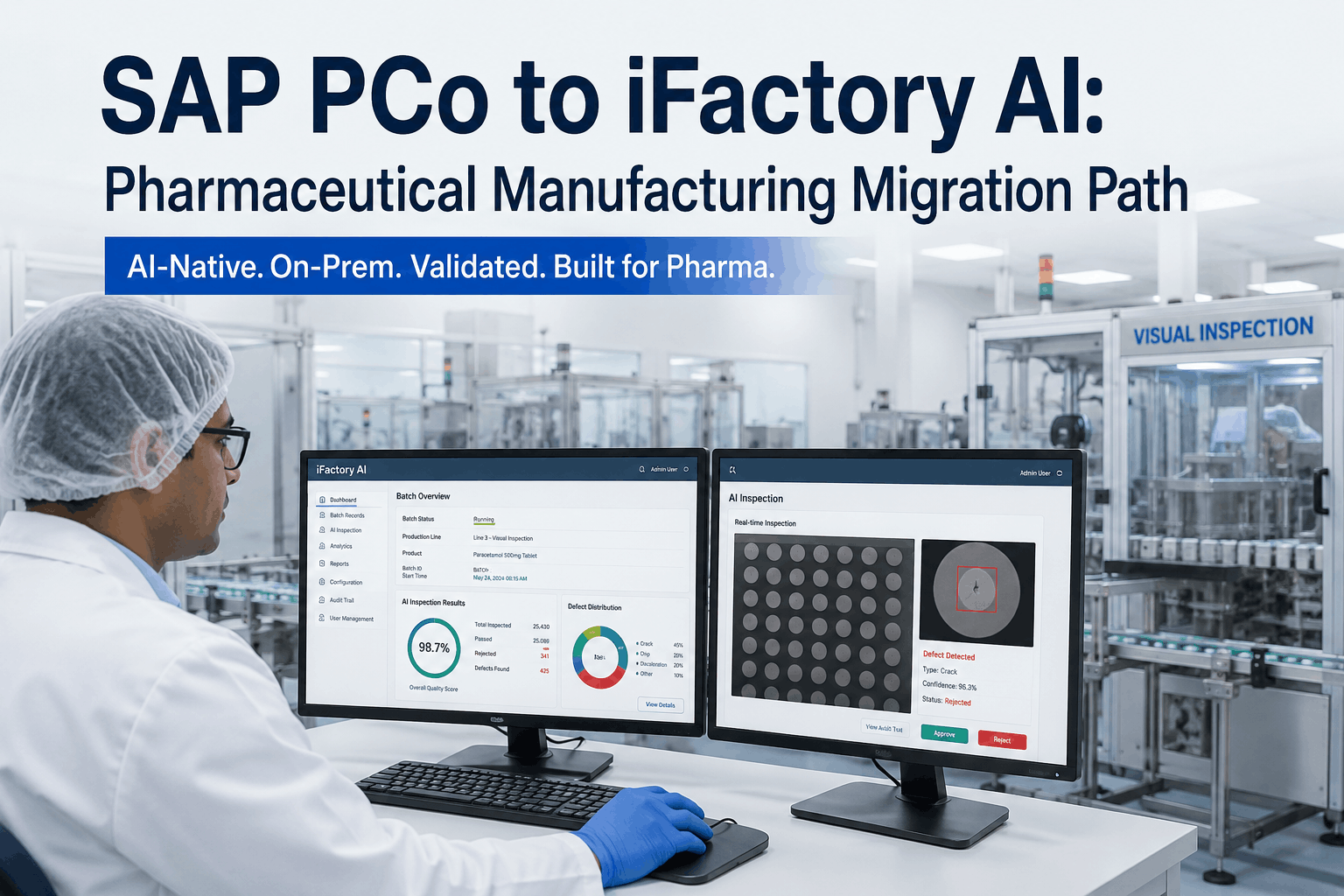
SAP PCo to iFactory AI: Pharmaceutical Manufacturing Migration Path
The end of legacy SPC for pharmaceutical manufacturing. Deep Learning Vision Inspection at 99.5%+ accuracy, validated CNN models with 21 CFR Part 11 audit trails, Annex 22-aligned static-model architecture, and three integrated AI capabilities — all on a pre-configured NVIDIA appliance. Live in 6–12 weeks.
Legacy SPC Is Ending — Here's What's Replacing It
For twenty years, pharmaceutical visual inspection has worked the same way. Rule-based vision systems with hand-tuned thresholds. Static SPC charts on every CTQ. Trained operators performing 100% manual inspection on critical defect classes. Batch release waiting on QA review of inspection records. The model worked when defect classes were few, lines were slow, and the regulatory framework was static. None of those conditions still hold. Modern pharmaceutical lines run faster, ship more SKUs per shift, face tighter defect-class taxonomies under the 2025–2026 regulatory updates, and operate in a labor market where trained visual inspectors are increasingly scarce. The legacy SPC paradigm is ending; the question for the digital transformation leader is what replaces it.
How Pharma SPC Worked
How Pharma Vision Works Now
AI Vision Inspection — The Centerpiece of iFactory for Pharma
Deep Learning Vision Inspection is the capability that ends legacy SPC for pharmaceutical manufacturing. Where rule-based systems define defects with thresholds, CNN models learn defect signatures from validated training sets — recognizing particles, cracks, fissures, fill anomalies, color deviations, label misregistration, missing components, and seal defects that hand-tuned thresholds simply can't characterize. Where rule-based systems require re-tuning for every new SKU, validated CNN models generalize across product families and adapt during validation runs. Where rule-based systems treat inspection as a binary pass/fail, iFactory AI Vision produces confidence-scored classifications with full image evidence chains that satisfy 21 CFR Part 11 audit requirements natively.
Particulate Detection
CNN models trained on validated particulate libraries — glass shards, fiber, foreign matter, agglomerates in injectable vials and IV bags.
Container Integrity
Crack, fissure, dent, and stress-mark detection on vials, ampoules, syringes, cartridges. Catches micro-cracks invisible to rule-based vision.
Fill & Closure
Fill-level verification, headspace check, stopper seating, crimp integrity, cap presence. Multi-CNN model evaluates each station in parallel.
Label & Serialization
Label position, text legibility, lot code verification, 2D code readability, serialization data integrity for DSCSA and EU FMD compliance.
Secondary Packaging
Carton fill, leaflet presence, tamper-seal integrity, blister-pack count, case fill verification before palletizing.
Want to see Deep Learning Vision Inspection running against your specific defect taxonomy? Schedule a Demo — workshop sessions include a live demonstration on representative pharmaceutical defect classes from your product portfolio. Sessions available this week.
21 CFR Part 11 & EU GMP Annex 22 — Built Into the Architecture
This is the section that matters most for the digital transformation leader. Regulatory compliance for AI in pharmaceutical manufacturing is no longer optional or future-state — it's the active 2026–2027 landscape. iFactory AI's architecture is designed against the specific requirements that govern AI in GMP manufacturing.
Electronic records & signatures
Every AI Vision decision is captured as a time-stamped electronic record with computer-generated audit trail. Operator entries, model versions, image evidence, and inference results are independently documented per 11.10(e). User authentication, access controls, and signature manifestation follow ALCOA+ principles.
Computerised systems
System validation aligned to GAMP 5 categories. Risk-based validation approach for AI Vision per Annex 11 §1 risk management. Configuration management, change control, periodic review, and supplier qualification documented in standard validation packages.
AI in GMP manufacturing
iFactory AI Vision uses static, deterministic CNN models — Annex 22's explicit requirement for AI in GMP-critical processes. No continuous learning in production. Model retraining is a controlled change-control event. Generative AI in the Copilot is segregated from inspection decisions and used only for non-GMP-critical operator assistance.
Good AI Practice (January 2026)
iFactory aligns to the 10 joint FDA/EMA principles — human-centric design, fitness for purpose, risk-based validation and oversight, multi-disciplinary expertise, and robust data governance. All AI decisions remain reviewable; final batch disposition stays with qualified human reviewers.
Attributable, Legible, Contemporaneous, Original, Accurate, plus Complete, Consistent, Enduring, Available
The Autonomous RCA evidence chain is built to ALCOA+ from inception. Every inspection event, every model decision, every operator action linked to user, time, image, and model version. Audit-ready, queryable across the full retention period.
The Three Complementary Capabilities — Beyond Vision
AI Vision is the centerpiece. The same iFactory NVIDIA appliance carries three more AI capabilities that close the gap between SAP MII / PCo and modern pharmaceutical manufacturing intelligence.
Predictive SPC
Forecasts process drift hours before traditional control-limit breach. Adaptive to product, batch, equipment age, and customer spec. Validated for GMP use as a process monitoring tool — final disposition stays with QA.
Autonomous RCA
When a deviation occurs, AI runs the multivariate investigation across upstream process data, raw materials, equipment history, and operator actions — surfacing top-3 root cause hypotheses with confidence scores in minutes. Evidence chain built to ALCOA+.
Industrial GenAI Copilot
Trained on your SOPs, batch records, validation documents, and GMP procedures. Available to operators and quality engineers for non-GMP-critical assistance — SOP lookup, deviation drafting, training support. Segregated from inspection decisions per Annex 22.
Pharmaceutical Verticals — Where AI Vision Pays Off Fastest
Sterile Injectable Manufacturing
Vial, ampoule, syringe, cartridge inspection at high speed. Particulate detection, container integrity, fill verification, stopper and crimp inspection.
Solid Oral Dose
Tablet, capsule, blister inspection. Color/shape/print quality, capsule integrity, blister-pack count, fill consistency. Coating uniformity through inline imaging.
Biologics & Biosimilars
High-value batch inspection with stringent particulate and integrity requirements. Bioreactor process monitoring with Predictive SPC plus AI Vision on every vial.
API & Bulk Pharma
Crystal size and uniformity, color consistency, packaging integrity. Predictive SPC on reactor temperature, pH, and dissolution. Continuous process verification.
Secondary Packaging
Carton fill, leaflet presence, tamper-seal, label position, serialization verification. DSCSA and EU FMD compliance at line speed with full audit trail.
Cell & Gene Therapy
Ultra-low-volume inspection, individual product traceability, complete chain-of-identity. Vision plus traceability for personalized therapies.
Want a vertical-specific analysis for your operation? Talk to Support with your product portfolio and current vision-inspection footprint, and the pharma team will return a focused analysis with projected ROI — typically within 3 business days, no obligation.
Three Migration Paths from SAP MII / PCo
Stay on SAP MII / PCo
Extended maintenance to 2030 at premium pricing. No AI capabilities. Vision inspection stays rule-based. RCA stays manual. Audit prep stays weeks-long.
SAP DMC Migration
Cloud-only re-architecture. AI capabilities bolted on as separate services. Validation re-baseline required. Long consulting engagement. Same SPC paradigm.
iFactory AI Leapfrog
On-prem NVIDIA appliance, GxP-ready, validation packages pre-built. AI Vision + Predictive SPC + Autonomous RCA + GenAI Copilot. 21 CFR Part 11 native. Annex 22 aligned.
Two Real Pharmaceutical Plant Outcomes
Mid-size CDMO operating sterile fill-finish lines for injectable vaccines
A contract manufacturer running four sterile fill-finish lines for vial and prefilled syringe products. Visual inspection was 100% manual on critical defects with backup rule-based vision. Particulate detection performance plateaued at 89% — known industry challenge. Inspection labor cost $4.2M/year. SAP DMC migration quote came in at $5.1M with cloud-only architecture incompatible with sterile-area data residency requirements.
Generic manufacturer with chronic coating defects and inspection bottleneck
A generic pharmaceutical manufacturer running 6 tablet lines producing 80+ SKUs. Coating defect rates varied 1.8–4.2% across product families. Rule-based vision required 4–8 hour re-tuning per SKU changeover. End-of-line manual inspection was the throughput bottleneck. Quality investigation cycle averaged 8 days. Recent FDA inspection finding around manual inspection consistency.
Neither scenario fits your operation exactly? Talk to Support with your current SAP MII / PCo footprint, inspection volume, and validation scope, and the pharma team will return a customized migration analysis with three-path ROI — typically within 3 business days, no obligation.
GxP-Ready Deployment — On-Prem or Cloud
iFactory On-Premise Appliance
- Pre-configured NVIDIA AI server — racked, software-loaded, validation packages pre-built.
- Validation deliverables included — IQ, OQ, PQ documents per GAMP 5 risk-based approach.
- Data residency inside plant — batch records, validation files, recipes never leave the facility.
- 21 CFR Part 11 audit trail — secure, computer-generated, time-stamped, independently captured.
- Operates during WAN outages — production inspection continues without external dependency.
iFactory Cloud
- Fully managed — no rack, no facility requirements.
- Same four AI capabilities — Vision Inspection, Predictive SPC, Autonomous RCA, GenAI Copilot.
- Cross-site benchmarking across every pharma plant on one validated tenant.
- Fastest deployment — first plant live in 2–4 weeks.
- Cloud GxP qualification — supplier validation packages pre-prepared.
The Industrial GenAI Copilot — For Non-GMP-Critical Operator Assistance
Trained on your SOPs, validation docs, batch records — segregated from inspection decisions
Per EU GMP Annex 22's requirement that generative and continuously learning models are not permitted for GMP-critical decisions, iFactory segregates the GenAI Copilot from all inspection and SPC decisions. The Copilot supports operators and quality engineers with non-GMP-critical tasks — SOP retrieval, deviation drafting assistance, training support, multi-language operator help. Final GMP decisions stay with qualified humans.
SOP & procedure lookup
Deviation drafting assistance
Training & onboarding support
Multi-language operator floor
Legacy SPC ended in 2024. The migration window closes in 2027.
Between SAP MII end-of-life, Annex 22 enforcement, and the FDA/EMA Good AI Practice principles, the digital transformation leader's window to leapfrog from legacy SPC into AI-native pharmaceutical manufacturing is open right now and closing in 2027. The Transformation Workshop is the fastest way to see what AI Vision Inspection looks like on your products, your lines, and your validation context.
Frequently Asked Questions
How does iFactory AI Vision satisfy EU GMP Annex 22's static-model requirement?
Annex 22 requires that AI models used in GMP-critical processes be static and deterministic — no continuous learning in production. iFactory AI Vision uses validated CNN models that are locked at validation. Model retraining happens only as a controlled change-control event, with full validation re-baseline per GAMP 5. The Industrial GenAI Copilot — which uses generative AI — is architecturally segregated from all inspection and SPC decisions and is used only for non-GMP-critical operator assistance.
What validation deliverables come with the iFactory deployment?
The on-premise appliance ships with pre-built validation packages aligned to GAMP 5 risk-based approach — User Requirements Specification (URS), Functional Specification (FS), Design Specification (DS), Installation Qualification (IQ), Operational Qualification (OQ), Performance Qualification (PQ), and Validation Summary Report (VSR). The deployment team works with your validation lead to execute and document IQ, OQ, and PQ on-site. Customer-specific risk assessment and FAT/SAT protocols are tailored during the 6–12 week deployment.
How does the audit trail satisfy 21 CFR Part 11?
Every AI Vision decision, every Predictive SPC alert, every Autonomous RCA event, and every operator action generates a time-stamped electronic record. The audit trail is computer-generated, secure, and independently captured per 11.10(e). User authentication uses multi-factor controls with role-based access. Electronic signatures follow 11.50 manifestation requirements with unique attribution per 11.200. ALCOA+ principles are honored across every data element: attributable to a specific user, legible, contemporaneous with the action, original or true copy, accurate, complete, consistent, enduring through retention, and available for inspection.
Can we integrate iFactory with our existing MES, LIMS, EBR, and SCADA systems?
Yes. The platform integrates with major pharmaceutical-stack systems — SAP S/4HANA, Werum PAS-X, Körber MES, Emerson Syncade, LabWare LIMS, Thermo Scientific SampleManager, BIOVIA OneLab — via OPC UA, OPC DA, REST APIs, and historian connectors. Electronic batch record (EBR) integration is supported via standard ISA-88 batch-level data exchange. Read-only by default during installation, so there is no production impact during onboarding.
What happens if our defect taxonomy changes or new SKUs are introduced?
New SKUs and new defect classes are handled as controlled change-control events. The deployment team works with QA to validate new CNN model versions through standard change-control workflow — training set definition, model training, internal validation, PQ revalidation, and release. Typical timeline for adding a new SKU is 2–4 weeks. For new defect classes that require new training data, the timeline extends to 4–8 weeks depending on data availability. Validation deliverables are produced as part of every change.
How does iFactory handle the 2026 FDA/EMA Good AI Practice principles?
The 10 joint principles published in January 2026 emphasize human-centric design, fitness for purpose, risk-based validation, multi-disciplinary expertise, and robust data governance. iFactory's architecture honors all 10 — human reviewers retain final disposition authority, models are validated for specific intended use, validation effort scales with risk, deployment teams include validation expertise alongside AI/software expertise, and data governance is built in via ALCOA+ audit trail. The validation packages explicitly map to each principle.
What does the Transformation Workshop deliver for digital transformation leaders?
A half-day session covering current-state SAP MII / PCo assessment, three-path migration comparison sized to your validation footprint and product portfolio, ROI modeling with your inspection cost baseline, live AI Vision demonstration on representative pharmaceutical defect classes, validation strategy walkthrough with GAMP 5 deliverables sample, Annex 22 alignment review, and 12-month deployment roadmap. Suitable for digital transformation leads, QA directors, IT/OT leadership, validation engineers, and operations VPs.
From SAP MII / PCo to AI-native pharma manufacturing in 6–12 weeks.
AI Vision Inspection. Predictive SPC. Autonomous RCA. Industrial GenAI Copilot. One pre-configured NVIDIA appliance. 21 CFR Part 11 native. Annex 22 aligned. GAMP 5 validation packages included. The Transformation Workshop is the fastest path to a sized, validated migration plan for your pharmaceutical operation.