Every second your production line runs without on-premise computer vision, defects are slipping past human inspectors at rates that cost manufacturers an average of $691,200 per line annually. Cloud-routed inspection cannot deliver the sub-100ms latency that line-speed rejection demands — and this page maps exactly why on-prem wins, what iFactory deploys, and how fast you see results. Book a 30-minute demo to see it applied to your facility.
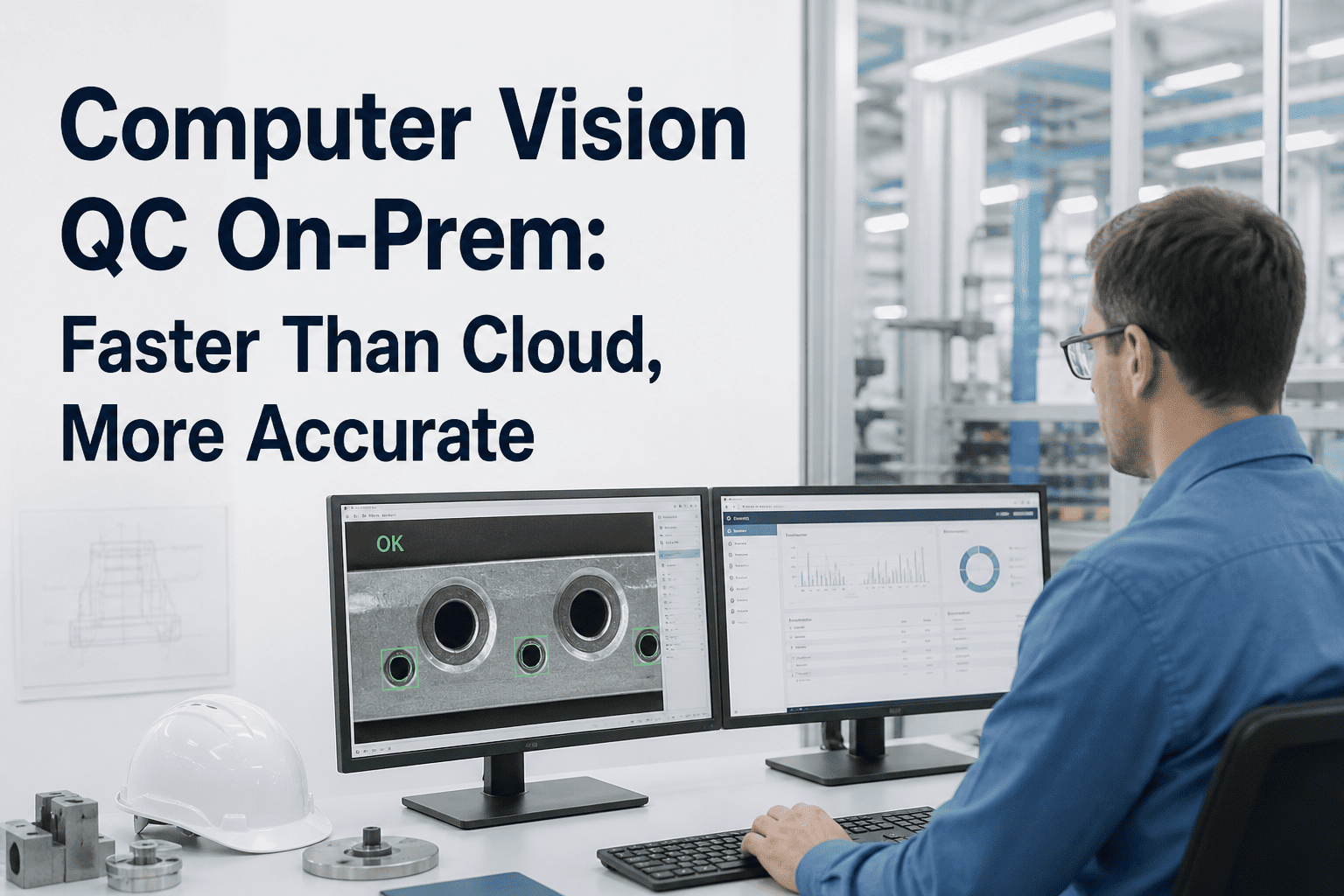
Computer Vision QC On-Prem: Faster Than Cloud, More Accurate
Defect detection, dimensional measurement, and OCR at sub-100ms latency — on your factory floor, with zero cloud dependency. Every part inspected. Every defect logged. Every decision auditable.
✔ Live demo of AI-powered defect detection on production lines
✔ Dimensional inspection and surface defect analysis using vision AI
✔ On-prem GPU inference for real-time quality control
✔ Integration with PLC systems for automatic reject or alert actions
✔ Architecture walkthrough for deploying vision QC inside factories
99%+
Defect detection accuracy after week one
<100ms
End-to-end inference, no cloud round-trip
35%
Throughput increase without new machines
2–4 wks
Typical go-live from camera installation
The Core Problem
Why Cloud Cannot Win at Line Speed
Manufacturing lines move at 200–800 parts per minute. A cloud round-trip introduces 150–400ms of latency — even on private peering. By the time a cloud model returns a reject signal, that defective part is already three stations downstream. On-premise GPU inference solves this physically, not just economically.
On-Prem (iFactory)
Cloud-Routed Vision
Inference Latency
<100ms guaranteed
150–400ms variable
Data Sovereignty
100% on-site, air-gappable
Data leaves facility
Network Dependency
Zero — runs offline
Single point of failure
Long-Term Cost
Amortized CapEx, no API fees
Recurring per-inference billing
OT Integration
Direct PLC/SCADA reject signal
Not feasible at line speed
Compliance (GMP, ISO)
Full audit trail, on-site
Cross-jurisdiction risk
What iFactory Inspects
Four Inspection Modes, One Unified Platform
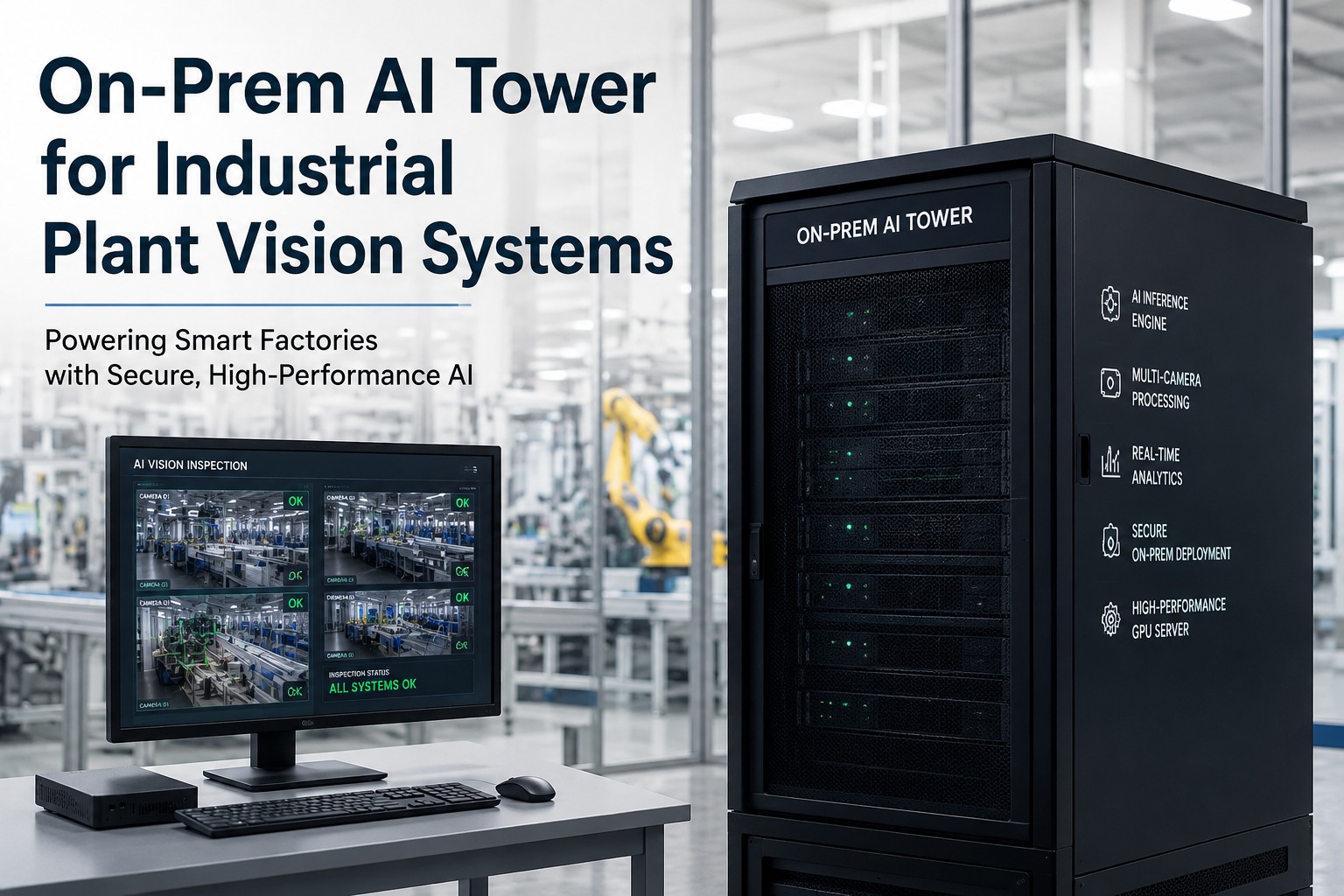
iFactory's on-premise vision stack covers every inspection type your quality team needs — deployed on NVIDIA Jetson or L4 GPU hardware already inside your facility.
01
Defect Detection
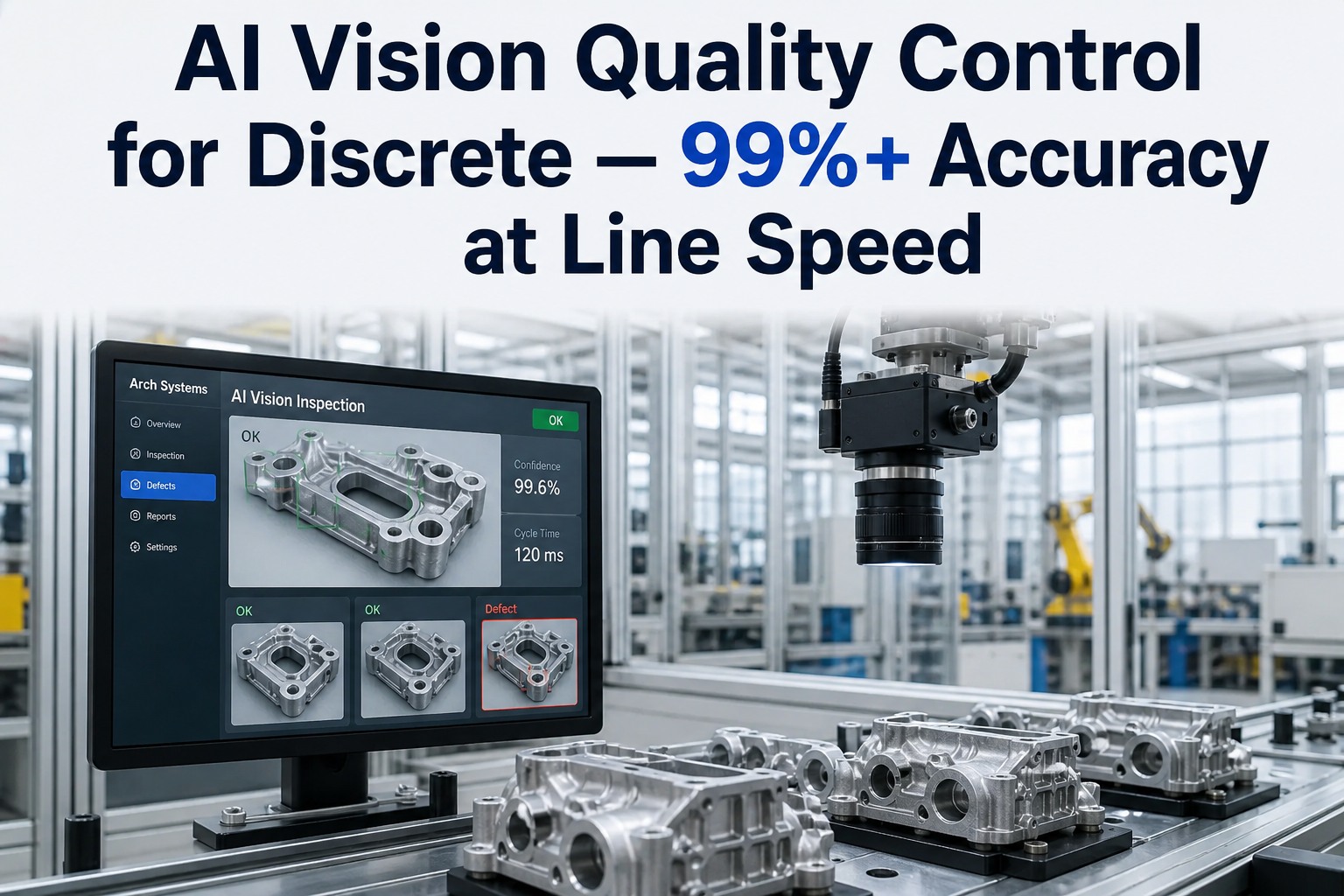
CNN and Vision Transformer models classify surface defects — scratches, cracks, contamination, voids — at micron resolution. Trained on 500–2,000 labeled images from your specific product. Accuracy starts at 92% and exceeds 99% within the first week through active learning on live production data.
Automotive · Electronics · Packaging
02
Dimensional Measurement
Structured light, laser triangulation, and stereo vision verify part geometry against CAD tolerances in real time. GD&T compliance checks to micron accuracy replace manual CMM sampling with 100% coverage at line speed.
Precision Parts · Aerospace · Medical
03
OCR & Label Verification
Optical character recognition validates serial numbers, date codes, barcodes, and regulatory labels against MES records. Wrong label, missing print, or smeared ink triggers immediate line stop — before product ships to a customer.
Pharma · Food & Bev · Logistics
04
Assembly Verification
Multi-angle camera arrays confirm correct component placement, fastener presence, weld seams, and connector seating. Each result is logged with image, timestamp, defect category, severity, and disposition — a complete audit record per unit.
Electronics Assembly · Automotive OEM
Latency Reality
The Bandwidth & Latency Math Cloud Pitches Skip
A single high-res camera at 60fps generates roughly 1.2 Gbps of raw data. Sending that to cloud for inference is economically and physically impractical at line speed. Here is the honest picture.
iFactory On-Prem (NVIDIA L4)
Line Safe
Private Peering (AWS / Azure)
Marginal
Public Cloud Inference API
Line Risk
Cloud + Network Degradation
Unusable
At 400 parts/min, a 300ms latency gap means the defective part is 2 stations downstream before a reject signal arrives. On-prem inference eliminates this gap entirely.
Deployment Timeline
Live in 4 Weeks — Not 4 Months
iFactory follows a structured 4-week rollout. You receive a working inspection system, not a proof-of-concept.
Week 1
Camera Setup & Data Collection
NVIDIA edge server installed, cameras mounted at inspection stations, baseline image dataset captured from your production parts. ONVIF and RTSP protocols connect existing IP cameras — no rip-and-replace.
Week 2
Model Training & Shadow Run
Deep learning model trained on 500–2,000 labeled images specific to your defect types. Shadow-run validation runs the model in parallel with your existing inspection — no line disruption. Initial accuracy: 90–92%.
Week 3
OT Integration & SAP Sync
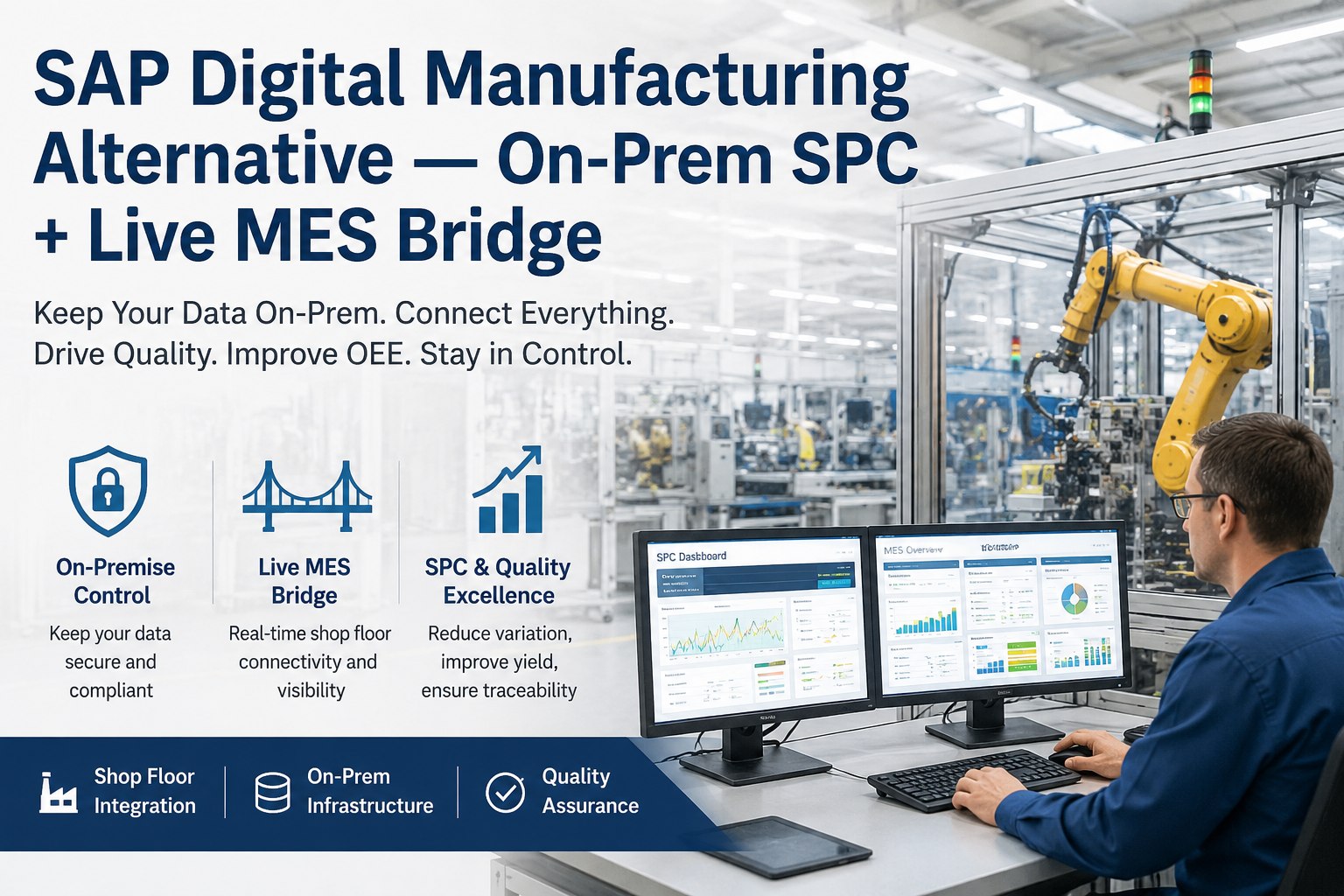
OPC-UA or MQTT bridge connects vision decisions to your PLC reject mechanism. SAP PM, MES, and CMMS sync via REST API — auto work orders created on defect events, quality records written to ERP in real time.
Week 4
Go-Live & Team Training
Full production deployment with active learning enabled. Accuracy reaches 99%+ within the first week of live production data. Your quality team is trained on the dashboard — no software installation required, browser-based interface.
ROI By the Numbers
What the Data Actually Shows
$691K
Average annual labor cost savings per production line from automated visual inspection
Source: AI Monk Labs Industry Analysis, 2026
85%
Drop in customer complaints after full-line computer vision deployment
3–6 mo
Typical payback period with up to 75% quality cost reduction
100%
Parts inspected vs. statistical sampling — every unit has a quality record
Industry Applications
Where On-Prem CV QC Is Deployed Today
Industry
Primary Inspection Task
Key Constraint
iFactory Outcome
Automotive OEM
Weld seam, surface finish, assembly
Zero-defect mandate, traceability
Per-VIN audit record, IATF 16949 compliant
Pharmaceuticals
Tablet inspection, blister OCR, label verify
GMP compliance, air-gap required
21 CFR Part 11 audit trail, on-site only
Electronics
PCB solder, component placement, connector
Micron tolerance, high throughput
Sub-100ms at 800 ppm line speed
Food & Beverage
Foreign object, fill level, label accuracy
FSMA, food safety regulations
100% coverage, no sampling risk
Aerospace
Dimensional metrology, surface NDT
AS9100, IP sovereignty
Air-gapped, CAD tolerance validation
“
For plant-floor quality control, cloud inference is architecturally the wrong answer. The latency budget for line-speed rejection is under 100ms — and that physically cannot be achieved with a cloud round-trip on anything but trivially simple products at trivially slow speeds. On-premise GPU inference is not a preference, it is an engineering requirement.
Technical Stack
What Runs Inside Your Facility
Every iFactory computer vision deployment is fully self-contained on NVIDIA edge hardware. No internet dependency. No vendor lock-in. No software licenses that expire.
Camera Layer
Existing IP cameras (ONVIF / RTSP)
High-res line scan for dimensional
Hyperspectral for material analysis
Multi-angle arrays for assembly
Inference Layer
NVIDIA Jetson (entry) or L4 GPU
YOLO / CNN / Vision Transformer
Sub-100ms end-to-end guaranteed
Active learning on live data
Integration Layer
OPC-UA, MQTT, Modbus to PLC
SAP PM / SAP S/4HANA connector
Oracle, Maximo, CMMS via REST
MES historian sync
Compliance Layer
Per-unit audit trail with image
21 CFR Part 11 / IATF 16949
RBAC and tamper-evident logs
Air-gap capable architecture
FAQ
Common Questions
How many labeled images do I need to train the model?
Most iFactory deployments train production-grade defect detection models on 500–2,000 labeled images from your own parts. Advanced data augmentation reduces this requirement significantly compared to general-purpose ML platforms. The model starts at 90–92% accuracy and improves to 99%+ within the first week through active learning on live production data.
Speak with an engineer about your specific defect types and expected image availability.
Do I need to replace my existing cameras?
No. iFactory connects to existing IP cameras via ONVIF and RTSP protocols out of the box. The NVIDIA edge server installs alongside your current infrastructure. Where higher resolution is needed for dimensional measurement or micron-level defect detection, additional line-scan or 3D cameras are added at specific inspection stations — existing cameras continue serving their current roles.
Talk to our integration team about your current camera setup.
Can the system send reject signals directly to my PLC?
Yes. iFactory's OT bridge connects via OPC-UA, MQTT, or Modbus directly to your PLC reject mechanism. Because inference runs on-premise in under 100ms, the reject signal arrives before the part reaches the rejection actuator — this is physically impossible with cloud-routed inference at any meaningful line speed. The bridge also writes quality events to your SAP PM, MES, or CMMS in real time.
Book a demo to see the integration live.
What compliance standards does the system support?
iFactory's on-premise architecture supports 21 CFR Part 11 for pharmaceutical GMP, IATF 16949 for automotive quality, AS9100 for aerospace, and ISO 9001 general quality management. Every inspection decision is logged with the original image, timestamp, defect category, severity score, and disposition outcome — a complete, tamper-evident quality record per unit. Air-gapped deployment is available for defense, semiconductor, and regulated cleanroom environments.
Review compliance documentation with our team.
How does iFactory compare to cloud vision APIs like Google Vision AI?
Cloud vision APIs (Google, AWS Rekognition, Azure CV) are designed for asynchronous batch tasks — cataloguing, content moderation, document processing. They are not engineered for line-speed rejection at under 100ms. iFactory trains models specifically on your defect types rather than relying on general-purpose pre-trained weights, which is why accuracy on your specific product exceeds 99% while generic APIs typically reach 80–88% on manufacturing defects without extensive fine-tuning. Production data also stays inside your facility.
See a side-by-side comparison in a live demo.
Start With One Line
Get a QC Vision Assessment for Your Facility
iFactory identifies your top defect categories by cost and calculates the specific improvement achievable at your plant — before you commit. Bring your quality data; walk out with a costed deployment plan in 30 minutes.
1000+Enterprise AI deployments shipped
50+SAP, MES & OT connectors built
99.5%Platform uptime SLA
24–48hrArchitecture sizing turnaround