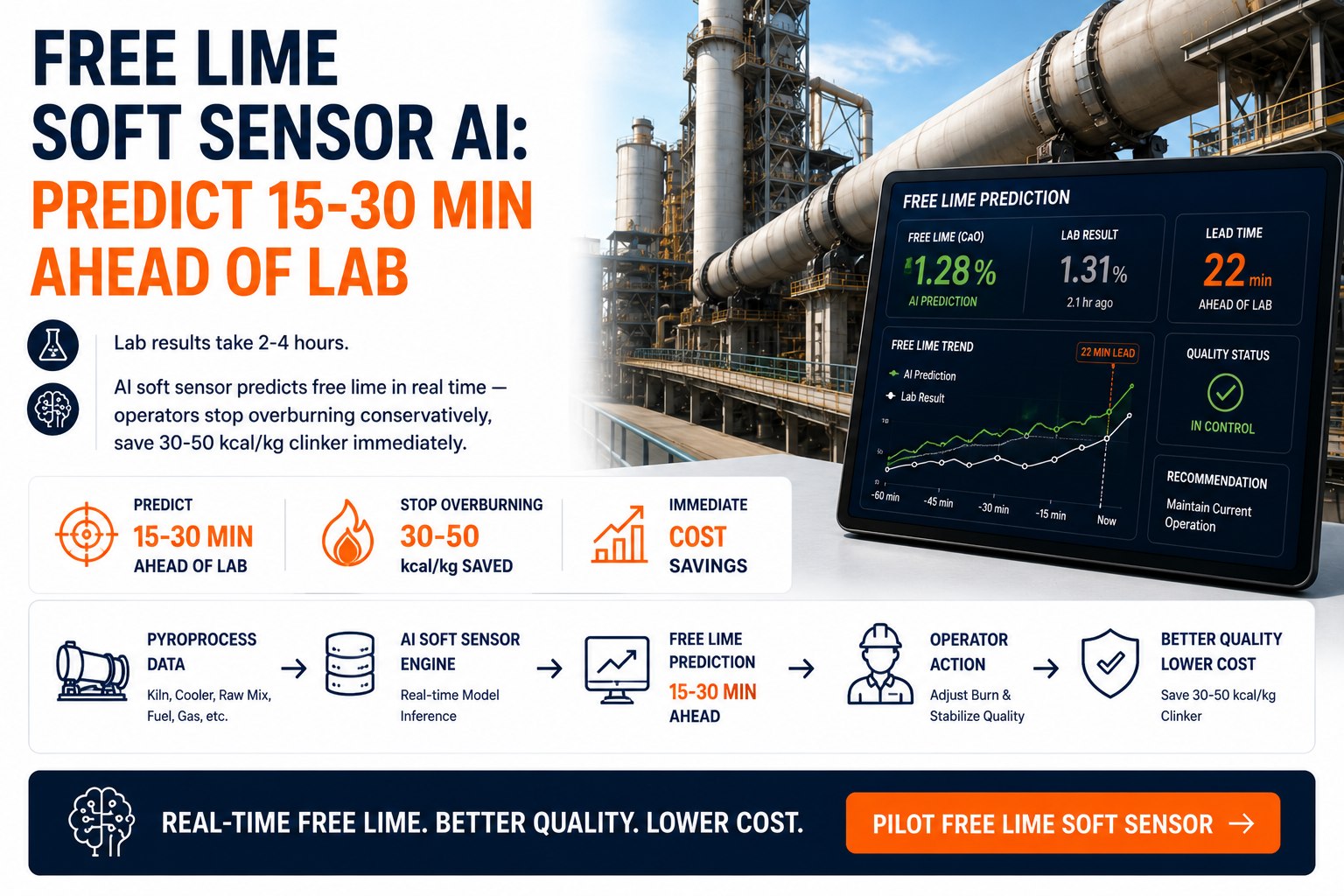
The kiln operator on the morning shift collects a clinker sample at 06:00. The bag goes to the lab at 06:12. The lab grinds, dissolves, runs the titration, and the free lime number lands on the operator's screen at roughly 09:30 — three and a half hours after the clinker that produced it left the cooler. Every cement plant in the world runs this way. The published industry data converges on the same numbers: standard lab cycle is two to four hours, the burning zone runs at 1,350 to 1,450°C which is too hot for direct in-process measurement, and the gap is closed by the operator's judgement — which on every shift, in every plant, defaults to running 30 to 50 kcal/kg hotter than necessary because nobody wants to be the operator who under-burned. Three to eight percent excess fuel per shift, baked into "normal" operations, invisible on the daily report. The free lime soft sensor is the AI that fills the gap. Trained on years of historical kiln data — burning-zone temperatures, kiln feed chemistry, fuel rates, secondary air, oxygen, NOx, kiln motor amps, cooler pressure, flame images from the kiln-hood camera — it predicts free lime 15 to 30 minutes ahead of the lab. The published research is consistent across approaches: Yuan et al. RBF neural network, Yao et al. decorrelated neural-net ensemble with random weights, the 2023 SVM study reporting 96% accuracy on real plant data, the Fuller / Imubit site trial at GCPV Monjos Spain feeding 15-minute predictions into ECS/ProcessExpert. The soft sensor does not replace the lab. The lab still produces the certified number. The soft sensor lets the operator stop running 50 kcal/kg hot while waiting for it. Ships pre-loaded on the iFactory turnkey on-prem AI server stack — RTX PRO 6000 Blackwell for single-plant, NVIDIA DGX Station GB300 Ultra Desktop Superchip for corporate fleet rollouts. Pilot is 30 days.
Free Lime Soft Sensor AI — Predict 15 To 30 Minutes Ahead Of The Lab,
Stop Overburning Conservatively. Save 30 To 50 kcal/kg Clinker. Pilot In 30 Days.
Real-time prediction of clinker free lime from kiln DCS data, gas analyser readings, kiln-hood flame images, and historical lab samples. Operators stop running hot to cover the lab delay. Quality stays inside spec; fuel cost drops immediately.Touch the RTX PRO 6000 Blackwell. Touch the NVIDIA DGX Station GB300 Ultra Desktop Superchip. See the soft sensor predict free lime in real time on a representative kiln model.
Two Clocks Run In Every Cement Plant — One Tells The Operator Too Late
The published industry data on cement plant lab cycles is unambiguous: clinker sampled at the cooler discharge takes two to four hours from sample bag to titration result on the operator screen. Some plants are faster (40 minutes is the published best case where the lab is highly automated and adjacent to the cooler); most are 2 to 3 hours; some are 4 hours. During that window the kiln keeps running. The operator either accepts the blind spot and runs hot for safety, or runs blind and risks an under-burn. The third option — running close to optimal because the soft sensor predicts free lime now — is what changes the economics. Talk to our pyroprocess lead about the lab cycle on your kiln today.
Inputs Already Sitting In Your DCS — Nothing New To Install
The published soft-sensor research is unanimous on this point: cement plants already collect the inputs the model needs. The DCS captures dozens of process variables every minute. The CEMS reports stack chemistry. The kiln-hood camera images already exist. The lab database has years of free lime samples paired with the operating regime that produced each one. The model fuses all of these. No new instrumentation typically required for Phase 1 deployment — though we will recommend supplementary sensors during the calibration audit if the existing instrumentation has known coverage gaps. Below is the input grid the soft sensor draws from.
- Burning-zone temperature (BZT) and gradient
- Kiln feed rate and feed chemistry (LSF, SR, AR)
- Main fuel rate, alternative fuel rate, total kcal/h
- Calciner temperature and oxygen
- Kiln motor amperage and torque trends
- Secondary & tertiary air temperatures
- Cooler bed depth and undergrate pressure
- Kiln speed (RPM) and shell temperature profile
- Kiln inlet O2 (most predictive single signal)
- NOx (proxy for flame intensity, fuel utilisation)
- CO & CO2 (incomplete combustion indicator)
- SO2 (sulphur cycle, ring-formation precursor)
- Stack particulate trend
- Flame intensity, shape, and length signature
- Burning zone refractory glow patterns
- Clinker bed appearance at the cooler interface
- Coating thickness inference from flame attenuation
- Published research uses 157 flame-image dataset for f-CaO regression
- Historical free lime samples (each tied to operating regime)
- Raw meal chemistry trends
- Coal/petcoke calorific value variations
- Alternative fuel blend ratios over time
- Clinker C3S, C2S, C3A, C4AF mineralogy where available
Why the existing instrumentation is usually enough: the published research consistently finds that the strongest predictive signals are kiln inlet O2, BZT, kiln motor amps, and the flame image — all of which most modern cement plants already collect. The model's job is fusing these signals against years of paired lab data, not generating new sensor channels. If your kiln-hood camera is missing or the BZT pyrometer has known reliability issues, we flag the gap during the calibration audit and recommend the supplementary sensors during Phase 1.
What The Kiln Operator Actually Sees On Shift
The soft sensor surfaces as a single card on the kiln operator's existing dashboard — not a new application, not a separate window. The card refreshes every minute with the current predicted free lime, the 15-minute forward projection, the 30-minute outer envelope, and a confidence band. Most operators read it once at the start of the shift, then glance at it every 15 minutes when they would normally have walked over to the lab for the latest result. The lab number still arrives on the screen at its usual cadence — but the operator no longer waits for it before deciding whether to back off the fuel.
What the operator does not have to do: walk to the lab, call the lab, refresh the lab database screen, or guess. The lab still produces the certified number on its usual cadence and that number is still the auditable record. The soft sensor lets the operator stop holding 50 kcal/kg of fuel headroom while waiting for it.
A Mid-Size Kiln, A Single Shift — Where The Savings Actually Land
Numbers below are illustrative for a representative 6,000 t/d kiln burning a mix of coal and petcoke at typical Indian / Asian fuel prices. Replace the inputs with your kiln's actual production rate, fuel mix, and fuel cost during the calibration audit. The point of the table is to show where the savings show up — line by line, on the daily report — rather than as one large opaque number.
| Recovery line | Before AI · baseline overburning | After AI · optimal operation | Annual recovery |
|---|---|---|---|
| Specific fuel consumption | 740 kcal/kg clinker | 700 kcal/kg clinker (40 kcal/kg saved · midpoint of 30–50) | ~$1.92M / yr at $42/t fuel cost |
| CO2 emissions | Baseline kiln emissions | ~5% reduction in fuel-related CO2 | ~22,000 t CO2 / yr avoided |
| Off-spec clinker rework | ~2 events per month requiring rework | ~0.5 events per month | ~$140K / yr saved |
| Quality complaint escalations | ~1 customer escalation per quarter | ~0 escalations · tighter free lime variance | ~$80K / yr avoided |
| Total · single 6,000 t/d kiln | — | — | ~$2.14M / yr |
How to read this: the fuel-cost line dominates by an order of magnitude — which is why every published industry source frames free lime soft sensors as a fuel-savings story first, a quality story second. A single 6,000 t/d kiln typically pays back the iFactory Phase 1 deployment within 4 to 8 weeks of go-live. Multi-kiln plants compound faster. Corporate-fleet rollouts on the DGX Station GB300 Ultra tier compound fastest because the cross-kiln model picks up systemic patterns single-kiln deployments miss.
Sign The Pilot Today — Verified Soft Sensor Predictions On Your Kiln In 30 Days
Free lime soft sensor is the iFactory deployment with the fastest pilot. The model trains on existing data — DCS history, CEMS, lab samples, kiln-hood camera frames — none of which require new instrumentation. The 30 days below covers shadow-mode validation against your historical lab samples; full operator-card go-live follows in weeks 5 through 8. If the pilot doesn't produce predictions within the accuracy band you sign off on, you don't proceed to full deployment.
Pull 90 to 180 days of DCS, CEMS, kiln-hood camera frames, and paired lab samples. iFactory engineer on site for the calibration audit — verifies BZT pyrometer, kiln inlet O2 analyser, kiln-hood camera frame rate, lab database structure. Flags any instrumentation gaps that need supplementary sensors.
Model trains on the historical dataset — typically a transformer or RBF ensemble per the published research, depending on which architecture wins on your specific data. Cross-validation against held-out lab samples. Performance benchmarked against the 96% accuracy reported in published SVM studies and the 1.3% precision band reported on neural-net approaches.
Soft sensor goes live in shadow mode — predictions stream every minute alongside the kiln operator's existing dashboard but do not yet drive recommendations. Each lab sample arriving on the operator screen is paired against the soft sensor prediction made when the sample was taken. The delta is logged. By day 30, you have 30 days of paired data to evaluate.
If the pilot's prediction-vs-lab delta is inside the accuracy band you signed off on at day 1 of the pilot, you proceed to full deployment (weeks 5 to 8 add the operator card, weeks 9 to 12 integrate with your existing kiln optimization system if you have one). If the predictions miss the band, you do not proceed and you do not pay for the full deployment.
Why we structure it this way: the published soft sensor literature contains many cases where laboratory-grade accuracy was reported but did not survive contact with a real plant's drift, fuel mix variation, and instrumentation reliability. The 30-day pilot tests against your kiln, not against a published benchmark. We would rather you cancel after 30 days than have you regret a 12-week deployment.
A Truck Pulls Up. Soft Sensor Live On The Kiln By Friday.
No procurement saga. No new sensors typically required. iFactory ships the on-prem AI server stack — assembled, burn-in tested, software pre-loaded — to your control building. Field engineer plugs in two cables (power, Ethernet), connects to the DCS through the historian, walks the operator team through the soft sensor card. The two server tiers below cover single-kiln and corporate-fleet deployments.
Imagine a tower computer about the size of a hotel-room safe sitting in the cement plant control building, paired with two small AGX Orin edge units. The tower trains the soft sensor on your historical data and runs the dashboards. The edge units handle the per-minute inference next to the DCS cabinet. One stack runs the soft sensor and every other iFactory AI you turn on later — kiln optimization, predictive maintenance, energy AI.
Imagine a sleek workstation about the size of a desktop briefcase. NVIDIA's DGX Station with the GB300 Grace Blackwell Ultra Desktop Superchip — 768 GB unified coherent memory, 20 petaFLOPS of AI compute, dual 400 GbE LAN. NVIDIA states the platform supports models up to 1 trillion parameters running locally without cloud infrastructure. For a corporate cement group, this is the box at headquarters that runs every plant's soft sensor, the cross-plant fuel optimization, and the corporate operator copilot — all simultaneously.
You don't need to choose right now. Most cement-plant customers start with Option A on a single kiln, see the 30-day pilot land, and then add Option B at corporate when they're ready to roll out across the group. Both run the same iFactory software, so nothing has to be rebuilt.Touch the hardware, type queries into the soft sensor, ask our pyroprocess lead the questions you bring from your floor.
What Quality Engineers & Pyroprocess Engineers Ask First
No. The lab still produces the certified free lime number that goes into your quality records, the regulatory paperwork, and the customer-facing certificates. The soft sensor lives alongside the lab — it lets the operator stop running 50 kcal/kg hot during the 2-to-4-hour gap before the lab number arrives. Some customers eventually reduce their lab sampling frequency once trust in the soft sensor is established; that is a quality-team decision, not an iFactory recommendation.
The model still works on DCS + CEMS inputs alone, with a small accuracy penalty. The published research shows kiln inlet O2, BZT, and kiln motor amps are the strongest individual signals — the flame image adds incremental accuracy. If your kiln-hood camera is offline or missing, we flag it during the calibration audit and recommend either repair or a low-cost replacement camera. Pilot proceeds either way.
No, by architecture. The soft sensor is read-only against your DCS. Predictions and recommendations surface to the operator card; the operator commits any setpoint change manually under your existing MOC procedure. The kiln control system's interlocks, alarms, and tuning loops remain entirely under your DCS engineer's authority. There is no write path in the tool surface.
Standard integrations to most kiln optimization platforms — Fuller's ECS/ProcessExpert, FLSmidth ECS/CemulatorMaster, KIMA Echo, ABB's Expert Optimizer, Siemens Cemat. The soft sensor prediction can either drive operator cards alone (Phase 1 default) or feed downstream into your existing optimizer to upgrade its quality-target adaptation cadence (the published Fuller / Imubit GCPV Monjos pattern). Decision is yours; we adapt to your existing landscape.
Published industry data shows 96% accuracy on classification (good / over-burn / under-burn) and roughly 1.3% precision on absolute free lime regression. Your kiln's actual accuracy depends on lab sampling frequency, instrumentation reliability, and historical regime coverage. The 30-day pilot is structured specifically to verify accuracy on your kiln before full deployment — if the predictions miss the accuracy band you sign off on at pilot start, you don't proceed.
The soft sensor handles alternative fuel substitution natively, provided the alternative fuel inputs (rate, calorific value, moisture, where measured) are flowing into the DCS or historian. Plants running 30%+ alt-fuel substitution often see the largest soft sensor benefit because alt-fuel calorific variation is exactly what makes manual operator judgement most conservative. The model adapts the prediction as the fuel mix changes.
For a single kiln or single-plant operation, the RTX PRO 6000 Blackwell stack (Option A) is the right answer. For corporate cement groups running multi-plant fleets where one node serves multiple kilns and runs cross-plant fuel optimisation, the NVIDIA DGX Station GB300 Ultra (Option B) is the right answer — its trillion-parameter capacity covers fleet-wide soft sensor inference plus enterprise LLM plus cross-plant analytics. Most customers start on Option A and add Option B at corporate when ready to roll out across the group.
The soft sensor keeps running. You own the appliance, the trained model weights, the audit trail, and the integration with your kiln control system. Renew support and quarterly retraining annually, run it in-house with our handover docs, or do a mix. No kill switch. The model gets sharper with continued retraining as your fuel mix and operating regime evolve; if you stop, it freezes at the last-trained state and continues running.
Interact With The On-Prem AI Servers Hands-On
Two ways forward. Walk the iFactory booth and interact with the on-prem AI server stack hands-on — touch the RTX PRO 6000 Blackwell, touch the NVIDIA DGX Station GB300 Ultra Desktop Superchip, type queries into the soft sensor running on a representative 6,000 t/d kiln model, watch predictions track live against historical lab samples on the screen in front of you. Bring your kiln's recent DCS export and our pyroprocess lead will calibrate the model against your data right there at the booth. Second: a 30-minute working session with our pyroprocess lead — bring 90 days of kiln data and a typical week of paired lab samples, and we'll project the accuracy band for your pilot. Sign the pilot, see verified predictions on your kiln in 30 days.