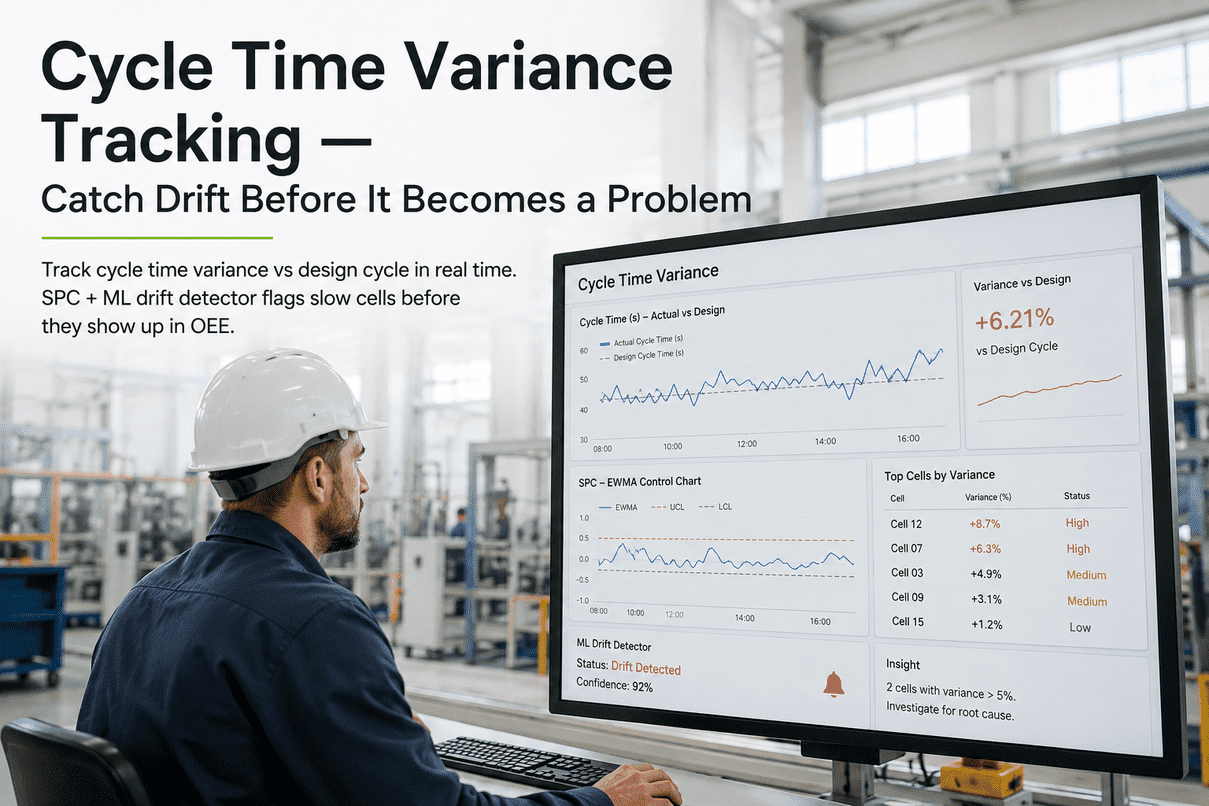
Every assembly line, machining cell, packaging station, and casting bay has a number it was designed around — the design cycle time. The pressing operation should take 14.2 seconds. The CNC machining cycle should take 87 seconds. The injection-mold shot should take 32 seconds. When the line was commissioned, that's what it did. A year later, almost nobody knows what it's actually doing right now. Operators run the line; supervisors track shift output; OEE reports come out monthly and show "performance" as a single rolled-up percentage. By the time OEE has visibly slipped, the cell has been running 8% slow for three months and nobody flagged it because no individual cycle was visibly broken — they were just slightly slow, every shift, drifting further from design. That's cycle time variance, and it's the quietest way a plant loses capacity. iFactory's Cycle Time Variance Tracker watches every cell's actual cycle vs. its design cycle in real time, runs a hybrid SPC + ML drift detector that catches both sudden shifts and the slow creep that classical control charts miss, and ranks cells by variance so the bottleneck of the day is on the screen before it's on the OEE report. Pre-loaded on a turnkey RTX PRO 6000 Blackwell Workstation, racked and ready, live in 6 weeks from PO.
Cycle Time Variance Tracking
Catch The Slow Drift Before It Shows Up In OEE
Every cell's actual cycle vs. design cycle, live, on one screen. Hybrid SPC + ML drift detector — EWMA and CUSUM catch the small persistent shifts; the ML detector handles the gradual non-stationary creep that classical control charts miss. Cells ranked by variance percentage, so the worst offenders surface first. The variance shows up days or weeks before OEE moves. Pre-loaded on a turnkey RTX PRO 6000 Blackwell Workstation. Engineer reviews; supervisor acts. The system never writes to the PLC.
The Number Everyone Knows And Nobody Tracks Continuously
"Design cycle time" is the time the cell was specified to take. It's printed on the line drawing, baked into the production plan, and used in capacity calculations. "Actual cycle time" is the time it's taking right now — and that number is almost never displayed live. The difference between them, expressed as a percentage, is cycle time variance. A 3% variance is normal. A 5% variance is a yellow flag. A 10% variance is a chronic problem that's been hiding for a while. Talk to our manufacturing AI lead about which cells you'd want to instrument first.
Set during commissioning. Printed in the line documentation. Used in the capacity plan and the takt-time calculation. Doesn't change unless engineering officially re-specifies it.
Computed live from PLC cycle-start and cycle-complete signals. Averaged over a rolling window. Updated every cycle. Stored alongside operator, shift, product variant, and tooling lot for later analysis.
Above 5% becomes a tracked bottleneck. Above 10% triggers a drafted maintenance review in the CMMS. The dashboard ranks every cell by this number so the worst case is at the top.
Why this matters in plain language: if your cell is supposed to take 14.2 seconds and it's actually taking 15.1, you're losing about 1 unit every 16. Across a shift, that's about 240 lost units. Across a month, it's roughly 5,000. None of those losses fail an alarm. None of them break a quality spec. They just quietly subtract capacity. The variance tracker makes that loss visible the day it starts.
Classical SPC Catches Sudden Shifts — It's Not Built For Drift
Statistical Process Control is the right tool for "did something change?". A Shewhart chart is excellent at flagging a single bad cycle. EWMA is better at small persistent shifts. CUSUM is the most sensitive of the three to very small drifts. But every classical SPC chart assumes the underlying process is independent and stationary — that "normal" stays normal over time. In a real plant, normal drifts. Tooling wears, fixtures loosen, ambient temperature changes, raw-material lots vary, the line itself ages. The process is non-stationary by nature. That's where SPC alone produces both false alarms and missed alarms — and where an ML drift detector running alongside SPC closes the gap.
Exponentially-weighted moving average gives recent cycles more influence. Catches a step change of half a standard deviation faster than a Shewhart chart. Documented sweet spot: average drift detection.
Cumulative sum accumulates deviations from target. Mathematically the most sensitive of classical SPC tools to tiny persistent shifts — the kind tooling wear actually produces.
Classical 3-sigma chart. Flags any single cycle that breaches a control limit. Fast, simple, easy to read.
Trained on what your cell's "normal" actually looks like over weeks of operation, including the drift that comes from tooling wear, ambient changes, and lot variation. Models the baseline itself, so when the process shifts away from learned normal, it's flagged — even if the absolute number is still inside SPC limits.
How The Hybrid Detector Works — Two Layers, Both Live, Same Screen
The detector runs both layers continuously and combines their signals. SPC layer (EWMA + CUSUM + Shewhart) catches the classical shift patterns. ML layer (a drift detector trained on the cell's recent history) catches the slow creep and the regime changes. An alert surfaces when either layer fires; the engineer's view shows both layers' state so the reason is always visible. The diagram below is the actual signal flow.
Cycle-start and cycle-complete tags pulled from the PLC over OPC-UA. Cycle duration calculated, stored with timestamp, operator ID, shift, product variant, and tooling lot. Works on Allen-Bradley, Siemens, Mitsubishi, Omron, Beckhoff — any PLC publishing those events.
Three classical control charts compute simultaneously. EWMA flags small persistent shifts. CUSUM accumulates deviation from target — most sensitive to tiny drifts. Shewhart catches sudden large excursions. All three states visible to the engineer.
An ML drift detector learns your cell's "normal" envelope over a 30–60 day training window — including the natural slow drift that comes from tooling wear and ambient change. Flags when the recent distribution diverges from learned-normal, even if SPC limits are intact.
Alert is raised when SPC fires OR ML drift fires. Confidence indicator combines both signals — high when both agree, lower when only one fires. The engineer sees which layer triggered, so a CUSUM-only alert vs. an ML-only alert vs. a both-layers-agree alert all look distinct.
Plant view ranks every cell by current variance. Worst at the top. Cell tile coloured green / amber / red. Hover shows the SPC + ML state, the trend, and the projected output loss this shift if uncorrected.
Variance above 10% sustained for one shift drafts a work order in OxMaint, SAP PM, IBM Maximo or Infor EAM — pre-filled with the cell, the suspected mode (tooling wear, fixture drift, operator-load variation), and the SPC + ML evidence. Maintenance lead reviews and releases. The system never auto-releases.
Bottleneck Cells — How A Variance > 5% Reveals The Constraint Before OEE Does
In a serial production line, the slowest cell is the line's pace-setter. If your slowest cell is running 6% slow, your whole line is running 6% slow. OEE reports this at the end of the month as a "performance" leg drop. By then, three weeks of capacity have already gone. The variance tracker shows the same information today, on the wall, before the leg drops. Below is the live ranking, structured the way the dashboard renders it.
| Rank | Cell | Design Cycle | Actual Cycle | Variance | Trend (7d) | Likely Cause | Status |
|---|---|---|---|---|---|---|---|
| 1 | CNC-04 Roughing | 87.0 s | 96.4 s | +10.8% | Rising | Tool wear (insert change due) | Red · WO drafted |
| 2 | Press-12 Form | 14.2 s | 15.3 s | +7.7% | Rising | Fixture clamping loose | Amber · review |
| 3 | Weld Cell W-08 | 22.5 s | 23.7 s | +5.3% | Flat | Operator-load variation | Amber · review |
| 4 | Mold IM-03 | 32.0 s | 33.1 s | +3.4% | Flat | Within normal envelope | Green |
| 5 | Pack PK-21 | 4.8 s | 4.9 s | +2.1% | Falling | Recovering from changeover | Green |
| 6 | Test TS-02 | 11.0 s | 11.0 s | 0.0% | Flat | On design cycle | Green |
What the wall display actually does: a line lead walking past the screen sees CNC-04 in red, the most likely cause already named, the work order already drafted. They don't have to investigate, calculate, or wait for the monthly OEE report. The variance number, the trend, and the recommended next action are on one tile. That's the difference between "find the bottleneck" and "fix the bottleneck".
Same Data, Two Audiences — Plant Lead & Manufacturing Engineer
A plant lead, supervisor, or line manager wants to know: which cell is dragging today, what's the projected output hit, and is anyone working on it. A manufacturing engineer or reliability engineer wants the underlying chart — which SPC layer fired, which ML detector triggered, what the 30-day trend looks like, what changed last shift. Both views are served from the same data; both are part of the standard package.
Pre-Racked RTX PRO 6000 Blackwell Workstation — Ships Configured
The Cycle Time Variance Tracker arrives on a single turnkey appliance: an RTX PRO 6000 Blackwell Workstation with the SPC engine, ML drift detector, dashboard, and CMMS hooks pre-loaded. Plug in power and Ethernet, point it at your PLC OPC-UA endpoint, and cycle data starts flowing on day one. The 96 GB GDDR7 ECC means you can run hundreds of cells' worth of detectors concurrently with headroom for the dashboard and an Omniverse twin overlay if you add one later.
Why on a single workstation: cycle-time variance tracking is a continuous, low-bandwidth, high-frequency workload — not a heavy training job. One RTX PRO 6000 handles a whole plant's worth of cells with capacity to spare. If you later add an Omniverse photoreal twin or vision AI on the same box, the 96 GB GDDR7 has the headroom for it. Register for Event.
From PO To Live Variance Wall In Six Weeks Flat
Variance tracking deploys faster than most plant AI work because it doesn't touch your control system and doesn't need new sensors — your PLC is already publishing the cycle-start and cycle-complete events. Microphones, vibration sensors, vision cameras: not required. The 6-week timeline is realistic for a 30-cell deployment. Larger fleets stage in 2-week increments after that.
RTX PRO 6000 workstation ships pre-configured. Field engineer racks it, plugs power and Ethernet. AGX Orin gateway configured against your PLC over OPC-UA. Cycle-start and cycle-complete tags mapped per cell. Design cycle times confirmed with manufacturing engineering. Cycle data flowing into the historian.
EWMA / CUSUM / Shewhart limits set per cell from 30 days of historical data. ML drift detector trained per cell on the same window. Variance thresholds (5% amber, 10% red) calibrated with the manufacturing engineer. Detectors run in shadow mode — visible to engineering, not surfaced to the floor.
Variance ranking promoted to wall display. CMMS auto-draft enabled at 10% sustained variance. 2-day on-site training for plant leads, supervisors, and manufacturing engineers. False-positive override workflow live. 24x7 remote monitoring active.
Per-cell ML detectors retrain monthly on fresh cycle data. Quarterly review with our manufacturing AI lead — accepted alert rate, prevented variance, false-positive rate, OEE attribution. Optional after year one. Stack keeps running either way.
Hardware, SPC + ML Software, Integration, Training — One PO
The Cycle Time Variance Tracker is delivered as a turnkey kit: the RTX PRO 6000 workstation, the AGX Orin gateway, the SPC + ML detector pre-loaded, the wall display app, the CMMS hook, and our manufacturing AI engineers on the floor for tag mapping, tuning, and supervisor handover. 6 weeks from PO. Owned by you outright. No recurring license, no per-cell fee, no per-seat charge.
Pre-racked, burn-in tested, IEC 62443 zoned. 96 GB GDDR7 ECC, 24,064 CUDA cores, 5th-gen Tensor with FP4. SPC engine, ML drift detector, dashboard pre-loaded. Air-gapped from public internet. One-time CapEx. Global shipping included.
OPC-UA / Modbus TCP / EtherNet-IP read-only client. Cycle-start and cycle-complete tag mappings configured per cell. Less than 10 ms cycle latency. 7-day local buffer survives network outages. DIN-rail mount, IP-rated.
EWMA / CUSUM / Shewhart in parallel per cell. ML drift detector trained per cell on your 30-day operating history. Combined alert engine. Per-cell control-limit tuning. Audit log on every alert and override.
Full-screen live ranking of every cell by variance percentage. Green / amber / red colouring. 7-day trend arrow. Most likely cause inferred. Projected output loss this shift. Same view in any browser, on any tablet, on any monitor.
Pre-built integration to OxMaint, SAP PM, IBM Maximo, Infor EAM. Drafts a work order on each sustained 10%-variance event with cell, suspected cause, SPC + ML evidence, projected output loss. Maintenance lead reviews and releases. The system never auto-releases.
2-day on-site training for plant leads, supervisors, manufacturing engineers, maintenance leads. 24x7 remote monitoring of all stack nodes. Monthly per-cell ML retrain. Quarterly performance review with our manufacturing AI lead. Optional after year one.
What Plant Leads & Manufacturing Engineers Ask First
No, by architecture. The AGX Orin gateway reads cycle-start and cycle-complete events from your PLC over OPC-UA read-only. There is no write path back. The system is a tracking and alerting layer; any cell-level intervention happens through your existing supervisor-led process and your existing CMMS, exactly as it does today.
OEE is a rolled-up performance leg, typically reported daily or monthly. By the time OEE has visibly slipped, the variance has been there for days or weeks. The variance tracker shows the underlying cycle-time data live, ranked by cell, with the SPC + ML detectors pre-attached. OEE tells you that you lost capacity last month; variance tells you that you are losing capacity this hour, and which cell is doing it.
SPC is the documented gold standard for sudden shifts and small persistent shifts where the underlying baseline is stable. EWMA and CUSUM have decades of literature behind them and are easy for engineers to reason about. ML detectors handle the cases SPC can't — non-stationary baselines, slow multi-week creep, regime changes from new operators or lots. Running them together gives you the trust of classical SPC with the coverage of modern drift detection.
The detectors are trained per cell on your specific operating envelope, including the natural variation from product variants, operator differences, and tooling lots. Those become part of the learned-normal envelope. The system flags drift away from the variation pattern, not just any variation. Override workflow lets engineers tag known events (changeover, training run, new operator) so they don't poison the next retrain.
Stays inside your perimeter. The full stack runs on-site, air-gapped from the public internet by default. Models train and run on the appliance you own. No data leaves your zone. Your detectors are trained on your cells only — we don't share weights between customers.
The stack keeps running. You own the workstation, the AGX Orin gateway, the trained detectors, the audit logs, and the dashboards. Renew support and monthly retraining annually, run it in-house with our handover docs, or do a mix. No kill switch, no recurring license fee, no per-cell charge.
Walk The Variance Wall Real Cells, Real Drift, Real Detection
A real cycle-time stream from a working bench rig. The SPC engine drawing EWMA, CUSUM, and Shewhart traces in parallel. The ML drift detector running alongside. The variance ranking wall lighting up as one cell drifts away from design. Bring your cell list and design-cycle table — our manufacturing AI lead will walk through what your floor would surface.