Senior chemical evaluators looking at SAP MII alternatives in 2026 are not running a like-for-like search. The capability bar for chemical process manufacturing platforms has moved decisively. Multivariate SPC has become the operational baseline for chemical processes — univariate charts on individual variables miss the relationship structure that defines actual process state. Reactor monitoring has shifted from descriptive trending to predictive intervention with hours-ahead forecasting. Process safety management evidence has moved from periodic reporting to continuous, audit-ready records that improve OSHA PSM, EPA RMP, and HAZOP posture rather than disrupt it. Quality control has integrated with process analytics rather than living in a separate workstream. And the entire stack now has to run on-premise — keeping recipe IP, alloy compositions, catalyst formulations, and process know-how inside the plant boundary rather than in cloud infrastructure that introduces validation burden and OpEx-growing AI compute charges. iFactory AI is the AI-native chemical process manufacturing platform purpose-built as the modern SAP MII alternative — pre-configured NVIDIA appliance running pre-loaded chemical industry models on-premise, delivering AI-powered SPC, predictive process analytics, quality control, real-time production intelligence, and reactor monitoring on a single platform engineered to the chemical evaluator's decision framework. This page is the senior chemical evaluator's guide to choosing a modern SAP MII alternative for process manufacturing — the capability matrix, the decision drivers, the reactor monitoring architecture, and how the platform actually evaluates against the criteria that drive chemical platform selection.
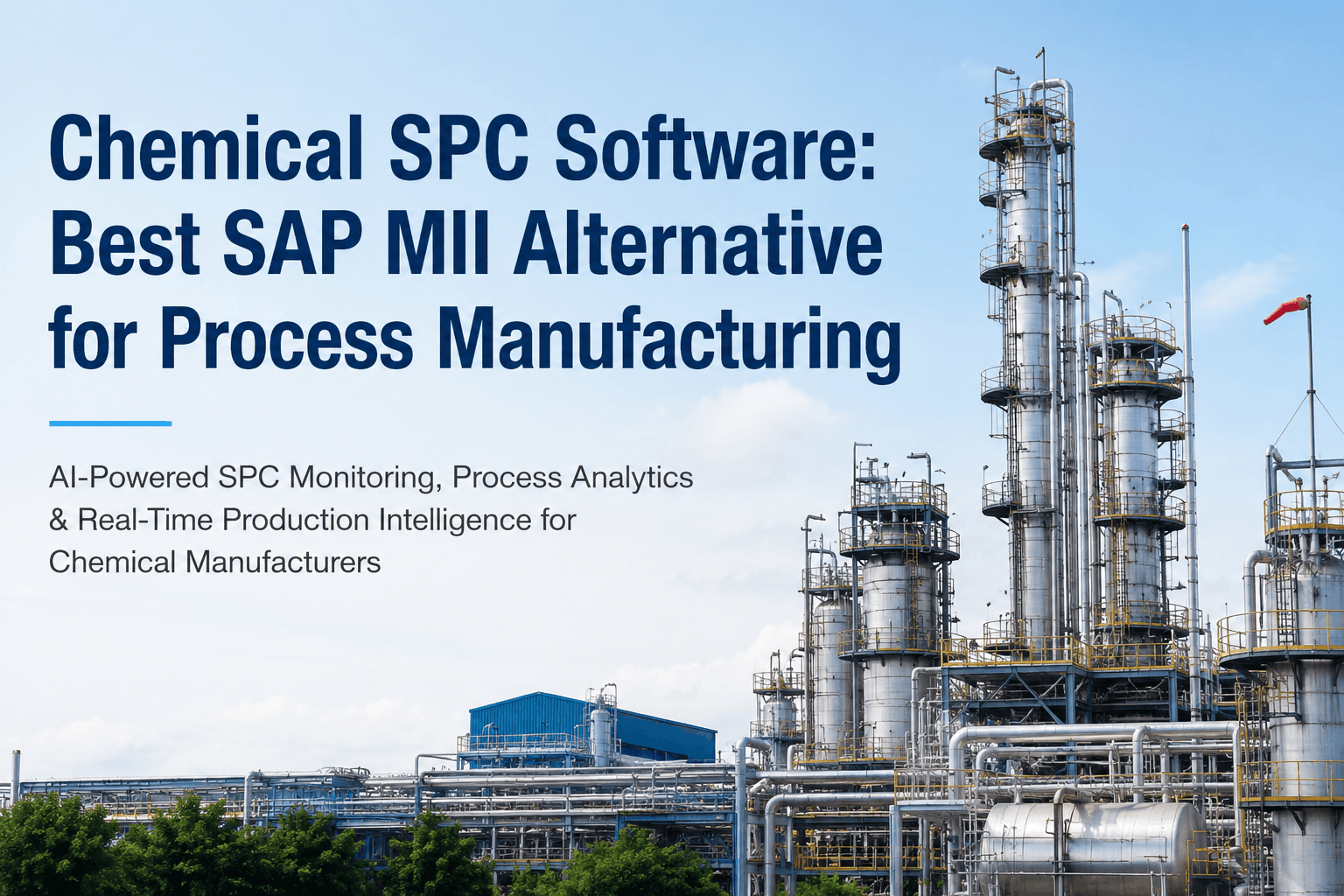
Chemical SPC Software: Best SAP MII Alternative for Process Manufacturing
The senior chemical evaluator's guide to a modern SAP MII alternative — AI-powered SPC monitoring, predictive process analytics, quality control, real-time production intelligence, and reactor monitoring on a single platform for chemical process manufacturing. On-prem deployment, OSHA PSM-aware, 6–12 week migration.
Chemical Evaluator's Capability Matrix — iFactory AI vs SAP MII
Chemical platform evaluators score alternatives on a defined set of capability dimensions that have to all be met for the platform to qualify as a viable SAP MII replacement for process manufacturing. The matrix below scores both platforms on each of the seven capability dimensions that drive senior chemical evaluation decisions in 2026 — covering the process-industry-specific concerns that discrete-manufacturing platforms typically miss.
The summary at the bottom of the matrix drives the evaluation conclusion. A modern chemical process manufacturing platform either has all seven capabilities native — running on the same data, the same audit log, the same operational envelope — or it does not. SAP MII covers basic descriptive SPC; everything else (reactor monitoring, predictive process analytics, PSM evidence assembly, predictive maintenance) requires bolt-on point solutions with separate integration cost. The evaluator's decision converges on whichever option meets the full capability set with the least integration burden.
Want this matrix walked through against your specific chemical operation? Schedule the AI Manufacturing Transformation Workshop — iFactory's chemical team will score the platform against your evaluation framework and demonstrate each capability on representative reactor and process data. Sessions available this week.
Chemical Evaluator's Decision Drivers
Senior chemical evaluators do not score platforms purely on capability — they score on the operational decision drivers that determine total cost of ownership, process safety posture, recipe and catalyst IP sovereignty, and long-term operational flexibility. The driver model below shows what actually weighs in a chemical SAP MII alternative evaluation, and how iFactory scores against each.
The six drivers above show up explicitly in chemical platform RFP responses, evaluator scorecards, and steering committee decisions. iFactory's positioning was designed against the chemical evaluation framework from inception rather than retrofitted into it — which is why the alignment is structural rather than coincidental.
Reactor Monitoring Architecture — How AI-Native Reactor Monitoring Actually Works
Why reactor monitoring belongs on the AI-native intelligence layer
Chemical reactors are the single highest-leverage station in any chemical operation — what happens in the reactor sets the downstream quality envelope, the yield baseline, the selectivity, the impurity profile, and the safety posture for everything that follows. Generic trending in SAP MII captures the data but cannot infer the reaction state. AI-native reactor monitoring runs the multivariate kinetic model continuously, predicts conversion and selectivity from current state, surfaces drift in catalyst activity, and ties reactor behavior to downstream quality outcomes. The architecture below shows how reactor monitoring composes on the iFactory platform.
The reactor monitoring engine is the highest-impact capability for chemical operations. Conversion forecasts give the operations team time to adjust feeds before the reaction drifts off-target. Selectivity drift tied to catalyst aging changes catalyst replacement from a calendar exercise to a condition-based one. Impurity profile prediction from kinetics prevents downstream specification misses. Safety margin tracking strengthens OSHA PSM compliance by continuously documenting approach to operational limits. Catalyst change timing optimization improves yield economics.
Want reactor monitoring architecture mapped to your specific reactor configuration? Send your reactor types, catalyst systems, and current monitoring setup to iFactory support and the chemical team will return a customised integration proposal — typically within 3 business days, no obligation.
Five AI-Native Capabilities for Chemical Process Manufacturing
Multivariate SPC
Adaptive MSPC with contribution plots for chemical variables
Process Analytics
PAT-integrated predictive quality across multi-step processes
Quality Control
Predictive CQA monitoring with in-batch intervention
Reactor Monitor
Kinetics, catalyst, selectivity, safety margin
PSM Evidence
OSHA PSM · HAZOP · LOPA continuous evidence
Three Migration Paths for Chemical SPC Modernization
Stay on SAP MII
Extended SAP maintenance. Univariate SPC, descriptive monitoring. PSM evidence reactive. Reactor monitoring stays in separate point solutions.
SAP DMC (Cloud)
Cloud-bound platform. Recipe and catalyst IP exits validated boundary. WAN-bound latency. OpEx-growing AI compute charges.
iFactory AI On-Prem
Modern SAP MII alternative. All 7 capabilities native including reactor monitoring and PSM evidence. On-prem, 6–12 weeks.
Six Chemical Operations Where the Migration Pays Back Fastest
Reactor Operations
Highest-leverage chemical application. Reaction kinetics monitoring with catalyst aging models. Predictive selectivity intervention.
Specialty Chemicals
Multi-step predictive quality with in-batch intervention. Customer-spec compliance improves substantially through upstream visibility.
Polymerization
Polymer MW distribution and viscosity prediction from reactor state. Grade transition optimization. Off-spec reduction during changeover.
Distillation Operations
Multivariate control across column pressure, reflux, trays, and feed composition. Purity inferential models replace lab-only verification.
Blending & Finishing
Multi-stream blending with predictive composition control. Customer-spec compliance evidence assembled continuously.
Predictive Maintenance
Condition-based monitoring of rotating equipment, heat exchanger fouling, and pump cavitation. Predicts failures days ahead.
Want operation-specific projections for your chemical plant? Send your chemical segment, process flow, and current SAP MII state to iFactory support and the chemical team will return a customised projection with 12-month roadmap — typically within 3 business days, no obligation.
Chemical Industry Compliance & Process Safety — Native to the Platform
Pre-built workflows for chemical regulatory and process safety frameworks
- OSHA PSM — Process Safety Management (29 CFR 1910.119)
- EPA RMP — Risk Management Plan compliance
- REACH — EU chemical registration & evaluation
- HAZOP / LOPA — process hazard analysis
- ISO 9001 — quality management systems
- ISO 14001 — environmental management
- Responsible Care — chemical industry framework
- Customer-specific specifications (CSRs)
The compliance and process safety workflows live alongside the SPC and reactor monitoring capability rather than as separate workstreams. Every alert, every predicted deviation, every operator response is logged with full audit traceability — strengthening rather than disrupting the regulatory posture. OSHA PSM-relevant events surface automatically, EPA RMP evidence accumulates continuously, and HAZOP / LOPA studies are supported with continuous process state evidence.
Two Real Chemical SAP MII Alternative Outcomes
Integrated chemical group standardizing across five process plants
A multi-site chemical group operating five plants — specialty chemicals, intermediates, polymer production, and one fine chemicals site — ran a portfolio evaluation for standardizing SPC, reactor monitoring, process analytics, and PSM evidence assembly across all sites. Plants had inherited a mix of SAP MII deployments, legacy historian-based systems, and point solutions over years. Multi-site benchmarking was effectively impossible. Customer-driven RCA requests required heavy manual assembly per site. Process safety reporting was reactive across the group.
Specialty chemical plant where process safety management drove the SAP MII replacement decision
A specialty chemical plant producing high-hazard intermediates ran a SAP MII alternative evaluation triggered by process safety management gaps. After a near-miss incident review and external HAZOP refresh, the senior leadership team mandated improved PSM evidence capability, continuous safety margin tracking, and stronger reactor monitoring — well beyond what SAP MII could deliver. The evaluation prioritized PSM posture alongside operational improvement.
Neither scenario matches your operation? Send your chemical segment, plant configuration, and current SAP MII state to iFactory support and the chemical team will return a customised evaluation analysis with 12-month roadmap — typically within 3 business days, no obligation.
iFactory's Chemical Deployment — On-Premise or Cloud
Same AI-native platform on either deployment model. On-prem is the recommended default for chemical operations given recipe and catalyst IP sovereignty, line-speed inference latency requirements, OSHA PSM evidence boundary considerations, and the OpEx-cap that on-prem CapEx provides for continuous-process operations.
iFactory On-Premise Appliance Recommended for chemical · recipe and catalyst IP stays on-site
- Pre-configured NVIDIA AI server — pre-loaded chemical models, racked, ready.
- <50ms edge inference — process-speed reactor decisions.
- Recipe & catalyst IP stays in plant — sovereignty preserved.
- OSHA PSM evidence continuous — audit-ready records.
iFactory Cloud For multi-site chemical groups with central governance
- Fully managed — no rack, no facility requirements.
- Same seven capabilities — full platform available.
- Multi-site portfolio benchmarking across plants.
- Fastest deployment — first plant live in 2–4 weeks.
Seven capabilities. One platform. The modern SAP MII alternative for chemical process manufacturing.
Multivariate SPC, predictive process analytics, quality control with in-batch intervention, reactor monitoring with kinetic models, real-time production intelligence, predictive maintenance, and continuous PSM evidence — on a pre-configured NVIDIA appliance with on-prem deployment that keeps recipe and catalyst IP inside the plant. Live in 6–12 weeks. The AI Manufacturing Transformation Workshop sizes the alternative for your chemical operation.
FAQ: Chemical SAP MII Alternative Evaluation
How does iFactory score against the typical chemical evaluation framework?
iFactory was engineered to the chemical evaluation framework from inception — meaning all six decision drivers (process safety posture, recipe and catalyst IP sovereignty, multivariate process reality, time to operational value, total cost of ownership, multi-plant standardization) and all seven capability dimensions (multivariate SPC, process analytics, quality control, real-time intelligence, reactor monitoring, PSM evidence, predictive maintenance) resolve favorably. Book a demo to walk through scoring against your specific evaluation criteria.
Does iFactory's reactor monitoring actually handle our specific reactor types?
Yes. The reactor monitoring engine handles batch reactors, continuous stirred-tank reactors (CSTRs), plug-flow reactors (PFRs), fluidized beds, and fixed-bed catalytic reactors. The kinetic models tune to plant-specific data during the first 60–90 days of operation. Catalyst aging models support both fresh and used catalyst inventories. PAT integration covers NIR, Raman, mass spectrometry, and in-situ pH / conductivity probes natively. The deployment team configures the reactor monitoring during the migration window based on your specific reactor configuration.
How does iFactory strengthen OSHA PSM and process safety posture?
The platform contributes to PSM posture in four concrete ways. First, continuous process state documentation against HAZOP scenarios and LOPA layers replaces periodic reporting. Second, safety margin tracking surfaces approach to operational limits before they reach trip conditions. Third, near-miss detection identifies precursor states that traditional alarm management misses. Fourth, audit-ready PSM evidence assembles continuously rather than being reconstructed before an audit. Customers report significantly improved auditor responses post-migration, and the platform supports both 29 CFR 1910.119 OSHA PSM requirements and EU Seveso III directives.
What is the difference between iFactory and SAP DMC for chemical operations?
iFactory is on-prem, pre-loaded with chemical AI capability, deploys in 6–12 weeks, and keeps recipe and catalyst IP inside the plant. SAP DMC is cloud-bound, takes 18–30 months for full deployment, and moves recipe and catalyst data outside the validated plant boundary into SAP-managed cloud infrastructure. The economics also differ — DMC compounds OpEx growth through AI compute consumption charges, while iFactory's on-prem CapEx caps the operational cost. For chemical operations that prioritize recipe IP sovereignty and operational simplicity, on-prem iFactory is the structurally cleaner alternative.
Can we keep our existing SAP S/4 HANA / ERP investment?
Yes — and it is the typical pattern. iFactory replaces the SPC, process analytics, reactor monitoring, quality control, and real-time intelligence workloads but integrates natively with SAP S/4 / ERP for production orders, BOM, material master, financial reporting, and downstream business processes. The S/4 investment stays intact. SAP MII can also remain in a parallel-run period during the migration if needed for transitional purposes, then be retired after parity is validated.
How does iFactory handle multi-plant chemical group deployments?
The platform deploys identically across plants — on-premise appliances at full-production sites, iFactory Cloud at smaller or development sites for cost efficiency. The standardized tooling accelerates best-practice transfer between plants because the MSPC charts, reactor monitoring views, PSM evidence formats, and quality control workflows all look the same. Portfolio-level benchmarking is supported natively. Multi-site safety reporting consolidates across plants for group-level PSM oversight.
Do I have to buy NVIDIA servers separately?
No. iFactory's on-premise appliance ships fully loaded — pre-configured NVIDIA AI server, chemical-industry SPC, reactor monitoring, and process analytics models pre-installed, network gear, cabling, edge devices for DCS / historian integration, integration adapters for SAP MII / xMII / ERP, LIMS, plant historians, and major DCS / PLC platforms. You provide rack space, line power, Ethernet, and integration points. The deployment team handles installation, validation, and configuration across the 6–12 week window.
What does the AI Manufacturing Transformation Workshop cover for chemical evaluation?
The half-day workshop covers — current-state SAP MII assessment for your chemical operation, scoring against your specific evaluation framework on the seven capability dimensions, reactor monitoring architecture walkthrough, PSM evidence approach, multivariate SPC demonstration on representative reactor and process data, three-path migration comparison with cost and timeline projections, multi-plant standardization approach if relevant, and ROI projection. Outcome is a structured evaluation document suitable for steering committee review.
The modern SAP MII alternative for chemical process manufacturing.
AI-powered multivariate SPC, predictive process analytics, quality control, real-time production intelligence, native reactor monitoring with kinetic models, and continuous OSHA PSM evidence — all on one on-prem platform with 6–12 week deployment timelines and recipe IP sovereignty preserved. The Workshop is the fastest way to score the alternative against your evaluation framework — sessions available this week.