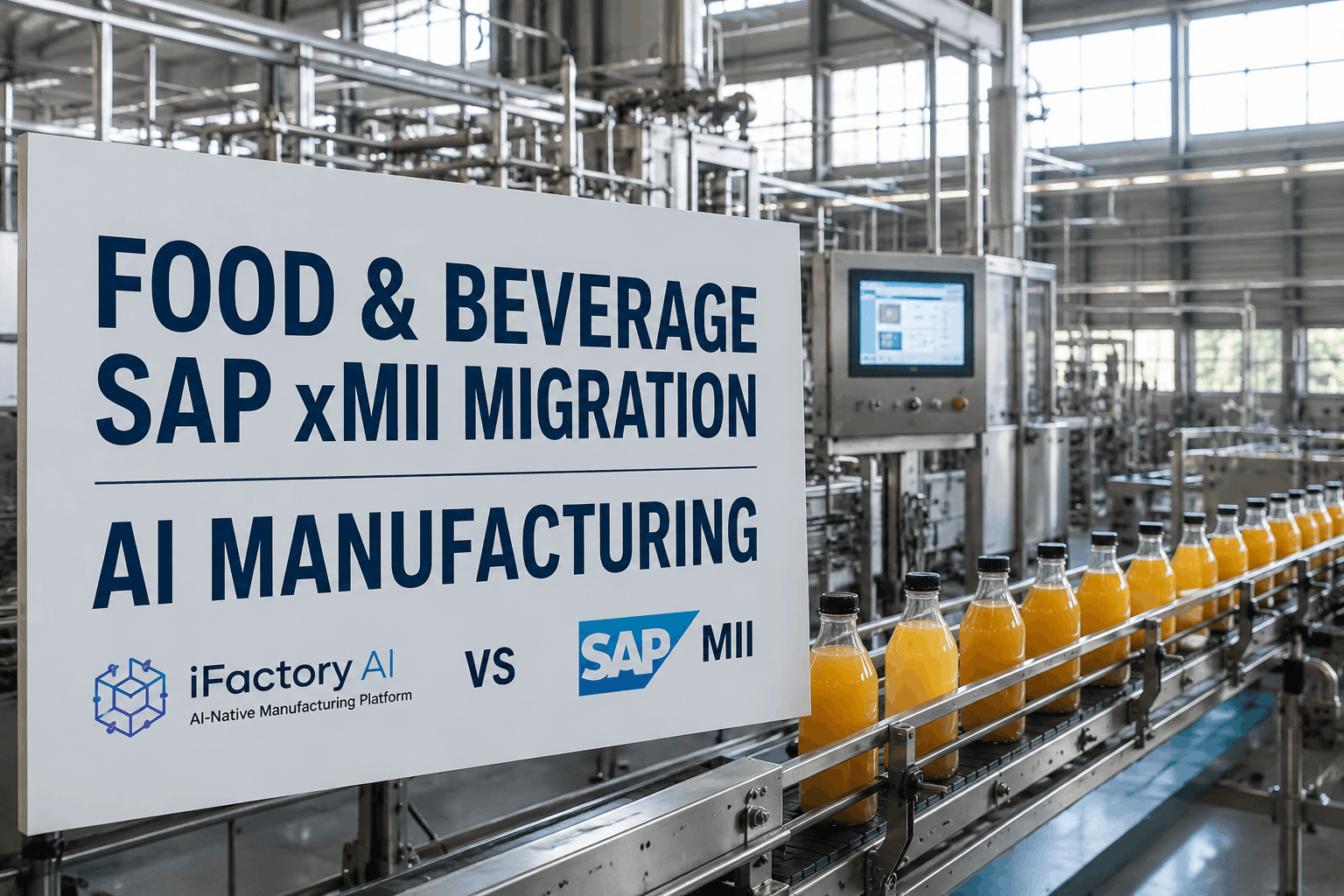
Quality leaders in food & beverage manufacturing are caught between two pressures that get worse every year — customer scorecard demands from major retailers tighten while plants face more product complexity, more allergens, more SKUs, more sanitation cycles, and tighter regulatory scrutiny under FSMA, BRC, SQF, and HACCP. The platform most quality leaders inherited to manage this — SAP MII or its descendants xMII and DMC — was designed for a fundamentally simpler era. It records what happened, surfaces deviations after the fact, and asks the quality team to investigate, document, and respond reactively. The result is a quality function that is always one step behind: chasing deviations rather than preventing them, scrambling for audit evidence rather than presenting it, defending customer scorecards rather than improving them. The AI-Native Manufacturing Revolution offers something fundamentally different: autonomous quality agents that monitor critical control points, allergen segregation, sanitation effectiveness, microbiological risk, and customer compliance continuously and proactively — surfacing issues before they become deviations and presenting audit-ready evidence on demand. iFactory AI delivers this on a pre-configured NVIDIA appliance running on-premise inside the plant — replacing SAP MII, SAP xMII, and SAP DMC with an AI-native platform purpose-built for F&B quality, deployed in 6–12 weeks. This page is the F&B quality leader's showdown: iFactory AI head-to-head with SAP MII / DMC across the dimensions that determine whether your quality function leads or trails.
Food & Beverage SAP DMC Migration: The AI-Native Platform Alternative
The F&B quality leader's showdown — iFactory AI vs SAP MII / xMII / DMC, scored across the dimensions that matter for HACCP, allergen control, sanitation, customer scorecards, and audit readiness. Six autonomous quality agents that turn reactive deviation management into proactive prevention. Pre-configured NVIDIA appliance, on-prem, 12-week deployment.
The Manufacturing Showdown: iFactory AI vs SAP MII / DMC
This is not a feature checklist. It is a scoring of the two platforms on the dimensions a quality leader actually owns — deviation rate, audit readiness, customer scorecard performance, recall risk, regulatory response time, and total cost of quality. On every dimension that matters for an F&B quality function in 2026, the two architectures produce visibly different outcomes.
The showdown is not close on any dimension a quality leader actually owns. The architectural difference — descriptive reporting on one side, autonomous quality agents on the other — translates directly into operational performance the quality function is measured on. The remaining question is not whether AI-native quality is better, but how to migrate to it with the least disruption.
Want the showdown scored against your specific F&B operation and quality metrics? Schedule the AI Manufacturing Transformation Workshop — iFactory's F&B team will score iFactory vs your current SAP MII/DMC state across your actual KPIs. Sessions available this week.
Six Autonomous Quality Agents for F&B
"Autonomous quality agents" is the architectural shift that delivers the showdown outcomes. Each agent is a specialized AI service that monitors a specific F&B quality domain continuously, runs anomaly detection, takes pre-defined actions within its scope, and escalates judgment calls to the quality leader with synthesized context. Six agents cover the core quality leader concerns in F&B operations.
HACCP CCP Agent
Monitors all critical control points continuously — temperature, time, pH, allergen segregation. Predicts CCP excursions hours ahead.
Allergen Control Agent
Tracks allergen segregation across lines, schedules, sanitation cycles. Flags cross-contact risk in real-time, verifies clean-down efficacy.
Sanitation & CIP Agent
Verifies CIP cycle effectiveness, optimizes adaptive CIP duration. Replaces fixed-time over-CIP with verified clean-to-target.
Microbiological Risk Agent
Correlates environmental, time-temperature, and historical micro data to flag elevated micro risk before lab results return.
Customer Compliance Agent
Tracks per-customer specs (Walmart, Target, Costco, Kroger). Flags scorecard risk before quarterly review, prepares audit evidence.
Recall Risk Agent
Maintains full lot-level traceability with predictive risk scoring. If a recall is needed, scope is bounded in minutes, not days.
The agents operate together, sharing context across the quality domain rather than in silos. When the Allergen Control Agent flags a cross-contact risk during a changeover, the Sanitation & CIP Agent verifies the relevant clean-down efficacy, the Microbiological Risk Agent updates its environmental model, and the Customer Compliance Agent confirms whether any active customer specs are affected — all without quality team manual coordination. The quality leader sees a single synthesized situation rather than four disconnected alerts.
Want to see the autonomous quality agents running against representative scenarios from your F&B operation? Schedule the AI Manufacturing Transformation Workshop — sessions include live agent demonstration tuned to your specific F&B segment. Sessions available this week.
The Quality Leader Command View
What changes for the quality function when six autonomous agents are working
For a quality leader, the most consequential change is the shift from chasing what happened to commanding what is about to happen. The command view below shows the four governance shifts that define AI-native quality leadership — what is replaced, what is gained, and where the quality function's time and attention move.
Three Migration Paths from SAP MII for F&B Quality
Stay on MII / xMII
Extended maintenance, reactive deviation management continues. No autonomous quality agents. Audit scramble continues. Cost of quality stuck.
SAP DMC (Cloud-Only)
Cloud migration with descriptive dashboards. No genuine autonomous agents. Latency limits real-time decisions. Cloud lock-in concern.
iFactory AI On-Prem
Six autonomous quality agents. Predictive deviation prevention. 2–4 hr audit response. HACCP/FSMA aligned. No cloud lock-in.
Six F&B Quality Operations Where Autonomous Agents Pay Back Fastest
Multi-Allergen Plants
Allergen Control Agent monitors segregation across lines, schedules, sanitation. Reduces cross-contact recall risk substantially.
CIP-Intensive Operations
Sanitation Agent verifies CIP efficacy and optimizes adaptive cycle duration. Cuts over-CIP cost while improving verification.
Customer-Audit-Heavy
Customer Compliance Agent maintains per-customer evidence continuously. Audit prep drops from weeks to hours.
High-Risk Micro Plants
Microbiological Risk Agent flags elevated risk before lab confirmation. Critical for ready-to-eat and dairy operations.
Co-Manufacturer Plants
Customer Compliance Agent maintains separate spec compliance per brand. Reduces spec violation risk across complex customer portfolios.
Multi-Site Quality Groups
All six agents operate across plants with portfolio-level quality intelligence. Quality leader gains real-time multi-site governance.
Want application-specific projections for your F&B operation? Send your F&B segment and current quality KPIs to iFactory support and the F&B team will return a customised projection with 12-month roadmap — typically within 3 business days, no obligation.
HACCP, FSMA, SQF, BRC & Customer Specs — Native to the Agents
Pre-built workflows for F&B quality frameworks
- HACCP — all critical control points monitored continuously
- FSMA — Food Safety Modernization Act (FDA)
- SQF — Safe Quality Food certification
- BRC / GFSI — global food safety standards
- Allergen management — 14 major allergens, segregation
- USDA — meat & poultry inspection support
- FDA 21 CFR Part 117 — preventive controls
- Customer specs — Walmart, Target, Costco, Kroger, more
Each compliance framework is not a separate workflow — it is a context the relevant agent operates within. The HACCP CCP Agent enforces HACCP framework rules; the Allergen Control Agent enforces FSMA preventive controls and customer allergen specs; the Customer Compliance Agent maintains per-customer scorecard evidence. This is what "native to the platform" means in practice — the agents are the compliance, not an add-on.
Two Real F&B Quality Leader Outcomes
Large dairy processor with 6 plants, multi-product portfolio, and tight customer quality demands
A large dairy processor running 6 plants producing fluid milk, yogurt, cheese, and specialty dairy products for major retail customers. Quality leadership lacked unified multi-site visibility — each plant ran SAP MII independently, scorecards lagged month-end consolidation, audit prep took weeks per customer. CIP cost ran 25% above benchmark from fixed-time over-cleaning.
Multi-category manufacturer with serious allergen segregation and customer scorecard pressure
A multi-category F&B manufacturer producing snack bars, beverages, and frozen desserts across shared production lines with 11 declared allergens in the portfolio. Allergen cross-contact represented serious recall risk; customer scorecards from two major retailers had slipped to yellow due to spec-compliance variability. SAP xMII recorded deviations but provided no predictive allergen-risk view.
Neither scenario matches your operation? Send your F&B segment, plant footprint, and quality KPIs to iFactory support and the F&B team will return a customised migration analysis with 12-month roadmap — typically within 3 business days, no obligation.
iFactory's F&B Deployment — On-Premise or Cloud
Same AI-native platform on either deployment model. Same six autonomous quality agents, predictive SPC, adaptive CIP, and customer-compliance intelligence. For F&B quality operations specifically, on-prem is recommended for latency, recipe IP protection, and operational independence during WAN outages — with cloud available for multi-plant quality groups wanting central governance.
iFactory On-Premise Appliance Recommended for F&B plants · solves cloud-only failure modes
- Pre-configured NVIDIA AI server — racked, software-loaded, ready to plug in.
- <50ms agent latency — quality decisions at production speed.
- Recipe and customer IP stays in plant — no cloud exposure.
- Works during WAN outages — agents continue operational.
iFactory Cloud For multi-plant F&B quality groups with central governance
- Fully managed — no rack, no facility requirements.
- Same agent capabilities — all six agents available.
- Portfolio-level quality intelligence across plants.
- Fastest deployment — first plant live in 2–4 weeks.
Quality leaders trail or lead based on architecture, not effort. AI-native is what leads.
Six autonomous quality agents — HACCP CCP, allergen control, sanitation/CIP, microbiological risk, customer compliance, recall risk — running together on a pre-configured NVIDIA appliance inside your plant. Deviations cut 70–85%, audit response down to 2–4 hours, customer scorecards moving from yellow to green proactively. The AI Manufacturing Transformation Workshop sizes the migration concretely for your F&B operation.
FAQ: F&B Autonomous Quality Agents & SAP MII Migration
What makes an autonomous quality agent different from a standard SPC alert?
A standard SPC alert fires when a measurement crosses a control limit and waits for a human to investigate. An autonomous quality agent operates continuously across a quality domain, runs anomaly detection, takes pre-defined corrective actions within its scope (like adjusting CIP cycle duration to verified clean-to-target), and only escalates judgment calls to the quality leader with synthesized context. The agent does the routine work; the leader makes the strategic decisions. Book a demo to see the agents on representative F&B scenarios.
How do the agents handle customer scorecard differences across retailers?
The Customer Compliance Agent maintains a distinct profile for each customer's scorecard requirements — Walmart's spec, Target's, Costco's, Kroger's, and so on — and runs continuous compliance monitoring against each. When a production run is destined for a specific customer, the agent verifies the relevant spec is being met and flags any predicted risk before the shipment goes out. Audit evidence is assembled per customer continuously.
How does this integrate with our existing SAP MII/ERP for traceability?
iFactory integrates natively with SAP MII/xMII/ERP for production context and lot data, plus with major plant historians (PI and similar), LIMS for micro and chemistry results, MES platforms, and quality management systems. The agents draw context from these existing systems rather than replacing them. The Recall Risk Agent uses the full lot traceability chain across these systems to bound any potential recall scope in minutes.
What if our HACCP plan changes — do we have to retrain the agents?
No. The HACCP CCP Agent is configuration-driven, not hard-coded — when a HACCP plan revision is approved, the new CCPs, limits, and monitoring procedures are configured into the agent, which then monitors against them continuously. The configuration change is auditable and version-controlled, satisfying both operational flexibility and regulatory documentation requirements.
Do I have to buy NVIDIA servers separately?
No. iFactory's on-premise appliance ships fully loaded — pre-configured NVIDIA AI server, software pre-installed, network gear, cabling, edge devices for line-side inference, and integration adapters for your plant systems. You provide rack space, line power, Ethernet, and integration points. The deployment team handles all installation, validation, and configuration. For cloud, no hardware investment at all.
Can we deploy at one plant first before rolling out portfolio-wide?
Yes — and it's the recommended approach for multi-site operations. Start with the plant where quality cost or audit pressure is highest. Validate the autonomous agents and quality outcomes. Then expand plant-by-plant, with portfolio quality intelligence unifying as each site comes online. A typical 4–6 plant deployment completes in 5–8 months end-to-end with central quality governance active progressively.
What does the AI Manufacturing Transformation Workshop cover?
The half-day workshop covers — current-state SAP MII / xMII / DMC assessment from a quality leader perspective, the six-agent demonstration on representative F&B scenarios, the showdown scored against your quality KPIs, three-path migration comparison with cost/timeline projections, HACCP/FSMA/SQF/BRC alignment, deployment roadmap, ROI projection on cost of quality and customer scorecard performance. Outcome is a concrete migration plan suitable for quality leadership, plant operations, IT, and finance.
End the audit scrambles. End the deviation chase. Lead with autonomous quality agents.
The F&B quality function leads or trails based on the architecture supporting it. Six autonomous quality agents on a pre-configured NVIDIA appliance inside your plant deliver predictive deviation prevention, continuous audit evidence, proactive scorecard protection, and cost of quality cut 50–70%. Live in 6–12 weeks, no cloud lock-in. The Workshop is the fastest way to size the migration for your specific operation — sessions available this week.