An automotive body shop produces 3,000 to 5,000 resistance spot welds, MIG seams, laser joints, and brazed connections on every vehicle — each one a potential structural failure if quality drifts unnoticed. A paint booth applies five chemical and thermal layers in series — pretreatment, electrocoat, primer, basecoat, clearcoat — any of which can harbour contamination, orange peel, runs, sags, or colour drift invisible under booth lighting. A final assembly line running at 60 to 90 vehicles per hour gives human inspectors seconds to evaluate 200-plus checkpoints per unit. The math does not work. Manual inspection samples 5 to 15 percent of production volume, and even on sampled units, trained inspectors catch 70 to 80 percent of surface defects under the best conditions — dropping to 68 percent by hour ten of a night shift as fatigue compounds under fixed lighting. The 12 to 18 percent that escapes becomes warranty claims averaging $850 to $1,200 per defect remediation, OEM scorecard penalties reaching $45,000 per rejected truckload at Tier-1 suppliers, and recalls that can run into billions. A peer-reviewed survey of more than fifty studies published in the journal Sensors in January 2026 confirmed that machine-learning-powered vision now reaches defect detection accuracy above 95 percent in live production, with some configurations hitting 98 to 100 percent — yet 77 percent of implementations remain stuck at pilot or prototype scale. The gap is not the algorithm. It is the deployment: the lighting, the edge compute, the integration with plant systems, and the operational methodology that sustains accuracy shift after shift. iFactory AI closes that gap with a turnkey AI vision inspection platform — pre-configured NVIDIA hardware, edge inference under 50 milliseconds, and integration with SAP, MES, and quality systems — deployed on your production line in 6 to 12 weeks, not 18 months of pilot limbo.
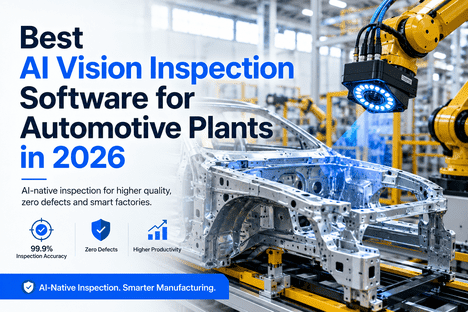
Best AI Vision Inspection Software for Automotive Plants in 2026
Turnkey AI vision that inspects 100% of production at line speed — detecting paint defects, weld porosity, panel misalignment, and assembly errors with 99%+ accuracy. On-premise NVIDIA hardware. SAP and MES integration. IATF 16949 traceability. Deployed in 6–12 weeks, not 18 months of pilot programmes.
The 1-10-100 Rule: Why Late Detection Destroys Automotive Margins
Every automotive quality engineer knows the 1-10-100 rule instinctively, but few plants have instrumented it. A defect caught at the stamping press costs $1 to address. The same defect discovered after paint costs $10. After final assembly and customer delivery, the cost exceeds $100 — often dramatically. In 2025, US passenger vehicle manufacturers paid $13.4 billion in warranty claims, up 8 percent year-over-year — the third consecutive annual increase. Ford alone spent $5.83 billion on warranty payouts, a 22 percent jump. GM reported $4.47 billion, up 12 percent. Tesla hit $1.45 billion, up 19 percent. The common thread is not poor engineering — it is late detection. iFactory's AI vision catches defects at the point of origin, collapsing the cost multiplier before it compounds.
The cost escalation is not theoretical — a paint defect on a rear quarter panel discovered after final assembly triggers 4.8 hours of disassembly, repair, and reassembly at $2,840 in labour and materials. The same defect caught 18 minutes after paint booth exit costs near zero to address. Schedule a demo to see where AI vision delivers the fastest ROI on your specific line configuration.
Human Inspectors vs AI Vision: The Structural Gap
The gap between human inspection and AI vision is not a matter of degree. It is structural. A trained inspector working a day shift under optimal lighting detects 78 to 84 percent of surface defects. By hour ten of a night shift, that drops to 68 percent. AI vision operates at 99.4 percent accuracy regardless of shift, lighting fatigue, or subjective judgment — and it inspects 100 percent of production volume, not the 5 to 15 percent that sampling covers. The comparison below shows exactly where the performance gap lives across every dimension that matters on an automotive production line.
The structural gap means that adding more human inspectors does not close the quality gap — it only adds cost without changing the fundamental limitations of human visual processing under production speed and fatigue. AI vision is not a supplement to human inspection. It is a replacement of the sampling model with a census model — every unit, every surface, every shift. Contact iFactory support to discuss how AI vision integrates alongside your existing quality team — augmenting judgment, not replacing people.
Five Inspection Zones Where AI Vision Pays Back Fastest
An automotive plant is not one inspection problem — it is five distinct visual inspection environments, each with different defect types, lighting requirements, camera configurations, and integration points. AI vision systems that work in the body shop may not work in the paint shop without different optics. iFactory deploys zone-specific vision configurations tuned to each environment — because a one-size-fits-all camera setup is why 77 percent of AI vision pilots never reach production.
Body Shop — Weld Integrity
Robot-mounted cameras with 3D laser profiling inspect every weld at line speed — measuring nugget diameter for spot welds, bead geometry for seams, keyhole stability for laser joints, and gap-and-flush for panel fit. Thermal cameras capture weld-zone heat signatures detecting incomplete fusion, porosity, and missing welds from robot programming errors.
Paint Shop — Surface Quality
Deflectometry and structured-light sensors scan entire painted bodies detecting orange peel, runs, sags, craters, dirt inclusions, colour drift, and clear coat thickness variation. Darkfield illumination reveals scratches invisible under standard lighting. Every defect geo-located on a 3D body model for targeted rework — no more full-panel re-sanding for a single crater.
Stamping — Die & Panel Quality
High-resolution area-scan cameras inspect stamped panels for splits, wrinkles, necking, surface scratches, and dimensional deviation within GD&T tolerances. Die wear patterns tracked over time predict when tool maintenance is needed before defect rates rise — shifting from reactive to predictive die management.
Final Assembly — Component Verification
Multi-camera arrays verify correct component placement, fastener presence, harness routing, label positioning, fluid fill levels, and ADAS sensor alignment. Assembly sequence validation catches missing parts and incorrect installations before the vehicle leaves the station — eliminating end-of-line rework that averages $2,840 per incident.
Incoming & Tier-1 Supplier Parts
AI vision at the receiving dock inspects incoming supplier parts before they enter the production line — catching defects that would otherwise propagate through body, paint, and assembly at escalating cost. Supplier quality scorecards auto-generated from inspection data provide objective evidence for supplier development and PPAP compliance.
Each zone requires different cameras, lighting, and AI models — a body-shop weld camera cannot inspect paint surfaces, and a paint deflectometry system cannot verify assembly fasteners. Schedule the AI Vision Assessment — iFactory's automotive team will map your specific zones, defect types, and line speeds to a zone-by-zone deployment plan with ROI projections. Sessions available this week.
Camera-to-Decision: How the AI Vision Pipeline Works
An AI vision inspection system is not a camera. It is a five-layer pipeline where weakness in any layer propagates through the entire stack — inadequate lighting produces images the AI model cannot learn from, insufficient edge compute creates inference latency that breaks real-time inspection at production speed, and missing integration means defects are detected but never acted upon. The pipeline below shows how iFactory's system processes every unit from image capture to automated quality decision.
The pipeline architecture is why iFactory delivers production-grade results where standalone camera vendors and generic AI platforms stall at pilot. A camera vendor sells Layer 1. An AI startup sells Layer 3. Neither owns the integration at Layer 5 that connects defect detection to quality decisions, work orders, and process correction. iFactory owns the entire stack — optics to action — and ships it as a pre-configured appliance. Book a demo to see the full pipeline running on automotive parts.
The $13.4 Billion Warranty Problem AI Vision Solves
Automotive warranty costs are not a finance problem — they are a quality detection problem with financial consequences. Every defect that reaches the customer generates a claim, a repair, a parts return, and potentially a recall. The economics are stark and worsening.
Root cause pattern: increased electronic content per vehicle, EV battery integration complexity, ADAS sensor alignment sensitivity, and manual quality processes that cannot scale with production complexity. AI vision addresses the largest controllable variable — catching visual defects before they become warranty events.
Typical payback on AI vision deployment is 6 to 12 months, driven primarily by warranty claim reduction (60–80%), eliminated rework, and quality labour reallocation to root cause analysis. Contact iFactory support with your current warranty and rework cost data — the team will return a plant-specific ROI model within 3 business days.
Automotive Standards & Compliance — Native to iFactory
Pre-built compliance workflows for automotive quality frameworks
For automotive OEMs and Tier-1 suppliers, IATF 16949 compliance is non-negotiable — it is a condition of doing business. BYD joined the IATF as a new member in 2026, signalling that even the fastest-growing EV manufacturers are aligning with established automotive quality frameworks. iFactory's AI vision platform generates IATF-compliant inspection records automatically — SPC data, measurement system analysis, defect Pareto charts, and process capability indices — eliminating the manual documentation burden that quality teams carry during surveillance and re-certification audits.
Two Real Automotive Plant Outcomes
Full-line OEM with body shop weld inspection and paint shop surface quality challenges
An OEM assembly plant producing 280,000 vehicles annually across two shifts. Human inspectors at paint booth exit were catching 78% of surface defects under fixed lighting. The remaining 22% advanced to final assembly where each late rejection cost $3,200 in disassembly, re-paint, and reassembly labour. Body shop relied on destructive teardown sampling for spot weld quality — inspecting 2% of the 4,200 welds per vehicle.
Tier-1 stamping supplier shipping Class A body panels to three OEM customers
A Tier-1 supplier stamping and shipping Class A outer body panels — doors, fenders, hoods, quarter panels — to three OEM customers. Micro-scratches invisible to manual inspection were discovered only after customer rejection, costing $45,000 per truckload in expedited rework plus OEM penalty fees. Customer scorecards were deteriorating, risking contract renewal.
Neither scenario matches your operation? Send your plant type, production volume, and current quality baselines to iFactory support — the automotive team will return a customised analysis with 12-month deployment roadmap within 3 business days, no obligation.
Why 77% of AI Vision Pilots Fail — and How iFactory Avoids It
The January 2026 Sensors journal survey confirmed what plant managers already know: 77 percent of AI vision implementations are stuck at pilot or prototype scale. The failure is almost never the algorithm. It is the deployment methodology. iFactory's turnkey model eliminates the four failure modes that kill automotive AI vision pilots.
Lighting Mismatch
Generic camera vendors ship hardware without designing lighting for specific defect types. A darkfield setup that reveals scratches cannot detect orange peel — different defects need different illumination. iFactory designs zone-specific lighting rigs validated against your actual defect library before hardware ships.
Insufficient Edge Compute
Cloud-based inference adds 200–500ms of latency per frame — too slow for line speeds of 60–90 vehicles per hour. iFactory deploys NVIDIA Jetson and L4 GPUs at the line side, keeping inference under 50ms with zero cloud dependency. The plant runs during WAN outages.
No Integration to Quality Systems
A camera that detects a defect but does not auto-log it in SAP QM, trigger a work order, or route the part to rework is a monitoring tool, not an inspection system. iFactory's Layer 5 integration connects vision output to SAP, MES, SCADA, and CMMS — closing the loop between detection and action.
Model Drift Without Retraining Infrastructure
AI models degrade as production conditions change — new suppliers, new paint batches, seasonal temperature shifts. Without on-premise retraining capability, accuracy drops within months. iFactory's NVIDIA appliance includes continuous model refinement on-site — no data leaves the plant, no cloud retraining dependency.
The automotive machine vision market will reach $6.09 billion by 2031. The question is not whether to deploy AI vision — it is how to get from pilot to production without the 18-month stall.
iFactory ships the complete pipeline — optics, edge compute, AI models, integration, and retraining infrastructure — as a pre-configured NVIDIA appliance. Deployed on your line in 6–12 weeks. 99%+ accuracy validated before go-live. No cloud lock-in. No pilot limbo.
On-Premise or Cloud — Same AI Vision Platform
iFactory On-Premise Appliance Recommended for automotive OEMs and Tier-1 suppliers
- Pre-configured NVIDIA AI server — racked, software-loaded, cameras pre-paired, ready to connect.
- <50ms edge inference — keeps up with 60–90 vehicles/hour line speeds.
- On-site model retraining — no production images leave the facility. Full data sovereignty.
- Works during WAN outages — inspection never stops, even if your network does.
- IATF 16949 audit-ready — image archive, SPC data, and traceability stored locally.
iFactory Cloud For multi-plant OEMs with centralised quality governance
- Fully managed — no rack space, no facility requirements, no hardware procurement.
- Same AI capabilities — identical models, accuracy, and integration points.
- Cross-plant benchmarking — compare defect rates, OEE, and yield across facilities.
- Fastest deployment — first line live in 2–4 weeks with cloud-edge architecture.
- AWS, Azure, GCP VPC — runs in your existing cloud environment.
FAQ: AI Vision Inspection for Automotive Plants
What defects can AI vision detect on automotive production lines?
AI vision detects any defect that is visually distinguishable under appropriate lighting: surface scratches, dents, craters, orange peel, paint runs and sags, colour drift, weld porosity, incomplete fusion, weld spatter, missing fasteners, incorrect component placement, panel misalignment, gap-and-flush deviation, label errors, and dimensional variations. Detection of defects smaller than 0.1mm requires specialised optics — subsurface defects (internal porosity, voids) require X-ray or CT, not optical vision. Book a demo to see detection on your specific defect types.
Does this work with our existing cameras and lighting?
If your cameras meet 5+ megapixel resolution with appropriate lighting for your specific defect type, yes — iFactory integrates via ONVIF and RTSP protocols and supports Cognex, Keyence, Basler, and FLIR hardware. However, most production-grade deployments benefit from optimised lighting rigs designed for specific defect detection — a darkfield setup for scratches, structured light for 3D geometry, deflectometry for reflective paint surfaces. The deployment team assesses existing hardware and recommends additions only where they materially improve detection accuracy.
How does it integrate with SAP and our MES?
iFactory integrates natively with SAP QM (inspection lots, usage decisions, defect catalogues), SAP PM (auto-generated work orders from defect trends), and SAP PP (production order linkage for full traceability). MES integration supports Siemens Opcenter, AVEVA, Rockwell Plex, and custom MES platforms via OPC-UA, REST API, and database connectors. Every defect is auto-logged with image evidence, station ID, shift data, VIN, and process parameters — no manual data entry required. Contact support with your current SAP and MES configuration for a compatibility assessment.
What is the typical ROI timeline?
Typical payback is 4 to 12 months depending on production volume and current defect escape rate. Primary savings come from reduced warranty claims (60–80% reduction), eliminated late-stage rework ($2,840 average per paint defect caught at assembly vs near-zero if caught at paint exit), quality labour reallocation from inspection to root cause analysis, and reduced scrap. Plants with high current defect escape rates see payback fastest — some within 90 days.
Does AI vision slow down the production line?
No. Analysis completes in under 0.3 seconds — faster than parts move between stations. Multi-camera configurations capture all surfaces simultaneously without stopping conveyors. The inspection is inline, non-contact, and invisible to production throughput. Line speed is not affected.
Can we start with one zone before plant-wide deployment?
Yes — and it is the recommended approach. Start with the zone where defect cost or escape rate is highest (typically paint shop exit or body shop weld inspection). Validate AI vision performance on that zone. Then expand zone-by-zone across the plant. Full five-zone deployment for a typical OEM assembly plant completes in 4 to 6 months with inspection accuracy validated at each stage before expansion. Schedule the AI Vision Assessment to identify your highest-ROI starting zone.
How does iFactory handle model accuracy drift over time?
Production conditions change — new paint suppliers, seasonal temperature shifts, tooling wear patterns, new vehicle models. AI models trained on historical data degrade if not continuously refined. iFactory's on-premise NVIDIA appliance includes continuous learning capability: new defect images are labelled by quality engineers and fed back into the model on-site, without sending production images to the cloud. Model accuracy is monitored via automated drift detection — if accuracy drops below threshold, the system flags it and initiates retraining. This is why on-prem matters — cloud-dependent systems cannot retrain without exporting sensitive production data.
Every vehicle that leaves your plant with an undetected defect is a warranty claim waiting to happen. AI vision makes the invisible visible — at line speed, on every unit, every shift.
99.4% defect detection accuracy. Under 0.3 seconds per inspection. 100% production coverage. Pre-configured NVIDIA appliance, on-premise, integrated with SAP and MES, live in 6–12 weeks. The AI Vision Assessment is the fastest way to map your zones, defect types, and line speeds to a deployment plan with ROI projections — sessions available this week.