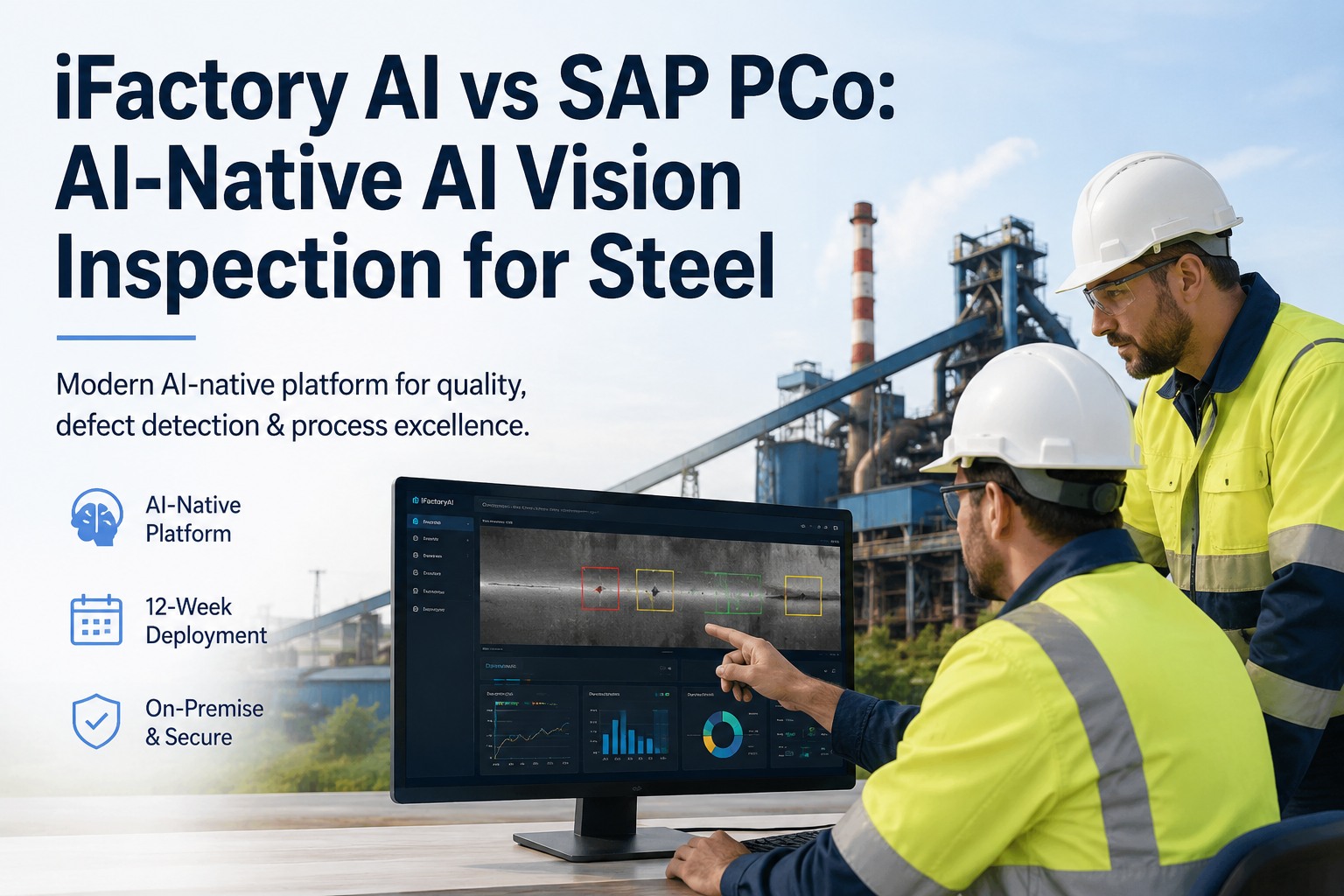
Surface defects in steel are where customer claims, scrap costs, and brand reputation actually live. A 1500 m/min hot strip mill produces 25 metres of coil per second; a slab caster outputs 1.5 metres per minute; a plate finishing line moves at 5–15 m/min. None of these line speeds give human inspectors a real chance to catch every scale break, edge crack, sliver, oil spot, oxide patch, or rolling mark. SAP PCo and SAP MII never had the architectural ability to participate — they ingested process signals and produced reports, but vision was always a separate point system bolted on with manual reconciliation. iFactory AI replaces that fragmentation with an AI-native vision pipeline integrated into the same platform as the SPC engine, batch records, and operator copilot. Defects detected by the line camera are immediately attributed back to upstream process windows and rolled into the customer-shareable heat record. 12-week deployment on-prem or cloud. This is the rolling mill analytics and computer vision quality control story SAP MII never delivered.
iFactory AI vs SAP PCo — AI-Native AI Vision Inspection for Steel
Replace SAP MII / PCo with steel-purpose-built AI vision inspection — hot strip, cold strip, plate, wire rod, slab surface. Sub-50ms edge inference at full line speed. Defect-to-process causal attribution native. 12-week deployment on-prem or fully-managed cloud.
Why SAP PCo Was Never Going to Solve Vision Inspection
SAP PCo was designed to ingest 1 Hz process signals and pass them upstream to xMII. Modern steel surface inspection runs at 30–120 frames per second per camera, with multiple cameras per zone, and requires sub-50ms causal inference. The architectural mismatch is not closable through configuration — it is a different category of system.
- Process signals only · no native vision pipeline
- 1 Hz polling · vision needs 30–120 fps
- Reconciliation overhead · separate vision system + manual cross-check
- No edge inference · WAN-bound architectures lose sub-50ms
- No causal attribution · defect-to-process linkage manual
- Cloud-mandatory (DMC) · disqualifies mill-protection latency
- Native AI vision pipeline · same platform as SQC, batch records
- 30–120 fps inference · matches line camera cadence
- Single data layer · vision + process + lab unified
- Sub-50ms edge inference · on-prem NVIDIA appliance
- Causal attribution native · defect linked to upstream process window
- On-prem or cloud · your choice, not the vendor's
Steel Surface Defects iFactory Vision Detects
Pre-trained on steel-specific defect classes across hot rolling, cold rolling, plate, slab, and finishing — a metallurgy AI platform grounded in real mill data. Continuously refined per customer site. The grid below covers the standard catalog.
Scale & Oxide
Mill scale, secondary oxide, scale pits on hot strip. Detected as the strip exits descaler stand.
Edge Cracks & Tears
Edge cracks, slivers, hairline tears on hot strip and plate edges. Detected before recoiling.
Pinholes & Inclusions
Non-metallic inclusions, gas porosity, casting-origin defects surfaced through rolling.
Rolling Marks & Streaks
Roll force variation marks, lubrication streaks, surface roughness deviation on cold strip.
Oil Spots & Stains
Lubricant residue, water stains, surface contamination on cold strip and galvanized lines.
Coating Uniformity
Galvanized zinc coating thickness variation, paint defects, anodize layer uniformity on finishing lines.
Gauge & Width Drift
Real-time gauge profile, width-edge drift, crown deviation across hot strip and plate.
Slab Surface Defects
Caster-output slab surface — longitudinal cracks, transverse cracks, depressions detected before reheat.
Want to see iFactory's vision pipeline running on your defect catalog? Book a demo today — iFactory's steel practice will train against a sample of your defect images during the session and show live detection.
From Defect Detection to Causal Attribution
Detecting a defect is only useful if the cause is also surfaced. iFactory's pipeline links every detected defect back to the upstream process window — heat chemistry, casting conditions, reheat profile, roll force trajectory — without manual reconciliation. The four-stage pipeline runs continuously across all line cameras.
Capture
Line cameras stream at 30–120 fps · multiple zones · hot and cold optics matched to mill stage.
Classify
Edge inference identifies and grades the defect class. Sub-50ms decisions for inline corrective action.
Attribute
Defect linked to upstream process window using causal graphs — heat chem, casting, reheat, rolling.
Disposition
Coil dispositioned · customer-shareable evidence appended to heat record · operator copilot notified.
iFactory AI vs SAP PCo + Standalone AOI (Automated Optical Inspection)
| Dimension | SAP PCo + Standalone AOI | iFactory AI Vision |
|---|---|---|
| Architecture | Two systems · manual reconciliation | One platform · one data layer |
| Frame rate | AOI handles · PCo blind to it | 30–120 fps native ingestion |
| Edge inference | AOI vendor-specific · 100–300ms typical | Sub-50ms on NVIDIA appliance |
| Causal attribution | Manual · engineers correlate later | Native · defect tied to process window |
| Defect catalog updates | AOI vendor release cycle | Continuous learning per site |
| Heat record integration | Separate export · manual merge | Auto-appended to batch record |
| Operator AI assistant | Not available | Natural-language defect queries |
| Total deployment | 12–24 months across two systems | 12 weeks · one platform |
12-Week Deployment · 30-Day First Detections
Install & Calibrate
NVIDIA appliance racked (on-prem) or cloud tenant provisioned. Line cameras connected at hot strip, cold mill, finishing zones. Pre-trained steel models loaded. Read-only connectivity to SAP MII / PCo.
First Detections
AI vision running across primary zones. Defect detections cross-referenced with upstream process data. Causal attribution operational. Operator AI copilot live on first console.
Full Line Coverage
All inspection zones online. Coil-level disposition tied to heat record. Customer-shareable surface evidence packaged. SAP MII reporting workflows migrated. Verified ROI documented.
Documented Steel AI Vision Outcomes
One platform for steel SQC, vision, batch records, and operator AI — not three systems and a reconciliation problem.
iFactory AI replaces SAP MII / PCo and standalone AOI with native AI vision inspection integrated into the same platform as SQC and batch records. Sub-50ms edge inference, causal attribution, customer-shareable surface evidence. 12-week deployment on a turnkey NVIDIA appliance or fully-managed cloud. Book a demo today.
FAQ — Steel AI Vision Inspection
Does iFactory ship on-prem only or is cloud available?
Both. On-prem (turnkey NVIDIA appliance with 99.9% uptime SLA) is the recommended default for steel plants — sub-50ms edge inference at line speed is non-negotiable for caster protection and high-speed strip inspection. Fully-managed cloud is available for multi-plant steel groups consolidating governance across finishing sites with reliable connectivity. Same platform, same vision pipeline, same causal engine on either deployment. Book a demo to walk through both options.
Can iFactory work with our existing AOI cameras and lighting?
Yes. iFactory's vision pipeline integrates with industry-standard line cameras (GigE, CoaXPress, Camera Link) and lighting systems already deployed in steel mills. The appliance ingests the existing camera feeds and runs the AI inference layer — no rip-and-replace of optical infrastructure. Where existing cameras are not yet deployed, iFactory's turnkey BOM includes camera and lighting selection sized for your line.
How does causal attribution actually work?
The vision pipeline runs alongside the SPC engine and the process data ingestion. When a defect is classified at a finishing camera, the causal graph maps backward in time across the data layer to identify which heat, which casting conditions, which reheat profile, and which roll force trajectory most likely produced it. Top-ranked causal candidates are surfaced with confidence intervals. Engineers move from forensic investigation to evidence review.
What about IATF 16949 and customer auditing?
Continuous evidence capture is the audit advantage for steel manufacturing MES modernization. Every defect detection, every classification, every causal attribution, every disposition decision is logged with timestamp, model version, confidence interval, and outcome. Customer audits and IATF 16949 reviews work from queryable evidence rather than reconstructed reports. Most steel quality manager software users report stronger audit posture after migration than before.
What does the demo session actually cover?
30-minute working session with iFactory's steel practice. Walks through AI vision running on actual steel defect images, sub-50ms edge inference timing, causal attribution against process data, heat record integration, and operator copilot in action. Output is a tailored ROI projection and 12-week deployment quote with full BOM sized for your specific mill type and line count. Slots available this week.
Replace SAP MII / PCo and standalone AOI with one AI-native vision platform.
Steel defect detection, causal attribution, customer-shareable surface evidence, operator AI assistance, autonomous manufacturing-grade quality intelligence — one platform, one data layer. 12-week turnkey deployment on a NVIDIA appliance or fully-managed cloud. Book a demo today.