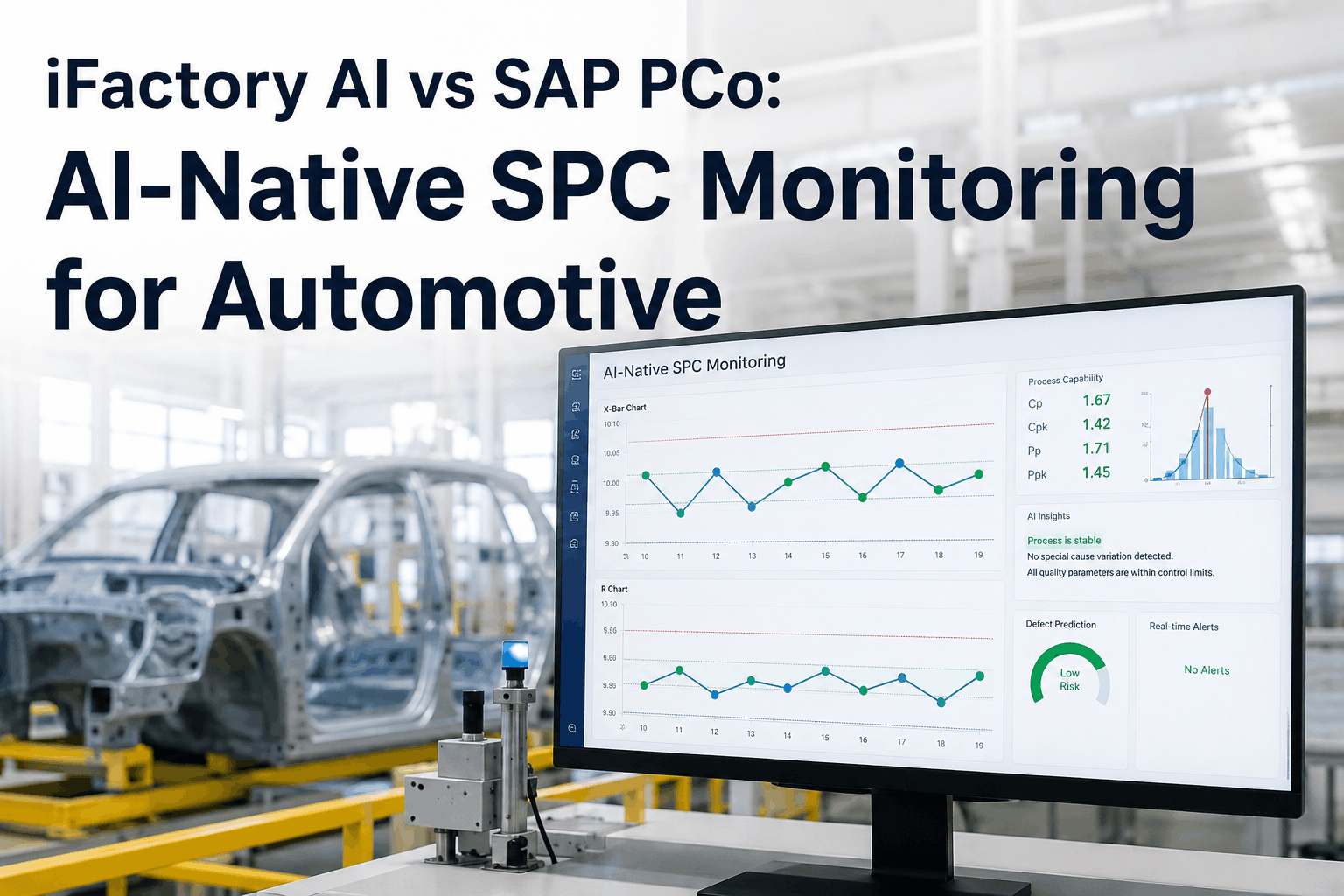
For automotive controls and process engineers responsible for shop-floor quality at line speed, the limitation of the SAP MII / SAP Plant Connectivity (PCo) architecture is structural rather than incidental — it is fundamentally an open-loop monitoring system. SAP PCo collects sensor and PLC data from the line, forwards it to xMII for dashboards and reports, and produces operational visibility — but it does not close the loop. When a weld goes out of specification, when a torque tool drifts, when paint thickness wanders, when a stamping die starts wearing, the SAP architecture sees it after the fact and reports it through a dashboard. The actual correction — adjusting weld parameters, retuning torque setpoints, modifying paint flow, compensating for tool wear — happens through manual operator intervention or pre-programmed PLC logic, neither of which can adapt as conditions change in real-time. Closed-loop manufacturing is the architectural shift that closes this gap: AI feedback control that observes the process continuously, infers what is happening, decides on a correction, and pushes the corrected setpoint back to the controller within the same control cycle. iFactory AI is the AI-native closed-loop manufacturing platform purpose-built for automotive — pre-configured NVIDIA appliance running closed-loop control models at sub-50ms edge inference, replacing SAP PCo as the data on-ramp and adding the AI feedback control layer that SAP MII / xMII never provided. This page is the automotive controls engineer's guide to AI-native closed-loop manufacturing — the architecture, the feedback control mechanics, the shop-floor coverage, and how the migration from SAP PCo actually works.
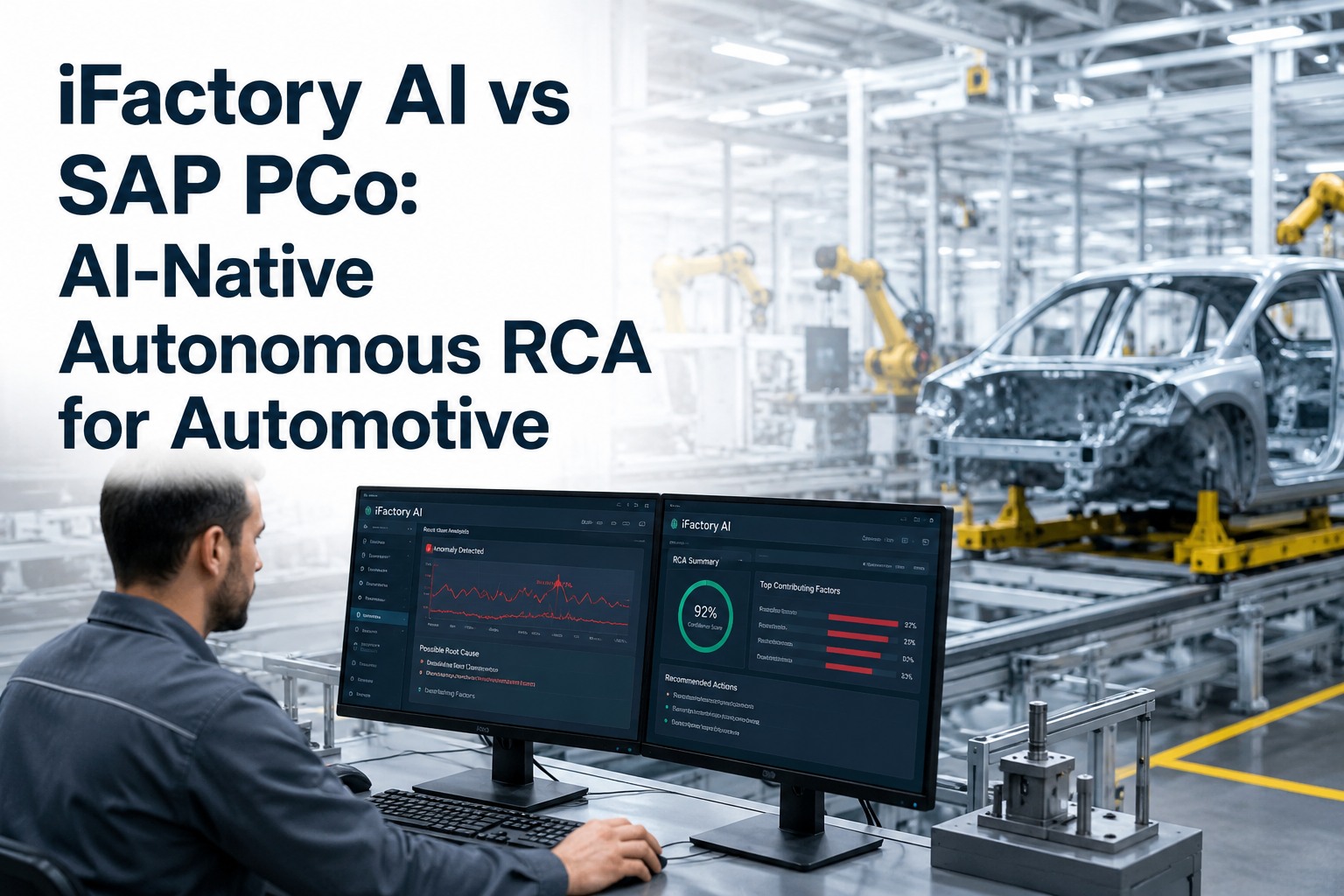
iFactory AI vs SAP PCo: AI-Native Closed-Loop Manufacturing for Automotive
The automotive controls engineer's guide to AI-native closed-loop manufacturing — replacing SAP PCo and SAP MII / xMII open-loop monitoring with AI feedback control across weld, paint, torque, stamping, assembly, and powertrain stations. Turnkey AI server, on-prem, 6–12 week go-live.
Open-Loop vs Closed-Loop: The Architectural Difference
The architectural distinction between SAP PCo open-loop monitoring and AI-native closed-loop control is the entire argument for modernization. Open-loop watches and reports; closed-loop watches, decides, and acts. For an automotive controls engineer, this is not a minor capability addition — it is a different operating model for shop-floor quality.
The right-side feedback arrow is what makes the architecture closed — the AI feedback control engine pushes corrected setpoints back to the PLC, closing the loop without human intervention. The PLCs and sensors do not change; the PCo middleware is replaced with the iFactory integration layer; and the entire xMII dashboard-and-human-intervention chain is supplemented (or replaced) with an automatic feedback path that operates faster than human reaction time.
Want this architecture mapped to your specific automotive shop-floor setup? Schedule the AI Manufacturing Transformation Workshop — iFactory's automotive team will diagram the closed-loop architecture for your weld, paint, torque, or stamping stations. Sessions available this week.
The AI Feedback Control Loop — Mechanics
The closed-loop architecture is more than a diagram — it is a mechanical sequence of operations executing many times per second across every controlled station. Understanding the four-step mechanics matters because it determines what is actually achievable: which corrections happen automatically, which escalate to operators, and what guarantees hold during edge cases.
The "bounded authority" point in step 3 is critical for automotive deployments — the AI feedback control engine acts within explicit, configured authority limits defined by the controls engineering team. Corrections that fall within authorized bounds happen automatically. Decisions that exceed authority (or that touch safety interlocks) are flagged and escalated rather than executed unilaterally. This is what makes closed-loop AI control safe to operate alongside the existing safety architecture.
Want to discuss bounded-authority configuration for your specific stations? Send your station list and current control architecture to iFactory support and the controls team will return a proposed authority framework — typically within 3 business days, no obligation.
Closed-Loop Coverage Across the Automotive Shop Floor
Where AI feedback control delivers across the automotive plant
Closed-loop control applies across most automotive shop floor stations, with the highest near-term payback in weld, paint, torque, and stamping where the process variation is well-instrumented and the correction pathway is clear. The coverage map shows the typical station-level deployment pattern.
The "without rip-and-replace" point matters operationally. Existing PLCs, sensors, robot controllers, paint flow controllers, torque tools, and station equipment all stay in place. The iFactory closed-loop layer sits above them, integrating via the same protocols PCo used (OPC UA, MQTT, PLC fieldbus) and pushing setpoint corrections back through the same paths. The controls engineering team gains closed-loop AI capability without restructuring the underlying control architecture.
Three Migration Paths for Automotive Closed-Loop Manufacturing
Stay on SAP PCo
Extended PCo + xMII maintenance. Open-loop monitoring continues. No closed-loop AI control. Defect rates and rework hold steady.
SAP DMC (Cloud)
Cloud modernization with descriptive analytics. Cannot deliver sub-50ms closed-loop control due to WAN latency. Cloud lock-in.
iFactory AI On-Prem
AI feedback control engine on a turnkey NVIDIA appliance. SAP PCo replacement with closed-loop layer. On-prem, no cloud lock-in.
Six Automotive Stations Where Closed-Loop Pays Back Fastest
Body Shop Weld
Real-time adjustment of weld current, electrode force, and weld time per weld based on inferred nugget quality. Reduces weld defects directly.
Paint Shop Film Thickness
Real-time paint flow correction based on inline thickness measurement. Holds film build within tight bands across vehicles and runs.
Torque Tooling
Closed-loop torque tool calibration as tools drift. Adjusts setpoint compensating for wear and angle effects. Reduces over- and under-torque defects.
Stamping Press
Real-time press parameter adjustment as dies wear. Maintains dimensional capability across the die life rather than degrading toward end of life.
Powertrain Machining
Automatic tool offset correction based on inline metrology. Cpk improves measurably without operator intervention.
EV Battery Cell & Pack
Closed-loop control of formation cycle parameters per cell variation. Pack assembly inspection with real-time alignment correction.
Want station-specific projections for your automotive plant? Send your station list and current quality baselines to iFactory support and the automotive team will return a customised projection with 12-month roadmap — typically within 3 business days, no obligation.
IATF 16949, PPAP & Automotive Quality — Preserved Through Closed-Loop Control
Compliance workflows pre-built for automotive frameworks
- IATF 16949 — automotive QMS standard
- PPAP — Production Part Approval Process
- APQP — Advanced Product Quality Planning
- MSA — Measurement Systems Analysis
- Process Capability (Cpk / Ppk) — automated
- Control Plans — live with closed-loop evidence
- FMEA — design and process
- OEM customer-specific requirements (CSRs)
Closed-loop control produces stronger compliance evidence than open-loop monitoring, not weaker. Every setpoint correction the AI feedback control engine makes is logged as an auditable event with the inferred process state, the decision rationale, the action taken, and the outcome verified. PPAP packages, control plan evidence, and Cpk/Ppk reporting all benefit from this continuous closed-loop record — automotive auditors see better process capability evidence on iFactory than on the SAP open-loop state.
Two Real Automotive Closed-Loop Outcomes
OEM body-in-white shop with multi-platform production and tight weld quality demands
An OEM body-in-white shop producing across three vehicle platforms operated 280+ resistance weld stations and faced recurring weld quality issues — variation in nugget formation across electrode life, current drift in older guns, and station-to-station inconsistency. SAP MII captured weld parameter data after the fact but provided no closed-loop adjustment capability; operators intervened periodically based on dashboard reports, but variation between interventions remained high.
Tier-1 powertrain supplier with machining Cpk variability across multi-machine lines
A tier-1 powertrain supplier produced critical engine components across 14 machining lines with each line containing 8–12 machining centers. Process capability (Cpk) varied line-to-line and degraded over each tool life as inserts wore. Operators performed periodic tool offset compensation manually, but the timing was inconsistent and Cpk reporting at end-of-shift was always lagging the actual process state.
Neither scenario matches your operation? Send your shop floor configuration and current SAP PCo + xMII state to iFactory support and the automotive team will return a customised migration analysis — typically within 3 business days, no obligation.
iFactory's Automotive Closed-Loop Deployment
Same AI-native platform on either deployment model. On-prem is recommended for automotive closed-loop control given the <50ms sense-to-correction latency requirement that cloud round-trip cannot meet, plus data sovereignty for process IP and operational independence during WAN outages.
iFactory On-Premise Appliance Recommended for closed-loop automotive control · sub-50ms latency
- Pre-configured NVIDIA AI server — pre-loaded automotive control models, racked, ready.
- <50ms sense-to-correction — closed-loop at controller speed.
- SAP PCo replacement — integration layer takes over the data on-ramp.
- Existing PLCs untouched — no rip-and-replace of control architecture.
iFactory Cloud For multi-plant automotive groups (cloud unsuited for closed-loop)
- Fully managed — no rack, no facility requirements.
- Portfolio-level analytics across plants.
- Closed-loop runs on edge appliances at each plant.
- Fastest deployment — first plant live in 2–4 weeks.
Close the loop. Stop watching defects happen and start preventing them in 50 milliseconds.
AI feedback control that replaces SAP PCo as the data on-ramp and adds closed-loop AI control across every station — weld, paint, torque, stamping, assembly, powertrain, EV battery. Turnkey NVIDIA appliance, on-prem, IATF 16949 evidence strengthened, 6–12 week go-live. The AI Manufacturing Transformation Workshop sizes the migration for your specific shop floor.
FAQ: Automotive Closed-Loop Manufacturing & SAP PCo Replacement
How does iFactory replace SAP Plant Connectivity (PCo) specifically?
iFactory's integration layer takes over the SAP PCo role as the data on-ramp from plant floor sources — speaking OPC UA, MQTT, and PLC fieldbus protocols natively (PROFINET, EtherNet/IP, Modbus), with the same tag mapping and routing capabilities PCo provided, plus the closed-loop feedback path that PCo never had. Existing PCo configurations and tag mappings are imported during deployment so the migration carries them across. Book a demo to see PCo replacement on your stack.
Is closed-loop AI safe to run alongside our existing safety architecture?
Yes — by design. The AI feedback control engine operates within explicit, configured authority bounds defined by your controls engineering team. Corrections within authorized bounds happen automatically; decisions exceeding authority or touching safety interlocks are escalated rather than executed. Existing safety PLCs, light curtains, e-stops, and interlocks remain the safety architecture; iFactory does not touch them. The closed-loop AI is layered on top of, not in place of, the safety architecture.
What <50ms latency claim is based on, and is it realistic?
The <50ms figure is the typical end-to-end latency for the sense-infer-decide-act cycle running on the on-prem NVIDIA appliance with the AI model executing as edge inference. The cycle decomposes roughly to: data acquisition from sensors/PLC ~5–10ms, AI inference 10–20ms, decision logic 5–10ms, setpoint push back to PLC 5–10ms. Cloud-only architectures cannot match this because the WAN round-trip alone consumes 200–600ms. This is why the recommended deployment is on-prem for closed-loop control specifically.
Do we lose the SAP MII / xMII dashboards our operators rely on?
No — iFactory provides equivalent and improved dashboards, plus AI-native capabilities the SAP xMII layer never delivered (predictive trends, natural-language plant queries, root-cause attribution). The migration plan covers dashboard parity validation during the parallel-run phase. Operators get the same operational visibility they have today, plus better diagnostic context, while the closed-loop control happens at the controller level whether the dashboard is being watched or not.
How is IATF 16949 evidence preserved or improved?
Improved. Every closed-loop correction the platform makes is logged as an auditable event with the inferred process state, the decision rationale, the action taken, and the outcome — producing a richer process capability record than SAP open-loop monitoring ever delivered. PPAP packages benefit from continuous Cpk evidence rather than periodic sampling. Control plans become living documents that reflect the actual closed-loop behavior. Auditors typically respond positively to the stronger evidence base.
Do I have to buy NVIDIA servers separately?
No. iFactory's on-premise appliance ships fully loaded — pre-configured NVIDIA AI server, automotive closed-loop control models pre-installed, network gear, cabling, edge devices for line-side inference, and integration adapters for SAP MII / xMII / ERP, PLCs, OPC UA, MQTT, and major shop-floor systems. You provide rack space, line power, Ethernet, and integration points. The deployment team handles installation and configuration across the 6–12 week window.
What does the AI Manufacturing Transformation Workshop cover for automotive closed-loop?
The half-day workshop covers — current-state SAP PCo + xMII assessment, closed-loop architecture walkthrough on your specific stations, AI feedback control demonstration (weld, torque, paint, machining), bounded-authority configuration discussion, three-path migration comparison with cost and timeline projections, IATF 16949 evidence preservation plan, deployment roadmap, and ROI projection. Outcome is a concrete migration plan suitable for controls engineering, plant operations, quality, IT/OT, and finance.
Open-loop watches defects. Closed-loop prevents them. The architectural shift is overdue.
SAP PCo replacement with AI feedback control across every shop-floor station — sub-50ms sense-to-correction, bounded-authority safety, existing PLCs untouched, IATF 16949 evidence strengthened. Turnkey NVIDIA appliance, on-prem, 6–12 week go-live. The Workshop is the fastest way to size the migration for your specific shop floor — sessions available this week.