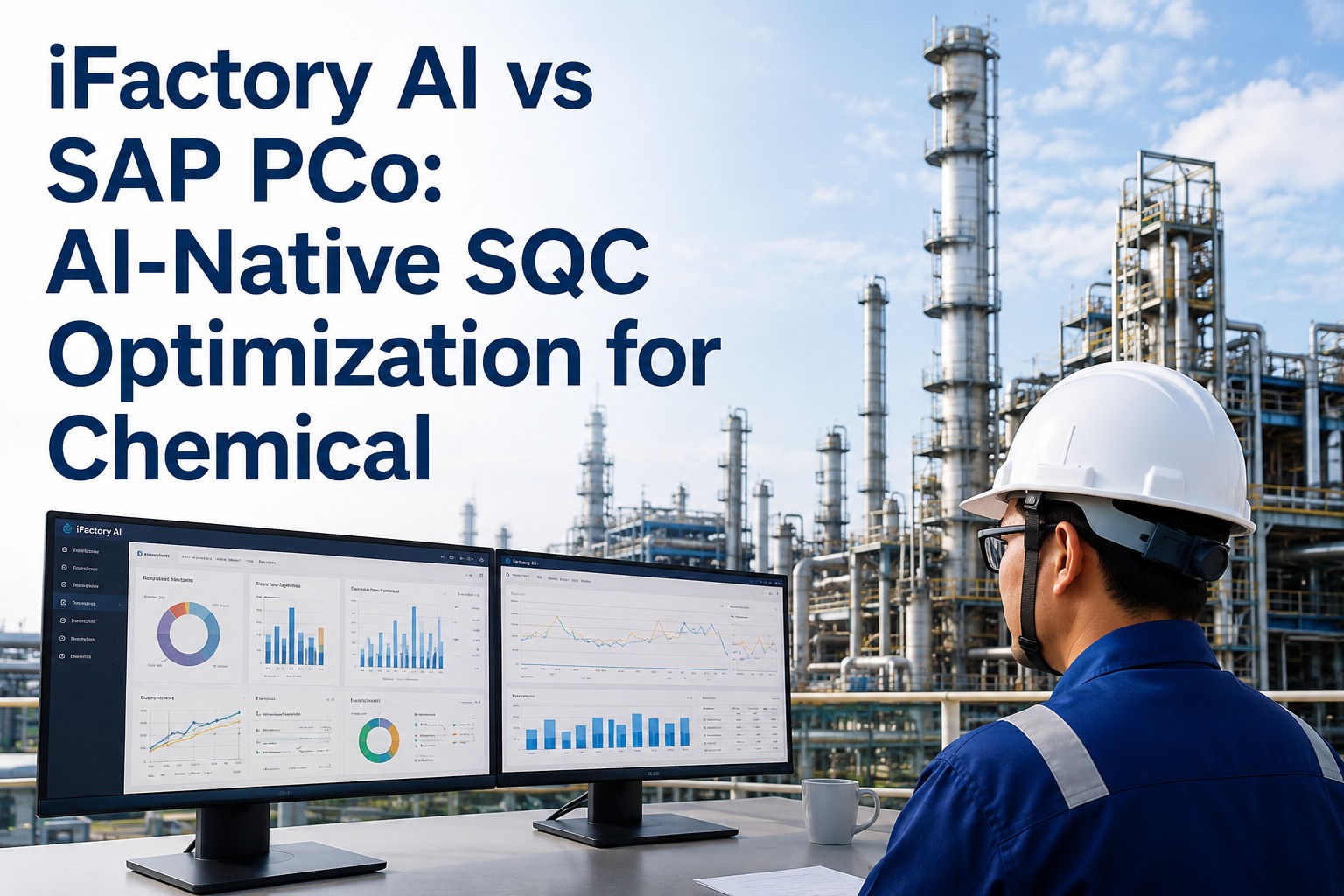
Chemical operations running SAP Plant Connectivity (PCo) as the data on-ramp into SAP xMII for SQC and reporting are working with an architecture that hit its capability ceiling years ago. SAP PCo was designed to forward plant-floor data — not to perform statistical quality control inference, not to deliver predictive process analytics, and definitely not to power the on-prem AI-native intelligence that modern chemical operations need for SQC optimization, chemical OEE, reactor monitoring, and quality optimization at line speed. xMII added descriptive SPC charts and OEE dashboards on top of the data PCo collected, but the entire pattern remains descriptive — looking backward at what happened rather than forward at what is about to happen. The modern chemical SQC AI platform has to deliver multivariate adaptive control, predictive quality optimization across multi-step processes, reactor state inference with kinetic models, OEE intelligence that explains its own loss attribution, an operator AI assistant that lets the control-room team query plant state in natural language, AI vision for inline visual quality, and all of it running on-prem with sub-50ms inference at line speed. iFactory AI is the AI-native chemical SQC platform purpose-built as the SAP PCo replacement and the on-prem alternative to SAP xMII — pre-configured NVIDIA appliance running pre-loaded chemical industry models on-premise, delivering AI-native MES capability, predictive analytics, reactor monitoring, chemical OEE software, the operator AI assistant, and AI vision manufacturing on one platform. This page is the chemical plant operations and IT team's guide to the iFactory AI vs SAP PCo decision — the architectural comparison, the SQC capability map, the operator AI assistant in action, and how the migration actually deploys in a chemical operation.
iFactory AI vs SAP PCo: AI-Native SQC Optimization for Chemical
The chemical plant operations and IT team's guide to the iFactory AI vs SAP PCo / SAP xMII decision — AI-native MES with predictive analytics, SQC AI platform capability, reactor monitoring, chemical OEE software, operator AI assistant, and AI vision manufacturing. On-prem NVIDIA appliance, sub-50ms inference, 6–12 week deployment.
iFactory AI vs SAP PCo + xMII — The Architecture Comparison for Chemical
SAP PCo was the standard plant connectivity layer for chemical operations running SAP xMII for SQC, OEE, and quality reporting. PCo collected from DCS, PLCs, plant historians, lab systems, and analyzers; xMII rendered the descriptive SQC charts, batch reports, and OEE views. The architecture worked for years but cannot extend to what 2026 chemical operations need — multivariate SQC, predictive analytics, reactor monitoring with kinetic models, OEE intelligence with cause attribution, operator AI assistant, and AI vision. The comparison below shows the architectural shift the chemical operations and IT team is actually weighing.
The architectural pattern is the same one that works for steel and aluminum PCo migrations adapted to chemical's process-industry reality. The L1/L2 control architecture stays in place. DCS systems (Emerson DeltaV, Honeywell Experion, Yokogawa CENTUM), PLCs, plant historians (OSIsoft PI), analyzers, and PAT systems are not touched. The iFactory integration layer replaces SAP PCo as the data on-ramp using the same protocols PCo spoke. The AI-native SQC and OEE engine replaces the xMII workload with multivariate capability, reactor kinetics modeling, operator AI assistant, and AI vision running on-prem at chemical line speed.
Want this architecture mapped to your specific chemical plant configuration? Schedule the AI Manufacturing Transformation Workshop — iFactory's chemical team will diagram your current SAP PCo + xMII setup and the modernized equivalent across reactors, separations, and downstream operations. Sessions available this week.
SQC AI Platform — Capability Comparison vs SAP xMII SQC
The capability comparison is what plant operations actually score. The SQC AI platform capability map below shows iFactory AI's seven SQC-relevant capability dimensions vs SAP xMII's descriptive SQC implementation — the same data sources both platforms can access, but very different inference, intelligence, and decision support running above them.
The capability map resolves the iFactory AI vs SAP PCo + xMII question for chemical operations. SAP xMII SQC is a descriptive layer over the data PCo collects — useful for reporting, structurally unable to deliver multivariate inference, predictive intervention, reactor kinetics, OEE attribution, operator AI assistant, AI vision, or line-speed decisions. iFactory delivers all seven on a single AI-native platform with the same plant-floor data sources xMII was already consuming.
The Operator AI Assistant for Chemical Process Operations
What the control-room operator can actually ask in natural language
The operator AI assistant is the capability that fundamentally changes how chemical control-room teams interact with the SQC platform. Instead of clicking through static SAP xMII charts and assembling answers manually from PI trends, lab data, and historical reports, the operator queries plant state in natural language. The assistant queries the unified data layer, runs the relevant inference, and surfaces the answer with supporting context. Below is what this looks like in actual control-room operation.
The operator AI assistant is structurally the same engine that powers MSQC, reactor monitoring, OEE attribution, and AI vision — exposed through a natural-language interface that the control-room team can use without specialized analytics training. The assistant runs entirely on-prem, with no cloud round-trip and no data egress. The audit log captures every query and response, so the assistant's contribution to operational decisions is fully traceable.
Want the operator AI assistant demonstrated against your specific chemical processes? Send your typical control-room queries and current data system layout to iFactory support and the chemical team will return a tailored demonstration plan — typically within 3 business days, no obligation.
Five AI-Native Capabilities for Chemical SQC Optimization
Multivariate SQC
Adaptive control charts with T² and SPE statistics
Reactor Monitor
Kinetic models, catalyst aging, conversion forecasting
Chemical OEE
Causal OEE attribution with predictive loss prevention
Operator AI
Natural-language plant queries for control-room teams
AI Vision Mfg
Edge AI vision for visual quality, level, safety
Three Migration Paths for Chemical SQC Modernization
Stay on PCo + xMII
Extended SAP maintenance with univariate SQC, static OEE views. Off-spec catches stay late. Operator AI and AI vision remain absent.
SAP DMC (Cloud)
Cloud modernization. WAN-bound latency unsuited for chemical line-speed decisions. Recipe IP exits plant. Cloud compute charges grow.
iFactory AI On-Prem
SAP PCo replacement with full SQC AI capability including operator assistant and AI vision. NVIDIA appliance on-prem, 6–12 weeks.
Six Chemical Operations Where the Migration Pays Back Fastest
Reactor Operations
Highest-leverage chemical SQC application. Multivariate reactor monitoring with kinetic models replaces univariate trending entirely.
Specialty Chemicals AI
Specialty chemicals AI deployment with multi-step predictive quality, AI vision for visual quality, and operator AI for control-room support.
Distillation Operations
Multivariate column control with predictive purity. Energy optimization through reflux and reboiler intelligence. Inferential purity replaces lab-only verification.
Polymer Production
Polymer MW distribution and viscosity prediction. Grade transition optimization. Off-spec reduction during changeovers through predictive control.
Packaging & Filling
AI vision for fill-level inspection, label verification, seal integrity, and cap detection. Defect rates dropped through inline visual inspection.
Plant-Wide OEE
Chemical OEE software with causal attribution replaces aggregate OEE views. Loss causes explained automatically. Recovery actions identified.
Want operation-specific projections for your chemical plant? Send your chemical segment, process flow, and current SAP PCo + xMII state to iFactory support and the chemical team will return a customised projection with 12-month roadmap — typically within 3 business days, no obligation.
Chemical Industry 4.0 Compliance & Process Safety — Native to the Platform
Pre-built workflows for chemical regulatory and safety frameworks
- OSHA PSM — Process Safety Management
- EPA RMP — Risk Management Plan
- REACH — EU chemical registration
- ISO 9001 — quality management systems
- ISO 14001 — environmental management
- Responsible Care — chemical industry framework
- HAZOP / LOPA — process hazard analysis
- Customer-specific SQC requirements (CSRs)
The chemical industry 4.0 framework alignment is built into the platform configuration during deployment. Compliance evidence assembles continuously rather than being reconstructed for audits. PSM-relevant events surface automatically. The chemical operations team gets stronger compliance posture as a byproduct of running the AI-native SQC platform.
Two Real Chemical SAP PCo Migration Outcomes
Specialty chemicals plant deploying AI-native SQC across multi-step synthesis
A specialty chemicals producer manufacturing high-margin intermediates and fine chemicals across multi-step synthesis lines ran SAP PCo + xMII for SQC reporting and basic OEE views. Univariate control charts missed multivariate process drift. Off-spec batch detection happened at QC release rather than in-process. The operations team needed AI-native SQC with operator AI assistant, AI vision on packaging, and reactor monitoring with kinetic models — none of which were achievable on the SAP stack.
Integrated chemical complex replacing SAP PCo across reactors, separations, and downstream
An integrated chemical complex operating multiple production units — reactors, distillation columns, separation trains, polymer extruders, and packaging lines — ran SAP PCo as the unified plant connectivity layer feeding xMII for SQC and OEE. The operations team needed plant-wide MSQC, causal OEE attribution, reactor kinetics, AI vision on packaging, and operator AI across all control rooms — capability gaps the SAP stack could not close. The migration replaced PCo with iFactory's integration layer and modernized the SQC and OEE workloads in one architectural move.
Neither scenario matches your operation? Send your chemical segment, plant configuration, and current SAP PCo + xMII state to iFactory support and the chemical team will return a customised migration analysis with 12-month roadmap — typically within 3 business days, no obligation.
iFactory's Chemical Deployment — On-Premise or Cloud
Same AI-native platform on either deployment model. On-prem is the recommended default for chemical operations given line-speed inference latency requirements (reactor and column dynamics move fast), recipe and catalyst IP sovereignty, OSHA PSM evidence boundary considerations, and the OpEx-cap that on-prem CapEx provides for continuous-process operations.
iFactory On-Premise Appliance Recommended for chemical · sub-50ms edge inference for reactors/columns
- Pre-configured NVIDIA AI server — pre-loaded chemical SQC models, racked, ready.
- <50ms edge inference — process-speed reactor and column decisions.
- SAP PCo alternative platform — integration layer takes over data on-ramp.
- L1/L2 control untouched — no rip-and-replace of plant-floor architecture.
iFactory Cloud For multi-plant chemical groups with central governance
- Fully managed — no rack, no facility requirements.
- Same SQC AI capability — full platform available.
- Portfolio-level benchmarking across plants.
- Fastest deployment — first plant live in 2–4 weeks.
The SAP PCo replacement and the on-prem alternative to SAP xMII for chemical SQC.
Multivariate SQC, reactor monitoring with kinetic models, chemical OEE software with causal attribution, operator AI assistant, AI vision manufacturing — all on a pre-configured NVIDIA appliance with on-prem deployment, sub-50ms edge inference, and 6–12 week migration from SAP PCo + xMII. The L1/L2 control architecture stays untouched. The AI Manufacturing Transformation Workshop sizes the migration for your specific chemical plant.
FAQ: iFactory AI vs SAP PCo for Chemical SQC
How does iFactory replace SAP Plant Connectivity (PCo) for a chemical plant?
iFactory's integration layer takes over the SAP PCo role as the data on-ramp from the plant floor — speaking OPC UA, MQTT, Modbus, PROFINET, EtherNet/IP, and DCS-native protocols (Emerson DeltaV, Honeywell Experion, Yokogawa CENTUM) plus the OSIsoft PI integration that chemical plants typically rely on. Existing PCo tag mappings are imported during deployment so the migration carries them across. The plant-floor L1/L2 control architecture is not touched. Book a demo to see PCo replacement on your specific chemical stack.
What's the difference between SPC and SQC in this context?
Statistical Process Control (SPC) and Statistical Quality Control (SQC) are closely related and overlap heavily in practice. SPC typically refers to in-process monitoring of process variables (temperature, pressure, flow), while SQC is broader and includes both in-process monitoring and product-quality outcomes (purity, viscosity, impurity profile, dimensional CQAs). iFactory's platform delivers both SPC and SQC capability on the same underlying AI engine. The "SQC AI platform" framing captures the broader scope chemical operations are looking for — process monitoring plus product-quality outcomes plus the inference connecting them.
How does the operator AI assistant actually work for control-room teams?
The operator AI assistant exposes the iFactory AI engine through a natural-language interface that runs in the control room. Operators ask questions in natural language ("Why is reactor 3 selectivity drifting?", "Compare today's yield to the last 30 days") and the assistant queries the unified data layer, runs the relevant multivariate inference, and surfaces the answer with supporting data and confidence indicators. The assistant runs entirely on-prem with no cloud round-trip. Every query and response is logged in the audit log for traceability. Control-room teams typically adopt the assistant quickly because it removes the click-through-dashboards workflow that consumes most of their analytics time today.
What does AI vision manufacturing cover in a chemical plant?
AI vision manufacturing in chemical operations typically covers four categories — packaging-line visual inspection (fill level, label position, cap presence, seal integrity), reactor visual monitoring (foam level, color change, two-phase boundary), safety visual monitoring (PPE compliance, hot-work area), and general plant safety (leak detection, fire watch, access control). iFactory's AI vision runs at the edge on the NVIDIA appliance with sub-50ms inference latency, integrating with existing camera infrastructure or new IP cameras deployed during the migration. The vision capability runs on the same platform as the rest of the SQC engine, so vision-detected events feed into the same audit log and the same operator AI assistant context.
How does iFactory handle our existing OSIsoft PI historian?
The OSIsoft PI historian (or AspenTech IP.21, or other plant historian) typically remains as the primary plant data store after the migration. iFactory integrates with PI through native AF/PI API connectors during deployment, reading tag data, batch data, and contextualized PI Asset Framework data. The platform adds the AI-native intelligence layer above PI rather than replacing PI as the historian. This pattern keeps the existing PI investment intact and means the historian retains its role as plant data store while iFactory becomes the inference and decision layer.
How does the migration handle our existing SAP MII / xMII SQC dashboards?
The migration plan covers dashboard parity validation during the parallel-run phase. Operators get equivalent and improved dashboards on iFactory, plus AI-native capabilities the xMII layer never delivered (multivariate SQC, predictive trends, contribution plots, operator AI assistant, AI vision). The familiar SQC chart interface remains available as a view in the new platform. Operators typically describe the experience as the same dashboard with much more useful underlying inference and predictive capability.
How does on-prem deployment protect our recipe and catalyst IP?
The on-prem NVIDIA appliance runs the full SQC, reactor monitoring, OEE, operator AI, and AI vision engine locally — no inference call needs to leave the plant. Recipe data, catalyst formulations, customer specifications, and process IP stay inside the plant boundary. The platform is also free from cloud connectivity dependencies (operations continue during WAN outages) and from OpEx-growing AI compute charges. For chemical operations with proprietary recipes and customer-specific formulations, the on-prem default is recommended for sovereignty reasons.
What does the AI Manufacturing Transformation Workshop cover for chemical?
The half-day workshop covers — current-state SAP PCo + xMII assessment for your chemical plant, MSQC demonstration on representative reactor and process data, operator AI assistant walkthrough, AI vision deployment review, chemical OEE attribution demonstration, three-path migration comparison with cost and timeline projections, OSHA PSM and chemical industry 4.0 compliance evidence approach, and ROI projection. Outcome is a concrete migration plan suitable for chemical operations, process engineering, IT/OT, and finance.
iFactory AI vs SAP PCo — the modern SQC AI platform for chemical.
Replace SAP PCo as the data on-ramp. Replace SAP xMII SQC with multivariate AI-native SQC. Add reactor kinetics, chemical OEE attribution, operator AI assistant, and AI vision manufacturing on top. All on a pre-configured NVIDIA appliance, on-prem, sub-50ms inference, 6–12 weeks. See live demo this week. The Workshop is the fastest way to size the migration — sessions available this week.