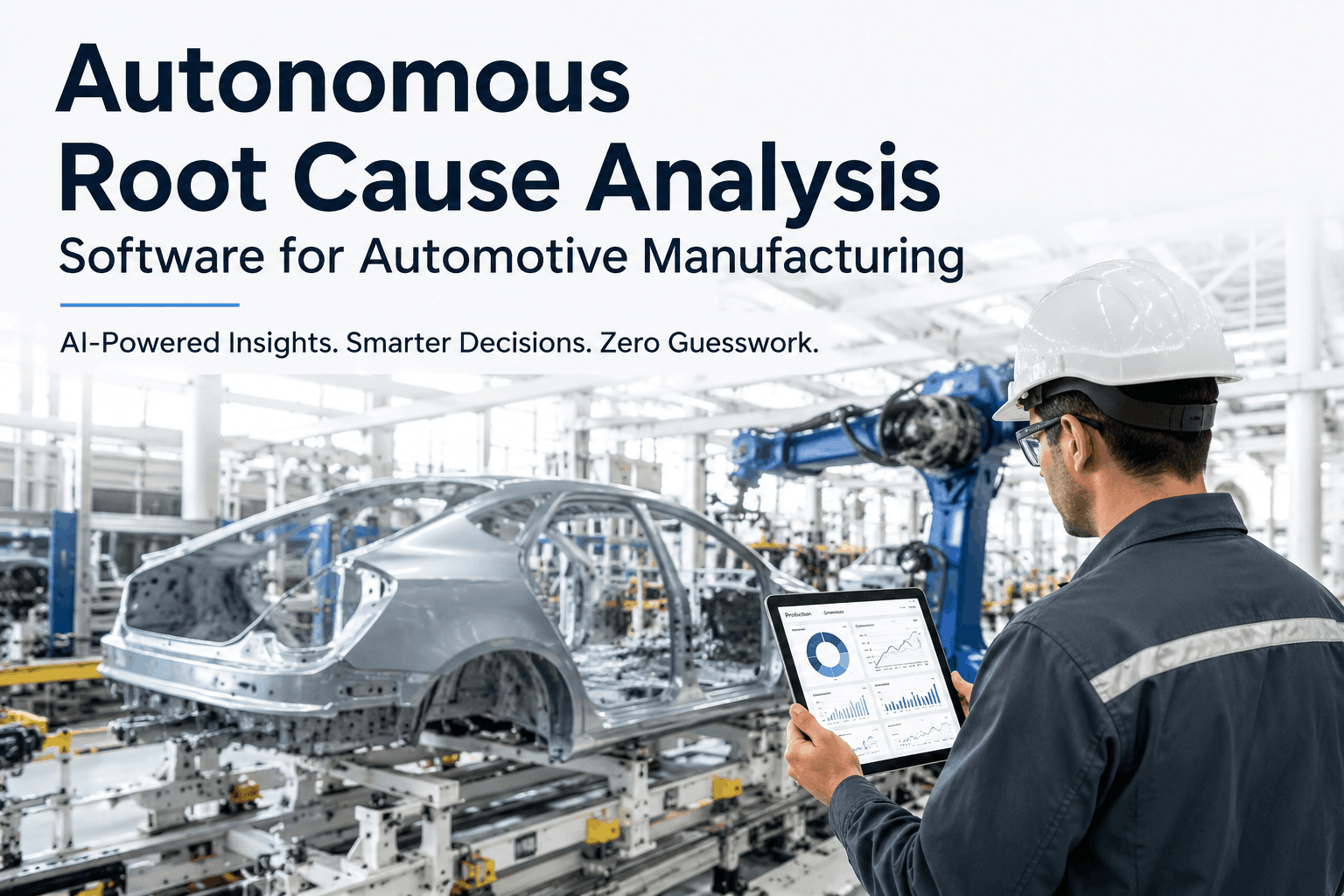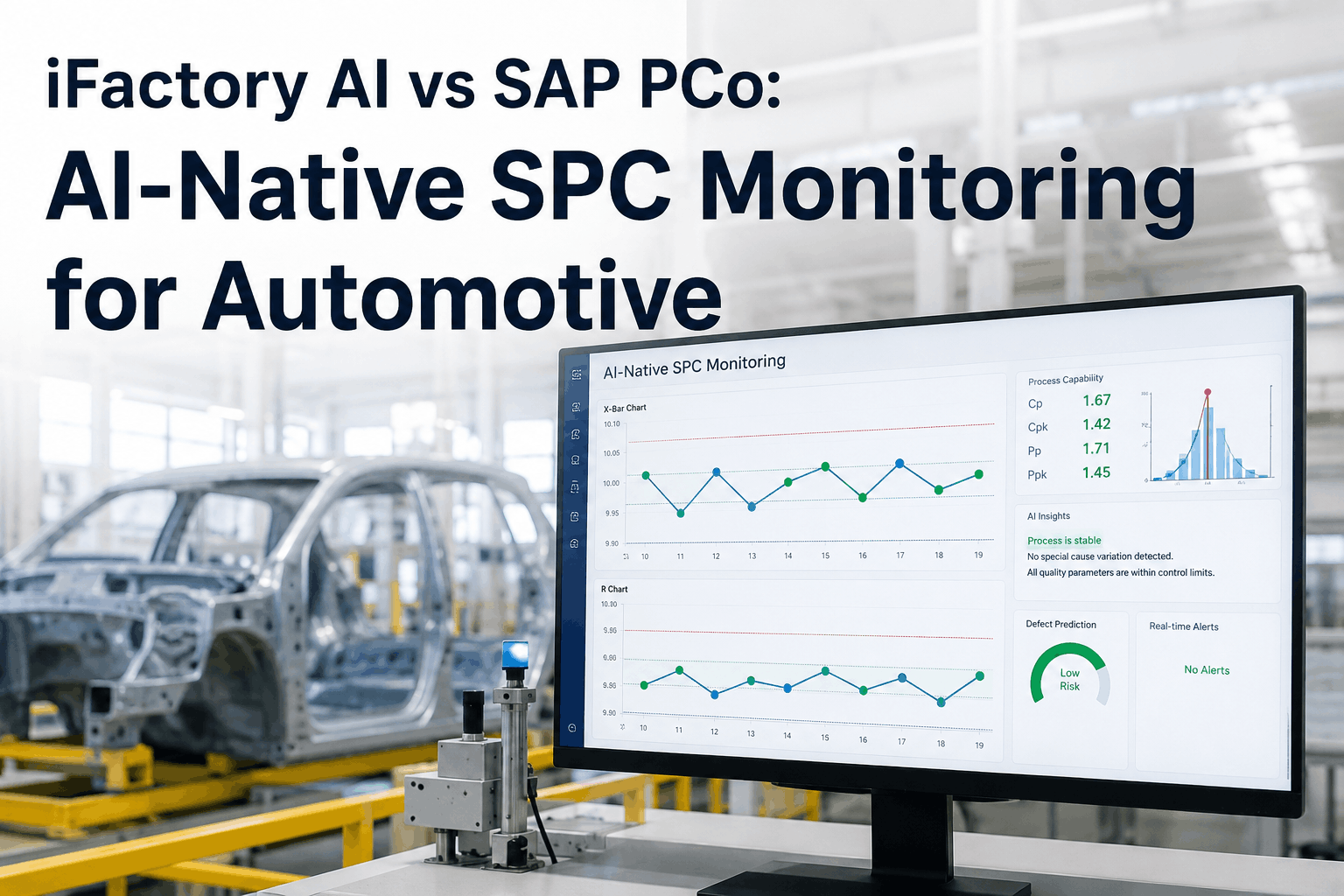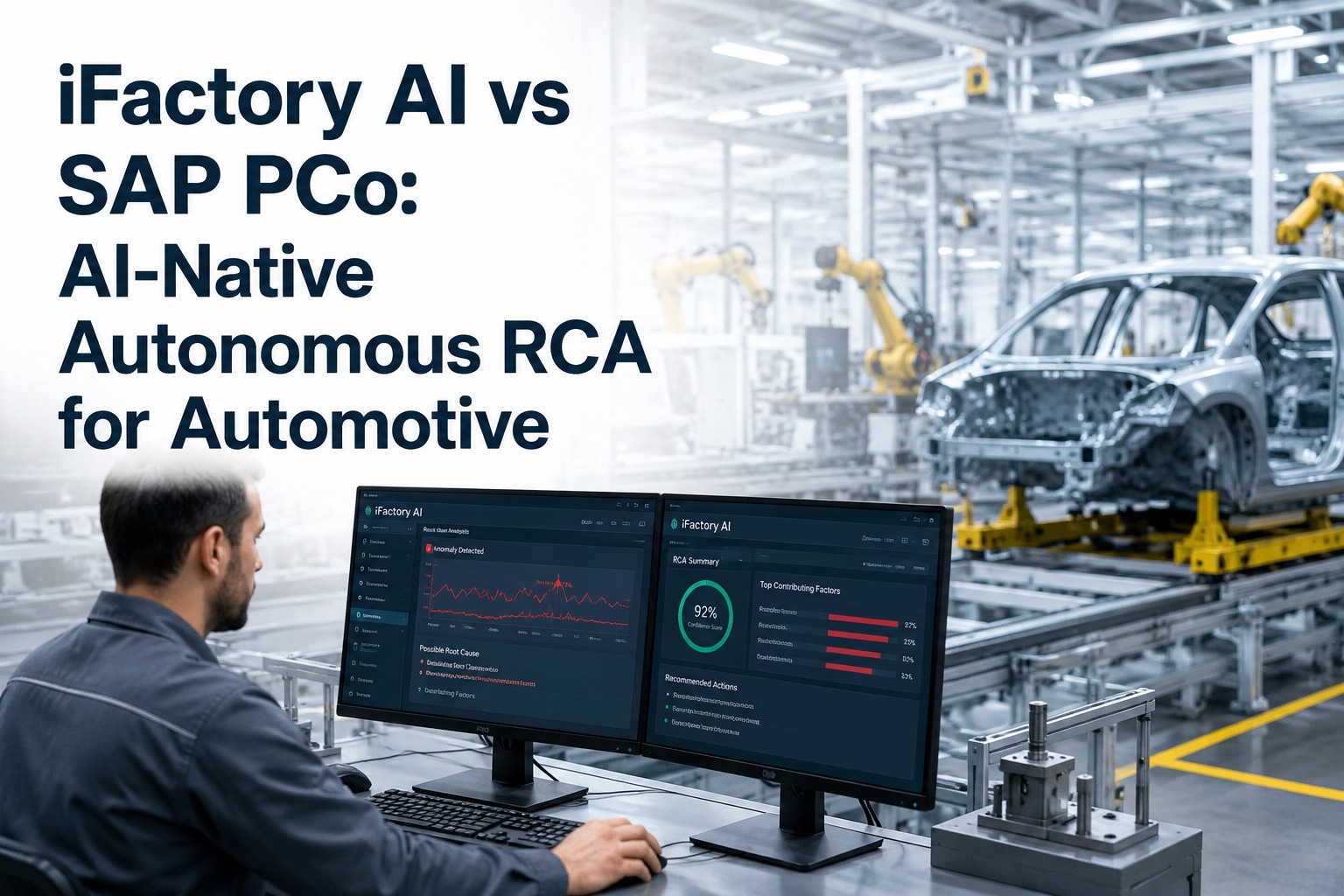
The RCA workflow is where SAP MII and SAP PCo show their age most clearly in automotive plants. A customer complaint lands on the quality leader's desk. The 8D clock starts. Engineers spend the next eight hours pulling MII reports, reconciling LIMS exports, tracing PCo signals, and reconstructing a timeline by hand to figure out which process variable on which shift produced the defect. That eight-hour cycle is the operational tax of legacy RCA — and it scales linearly with every customer escalation. Autonomous RCA collapses that cycle to seconds. An AI-native causal engine maps the defect back to ranked causal candidates with confidence intervals, surfaces the responsible process windows, and writes the 8D draft before the quality engineer opens their morning email. iFactory AI delivers it on-prem (turnkey NVIDIA appliance) or as fully-managed cloud, integrated with the existing SAP S/4HANA estate. This is the comparison.
iFactory AI vs SAP PCo — AI-Native Autonomous RCA for Automotive
Replace SAP MII / PCo with autonomous root cause analysis purpose-built for automotive — causal attribution in seconds, multivariate signal correlation, AI vision linked to process data, 8D draft assembled live. 12-week deployment on a turnkey NVIDIA appliance. On-prem or fully-managed cloud, your choice.
The Eight Hours That Disappear With Autonomous RCA
The single most expensive workflow in automotive quality is the manual RCA cycle. The comparison below shows what an investigation actually looks like on SAP MII / PCo versus on iFactory AI's autonomous engine — same defect, same plant, same data.
- 0:00 · Defect complaint received
- 0:30 · Pull MII process trends for affected window
- 1:30 · Reconcile LIMS lab results from spreadsheet
- 2:30 · Cross-check PCo signal timestamps
- 4:00 · Build manual fishbone in workshop
- 5:30 · Validate top causal hypothesis
- 7:00 · Write 8D / D-FMEA document
- 8:00 · Submit response to customer
- 0:00 · Defect complaint received
- 0:02 · Causal engine pulls all signals for window
- 0:04 · Multivariate correlation runs across process, lab, vision
- 0:06 · Top causal candidates ranked with confidence
- 0:08 · Causal attribution shown to engineer
- 0:30 · Engineer reviews, accepts or refines
- 15:00 · 8D draft auto-populated, ready for review
- 45:00 · Submission completed
Want to see autonomous RCA running on your data? Book a demo today — iFactory's automotive practice will run a live RCA on a recent defect from your plant in the session, no obligation.
How the Autonomous RCA Engine Actually Works
Four pipeline stages running continuously against live plant data. Not a batch job that runs on-demand — a streaming engine that has the causal model already trained and ready when the next defect lands.
Signal Ingestion
All plant signals streamed continuously — process variables, AI vision events, lab results, machine telemetry, operator actions. 100Hz+ ingestion at the edge.
Causal Modeling
Multivariate causal graphs learned per process zone. PCA, PLS, Granger causality, counterfactual inference. Models retrained continuously.
Attribution
Defect mapped to ranked causal candidates with confidence intervals. Top 3–5 hypotheses surfaced, each tied to specific process windows and variables.
Recommendation
Corrective action proposed, 8D / D-FMEA draft pre-populated, engineering review queued. Engineer accepts or refines; the engine learns from the feedback.
Four Automotive RCA Scenarios That Move From Hours to Seconds
Body Shop · Weld Quality
Weld spatter excursion on Line 3 → autonomous RCA traces to electrode wear pattern + voltage ramp on Robot 17, suggests electrode dressing schedule adjustment.
Paint Shop · Color Drift
Color out-of-spec on Customer A units → engine correlates to humidity spike + booth turnover delay + specific paint lot, recommends booth purge cycle adjustment.
EV Battery · Cell-to-Pack Defect
Pack-level capacity drift identified → cross-layer attribution to cell formation cycle anomaly + module weld parameter shift, recommends formation profile correction.
Assembly · Torque Failure
Customer complaint of loose fastener → torque tool history + calibration drift on Station 7 + operator change identified as combined cause, recommends calibration cycle.
iFactory AI vs SAP PCo · Side by Side
| Dimension | SAP PCo / MII | iFactory AI Autonomous RCA |
|---|---|---|
| RCA cycle time | 6–10 hours per investigation | Seconds to ranked causes |
| Causal modeling | Manual fishbone in workshop | Multivariate causal graphs · streaming |
| Signal cadence | 1 Hz polling typical | 100 Hz+ at the edge |
| AI vision integration | External system · reconciled manually | Native pipeline · same data layer |
| EV battery cross-layer | Not natively supported | Cell-to-pack causal attribution native |
| 8D / D-FMEA drafting | Engineer writes from scratch | Auto-populated · engineer reviews |
| Operator AI assistant | Not available | Natural-language queries · live answers |
| Deployment | Cloud-mandatory (DMC) / EOL (MII) | On-prem turnkey or fully-managed cloud |
12-Week Deployment · 30-Day First RCA
Connect
NVIDIA appliance racked or cloud tenant provisioned. Read-only connectivity to SAP MII / PCo / S/4, MES, LIMS, vision systems. Automotive RCA models pre-loaded.
First Autonomous RCA
Causal models active across body, paint, assembly, EV battery. First autonomous RCA reports generated against live defects. Engineering reviews and refines.
Plant-Wide Rollout
All zones online. 8D auto-drafting integrated with quality workflow. Operator copilot live on all consoles. Verified ROI documented. SAP MII / PCo retired per workload.
Documented Outcomes
Move automotive RCA from hours of engineering effort to seconds of AI attribution.
iFactory AI replaces SAP MII / PCo with autonomous root cause analysis purpose-built for automotive — causal engine streaming live, AI vision linked, 8D auto-drafted, 12-week deployment on a turnkey NVIDIA appliance or fully-managed cloud. Book a demo today.
FAQ — Autonomous RCA for Automotive
How does autonomous RCA differ from traditional 5-Why or fishbone analysis?
Traditional methods are structured ways for human engineers to investigate a defect after the fact — they require people to formulate hypotheses, pull data, validate manually. Autonomous RCA runs streaming causal models against live data continuously, so when a defect happens, ranked causal candidates with confidence intervals are already computed. Engineers move from investigator to reviewer. The methodology is causal AI (graphs, counterfactual reasoning, Granger causality) rather than checklist analysis. Book a demo to see it run on your data.
Does iFactory ship as on-prem only or is cloud available?
Both. On-prem (turnkey NVIDIA appliance with 99.9% uptime SLA) is the recommended default for automotive plants with strict latency, line-speed AI vision, or data sovereignty requirements. Fully-managed cloud is available for multi-plant automotive groups consolidating governance. Same platform, same causal engine, same RCA depth on either deployment. Many automotive groups deploy hybrid: on-prem at flagship plants, cloud at smaller sites.
Can the autonomous RCA handle EV battery cross-layer attribution?
Yes. The causal engine treats cell, module, and pack levels as connected layers in one causal graph. A defect detected at pack-level test traces back through module weld parameters, BMS firmware versions, and individual cell formation conditions. Cross-layer attribution that previously required days of forensic engineering happens in seconds, with confidence intervals on each contributing factor.
How does this integrate with our existing SAP S/4HANA?
Natively. iFactory replaces the SAP MII / PCo middleware while preserving SAP S/4HANA for production orders, BOM, materials, and financial reporting. The autonomous RCA engine reads relevant context from S/4 (which lot, which customer, which order) and writes back disposition decisions, customer complaint linkage, and 8D references. No ERP-side rebuild needed.
What does the demo session cover?
30-minute working session with iFactory's automotive practice. Walks through autonomous RCA running against a recent defect from your plant — multivariate causal attribution, ranked candidates, 8D auto-draft, AI vision integration, EV battery cross-layer scenarios where relevant. Output is a tailored ROI projection and 12-week deployment quote with full BOM. Slots available this week.
Eight hours of RCA per investigation, every investigation — gone.
iFactory AI is the autonomous RCA platform for automotive plants moving off SAP MII / PCo. Causal AI engine, AI vision native, 8D auto-drafting, EV battery cross-layer attribution. 12-week deployment on a turnkey NVIDIA appliance or fully-managed cloud. Book a demo today.