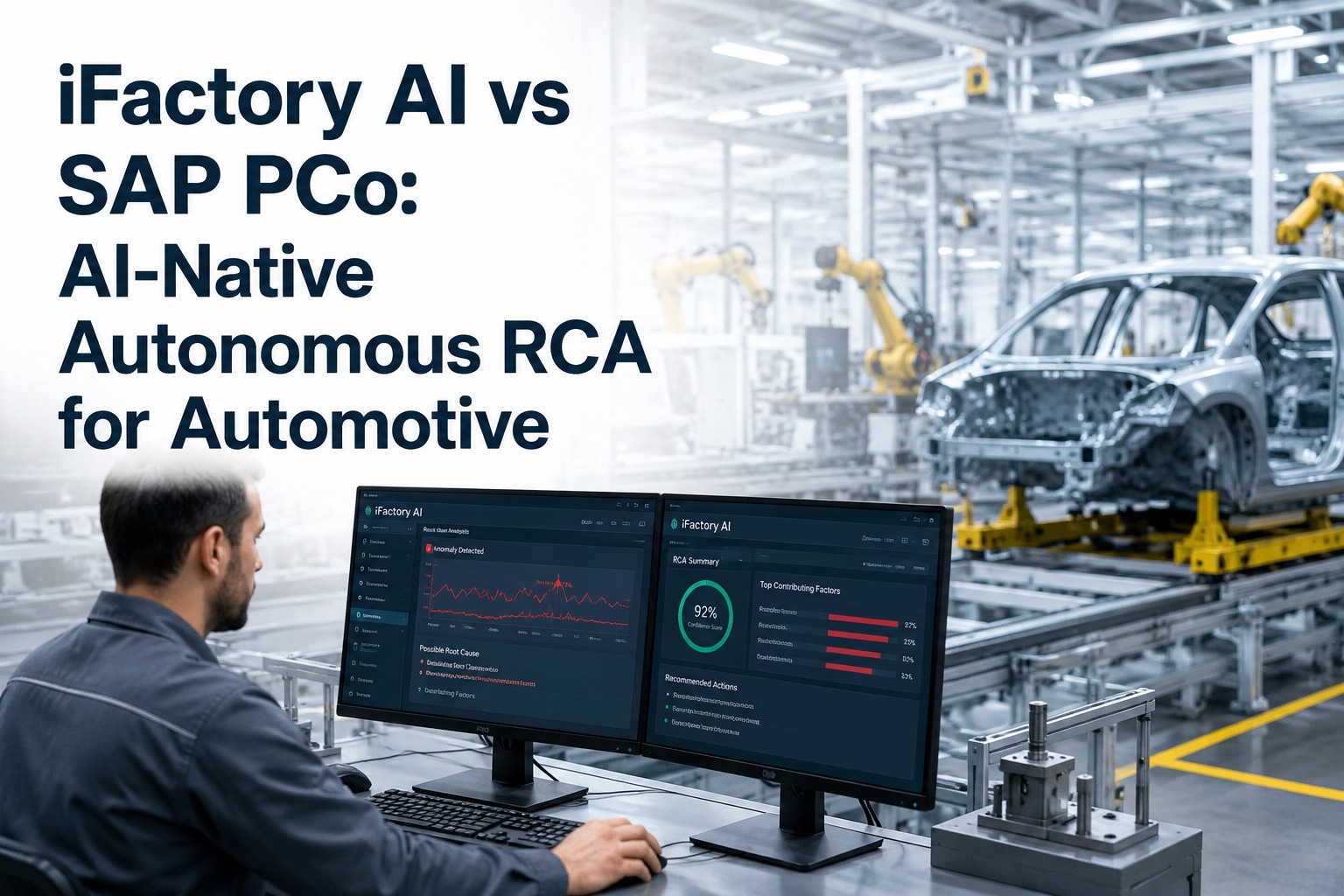
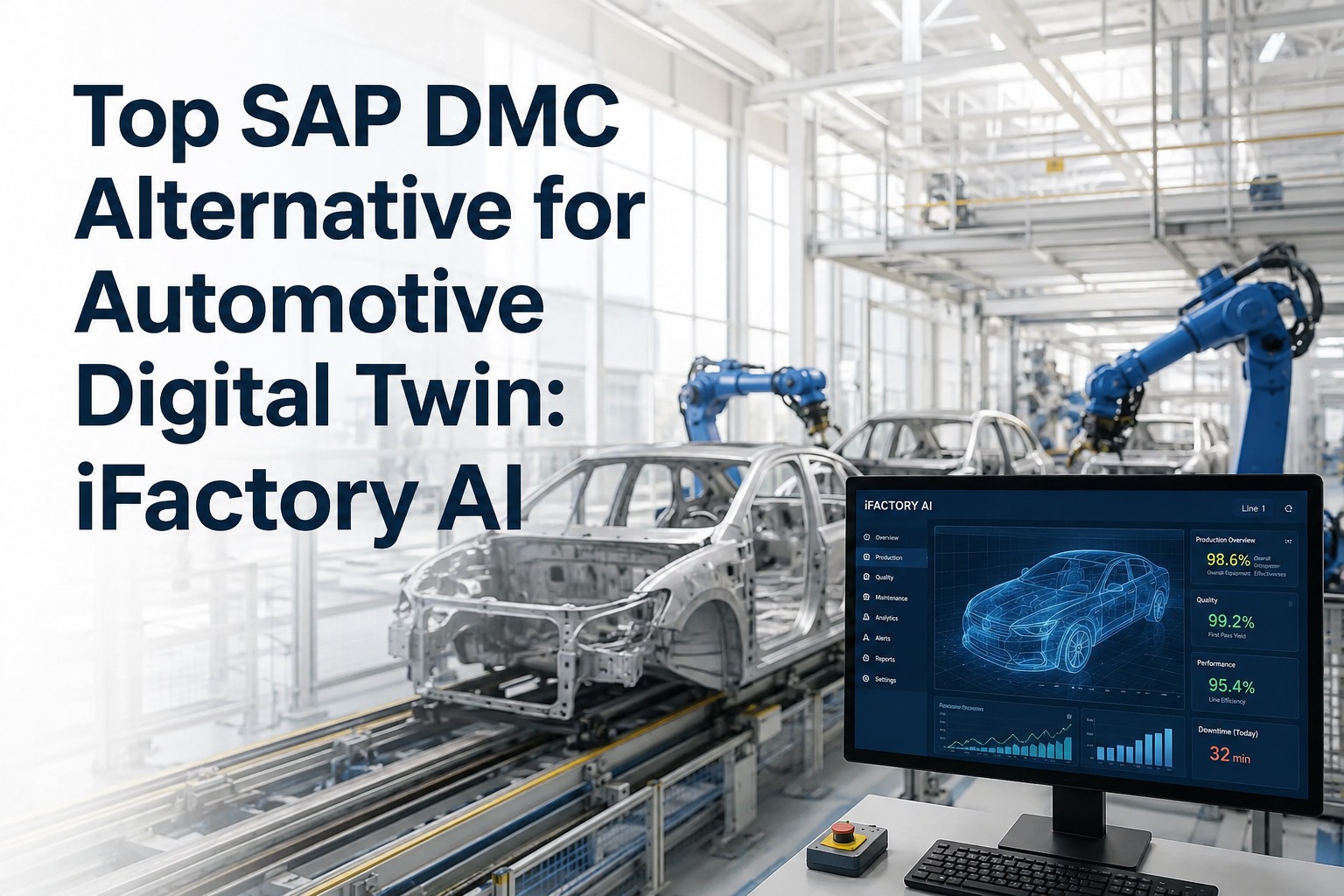
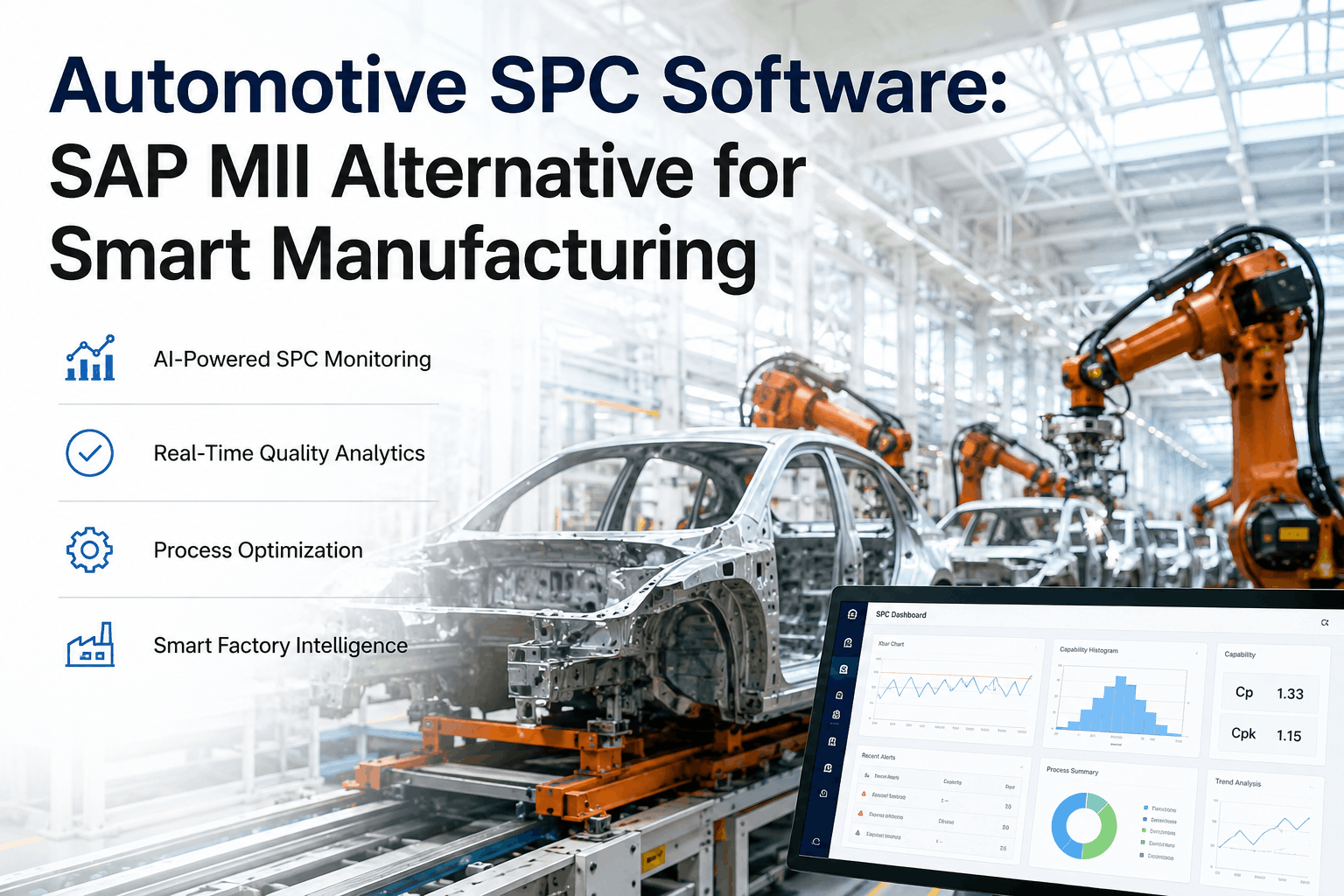
Legacy SPC is ending in automotive manufacturing — not because anyone declared it over, but because operators on modernized lines can no longer tell when it used to apply. The threshold-based control chart, the after-the-fact deviation report, the manual root-cause investigation, the rolling subgroup average — these worked for a previous era of automotive operations and they've quietly become inadequate for current production speeds, complexity, and customer scorecard pressure. The replacement is Digital Twin Manufacturing — a live AI-driven model of every press, weld gun, paint booth, machining cell, and assembly station that synchronizes with the physical operation in real-time, predicts where scrap is about to happen, and gives the operator the early-warning window needed to intervene before a panel, BIW assembly, or finished engine becomes rework or scrap. iFactory AI delivers this on a pre-configured NVIDIA appliance running on-premise — replacing SAP MII, SAP xMII, and SAP PCo with an AI-native platform that runs the digital twin and the predictive scrap prevention layer together, deploying in 6–12 weeks. SAP DMC offers the cloud-only alternative; iFactory keeps the operation on-prem with all data, models, and predictions staying inside the plant. This page is the operator's guide to the end of legacy SPC, what digital twin manufacturing actually means in automotive operations, and how predictive scrap prevention changes day-to-day work on the floor.
iFactory AI vs SAP PCo: AI-Native Digital Twin for Automotive
The end of legacy SPC in automotive manufacturing — digital twin replaces threshold control charts, predictive scrap prevention catches deviations hours before they become rejected parts. SAP MII / xMII / PCo / DMC alternative running on-prem inside your plant. Pre-configured NVIDIA appliance, real-time analytics, no cloud lock-in. Live in 6–12 weeks.
The End of Legacy SPC — What's Actually Changing for Operators
Legacy SPC in automotive manufacturing worked through a specific operational pattern: collect samples at fixed intervals, plot them on a control chart, watch for trend rules to fire, investigate after the fact, document for IATF audit. That pattern made sense when production speeds were slower, parameters were fewer, and the cost of post-hoc analysis was acceptable. None of those conditions hold in modern automotive operations — and operators on lines running modernized digital twin platforms experience the change immediately.
What operators do today
- Collect samples at fixed intervals across the shift
- Manually log results into xMII or supplemental spreadsheet
- Watch control charts for trend rule violations
- Investigate after a violation has occurred
- Document deviation reports for IATF audit trail
- Discover scrap at downstream IPC or final QC
- Build deviation paperwork for each scrap event
- Receive feedback hours or shifts after the cause
- Maintain separate sample-collection vs production focus
What operators do on modernized lines
- Digital twin monitors every parameter continuously
- No manual data collection — sensors feed the twin
- AI surfaces drift hours before any threshold violation
- Predictive scrap warnings arrive with recommended action
- Audit trail assembled automatically by Compliance Layer
- Scrap prevented in process — never reaches downstream
- Investigation Agent pre-builds RCA before alert fires
- Feedback within minutes of cause — same shift action
- Production focus uninterrupted by data collection
Operators describe the experience of moving from legacy SPC to digital twin SPC consistently — the work feels less reactive, more proactive, and significantly less paperwork-heavy. The line still runs the same operations; the operator role still owns quality outcomes. What changes is that the AI handles the routine monitoring, prediction, and documentation work that historically consumed operator attention, leaving room for the substantive decision-making that benefits from human judgment.
Want to see the digital twin SPC paradigm running on a representative automotive scenario from your operation? Schedule the AI Manufacturing Transformation Workshop — sessions include live demonstration matched to your stamping, BIW, paint, or assembly operations. Sessions available this week.
The Digital Twin Architecture — What It Actually Is
"Digital twin" is one of the most over-used terms in manufacturing software marketing. Most platforms calling themselves digital twins are actually descriptive dashboards or 3D visualization layers — useful, but not the same thing. iFactory's digital twin architecture combines four working layers that together create the live, predictive, action-ready twin of the physical operation.
The architecture is continuous and bidirectional. Sensor data flows up through ingestion and context to the AI model layer where the digital twin synchronizes with the physical plant. Predictions, anomalies, and recommended actions flow back down to the operator interface in real-time. Operator decisions feed back into the model layer through the learning loop. The full round-trip from process event to operator-actionable signal runs under 50ms on the on-prem NVIDIA appliance — fast enough that operators experience it as the plant simply telling them what's happening, rather than as a separate analytics layer.
Predictive Scrap Prevention — How It Plays Out in Real Time
From sensor drift to in-flight intervention
The digital twin doesn't just monitor — it predicts. When a stamping press tonnage drifts, when weld current shifts, when paint booth temperature trends, the twin's predictive models identify the signature 2–24 hours before the resulting parts would actually reach scrap status. Operators see the warning, take action while there's still time, and prevent the scrap from ever occurring. The timeline below shows what this actually looks like for a typical automotive process.
The 22-hour gap between when the digital twin flags the deviation signature and when legacy SPC would catch it at IPC failure represents the operational difference between predictive and reactive paradigms. For an automotive plant running 200 units per hour, that's 4,400 units of potential scrap prevented per detected event. Multiply across the typical 30–60 such events per quarter, and the dollar value of predictive scrap prevention becomes the dominant ROI driver for the platform investment.
Want a sized predictive scrap prevention projection for your specific automotive operation? Schedule the AI Manufacturing Transformation Workshop — iFactory's automotive team will model your scrap baseline, predictive warning window, and projected dollar savings across stamping, BIW, paint, machining, and assembly. Sessions available this week.
Three Migration Paths from SAP MII / PCo for Automotive
Stay on MII / PCo
Extended maintenance, legacy SPC paradigm continues. No digital twin, no predictive scrap prevention. Operator workflow unchanged from current state.
SAP DMC (Cloud-Only)
Cloud migration adds latency, IP exposure. No genuine digital twin capability — descriptive dashboards rather than predictive twin. Cloud lock-in concern.
iFactory AI On-Prem Twin
Four-layer digital twin with predictive scrap prevention. Real-time AI inference. No cloud lock-in. IATF aligned out of box.
Six Automotive Operations Where the Digital Twin Pays Back Fastest
Stamping Press Operations
Digital twin tracks tonnage, blank holder force, die temperature, and lubrication signature. Predicts panel scrap (splits, wrinkles, springback) hours before they reach the die.
Body-in-White Welding
Twin monitors weld current, voltage, force, time across hundreds of guns simultaneously. Predicts weld quality drift before BIW assemblies reach inspection.
Paint & Finish
Twin tracks paint booth temperature, humidity, flow, atomization. Predicts dirt count, color variance, and finish defects before bodies reach inspection.
Powertrain Machining
Twin tracks spindle load, vibration, tool wear, coolant flow. Predicts dimensional drift and tool failure before machined components reach final QC.
Assembly Line Operations
Twin tracks torque signatures, fit tolerances, alignment measurements at assembly stations. Predicts downstream rework events from upstream signatures.
Tier 2/3 Material Quality
Twin correlates downstream scrap signatures to specific material lots. Predicts which incoming material lots will cause process problems before consumption.
Want application-specific scrap projections for your automotive operation? Send your top scrap drivers, current SAP MII / PCo state, and production volumes to iFactory support and the automotive team will return a customised scrap-prevention ROI map with 12-month roadmap — typically within 3 business days, no obligation.
IATF 16949, ISO 9001, PPAP & CSR — Built Into the Twin
Pre-built workflows for automotive quality frameworks
- IATF 16949 — automotive quality management system
- ISO 9001 — quality management system foundation
- PPAP — Production Part Approval Process automation
- APQP — Advanced Product Quality Planning support
- FMEA — Failure Mode Effects Analysis integration
- MSA — Measurement System Analysis automation
- SPC per AIAG manual — full Western Electric and Nelson Rules
- Customer-Specific Requirements — Ford, GM, FCA, VW, Toyota
The digital twin captures every quality-relevant event continuously, building IATF 16949 audit trail and PPAP evidence as the operation runs. Customer audit prep typically drops from 1–3 weeks of manual evidence assembly to 2–4 hours of review and approval. The audit trail follows the AIAG standard for SPC, includes Western Electric and Nelson Rules detection, and supports all major OEM customer-specific requirements.
Two Real Automotive Digital Twin Outcomes
Tier 1 automotive stamping plant with elevated panel scrap and tool wear costs
A Tier 1 stamping operation producing body panels for two OEM customers across 14 press lines. Panel scrap ran 3.8% with downstream rework at 5.2% — costing approximately $18M annually in direct scrap and rework material plus additional cost in delivery delays and customer scorecard impact. SAP MII handled SPC but couldn't predict tool wear or process drift before panels became scrap.
Engine manufacturer with high powertrain machining scrap and unpredictable tool failures
A mid-volume automotive engine plant producing engine blocks, heads, and crankshafts across 47 machining centers. Machining scrap averaged $9.2M annually with tool replacement cost adding another $4.4M. Unpredictable tool failures caused 18–24 hours per month of unplanned downtime. SAP xMII captured machine data but couldn't predict tool degradation or component drift.
Neither scenario matches your operation? Send your top scrap drivers, automotive segment, and SAP MII / PCo footprint to iFactory support and the automotive team will return a customised digital twin migration analysis with 12-month roadmap — typically within 3 business days, no obligation.
iFactory's Automotive Deployment — On-Premise or Cloud
Same AI-native platform on either deployment model. Same digital twin, same predictive scrap prevention, same IATF 16949 framework alignment. For automotive operations specifically, on-prem is strongly recommended because of latency requirements at production speed, customer data sovereignty, and "no cloud lock-in" considerations called out in the meta description.
iFactory On-Premise Appliance Strong default for automotive plants · no cloud lock-in
- Pre-configured NVIDIA AI server — racked, software-loaded, ready to plug in.
- <50ms edge inference — keeps up with stamping, weld, paint, machining speeds.
- No cloud lock-in — data, models, predictions stay inside the plant.
- Works during WAN outages — 24×7 operations resilient.
iFactory Cloud For multi-plant OEMs with established cloud governance
- Fully managed — no rack, no facility requirements.
- Same digital twin platform — multivariate, LSTM, predictive scrap, RCA.
- Cross-plant benchmarking across all sites in one tenant.
- Fastest deployment — first plant live in 2–4 weeks.
Legacy SPC ended quietly. Digital twin manufacturing is what comes next.
Threshold-based control charts, after-the-fact deviation reports, manual root-cause investigation — these worked for a previous era of automotive operations. Digital twin manufacturing with predictive scrap prevention is what modern production speeds, complexity, and customer pressure actually need. Running on a pre-configured NVIDIA appliance inside your plant. No cloud lock-in. The AI Manufacturing Transformation Workshop sizes the migration for your specific automotive operation.
Frequently Asked Questions
How is iFactory's digital twin different from other vendors calling theirs digital twins?
Most platforms calling themselves digital twins are descriptive dashboards or 3D visualization layers — they show what's happening, often beautifully, but they don't predict what will happen next or prevent scrap. iFactory's four-layer architecture combines real-time data ingestion, AI model layer (multivariate + LSTM + predictive scrap + causal RCA), and operator action interface. The twin runs predictively in continuous sync with the physical plant, not just descriptively after the fact.
What's "cloud lock-in" and why does the meta description call it out?
Cloud lock-in is the operational and commercial situation where moving off a cloud-only platform requires re-implementing significant data structures, integrations, and validations — making the original platform difficult to leave even when better alternatives emerge. SAP DMC, like other cloud-only MES platforms, creates this lock-in by default. iFactory's on-prem deployment keeps all data, models, and predictions inside the plant where they remain portable and under your control.
Does the digital twin replace operators or augment them?
Augment. The digital twin handles continuous monitoring, prediction, anomaly detection, and audit trail assembly — work that historically consumed operator attention without adding judgment value. Operators retain authority over interventions, decisions, and process adjustments. The result is operators spend more time on substantive decisions and less time on manual data collection and reactive paperwork. Headcount typically stays the same; operator satisfaction and productivity improve.
How does the digital twin handle SAP PCo functionality specifically?
SAP PCo (Plant Connectivity) handles plant-floor data acquisition and protocol conversion — the layer between PLCs/sensors and the MES. iFactory's Data Ingestion & Context layer provides equivalent functionality with native support for OPC UA, MQTT, Modbus, direct PLC connections, and major automotive equipment vendors. The platform consolidates PCo function and MES intelligence onto one stack rather than maintaining them as separate licenses and integration layers.
Do I have to buy NVIDIA servers separately?
No. iFactory's on-premise appliance ships fully loaded — pre-configured NVIDIA AI server, software pre-installed, network gear, cabling, industrial cameras for stamping/weld/paint inspection, edge devices for line-side inference. You provide rack space, line power, Ethernet, and PLC/SCADA/MES integration points. The deployment team handles installation, validation, and configuration. For cloud, no hardware investment at all.
Can we start with one production line before going plant-wide?
Yes — and it's the recommended approach. Start with the line where scrap cost is highest (typically stamping, paint, or powertrain machining for automotive plants). Validate the predictive scrap prevention accuracy and prove the ROI on a single line. Then expand line-by-line in 2–4 week waves. Full plant deployment for a typical 10–25 line automotive operation completes in 4–6 months end-to-end with the digital twin synchronized across all lines from week 12.
What does the AI Manufacturing Transformation Workshop cover?
The half-day workshop covers — current-state SAP MII / PCo assessment, digital twin architecture walkthrough specific to your plant, live predictive scrap prevention demonstration on your representative processes (stamping/BIW/paint/powertrain/assembly), three-path migration comparison sized to your operation, deployment roadmap with milestone dates, ROI analysis on scrap and rework prevention. Outcome is a concrete migration plan. Suitable for operations leaders, IT, QA, and finance representatives.
The end of legacy SPC isn't a future event. It's a deployment timeline.
Digital twin manufacturing with predictive scrap prevention is what comes after SAP MII, xMII, and PCo. It runs on a pre-configured NVIDIA appliance inside your plant — no cloud lock-in, no validated boundary disruption, no waiting for the architecture to mature. Live in 6–12 weeks. The AI Manufacturing Transformation Workshop is the fastest way to see what this looks like specifically for your automotive operation — sessions available this week.