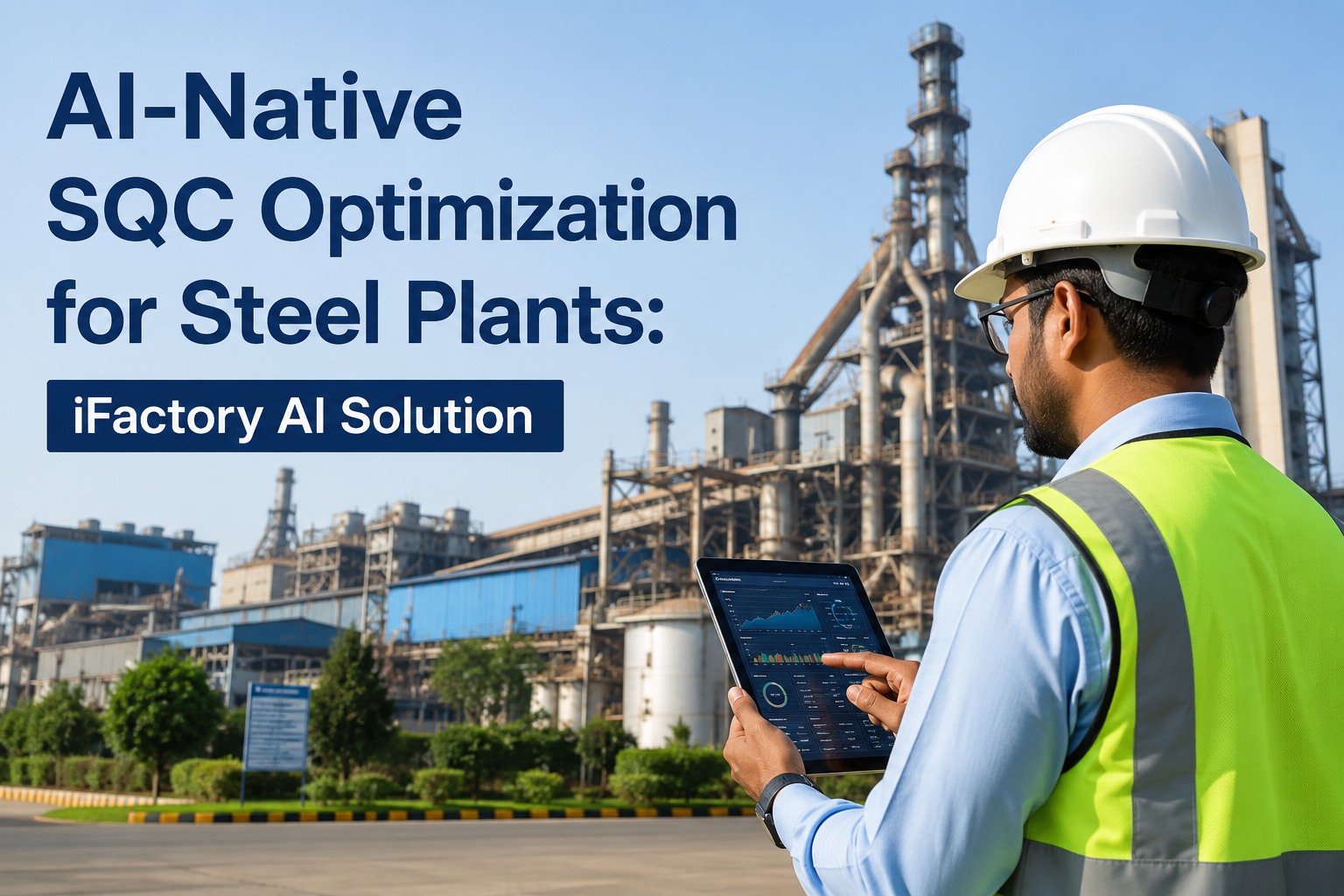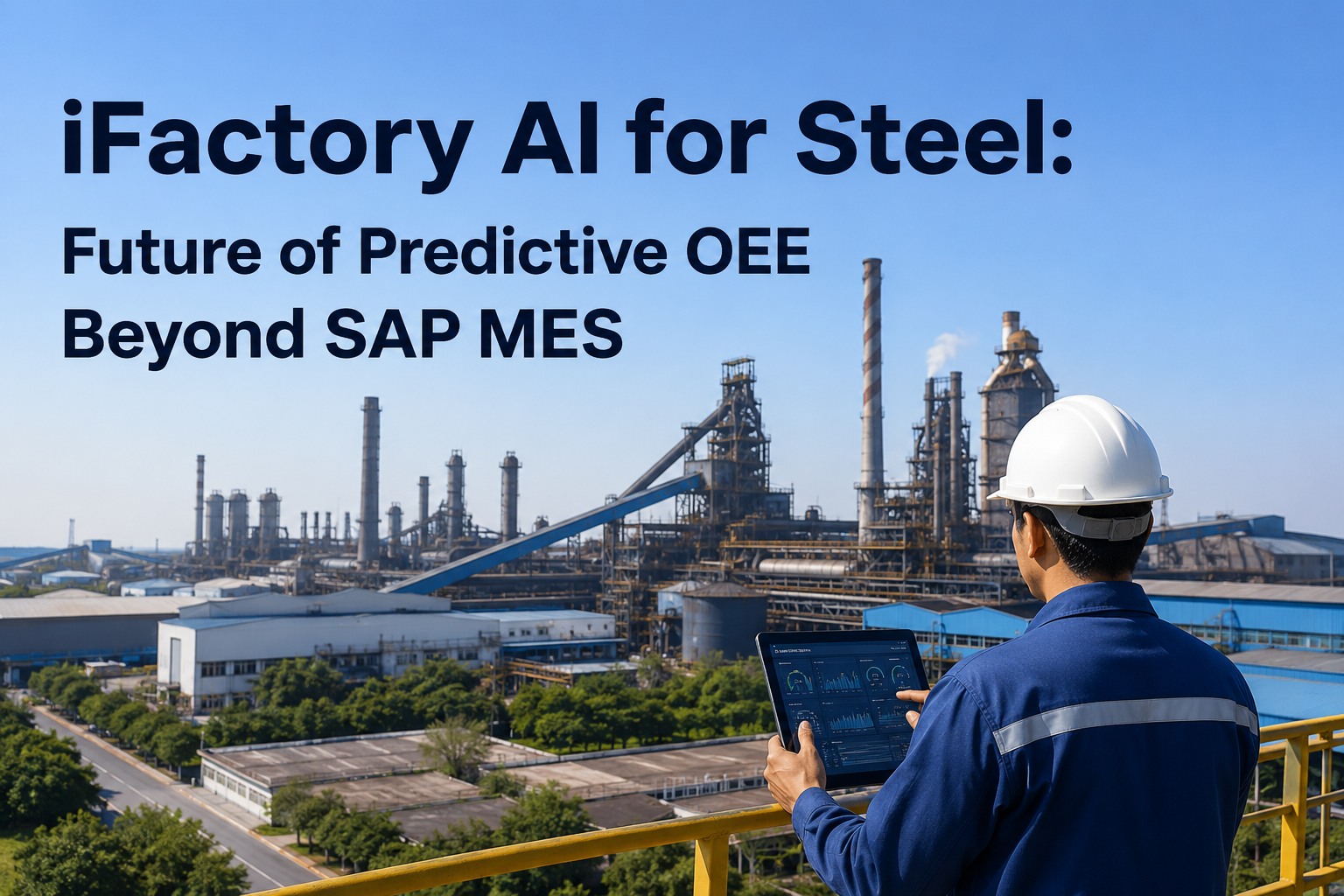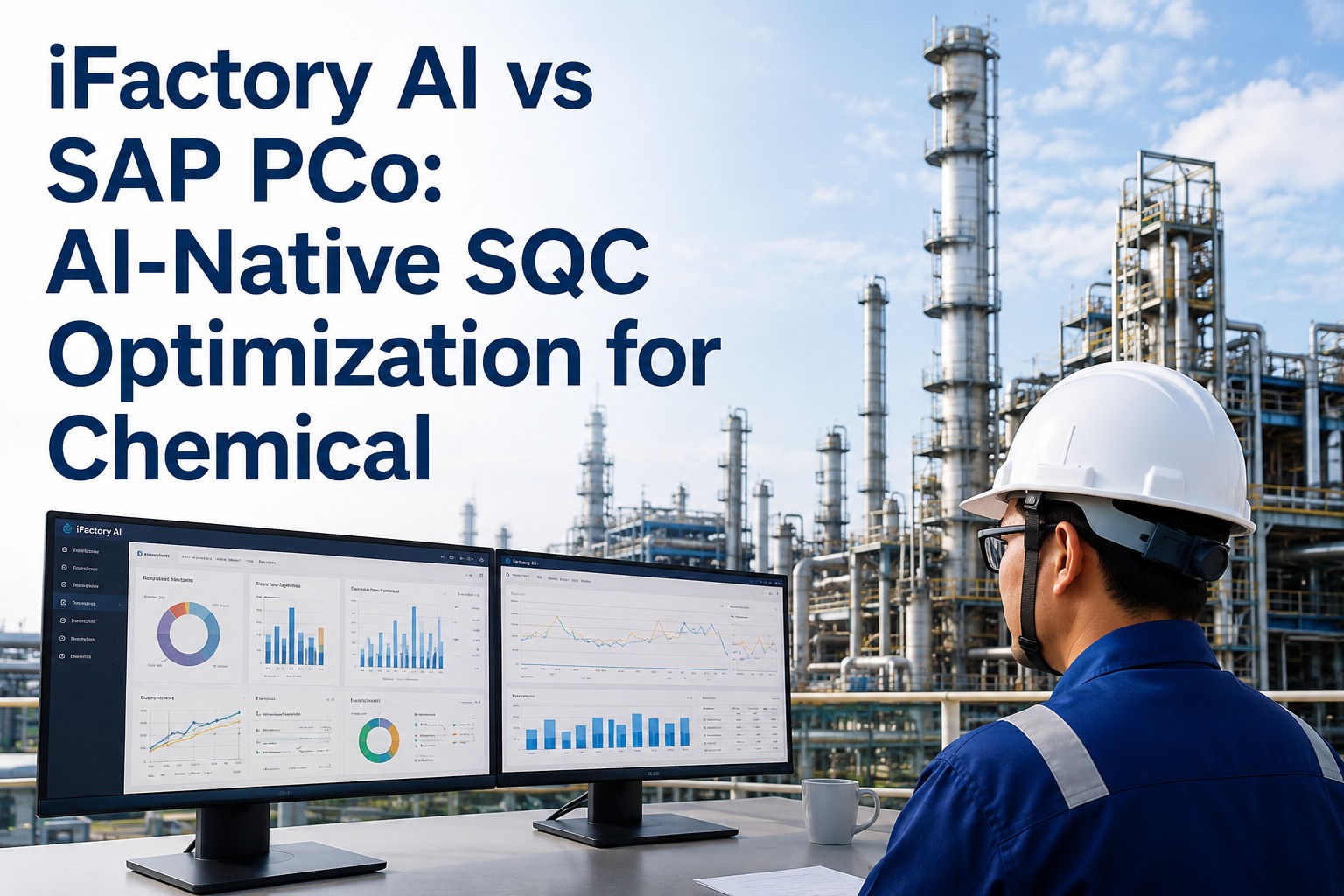
Walk into a steel mill at 03:00 on a Tuesday. The caster strand is mid-cast on a 380mm peritectic-sensitive grade. The hot strip mill is two coils into a campaign with work-roll wear progressing predictably. A scrap delivery just unloaded into the EAF bay. The shift supervisor is monitoring 11 lines, 47 critical control points, and roughly 1,200 active alarms across SAP MII screens — most of them static-limit false alarms that have to be triaged before the real ones can be found. This is the operating reality that defines whether the shift makes prime-quality yield or eats reject coil at the back end. And it's the reality that the next generation of manufacturing intelligence is built to solve — not by giving the supervisor better dashboards, but by giving the supervisor a crew. Inside the iFactory AI factory, Autonomous Quality Agents run continuously, each agent specialized to one quality function — a Caster Agent watching mold dynamics, a HSM Agent tracking exit temperature and crown, a Yield Agent monitoring grade transitions, an RCA Agent running multivariate investigations on every deviation, a Compliance Agent maintaining the audit trail. They communicate, share context, recommend coordinated actions, and surface only what the supervisor actually needs to decide on. The supervisor becomes an orchestrator rather than an alarm-triage operator. This is the shift supervisor's guide to ending SAP xMII's static-alarm chaos and stepping into the AI Factory — where Autonomous Quality Agents run the floor and humans run the decisions that matter.
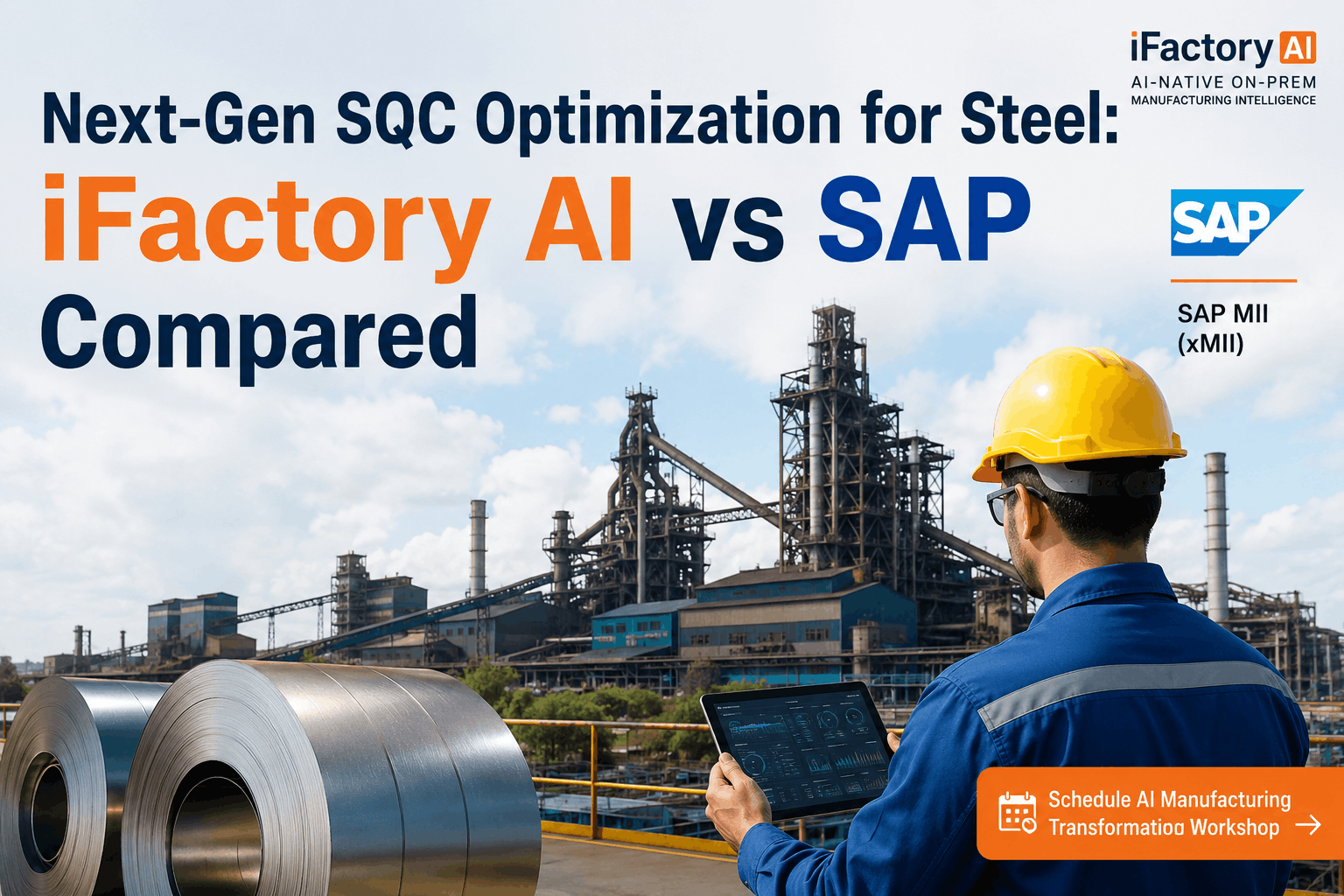
Next-Gen SQC Optimization for Steel: iFactory AI vs SAP Compared
Inside the AI Factory — Autonomous Quality Agents replace static-alarm chaos with coordinated AI crews working every line, every shift. Caster Agent, HSM Agent, Yield Agent, RCA Agent, Compliance Agent — your shift, multiplied. NVIDIA appliance with full BOM. Live in 6–12 weeks.
The Shift Supervisor's Problem — Static-Alarm Chaos
SAP MII was designed for a 2004 model of the steel mill — fewer SKUs, slower lines, simpler grade portfolios, smaller customer-specific requirements. The system enforces static SPC limits and routes every breach as an individual alarm to the shift supervisor's console. On a modern integrated mill running 11 lines across BOF, caster, HSM, plate, and cold rolling — with active grade campaigns, work-roll wear progression, scrap mix variation, and customer-spec clamps — the math doesn't work. The shift supervisor sees thousands of alarms per shift. Most are noise. The signal — the real upstream drift that will create downgraded coil in two hours — gets buried.
1,200+ alarms per shift
Static MII limits fire on every grade transition, every campaign progression step, every scrap-mix variation — most are false.
Alarm fatigue sets in
Operators learn to ignore. The 90% noise teaches the floor that alarms don't matter. The 10% real ones get missed.
Real drift goes uncaught
By the time downgraded coil shows up at the back end, the drift event that caused it is 4–8 hours old. RCA takes days.
The supervisor is fire-fighting
Shifts are spent triaging alarms instead of orchestrating the mill. Improvement projects sit on the shelf.
The AI Factory Answer — Five Autonomous Quality Agents
Inside the AI Factory, the SAP MII alarm console is replaced by a crew of specialized AI agents, each running continuously, each focused on one quality function. Agents share context with each other through the platform's semantic data layer — when the Caster Agent detects mold-friction drift on a peritectic-sensitive grade, the HSM Agent already knows that grade is coming and adjusts its expectation envelope. When the Yield Agent flags a transition issue, the RCA Agent is already pre-loaded with the upstream history. The supervisor receives consolidated, prioritized, context-rich recommendations — not raw alarm streams.
Caster Agent
Monitors mold level oscillation, mold friction, taper consistency, casting speed across every strand. Watches for breakout precursors, sticker patterns, peritectic-grade transition risk, and longitudinal-crack signatures. Sends precursor alerts 4–12 minutes ahead of static-limit breach.
HSM & Plate Agent
Tracks finishing-mill exit temperature, crown, profile, flatness across every stand. Models work-roll wear over the campaign, applies grade-specific envelopes, and reads customer-spec clamps from the order system. Flags coil-to-coil drift before it produces mixed-quality material.
Yield & Transition Agent
Specializes in grade transitions, EAF heat-to-heat variation, and tap-stream composition. Tracks scrap mix variation, recommends trim-alloy adjustments based on similar historical heats, and surfaces re-blow risk before the tap. Owns the first-coil prime-yield outcome on every grade change.
RCA Agent
When any deviation occurs anywhere in the mill, the RCA Agent runs the multivariate correlation across upstream cascade — caster strand, reheat furnace zones, descaler, every HSM stand, every coiler. Surfaces top-3 root cause hypotheses with confidence scores and recommends corrective action. Builds the evidence chain automatically.
Compliance & Audit Agent
Maintains the continuous audit trail across every quality decision, every model version, every operator action. Pre-packages customer-specific documentation (automotive PPAP-style, energy-sector certifications, regulatory submissions). Surveillance audit closeout becomes a routine artifact instead of a 6-week project.
Want to see the Quality Crew running on a representative shift from your mill? Schedule a Demo — workshop sessions include a live agent walk-through using a 12-hour shift replay from a comparable mill, with the agent recommendations rendered against actual events. Sessions available this week.
How the Crew Works Together — A Real Shift Walkthrough
The single most important thing to understand about the Quality Crew is how the agents coordinate. They aren't five independent systems sending five separate alert streams to the supervisor. They share context through a unified semantic layer, prioritize together, and produce one prioritized recommendation feed. Here's how one event cascades through the crew on a single shift.
Detects grade transition incoming
"Transition to S420MC starting at 06:42 · scrap mix has 18% more high-Si scrap than last similar campaign · expected re-blow risk elevated · recommend trim alloy adjustment per heat plan H-024."
Adjusts envelope for peritectic grade
"Mold level envelope tightening for incoming peritectic grade · breakout-precursor sensitivity at maximum · monitoring mold friction baseline reset to S420MC profile. Standing by for first heat."
Pre-loads grade envelope
"HSM envelope shifted to S420MC profile · exit temperature target 1,065°C ±15 · crown target +25μm · customer Toyota order with tight YS spec clamps active. Stand forces baseline reset."
Mold friction drift detected
"Strand 2 mold friction trending +8% over last 12 minutes · breakout-precursor pattern emerging · recommend reduce casting speed 4% and inspect mold copper at next changeover. Estimated breakout risk window: 22 minutes."
Pre-loaded with upstream context
"Already correlating · last 3 similar friction signatures resolved with copper inspection · 1 resulted in breakout. Cooling-water temperature drifted +2°C in last hour. Recommending immediate corrective action over wait-and-watch."
Logging the response chain
"Event chain captured · supervisor decision: reduce casting speed at 07:16 · friction normalized 07:28 · breakout averted. Evidence chain auto-packaged for monthly quality review. PPAP-style documentation ready if Toyota requests."
Three More AI Capabilities on the Same Appliance
The Quality Crew is the operating model. The underlying capabilities are what makes the crew possible — three AI primitives that run on the iFactory NVIDIA appliance and feed every agent.
Predictive SPC
LSTM forecasting plus autoencoder anomaly detection running on every CTQ. Drives the Caster Agent and HSM Agent's lead-time advantage over static MII limits.
AI Vision Inspection
CNN-based detection for hot-band surface defects, edge cracks, cobble events, slab surface anomalies, scale patterns. Feeds defect events directly to the RCA Agent for upstream attribution.
Industrial GenAI Copilot
The supervisor's natural-language interface to the entire crew. Ask "what's the crew watching right now" or "show me the past 6 hours of strand 2 friction" and get answers in plain language across English, Hindi, Spanish, Mandarin.
Three Migration Paths — Supervisor's View
Stay on SAP xMII
Alarm flood continues. Static limits stay static. RCA stays manual. Improvement projects stay on the shelf. Extended maintenance to 2030 at premium pricing.
SAP DMC Migration
Cloud-only re-architecture. Same static-limit paradigm in a new platform. AI agents would be a separate ecosystem. WAN dependency creates production risk for remote mill locations.
iFactory AI Factory
Autonomous Quality Agents on-prem. Full BOM included — NVIDIA appliance, cameras, edge devices, integration. Live in 6–12 weeks. On-prem inference at edge latency. No WAN dependency.
Steel Verticals — Where the Quality Crew Lands Fastest
Integrated Mills · BOF + Continuous Casting
Caster Agent on every strand. Yield Agent owning BOF tap chemistry. RCA Agent on every coil downgrade.
EAF Mini-Mills · Mixed Scrap
Yield Agent tracking scrap mix and trim-alloy adjustments. RCA Agent on every off-grade heat.
Hot Strip & Plate Mills
HSM Agent owning exit temperature, crown, profile. Customer-spec clamps active for tight automotive orders.
Cold Rolling & Finishing
HSM Agent extended to cold mill. AI Vision on surface, edge, and coil-end quality. Compliance Agent on automotive PPAP packaging.
Want a vertical-specific Quality Crew analysis for your mill? Talk to Support with your mill type and top three quality pain points — the steel team will return a focused crew-deployment roadmap typically within 3 business days, no obligation.
Two Real Steel Mill Outcomes
Integrated 3.8 Mt/yr steelmaker — alarm chaos and slow RCA
A regional integrated mill running SAP xMII across BOF, casters, HSM, and plate mill. Alarm volume averaged 1,400 per shift. Supervisors spent 60% of shift time on alarm triage. RCA on downgrade events took 4–8 days. SAP DMC quote came in at $4.6M over 22 months with cloud-only architecture.
EAF mini-mill with chronic re-blow heats & trim-alloy overspend
A 1.4 Mt/yr EAF mini-mill running mixed scrap. Re-blow rate 19–23% — every fifth heat. Trim-alloy spend $5.6M/year, well above benchmark. Static-limit SPC charts were ignored due to false-alarm rate. Supervisor shift logs showed 70%+ time on alarm triage.
Different mill configuration? Talk to Support with your current setup and the steel team will return a customized Quality Crew deployment analysis — typically within 3 business days, no obligation.
Deployment — On-Prem AI Factory or Managed Cloud
iFactory On-Premise AI Factory
- Pre-configured NVIDIA AI server — racked, software-loaded, ready to run.
- Full BOM included — server, network gear, cameras, edge devices, integration labor.
- All 5 Quality Agents running on-appliance with edge latency.
- Operates during WAN outages — mill keeps running, agents keep watching.
- Grade IP, recipes, customer specs stay inside the plant.
iFactory Cloud AI Factory
- Fully managed — no rack space at the mill.
- Same five Quality Agents running across every mill on one tenant.
- Cross-mill benchmarking — compare agent performance and yield outcomes across plants.
- Fastest deployment — first mill live in 2–4 weeks.
- Centralized agent governance for multi-site oversight.
Industrial GenAI Copilot — Your Interface to the Crew
One Copilot, five agents, every question answered
"What's the crew watching right now?"
"Why did coil 24-A-08172 downgrade?"
"Show me last 30 days of strand 2 friction"
स्टैंड 3 का लोड क्यों बढ़ रहा है?
Step inside the AI Factory. Step out of the alarm flood.
The SAP xMII migration deadline is December 2027. The shift between static-alarm chaos and the AI Factory operating model is happening right now in 2026. The Transformation Workshop is the fastest way to see the Quality Crew running against your mill, your grade portfolio, and your customer specs.
Frequently Asked Questions
How do the agents stay coordinated rather than producing conflicting recommendations?
The Quality Crew uses a shared semantic layer — a unified representation of the mill that all agents read from and write to. When the Caster Agent detects a friction anomaly, that event becomes context for the HSM Agent (which knows the affected slab will arrive later) and the RCA Agent (which pre-loads upstream history). Recommendations are coordinated through a supervisor orchestration layer that consolidates, prioritizes, and de-duplicates before surfacing to the supervisor. Agents do not act autonomously without human approval — they operate in analysis-and-recommendation mode by default, with action mode available for narrow, well-validated workflows.
Does this require us to retrain operators and supervisors?
Operators continue using existing HMIs and consoles. The change is in what reaches the supervisor — instead of raw alarm streams, supervisors see a consolidated recommendation feed from the crew. A typical supervisor onboarding takes one shift. The Copilot interface is natural-language and requires no training. The biggest behavioral change is positive: supervisors spend less time triaging alarms and more time on orchestration work — running improvement projects, mentoring operators, working with maintenance. Plants typically report this as the most welcomed change of the deployment.
What does iFactory integrate with on a steel mill IT/OT stack?
The platform connects to major steel-stack systems — Siemens TIA / Simatic, Primetals, ABB Ability — at Level 2, plus historians (PI, Aspen IP.21, GE Proficy, Wonderware) and Level 1 PLCs via OPC UA, OPC DA, MQTT, Modbus, and direct historian connectors. Read-only by default — no production impact during installation. Operators continue using existing HMIs. The deployment team handles all integration during the 6–12 week installation window.
How do agents handle different mill configurations — integrated vs mini-mill?
The five agents are configurable to each mill type. For an integrated mill, the Caster Agent monitors all strands, the HSM Agent covers the strip mill plus plate if present, the Yield Agent owns BOF tap chemistry. For an EAF mini-mill, the same Yield Agent specializes in scrap-mix awareness and trim-alloy recommendations. The RCA Agent and Compliance Agent are universal. Agent training happens during the 6–12 week deployment using your historical data — typically 12–24 months of historian and quality records.
What about safety and autonomous action authority?
By default, agents operate in analysis-and-recommendation mode — they observe, correlate, and recommend, but actions stay with the supervisor and operators. For narrow, well-validated workflows (e.g., automatic descaler purge initiation), action mode can be enabled with full governance — every autonomous action is logged, reviewable, and reversible. No autonomous action authority on safety-critical decisions. The framework explicitly follows the human-in-the-loop principle that the 2026 industrial AI standards converge on.
How do we measure whether the Quality Crew is working?
Four operational metrics typically tracked: alarm volume reaching the supervisor (target: 80%+ reduction by week 4), prime-quality yield (target: 6–18 pp lift in 6 months depending on mill type), RCA cycle time (target: days to minutes), supervisor time-on-orchestration vs time-on-triage (target: invert from 30/70 to 70/30). All four are tracked in the Compliance Agent's dashboard and reviewable in weekly steering reviews during the first 6 months post-deployment.
What does the Transformation Workshop deliver for shift supervisors?
A half-day session covering current-state SAP xMII assessment, three-path migration comparison sized to your mill, ROI modeling on alarm reduction and yield lift, live Quality Crew demonstration on a representative mill shift replay, agent-by-agent walk-through with your specific grade portfolio in mind, GenAI Copilot demonstration, and 12-month deployment roadmap. Suitable for shift supervisors, operations managers, quality leads, and IT/OT partners — typically a joint session with all four functions present.
SAP xMII alarm console. Or AI Factory Quality Crew. Same shift, different reality.
December 2027 is fixed. The Quality Crew operating model is available now. The Transformation Workshop is the fastest path to a sized, mill-specific roadmap for stepping out of alarm chaos and into the AI Factory.