The SAP-to-shopfloor gap is the operational fault line that defines manufacturing IT today. Every VP Manufacturing recognizes it — production orders live in SAP S/4HANA, recipes and routings live in Siemens Opcenter MES, sensor data lives in OPC servers and historians, SPC results live in vendor-specific dashboards. Each layer holds part of the operational truth; none holds it whole. Operators rekey data between layers. Quality teams export, reconcile, and reformat to assemble audit packages. Production planning runs on yesterday's truth while the shop floor runs on this minute's signals. Capital efficiency stagnates because integration debt has been paid down only partially across decades of point-solution buying. iFactory AI closes the gap with a single platform that streams SAP S/4HANA production orders, Siemens Opcenter MES recipes and routings, MSMQ middleware messages, and live PLC parameters into one integrated SPC engine — running on a pre-configured NVIDIA appliance inside the plant, deployable in 12 weeks. This page is the VP Manufacturing's guide to what end-to-end real-time integration actually looks like architecturally, what the deployment timeline involves, and what the operational outcome is once the SAP-to-shopfloor gap has been closed.
Real-Time SAP-to-MES-to-SPC Integration Platform
End-to-end integration in a single platform — SAP S/4HANA production orders, Siemens Opcenter MES recipes, MSMQ middleware, PLC sensor data, and live SPC engine streaming in continuous sync. Pre-configured NVIDIA appliance, on-premise deployment, 12 weeks from contract to operational. Replaces the patchwork of IDoc handlers, MES connectors, OPC bridges, and SPC point solutions that most plants run today.
The SAP-to-Shopfloor Gap — Why It Exists and What It Costs
The gap exists because each layer of the manufacturing IT stack was built independently across decades, by different vendors, optimized for different concerns. SAP optimized for ERP, finance, and supply chain. MES vendors optimized for execution and traceability. OPC and PLC standards optimized for protocol compatibility. SPC vendors optimized for statistical analysis. Each layer works well in isolation; together they leave seams. Operators bridge the seams manually. Quality teams reconcile across layers retroactively. The cost shows up in three forms: time spent rekeying and reconciling, errors introduced at each transcription boundary, and missed quality outcomes when signals don't reach decision-makers fast enough.
The economic case for closing the gap reduces to three measurable categories — direct labor cost recovered from eliminated manual data bridging (typically 30–50% of operator and supervisor time today), error cost reduction from removed transcription boundaries, and operational improvement from signals reaching decision-makers in time to act. For a typical 5–10 line plant, the gap closure value runs $1.8M–$4.2M annually, with payback on the integration program in 8–14 months.
Want a sized gap-closure analysis for your specific manufacturing operation? Schedule the SAP-MES-SPC Integration Workshop — iFactory's integration team will model your specific manual bridging cost, error rate, and operational opportunity across the SAP/MES/SPC stack. Sessions available this week.
The Five-Layer End-to-End Integration Stack
iFactory's platform consolidates the manufacturing IT stack into five logical layers, all running on a single NVIDIA appliance inside the plant. Each layer handles a specific responsibility, integrates natively with the layers above and below, and contributes to the unified data and quality model. The architecture is the same across all manufacturing industries — discrete, process, hybrid — because the integration responsibilities are universal.
The layers communicate continuously and bidirectionally. SAP production order release flows down through MES recipe activation, through MSMQ event broadcast, through PLC parameter setup. Real-time PLC data flows up through MSMQ, into the SPC engine for analysis, and continues up to MES for execution tracking and SAP for batch record completion. Every transaction touches every relevant layer, with no manual data entry required and complete audit trail across the stack.
Want to see the five-layer integration stack walked through with your specific SAP/MES/PLC environment? Schedule the SAP-MES-SPC Integration Workshop — iFactory's integration team will walk through architectural fit, specific protocol requirements, and 12-week deployment plan. Sessions available this week.
Production Order Lifecycle — End-to-End Through the Stack
How a single production order moves through all five layers
The clearest way to understand end-to-end integration is to follow one production order through its full lifecycle. The visualization below shows the order journey from SAP creation through MES execution, PLC parameter capture, SPC analysis, and back to SAP batch record completion — all happening continuously with no manual data entry.
Forward path · order release
SAP S/4HANA → MES recipe activation → PLC parameter setup → SPC engine initialization · all automated through native integrations.
Reverse path · execution feedback
PLC sensor data → SPC analysis → MES execution status → SAP batch record completion · all in continuous real-time stream.
Quality events · in-line handling
Predictive scrap signature detected → operator notified → process adjustment captured → audit trail updated · without leaving the line.
Exception path · deviation
Deviation triggers → Investigation Agent builds RCA → MES routing modified · SAP order updated → quality evidence attached automatically.
Six Integration Use Cases That Pay Back Fastest
Real-Time Order Status
Production planners in SAP see real-time order status, projected completion, and quality state without manual updates from the shop floor. Variance to plan visible immediately.
Automated Batch Records
Every process event, parameter value, operator action, and quality result flows into the SAP batch record automatically. Manual batch record completion eliminated entirely.
Live SPC on Production Orders
SPC monitors parameters in the context of the active production order, not as line-aggregate. Adaptive control limits tune per order, per product, per shift.
Closed-Loop Quality
Quality deviations trigger automated MES routing changes, SAP order adjustments, and PLC parameter modifications without exiting the integrated platform.
Continuous Audit Readiness
Customer, regulatory, and internal audit packages assembled continuously as the operation runs. Audit prep time drops from weeks to hours.
Multi-Plant Standardization
Identical integration stack across all plants enables consistent workflows, comparable metrics, and rapid replication of best practices. Plant-by-plant variation collapses.
Want an integration-use-case-specific ROI projection for your manufacturing operation? Send your current SAP/MES/SPC footprint and integration pain points to iFactory support and the integration team will return a customised ROI map with 12-month roadmap — typically within 3 business days, no obligation.
Protocols, Standards & Connectors — What Ships in the Box
Pre-built integrations across ERP, MES, middleware, and shop floor
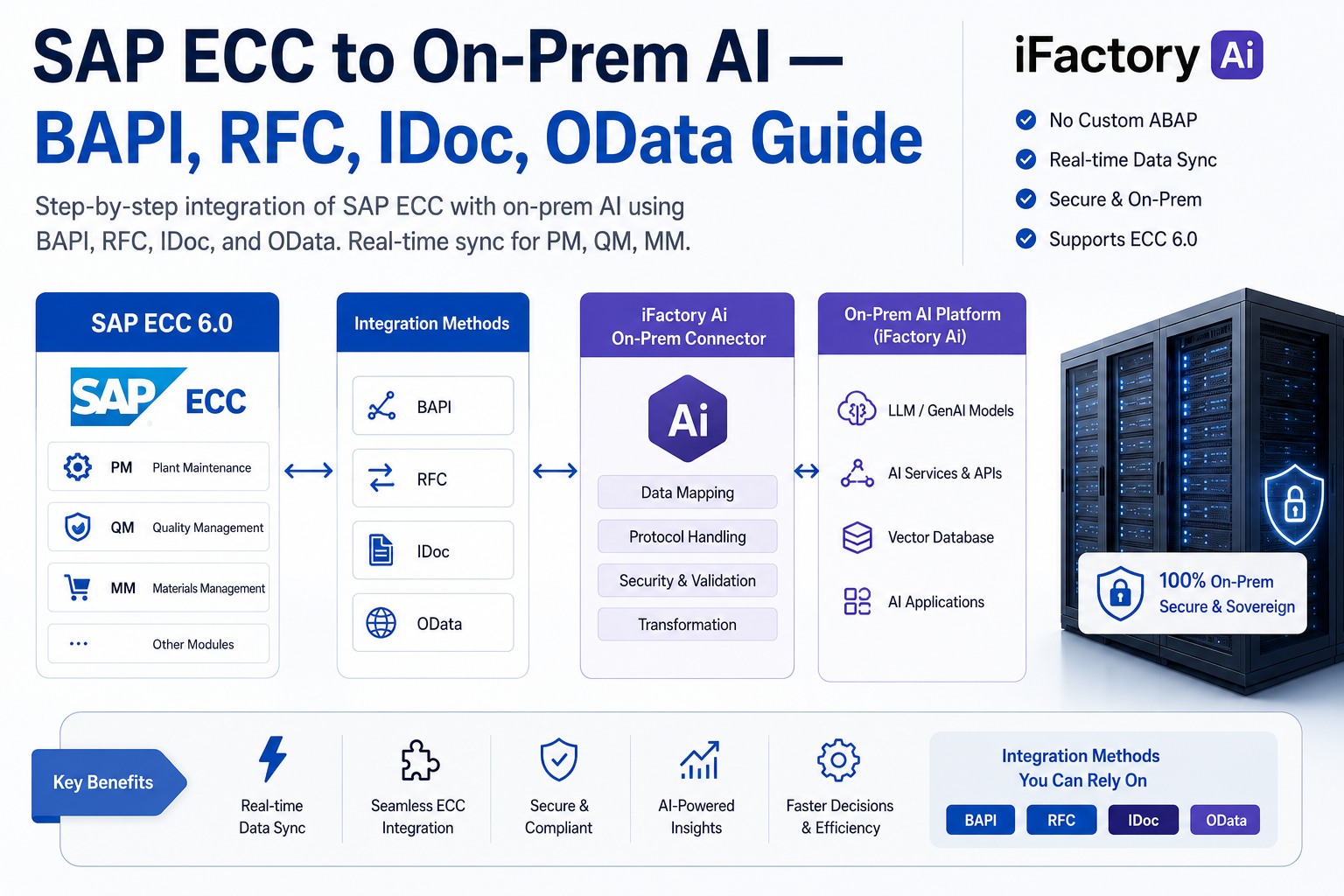
- SAP S/4HANA — IDoc (LOIPRO, COCO), BAPI, OData, S/4HANA Cloud Connector
- SAP ECC legacy — IDoc, RFC, BAPI bridges for in-flight migrations
- Siemens Opcenter MES — REST API, S95 messages, OPC UA companion
- Other MES — GE Proficy, Rockwell FactoryTalk, Honeywell, AspenTech
- MSMQ middleware — guaranteed delivery messaging
- OPC UA + OPC Classic — industrial protocol standard
- MQTT — IoT and edge messaging
- Industrial protocols — Modbus, EtherNet/IP, PROFINET, EtherCAT
- PLC native — Siemens S7, Rockwell ControlLogix, Mitsubishi, Schneider
- Field bus — DeviceNet, ControlNet, AS-i
- Time-series databases — InfluxDB, OSIsoft PI, AspenTech IP.21
- S88/S95 — ISA batch and enterprise-control standards
The deployment team configures the specific integrations needed during the 12-week installation. For most manufacturing operations, 60–80% of required connectors are activated in the first 4 weeks; remaining edge cases (legacy systems, custom protocols) are handled in weeks 8–12 alongside model training and operator workflow validation.
Two Real End-to-End Integration Outcomes
Discrete manufacturer with SAP S/4HANA, Opcenter MES, and 6 siloed point solutions
A discrete manufacturer running SAP S/4HANA for ERP, Siemens Opcenter MES for execution, and 6 additional point solutions (historian, vendor SPC tool, vision system, label printer, quality dashboards, audit tool). Manual data bridging between layers consumed approximately 11 FTE-equivalent across operations and quality teams. Audit prep ran 2–3 weeks per cycle.
Process manufacturer with quality compliance pressure and legacy SAP MII patchwork
A process manufacturer running SAP MII for legacy integration, with manual SPC at filling and packaging stations. Customer audit pressure from major retail accounts demanded faster audit response and richer compliance evidence. Annual audit-prep labor exceeded $1.8M; quality data assembly consumed an additional $900K in supervisor and engineering time.
Neither scenario matches your situation? Send your current SAP/MES/SPC stack, plant footprint, and integration pain points to iFactory support and the integration team will return a customised migration analysis with 12-month roadmap — typically within 3 business days, no obligation.
iFactory's Integration Deployment — On-Premise or Cloud
Same end-to-end integration platform on either deployment model. Same five-layer architecture, same protocol support, same SAP S/4HANA connectivity. On-premise is recommended for plants where latency, data sovereignty, or WAN reliability are operational concerns. Cloud is appropriate for multi-plant operations with established cloud governance frameworks.
iFactory On-Premise Appliance Default for plants with sensitivity to latency, sovereignty, or WAN risk
- Pre-configured NVIDIA AI server — racked, software-loaded, ready to plug in.
- <50ms end-to-end latency — PLC signal to SPC engine.
- Data sovereignty preserved — recipes, IP, and operational data stay in plant.
- Works during WAN outages — local SAP/MES integration via cached state.
iFactory Cloud For multi-plant operations with established cloud governance
- Fully managed — no rack, no facility requirements.
- Same integration stack — SAP/MES/MSMQ/PLC/SPC layers.
- Cross-plant orchestration across multi-site operations.
- Fastest deployment — first plant live in 2–4 weeks.
The SAP-to-shopfloor gap stays closed for as long as the platform runs.
Five integrated layers — SAP S/4HANA, Siemens Opcenter MES, MSMQ middleware, PLC layer, iFactory AI SPC engine — running in continuous sync on a pre-configured NVIDIA appliance inside the plant. End-to-end latency under 50ms. 12-week deployment from contract to operational. No manual data bridging, no audit-prep marathons, no integration patchwork to maintain. The Integration Workshop sizes the migration for your specific manufacturing operation.
Frequently Asked Questions
Does iFactory replace SAP S/4HANA or Siemens Opcenter MES?
No. iFactory integrates with SAP S/4HANA and Opcenter MES rather than replacing either. SAP remains the system of record for production orders, materials, batch records, and supply chain. Opcenter remains the execution and routing layer. iFactory adds the integration fabric (MSMQ + protocol bridging), real-time PLC data capture, and AI-native SPC engine that together close the gap between these layers — without replacing what already works.
What about migrations from SAP ECC to S/4HANA?
iFactory supports both SAP ECC (legacy) and SAP S/4HANA (current) natively, with seamless transition support during ECC→S/4HANA migration projects. The platform consumes IDocs, BAPIs, and OData from either source. Many customers deploy iFactory before or during the SAP migration as the integration layer, reducing migration risk by preserving shop floor continuity through the SAP transition.
Why MSMQ specifically — isn't it Microsoft-specific legacy middleware?
MSMQ remains in extensive use across manufacturing IT today, particularly for guaranteed-delivery messaging between SAP, MES, and shop floor systems. iFactory natively supports MSMQ alongside modern alternatives (MQTT, OPC UA, Kafka) — recognizing that real plants have heterogeneous middleware. Customers can migrate from MSMQ to modern middleware over time while iFactory continues to function across the transition.
What's the role of the SPC engine being on the same platform as the integration layer?
Co-locating the integration fabric with the SPC engine eliminates the latency and complexity of moving data between separate systems for analysis. PLC sensor data hits the SPC engine within the same compute environment that handles SAP/MES integration — enabling sub-50ms end-to-end analysis. Most architectures put SPC in a separate tool, adding network hops and protocol conversions that degrade real-time response.
Do I need to buy NVIDIA servers separately?
No. iFactory's on-premise appliance ships fully loaded — pre-configured NVIDIA AI server, software pre-installed, network gear, cabling, edge devices for line-side inference. You provide rack space, line power, Ethernet, and PLC/SCADA/MES integration points. The deployment team handles installation and configuration. For cloud, no hardware investment at all.
How does the 12-week deployment actually work?
Weeks 1–4 — appliance ships and racks, baseline SAP/MES connectivity established, initial PLC data flow validated. Weeks 5–8 — AI models train on plant data, operator workflows validated on pilot lines, MSMQ fabric configured across the stack. Weeks 9–12 — go-live on first lines, operator training, audit evidence framework activated, optimization based on initial operation. Most plants are operational on first lines by week 8 with full plant coverage by week 12.
What does the SAP-MES-SPC Integration Workshop cover?
The half-day workshop covers — current-state SAP/MES/SPC assessment with focus on integration pain points, five-layer architecture walkthrough specific to your environment, live demonstration of SAP order release flowing through MES, MSMQ, PLC, and SPC engine, ROI analysis on labor savings and operational improvement, deployment roadmap with milestone dates. Outcome is a concrete integration migration plan. Suitable for VP Manufacturing, operations leaders, SAP team, MES team, IT, and finance representatives.
Integration debt has been the manufacturing IT problem for 30 years. iFactory closes it in 12 weeks.
SAP S/4HANA, Siemens Opcenter MES, MSMQ middleware, PLC layer, iFactory AI SPC engine — five layers in continuous real-time sync on a single on-premise NVIDIA appliance. No more manual data bridging, no more audit-prep marathons, no more integration patchwork. End-to-end latency under 50ms. 12-week deployment. The Integration Workshop is the fastest way to size the migration for your specific operation — sessions available this week.