In 2025, "AI-powered manufacturing" mostly meant a SaaS subscription, a cloud connector, and a leap of faith that your competitor's hyperscaler wasn't somewhere on the same logical infrastructure. In 2026, that posture has collapsed. EU Annex 22 explicitly requires AI oversight committees and model explainability for GMP-regulated AI/ML — achievable only when the model and the data both sit inside a validated environment you control. CMMC 2.0 final rule made data sovereignty a contractual obligation for defense suppliers. Food safety regulators are quietly adopting the same posture. The 24/7 plants that genuinely cannot tolerate a multi-region cloud outage have stopped asking whether on-prem is "still relevant" — they're asking which platform deploys fastest behind the firewall. For pharma, food, defense, and continuous-operations manufacturers, cloud-first SAP Digital Manufacturing Cloud is not always the answer. This is the field guide to the top on-premise AI manufacturing platforms in 2026 — what they share, where they differ, and what to evaluate before you sign. Book a 30-minute architecture walkthrough with our deployment engineers.
DATA SOVEREIGNTY · GMP · CMMC · 24/7 OPS
Cloud-First Was the 2024 Story. On-Premise AI Is the 2026 Architecture for Regulated Manufacturers.
For pharma running under EU Annex 22 and 21 CFR Part 11, defense suppliers under CMMC 2.0, food manufacturers under FSMA 204, and 24/7 process plants where multi-region cloud failure means lost batches — cloud-first SAP DMC introduces compliance complexity and latency that on-premise AI eliminates by design. The top platforms in 2026 ship pre-validated, deploy in 6 to 12 weeks, and run on NVIDIA on-prem hardware behind your firewall. Perpetual license. Source code included.
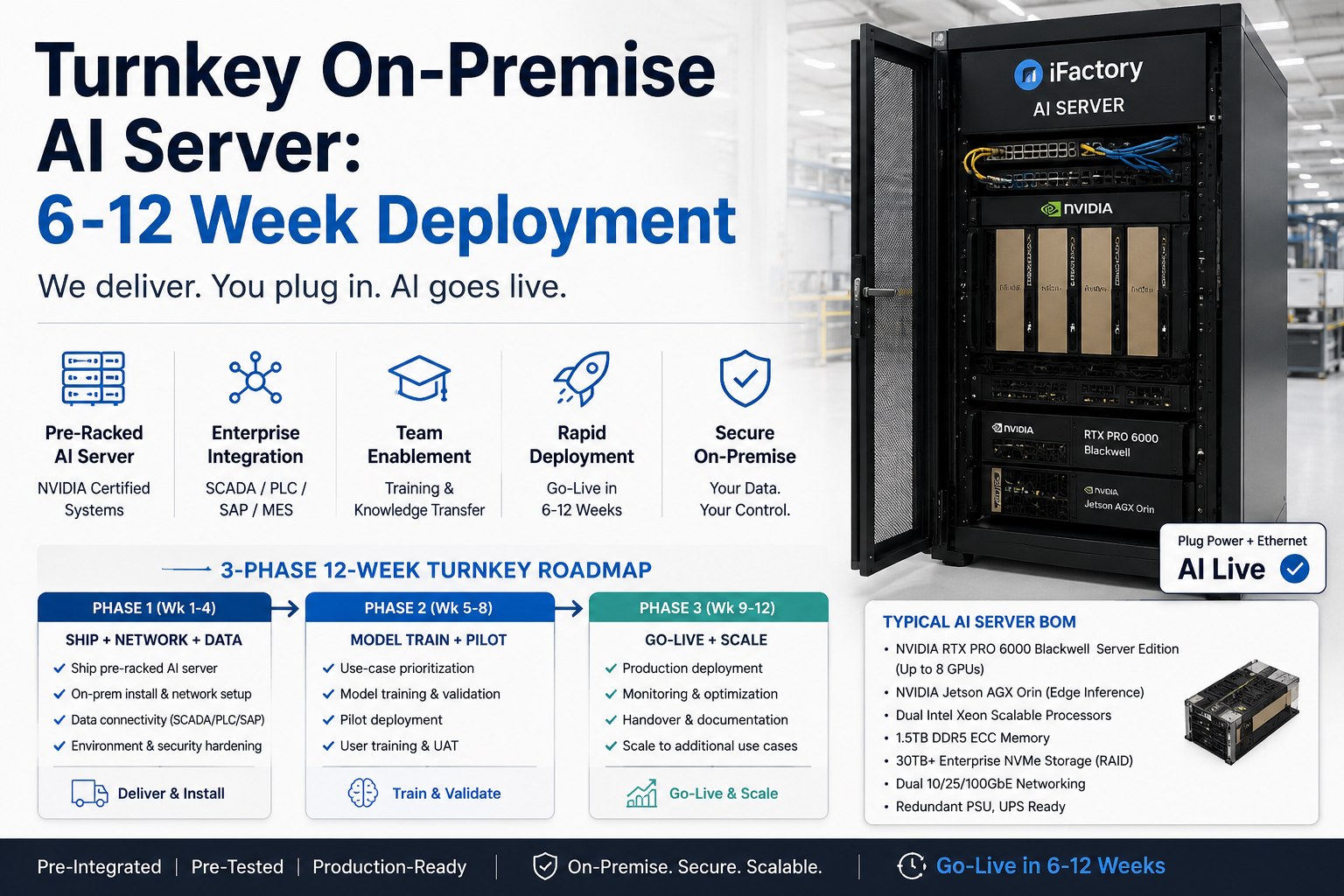
The On-Prem Server Stack — What Every Top Platform Runs On
The platforms leading the 2026 on-prem AI manufacturing category share a common reference architecture — three NVIDIA hardware tiers behind the plant firewall, never connected to the public internet, supporting workloads from edge vision inference to enterprise-wide model retraining. Schedule an architecture walkthrough with our deployment engineers.
WhereMounts at production lines, QC labs, cleanrooms
FormRuggedized box, fits in switchgear cabinet
What it does: Runs vision models for defect detection, voice-to-intent for operator queries, and OPC-UA data subscriptions for time-series anomaly detection. Local buffering ensures no data loss during network maintenance.
EDGEVISION · VOICE · OPC-UA
CONTROL ROOM · PLANT AI CORE
RTX PRO 6000 Blackwell The Plant AI Core
JobLLM inference, MES copilot, predictive models
SpeedSub-2-second contextual card generation
WhereSits in your control room behind your firewall
FormTower computer, fits under a desk
What it does: Runs the open-weight LLM that powers operator copilots, contextual MES cards, and predictive maintenance models. Source-available platforms ship with model registry, version control, and Annex 22-ready drift monitoring out of the box.
LLM+ CV + TIME-SERIES MODELS
ENTERPRISE · FLEET TRAINER
NVIDIA DGX Station GB300 · Fleet Model Trainer
JobFine-tunes models on your plant data
SpeedFull retrain cycle in hours, not weeks
WhereSits at corporate HQ in a server rack
FormRack-mounted, 24/7 enterprise grade
What it does: Trains models on your proprietary plant data — fuel mix, process envelopes, deviation patterns. Model weights never leave your perimeter. Cross-site fine-tuning supports fleet learnings without exporting raw data.
FLEETSOVEREIGN MODEL TRAINING
100%
Stays inside your plant · zero internet egress
$0/mo
Perpetual license · buy once, own forever
Air-Gap
Capable · for ITAR, classified, GMP-critical sites
Yours
Source code included · modify it freely
The Industry Fit Matrix — Where On-Prem AI Beats Cloud-First MES
Five regulated industries where cloud-first SAP DMC architectures introduce risk that on-prem AI eliminates by design. Each row shows the cloud compliance gap, the operating consequence, and the on-prem advantage. Talk to our compliance support team about your industry.
EU Annex 22 + 21 CFR Part 11 require AI oversight committee, model explainability, and audit trail on every inference touching CQAs. Hyperscaler tenancy makes this defensible only with substantial CSV burden.
Model registry on DGX · training data hashed · Part 11 audit trail on every prediction · pre-built validation package · 70% CSV cost reduction · validated state in 8 weeks.
CMMC 2.0 Level 2/3 + ITAR + DFARS 7012 require CUI never leaves the controlled perimeter. AI inference in a hyperscaler tenant is a controlled-export concern. Audit cost is significant.
Air-gap capable deployment · model weights and inference logs stay inside the enclave · CMMC Level 3-compatible architecture · ITAR-eligible deployment with US-citizen-only operator access.
FSMA 204 traceability requirements + recall-readiness drills demand sub-second access to batch genealogy. Cloud round-trip during a recall investigation creates audit exposure. Bandwidth fragility in remote sites is a real risk.
Recall queries answer locally in under 2 seconds. Cold-chain anomaly detection runs at the line — bandwidth-independent. Validated traceability schema preserved across firewall.
CONTINUOUS PROCESS · 24/7
Refining · cement · chemicals · steel
A 30-minute hyperscaler region outage costs $300K-$1.2M at a refinery or cement plant. SLAs cover compute but not your throughput. Process control loops cannot wait for cloud round-trips.
Local inference operates regardless of WAN status. Sub-50ms loop response keeps process control inside operating envelopes. Air-gap mode supported for high-availability runs.
SEMICONDUCTOR / DISCRETE
Wafer fab · advanced packaging · automotive Tier-1
Process recipes are billion-dollar IP. Cloud tenancy plus model-training data exposure are non-starters. SECS/GEM integration with cloud MES adds latency that disturbs tool-time.
Recipe data + AI inference both behind the firewall. SECS/GEM bridge at the Jetson — no cloud round-trip. Models fine-tuned on your fab data, weights never leave.
CLOUD-FIRST SAP DMC TYPICAL 3-YEAR TCO PER SITE
$400K-$1.5M + integration
Three Real On-Prem Deployment Scenarios — How the Platform Lands
Three real scenarios from manufacturers who evaluated cloud-first SAP DMC and chose on-prem AI instead. Each shows the compliance pressure point or operational reality that decided it. Book a 30-minute deployment walkthrough.
SCENARIO 01
"EU Annex 22 explicitly requires an AI oversight committee and model explainability. Our SAP DMC implementation in hyperscaler tenancy cannot defend either. What does on-prem look like?"
THE PROBLEM
Top-20 pharma manufacturer. Mid-rollout of SAP DMC for a new biologics line. EU Annex 22 final guidance issued Q2 2026 — requires AI oversight committee, model explainability, training data lineage, drift monitoring with auto-alerts. The hyperscaler tenancy in the current SAP DMC plan makes evidence-gathering for these requirements a 9-month CSV project. Validation director paused the rollout.
HOW ON-PREM AI SOLVES IT
Model Registry on DGX
Every AI model versioned, training data hashed, validation evidence linked. Annex 22 controlled model selection rationale captured natively — not bolted on.
Explainability Outputs (RTX)
SHAP / feature attributions surfaced on every inference touching a CQA. AI oversight committee dashboard built into the platform — not a custom report deliverable.
Inspector-Ready in 8 Weeks
Pre-built IQ/OQ/PQ executed against site config. Annex 22 evidence pack generated automatically. Biologics line launches without rollback.
THE RESULT
Annex 22-defensible in 8 weeks. 9-month CSV gap closed. Biologics line on schedule.
SCENARIO 02
"Our defense contract has a CMMC Level 3 requirement landing next year. Our AI inference cannot live in a hyperscaler tenant. What architecture survives audit?"
THE PROBLEM
Tier-1 defense supplier producing radar sub-assemblies. CMMC 2.0 Level 3 contractual requirement landing for the next program. Current AI vision inspection runs through a hyperscaler vendor — CUI flows through their region. ITAR review flagged this as a controlled-export concern. Program manager has 90 days to remediate or lose the contract bid.
HOW ON-PREM AI SOLVES IT
Air-Gap Deployment
Jetson + RTX + DGX inside the controlled enclave. Zero internet egress. US-citizen-only operator access enforced via badge auth. ITAR-eligible by design.
CMMC Level 3 Evidence Pack
Pre-mapped to NIST SP 800-171 r2 controls. Logging, encryption, access control, incident response — all evidence-ready from day one.
Contract-Eligible in 10 Weeks
Vision inspection migrated to the on-prem stack. C3PAO assessment passes. Program contract awarded.
"Our refinery had a 22-minute hyperscaler region outage during a turnaround. AI inference dropped. We lost real-time critical path. What changes with on-prem?"
THE PROBLEM
Mid-size refinery in the middle of a 32-day turnaround. Cloud-hosted critical path AI dropped during a 22-minute hyperscaler region outage. Tool-time crashed. PTW approvals stalled. The day's recovery target slipped. Turnaround lead's question: why does production reliability depend on a vendor we don't control?
HOW ON-PREM AI SOLVES IT
Plant AI Core (RTX) On-Site
Critical-path engine + PTW workflow + LOTO chains run on the local RTX. WAN status irrelevant for execution-critical paths.
Offline-Capable Operator UI
Mobile devices sync with the local cluster, not the cloud. Internet outage = zero impact on tool-time, permits, and critical path.
Next STO Runs Clean
Cloud connectivity used only for fleet rollups to corporate. Site operations independent of WAN. STO finishes on plan.
THE RESULT
Next 28-day STO finished on plan. Zero cloud-outage exposure. Production decoupled from WAN.
$2-10M
Typical 3-year value at a regulated manufacturing site moving AI inference from cloud-first SAP DMC to on-prem — compliance gaps closed, hyperscaler dependency eliminated, latency improved, data sovereignty assured. Most facilities reach break-even within the first audit cycle or major operational event.
Architecture Walkthrough · Pre-Built Validation · 6-12 Week Pilot
See the Top On-Prem AI Stack Live · Against Your Use Case.
Book a 30-minute architecture walkthrough with our deployment engineers. We map your industry, your compliance scope (Annex 22, CMMC, FSMA 204, ITAR), and your current SAP footprint. You leave with a side-by-side comparison against cloud-first SAP DMC plus a 6-to-12-week pilot plan. Perpetual license. Source code included. Zero hyperscaler dependency.
The most common questions enterprise architects, IT directors, and compliance leaders ask when evaluating on-premise AI manufacturing platforms in 2026. Talk to our deployment support team.
Do we have to replace SAP DMC or our existing MES?
No. The leading on-prem AI platforms in 2026 are designed to coexist with SAP DMC, SAP MII, Werum, Rockwell PharmaSuite, Tulip, and other MES platforms. They operate as the AI intelligence layer running alongside the MES — predictive models, computer vision, contextual operator copilots, voice queries, and AI-driven anomaly detection. The MES keeps doing what it does well (work order execution, batch records, genealogy). The AI layer adds capabilities the MES was never designed for, all running on-prem.
How does on-prem AI handle EU Annex 22 and 21 CFR Part 11?
The top platforms ship with model registry, training data lineage hashes, validation evidence templates, drift monitoring with auto-alerts, and 21 CFR Part 11-compliant audit trails on every inference touching a CQA. Pre-authored IQ/OQ/PQ packages reduce CSV burden by roughly 70% versus building from scratch. EU Annex 22 final guidance (expected 2026) requires controlled model selection, training validation, and continuous monitoring — all native to the platform, not custom-built. Talk to a compliance support engineer for a validation plan template specific to your dosage forms or product family.
What about CMMC 2.0, ITAR, and defense compliance?
Air-gap deployment is supported natively. The Jetson + RTX + DGX stack runs inside the controlled enclave with zero internet egress. Operator access can be restricted to US-citizen-only via badge auth, satisfying ITAR-eligible deployment requirements. The platform is pre-mapped to NIST SP 800-171 r2 controls for CMMC Level 2/3 — logging, encryption, access control, and incident response evidence are generated from day one. C3PAO assessments typically pass on the first review when the architecture is in-scope.
What's the typical 3-year TCO compared to cloud-first SAP DMC?
Cloud-first SAP DMC at a single site typically runs $400K-$1.5M over 3 years, including license, integration, consulting, and ongoing subscription. On-prem platforms with perpetual licenses (no monthly recurring) and pre-built validation packages typically run $250K-$650K total over 3 years — including hardware. The real saving compounds with prevented outages, prevented audit findings, and prevented contract losses (especially for defense and regulated pharma). Most enterprises reach break-even within the first audit cycle.
How fast can we get a pilot live?
Typical timeline: Weeks 1-4 — architecture walkthrough complete, hardware sized, asset library configured, integration with existing MES tested. Weeks 5-8 — pilot use case live on one line (vision inspection, predictive maintenance, MES copilot, or other). Weeks 9-12 — validation evidence pack assembled, operator training complete, ready for compliance review or production go-live. From contract signature to a live, audited pilot: 6-12 weeks. Most enterprises with a clear use case land a pilot before their next major audit or product launch.
Top On-Prem AI Platforms · 2026 Architecture Guide
Stop Renting Your Manufacturing AI. Own It Behind the Firewall.
Book a 30-minute call with our deployment engineers. Walk through your industry, your compliance scope, and your current SAP footprint. See the on-prem reference architecture live. Pilot in 6 to 12 weeks. Perpetual license. Source code included. Zero hyperscaler dependency.