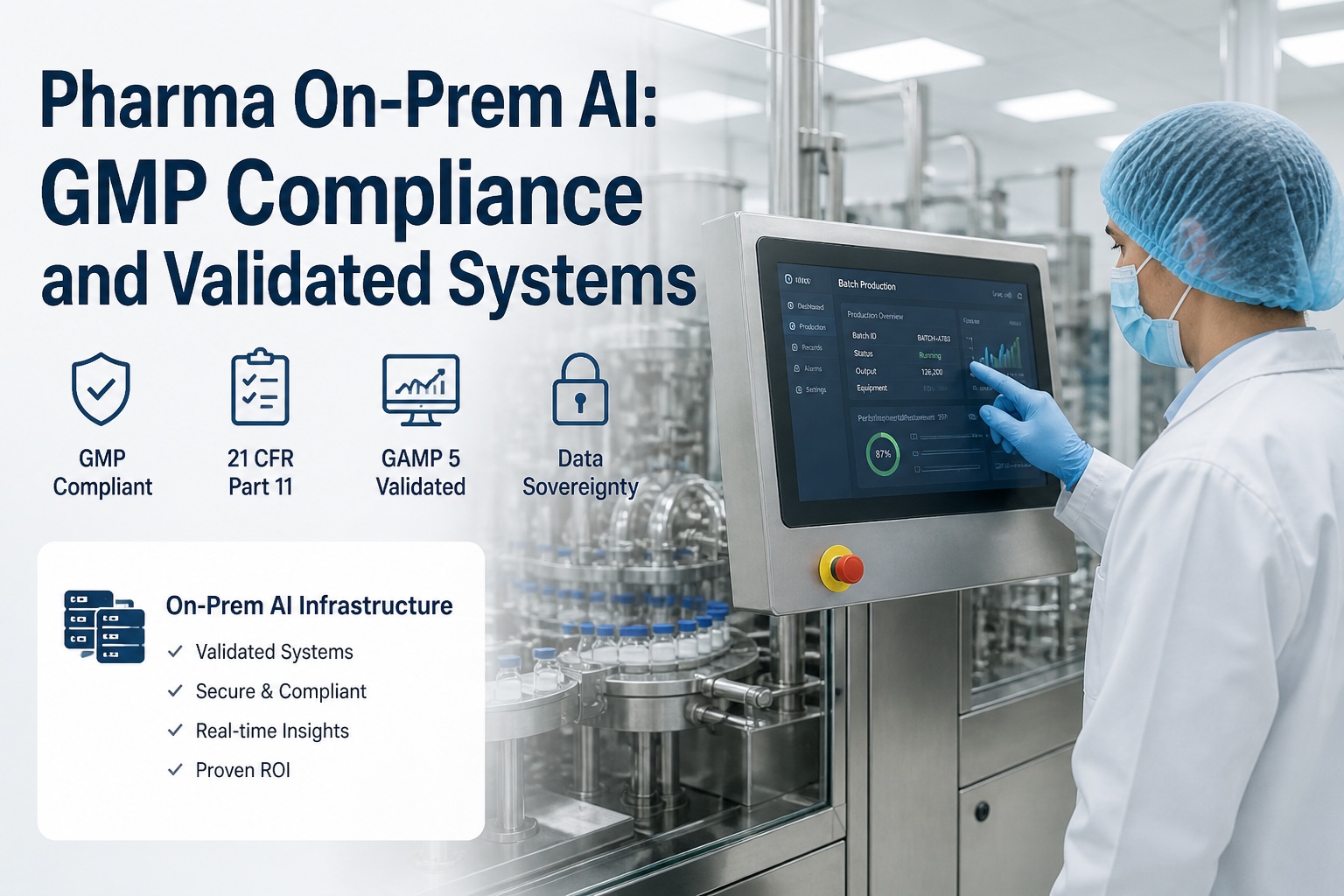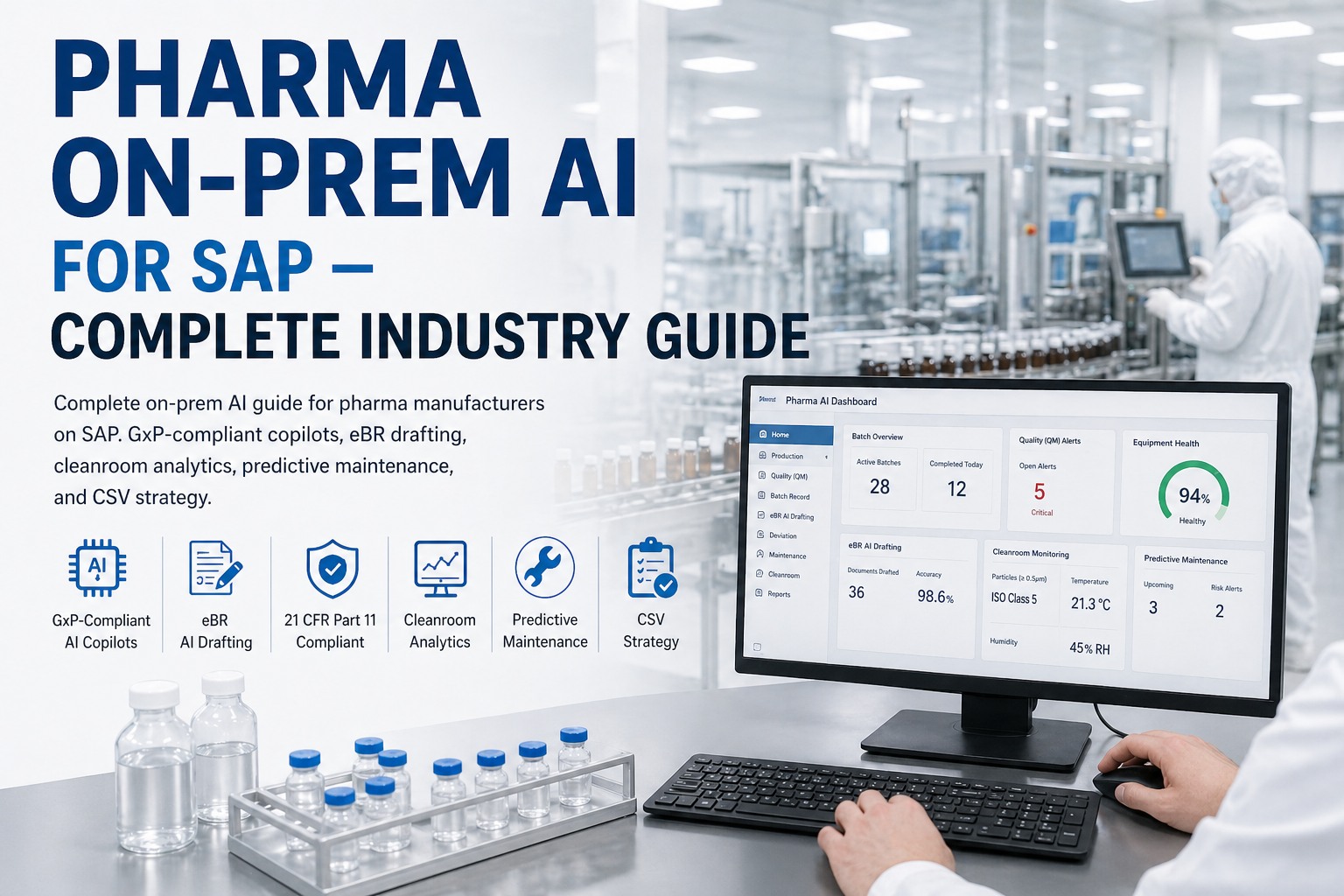
Pharma is the most regulated manufacturing sector in the world — and the one where AI has the clearest, hardest boundary. Regulated electronic records, signatures, and batch releases can never be performed by an AI. They can be drafted, reconciled, observed, and routed by an AI — but the final signature must always come from a credentialed human in a 21 CFR Part 11 compliant workflow. This guide is the working operator's plan for on-prem AI on top of SAP ECC or S/4HANA in a pharma plant. GxP-compliant copilots, electronic batch record (eBR) drafting, cleanroom analytics, GxP-validated predictive maintenance, deviation management, and environmental monitoring. Production-tested across solid dosage, sterile and aseptic, biologics, API, and OSD operations.
Pharma On-Prem AI for SAP — Complete Industry Guide
GxP-compliant copilots, eBR drafting, cleanroom analytics, validated predictive maintenance, deviation management, and environmental monitoring. AI drafts, routes, and observes. The credentialed human still signs. Live on your SAP plant in 8–12 weeks, fully sovereign, fully audit-ready.
What You Get — Turnkey Pharma Package
Hardware, software, GxP-validated connector library, pre-written IQ/OQ scripts, regulatory playbooks, training, and 24×7 support — pre-configured for pharma operations and shipped racked.
Hardware
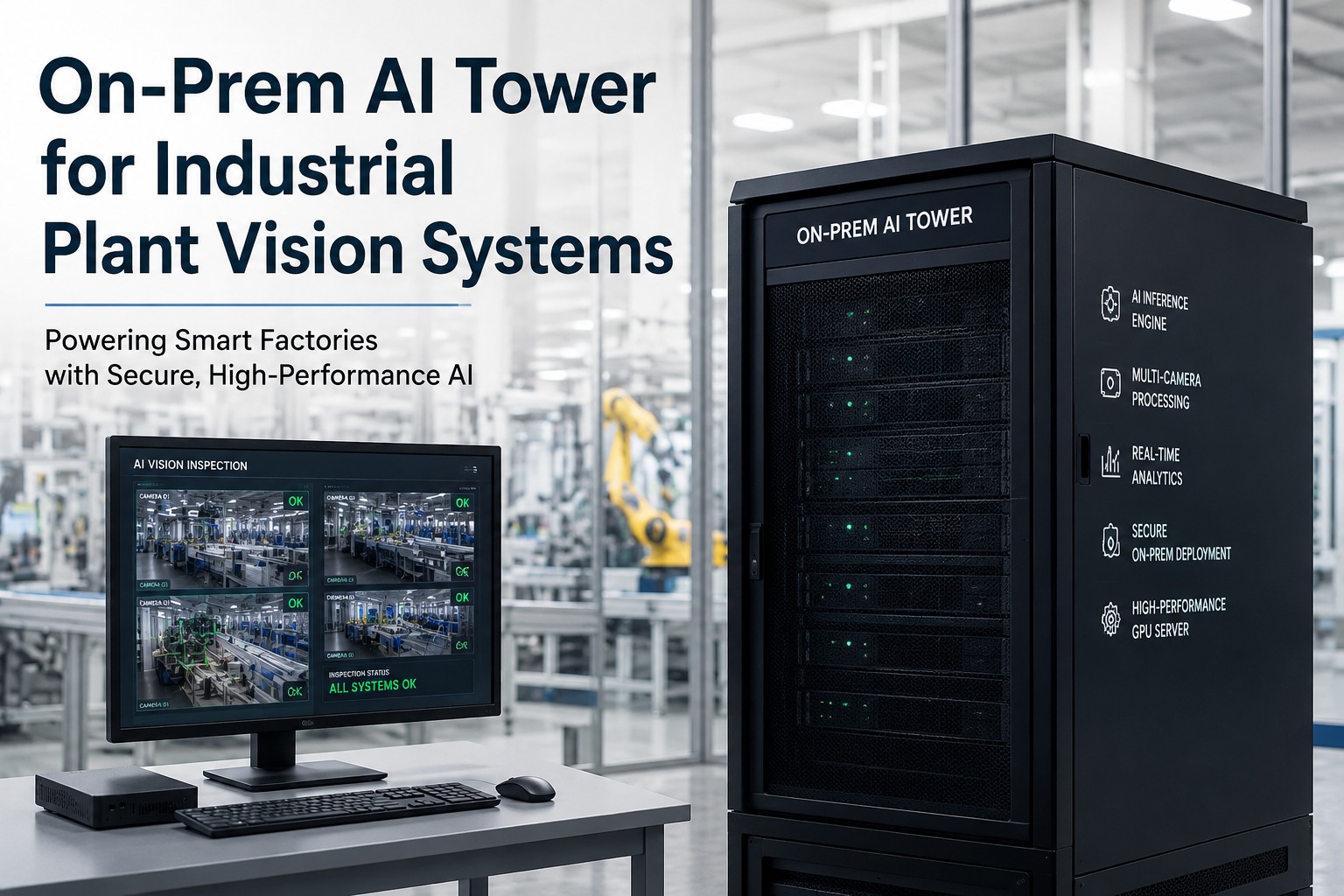
NVIDIA DGX HA pair, validated environment, IQ/OQ documentation included.
Pharma Connectors
SAP PP-PI, QM, MM, EWM, plus EM/BMS, MES, LIMS, weighing/dispensing.
GxP Playbooks
21 CFR Part 11 workflows, ALCOA+ checklist, CSV strategy, audit pack.
Validated Support
24×7 monitoring, regulatory updates, change-control coordination, SLA.
Why On-Prem AI Is Different in Pharma
Pharma operations balance three hard constraints — patient safety, regulatory compliance, and brutal cost-of-goods pressure. Recipe IP, batch genealogy, deviation history, and supplier qualification data cannot live outside the validated boundary. The numbers below frame the stakes.
Five Pharma Sub-Segments — One Validated Platform
Different pharma segments have different validation burdens. Sterile and biologics carry the heaviest. Solid dosage runs the highest volume. API/bulk runs the most complex chemistry. iFactory ships pre-validated playbooks for all five.
Tablets, Capsules, Granulation
Granulation moisture, tablet weight/hardness vision, coating uniformity, dissolution-predictive sensors, batch record drafting from weigh/dispense.
Injectables, Ophthalmics, Vials
Aseptic boundary monitoring, vial inspection vision, lyophiliser cycle integrity, isolator pressure cascade, environmental monitoring class-A grade.
Vaccines, mAbs, Cell & Gene Therapy
Bioreactor parameter trending, scale-up modeling, viability and titer prediction, single-use system tracking, cold chain end-to-end.
Active Ingredients, Intermediates
Reactor profile control, crystallization endpoint detection, impurity-pattern recognition, yield trending against the master recipe.
Suspensions, Syrups, Topical Creams
Mixing time vs viscosity, particulate exclusion vision, fill-weight vision, cap-torque, label and pharmacovigilance code verification.
AI Drafts. Reviewer Approves. Authorized Signer Signs.
This is the architectural rule that every iFactory pharma deployment follows. AI can draft an electronic batch record. AI can route it. AI can flag an exception. AI can never sign a regulated action. The diagram below shows where the boundary sits.
iFactory AI Brain
- Drafts eBR narrative from sensor + SAP data
- Reconciles weigh/dispense vs recipe
- Detects deviations and routes to QA
- Suggests CAPA from history
- Logs every action to audit trail
Operator / QA Reviewer
- Reviews AI-drafted records
- Adds witness data and observations
- Routes for technical or QA approval
- Initiates change controls if needed
- Reviewer e-signature applied
Authorized Signer · QP
- Reviews complete reviewed record
- Applies 21 CFR Part 11 e-signature
- Releases batch to SAP PP/PI
- Accountable for regulatory submission
- Identity verified · credentials current
The Nine Principles of Data Integrity — Built In
ALCOA+ is what every FDA, EMA, and PMDA inspector looks for. Each principle is enforced architecturally — not by training operators to "remember to do the right thing". iFactory's audit trail is structurally compliant by design.
Attributable
Every entry tied to a credentialed user identity. AI actions tagged as system-generated and never confused with human actions.
Legible
Machine-readable and human-readable. Original record preserved exactly. No font, layout, or character corruption ever.
Contemporaneous
System timestamp at the moment of action. NTP-synchronised, drift bounded under 100 ms across the entire validated estate.
Original
First-capture record retained with cryptographic hash. Any subsequent copy is provably a true copy with traceback.
Accurate
Sensor calibration tracked, AI confidence logged with every prediction, every deviation captured before record locked.
Complete
No gaps. Every action between batch start and batch release captured. Failed entries logged, not silently dropped.
Consistent
Same data shown the same way to operator UI, audit report, and regulatory export. No view-time transformations.
Enduring
Retained for the regulated retention period — typically batch life plus one year minimum, often longer for biologics.
Available
Retrievable on demand for inspectors. Audit export pack assembled in minutes — not weeks of binder hunting.
How an Electronic Batch Record Actually Flows
The six-stage flow below is the eBR workflow shipped with every iFactory pharma deployment. The dashed boundary in the middle marks the GxP signature line — AI stops at stage 3, human takes over from stage 4.
Batch Start
SAP PP-PI process order released. AI initializes batch record skeleton, master recipe loaded, ALCOA+ trail opened.
Drafting & Reconciliation
AI drafts narrative from weighing, dispensing, and sensor data. Reconciles materials vs recipe. Flags deviations.
Routes for Review
AI assembles complete draft and routes to operator and QA reviewers. Draft locked from further AI modification.
Review & Witness
Reviewer reads draft, adds witness data and observations. Approves or sends back for correction. E-signature applied.
21 CFR Part 11 Release
Qualified Person reviews complete record, verifies identity, applies regulated e-signature. Batch officially released.
SAP Posted
Batch status posted back to SAP PP-PI as released. Audit pack assembled. Archive retention timer starts.
Six AI Playbooks Shipped for Pharma
Every iFactory pharma deployment activates these six use cases by default. All six respect the GxP signature boundary — AI drafts, routes, and observes; the credentialed human always signs.
eBR Drafting & Reconciliation
AI assembles the batch narrative — equipment status, weighing reconciliation, in-process sampling, deviation flags. Drafts a complete eBR within minutes of batch end. Human reviewer approves; QP signs for release.
Cleanroom Analytics
Continuous monitoring of particle counts, viable counts, pressure cascade, temperature, humidity. Trending and anomaly detection. AI flags excursions to QA before they cross Grade A/B/C/D limits.
Validated Predictive Maintenance
AI predicts failures on critical pharma equipment (mixers, granulators, isolators, autoclaves). Drafts SAP PM work orders for maintenance planner approval. PM scope respects validated state and change control.
Deviation Management
AI categorises deviations against historical taxonomy, suggests probable root causes from past CAPA, recommends investigation scope. QA owns the investigation and decisions; AI accelerates the paperwork.
Environmental Monitoring
Continuous EM data fused with batch context. Predicts microbial-recovery patterns from past trends. AI flags pressure cascades, HEPA filter degradation, and personnel-gowning anomalies for QA review.
GxP-Bounded Operator Copilot
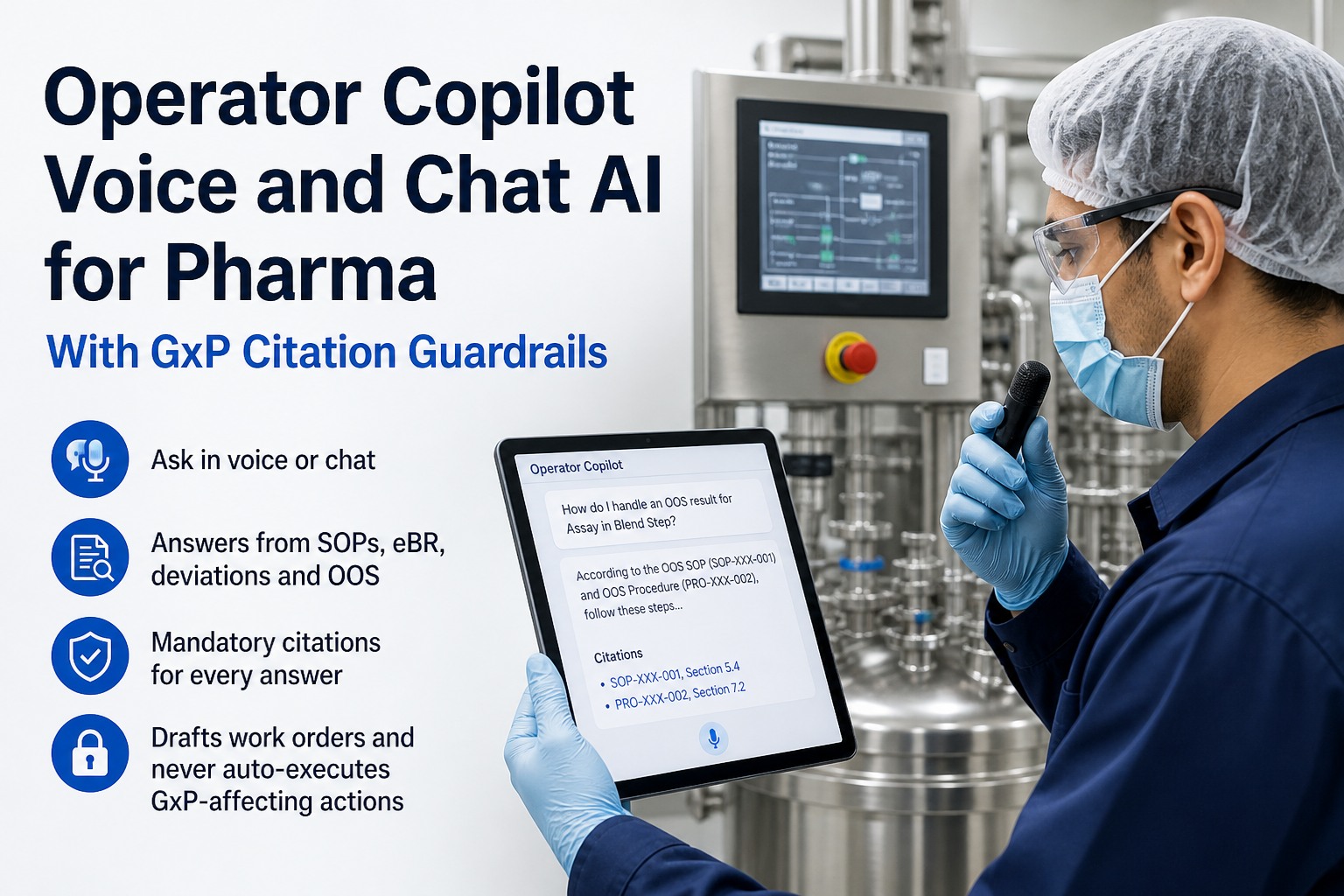
Operator copilot grounded in master batch record, SOPs, batch history, and live sensor data. Answers questions but never triggers regulated actions autonomously. Every interaction logged in audit trail.
QA Director Asks. AI Answers. Reviewer Decides.
A QA Director investigates a batch deviation. The dialogue below shows the AI providing context — grounded in eBR draft, master record, and EM sensor history — but staying strictly inside the GxP boundary.
· Differential pressure dropped from 45 Pa to 18 Pa for 47 seconds
· Grade A spec is >30 Pa — excursion is reportable
· Coincident events — HEPA chamber 2 filter at 87% of validated life · personnel airlock cycle at 14:21:53
· Five similar excursions in last 90 days — three traced to HEPA approach-to-change-out
· Suggested CAPA scope · HEPA replacement on chamber 2 · review airlock interlock timing
This is investigation context only. The deviation decision and CAPA scope are yours to set. I have drafted the Q-notification but it is not posted until you approve.
Pre-Validated for CSV — IQ and OQ Documentation Included
iFactory ships with the full ISPE GAMP 5 documentation pack — user requirements specification, functional spec, design spec, IQ scripts, OQ scripts, and traceability matrix. Your validation team executes; the documents are pre-written.
Every left-side document maps to a right-side test. iFactory provides pre-written scripts; your CSV team executes against your specific environment and signs off.
- GPU NVIDIA RTX PRO 6000 Blackwell · 96 GB
- CPU AMD Ryzen 9 9900X · 12 cores
- RAM 128 GB DDR5 · 6000 MHz
- Storage 2 TB NVMe M.2 SSD · validated
- Power 1000 W · 80+ Gold
The main pharma AI brain. Runs the GxP-bounded operator copilot, eBR drafting, deviation management, cleanroom analytics, and validated PdM — all together. About the size of Meta's Llama 3 70B. The brain most pharma sites use as their on-prem AI core.
- Module NVIDIA Jetson AGX Orin
- CPU 12-core ARM Cortex-A78AE
- GPU 2048-core Ampere + 2× DLA
- RAM 64 GB unified LPDDR5
- Network OPC-UA · EtherNet/IP native
Edge brain that sits next to a pharma machine — isolator, autoclave, granulator, lyophiliser, bioreactor. Talks to the PLC, processes batch sensor data in under a second, sends results to the main AI brain. Ruggedized for cleanroom-adjacent install.
- Module NVIDIA Jetson AGX Orin
- Decoder NVDEC hardware video engine
- Codecs H.264 · H.265 · AV1
- Streams 8–16 simultaneous RTSP feeds
- AI CNN / vision models on DLA engines
Watches up to 16 cameras at once — vial inspection, label verification, gowning audit, cleanroom personnel, line clearance. Video never leaves the plant. Required for GxP, patient privacy, and recipe IP protection.
- GPUs 72× NVIDIA Blackwell Ultra (B300)
- CPUs 36× NVIDIA Grace · 72 Arm cores each
- Memory ~20 TB HBM3e pool
- Fabric NVLink Gen6 · 1.8 TB/s GPU-to-GPU
- Compute ~1.4 ExaFLOPS FP4 · liquid-cooled
The flagship — a small data centre in one rack. Big enough to run cross-site digital twin across continents, biologic process simulation, large-model R&D for novel drug discovery, and multi-plant deviation analytics — all at the same time. Used by global pharma manufacturers as their AI centre of gravity.
The 12-Week Pharma Rollout — With Validation Gates
Same 8–12 week shape as every iFactory deployment, with pharma-specific milestones — IQ/OQ execution, GxP boundary testing, eBR workflow validation, and authorized-signer onboarding.
- NVIDIA DGX delivered, racked, IQ executed and signed
- SAP PP-PI, QM, EM connectors wired in read-only mode
- User requirements signed off; functional spec issued
- Audit trail and ALCOA+ logging validated end-to-end
- OQ scripts executed, deviations resolved and closed
- eBR drafting workflow piloted on one product
- GxP signature boundary tested with sample batches
- Authorized signer onboarding and credentialing complete
- Performance qualification under real batch load
- Plant-wide rollout, all products, all shifts
- Mock audit drill — full traceability pack assembled
- 24×7 monitoring active, change-control protocol live
What Pharma Plants Measure After Go-Live
Numbers below are aggregated across iFactory pharma deployments — solid dosage, sterile/aseptic, biologics, API, and OSD operations all running on SAP PP-PI plus QM.
See GxP-bounded pharma AI live at SAP Sapphire 2026
Live demo — AI drafting an eBR while a QP signs in real time, deviation auto-categorization, cleanroom analytics, validated PdM. Book a 20-minute walkthrough.
Frequently Asked Questions
Do I need to buy NVIDIA servers separately?
No. Fully-loaded NVIDIA DGX AI servers are supplied and installed as part of the iFactory package — including a Tier-3 HA pair for the pharma use case. They ship pre-racked, pre-cabled, with the GxP-validated software stack, IQ documentation, and audit trail components pre-installed. You provide power and Ethernet. We provide the rest.
Does iFactory's AI ever electronically sign a regulated record?
No. This is an architectural rule, not a configuration toggle. The AI drafts records, reconciles materials, flags deviations, suggests CAPA, and routes documents for review. Every regulated electronic signature — 21 CFR Part 11, EU GMP Annex 11 — is applied by a credentialed human via a separate signature ceremony that the AI cannot trigger or bypass.
How does this support 21 CFR Part 11 compliance?
Three layers. One — every action is attributable to a unique credentialed user (or tagged as AI/system). Two — every signature requires identity verification and a manifestation of intent (clicking "I attest", typing reason). Three — the audit trail is uneditable, time-stamped, and exported on demand. iFactory's audit trail has been reviewed in pharma inspections without findings on the AI layer.
Is the system pre-validated (IQ/OQ)?
Yes. iFactory ships with the full ISPE GAMP 5 documentation pack — URS, FS, DS, traceability matrix, plus pre-written IQ and OQ test scripts. Your CSV team executes the scripts against your specific plant environment and signs the protocols. We do not ship "validated" — only your team can validate the deployed system on your site. We ship "validatable in weeks, not months".
Can iFactory run in a fully air-gapped GxP environment?
Yes. The full pharma AI stack runs entirely offline — DGX hardware, NeMo models, RAPIDS, NIM inference, SAP connectors, EM mesh. No external API calls. This is the required posture for defense-rationed manufacturing, government-priority pharma, and certain biologics operations where complete network isolation is mandated.
Does iFactory support cleanroom Grade A/B/C/D environments?
Yes. The cleanroom analytics module uses ISO 14644-1 Grade A through D thresholds out of the box — Grade A at ≤3,520 particles/m³ (0.5µm), Grade B at ≤352,000, and so on. Pressure cascade, viable counts, gowning audit, HEPA filter approach-to-end-of-life all monitored continuously and surfaced as QA notifications, never autonomous actions.
How does AI handle deviations — does it close them automatically?
No. AI categorises the deviation against historical taxonomy, suggests probable root cause from past CAPA records, drafts the deviation narrative, and routes to QA. QA decides the investigation scope, classification, CAPA, and closure. The deviation lifecycle stays under quality unit control — AI accelerates the paperwork around it, not the decision itself.
What is the typical ROI for a pharma deployment?
Average $3.4M three-year savings per plant. The biggest line items are documentation labour reduction (eBR drafting cuts 50%, deviation investigation 60%), batch-release acceleration (often from 5–7 days to same-day), and reduction in repeated CAPA on the same root cause. Most pharma plants pay back the project in 12–18 months — faster than the typical pharma capital project.
Faster Batch Release. Cleaner Audit. The GxP Boundary Held.
GxP-compliant pharma AI on SAP — eBR drafting, cleanroom analytics, validated PdM, deviation management. AI drafts and routes. The QP signs. Live in 8–12 weeks. Sovereign, on-prem, and inspection-ready from day one.