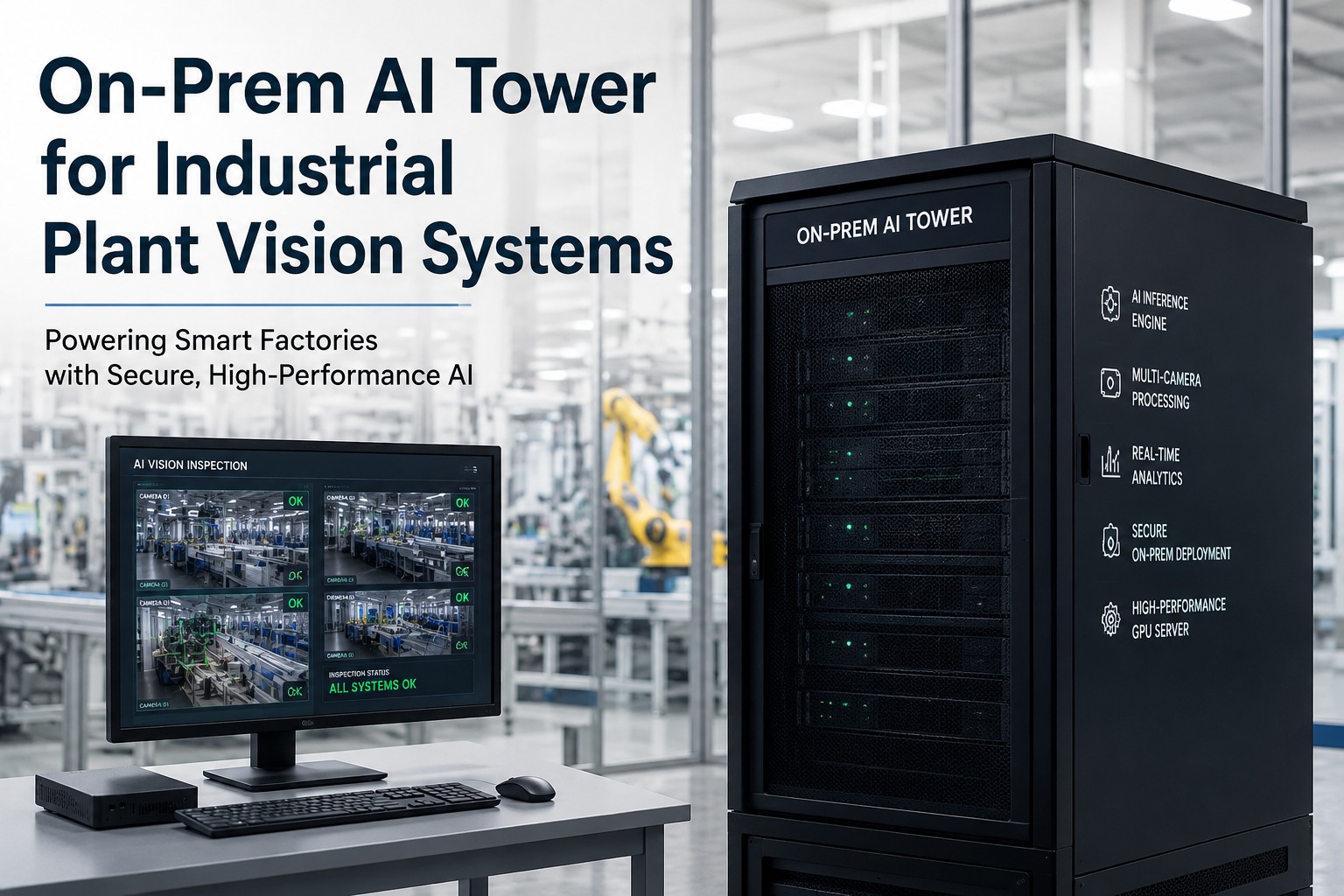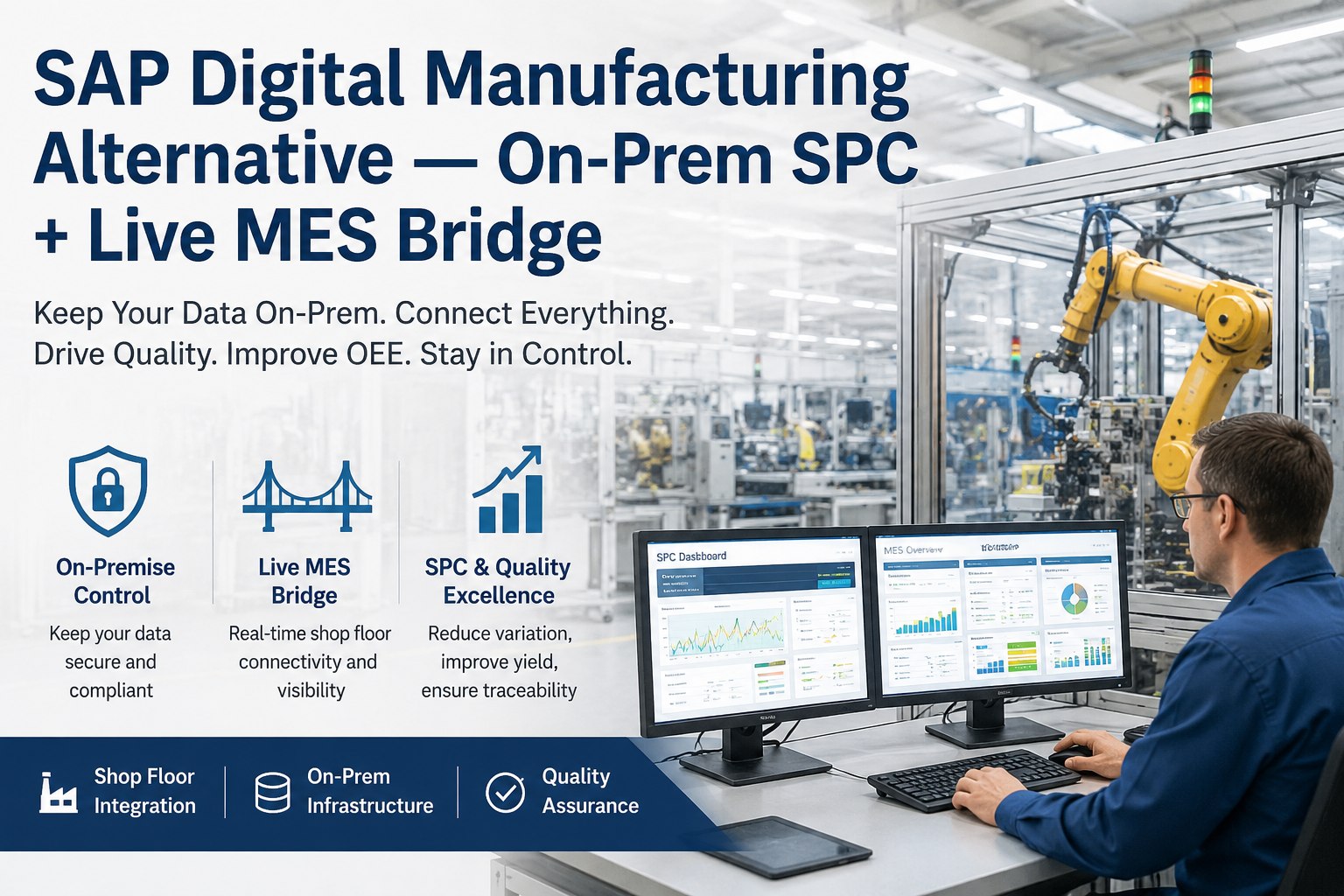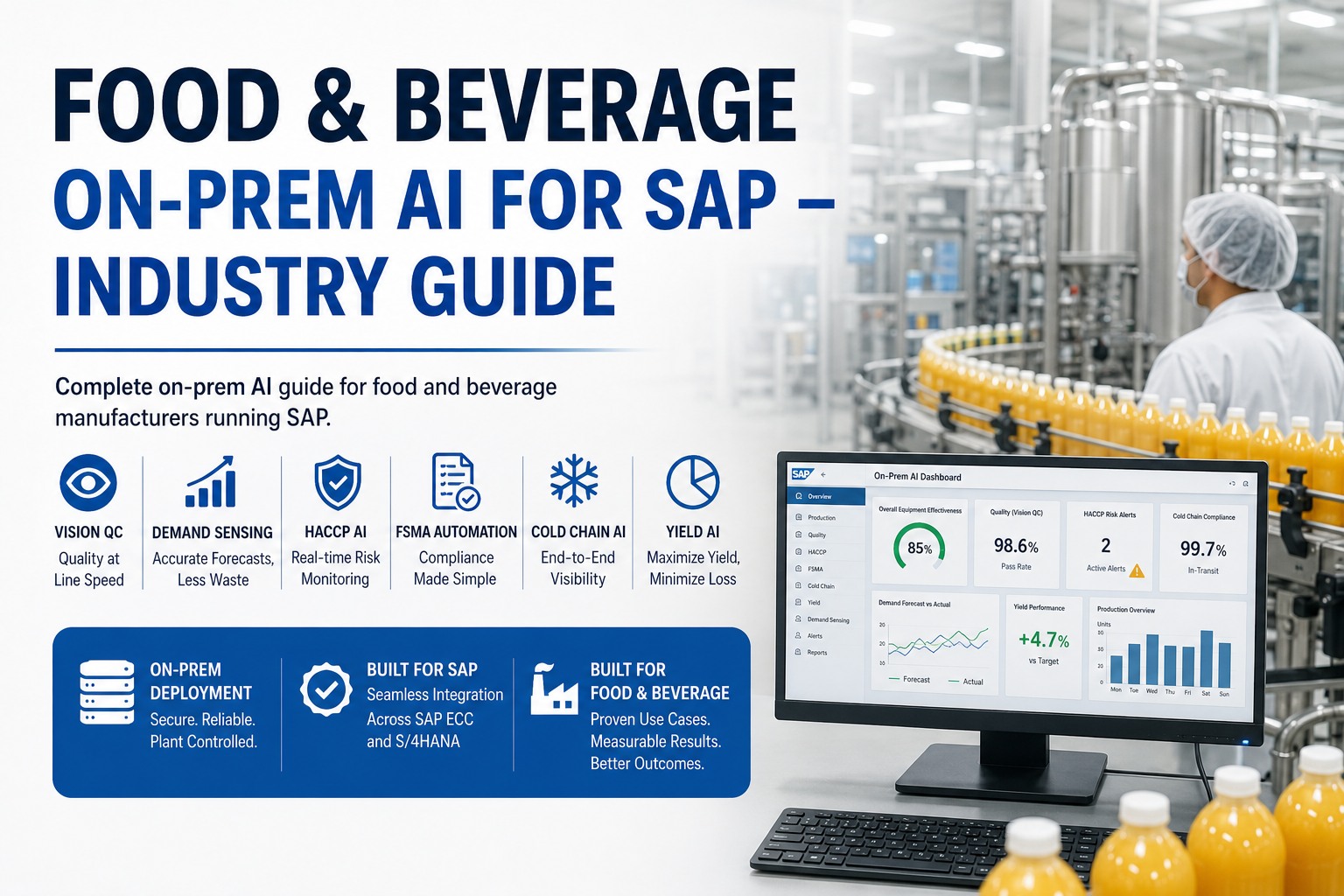
Food and beverage is the world's largest manufacturing sector by revenue — and the one with the tightest tolerances for what AI is allowed to touch. Recipe IP, supplier pricing, batch genealogy, and consumer-facing brand records cannot live in someone else's cloud. This guide is the working operator's plan for layering on-prem AI on top of SAP ECC or S/4HANA in a real F&B plant — vision QC on the line, demand sensing tied to POS, HACCP critical-control-point automation, FSMA 204 sub-2-hour traceback, recipe yield optimization, and cold chain monitoring end to end. Production-tested across dairy, bakery, beverage, meat and poultry, snacks, and frozen foods deployments.
Food and Beverage On-Prem AI for SAP — Complete Industry Guide
Vision QC on the line, demand sensing tied to POS, HACCP critical-control-point automation, FSMA 204 sub-2-hour traceback, recipe yield optimization, and cold chain monitoring end-to-end. All grounded in your SAP. All on-premise. All sovereign.
What You Get — Turnkey F&B Package
Hardware, software, F&B-specific connector library, regulatory playbooks, training, and 24×7 support — all pre-configured for food and beverage operations and shipped racked.
Hardware
NVIDIA DGX, food-grade IP65 vision modules, sensor mesh — pre-racked.
F&B Connectors
SAP QM, PP, MM, SD, EWM connectors plus HACCP & FSMA traceability schema.
Regulatory Playbooks
HACCP CCP runbooks, FSMA 204 traceback procedures, allergen control, recall drills.
Support
24×7 monitoring, audit support, regulatory update tracking, SLA-backed uptime.
Why On-Prem AI Is Different in Food & Beverage
F&B is the world's largest manufacturing sector — and the one with the highest cost of getting AI wrong. Recipe IP, supplier pricing, batch genealogy, consumer-facing brand records. None of it belongs in someone else's cloud. The numbers below frame the stakes.
Six F&B Sub-Verticals — One Connector Layer
Different sub-verticals have different bottlenecks. Dairy fights spoilage and CIP cycles. Bakery fights moisture and consistency. Beverage fights carbonation and fill accuracy. Meat fights microbial control and chilling. iFactory ships pre-built playbooks for all six.
Dairy
Spoilage · CIP · Cold chain
UHT processing, CIP cycle optimization, microbial PCR signal modeling, raw milk silo monitoring, plant-condition checks.
Bakery
Moisture · Consistency · Allergens
Dough rheology prediction, oven profile control, moisture vision QC, allergen lane separation, label verification.
Beverage
Fill · Carbonation · Labeling
Fill-level vision QC, carbonation control, label tilt detection, seal integrity, foreign-object exclusion on the filler.
Meat & Poultry
Microbial · Chilling · Trim
Chiller temp curve monitoring, primal cut yield vision, microbial-risk timing, USDA traceability, gas mix QM in MAP packs.
Snacks & Confectionery
Coating · Seasoning · Texture
Coating uniformity, seasoning weight control, fry-oil quality, breakage rates, gram-weight variance, allergen cross-contact.
Frozen Foods
Cold chain · Freezer load · IQF
Freezer tunnel residence time, IQF airflow, blast-chill curve, frost-build de-ice prediction, pallet aggregation.
Where AI Touches an F&B Production Line
Every line has the same shape — ingredients in, finished pallets out. The diagram below maps the six stages every F&B plant runs and where the iFactory AI brain sits at each one.
Supplier QC AI scans inbound trucks; SAP MM batch attributes verified; allergen segregation enforced; cold chain on receipt.
Recipe compliance verified against SAP PP master recipe; deviation alerts; CIP cycle effectiveness from sensor data.
Vision QC on shape, size, count; oven/cook-zone temperature curves; HACCP CCP auto-monitoring with timestamp evidence.
Chill curve adherence vs spec; freezer tunnel residence time; AI predicts chiller-fault probability before excursion.
Fill weight check, seal integrity vision, label verification (allergen + best-before), case aggregation to SAP EWM.
Pallet build, refrigerated truck temp pre-cool, FSMA 204 KDE/CTE capture, demand-driven loading from SAP SD.
Compliance Built In — Not Bolted On
Every regulated F&B plant lives inside a stack of frameworks. iFactory's data model maps directly to each one — meaning the same connector ships HACCP evidence, FSMA 204 KDE/CTE capture, SQF/BRC audit packs, and FDA 21 CFR 117 documentation simultaneously.
HACCP
7 principles · CCP automation · timestamp evidence on every critical limit
FSMA 204
KDE/CTE capture · sub-2hr traceback · FTL traceback ready · Jan-2026 deadline
SQF
Edition 9 module mapping · automated audit prep · score gap analysis
BRCGS
Issue 9 alignment · unannounced audit readiness · root-cause logs
FDA 21 CFR 117
Preventive controls · hazard analysis · supplier verification records
ISO 22000
PRP/oPRP/CCP framework · global food-safety management · audit traces
Six AI Playbooks Shipped for Food & Beverage
Every iFactory F&B deployment activates these six use cases by default. Each one is a playbook — model, SAP integration points, data sources, expected outcome, and operator workflow already wired.
Vision Quality Control
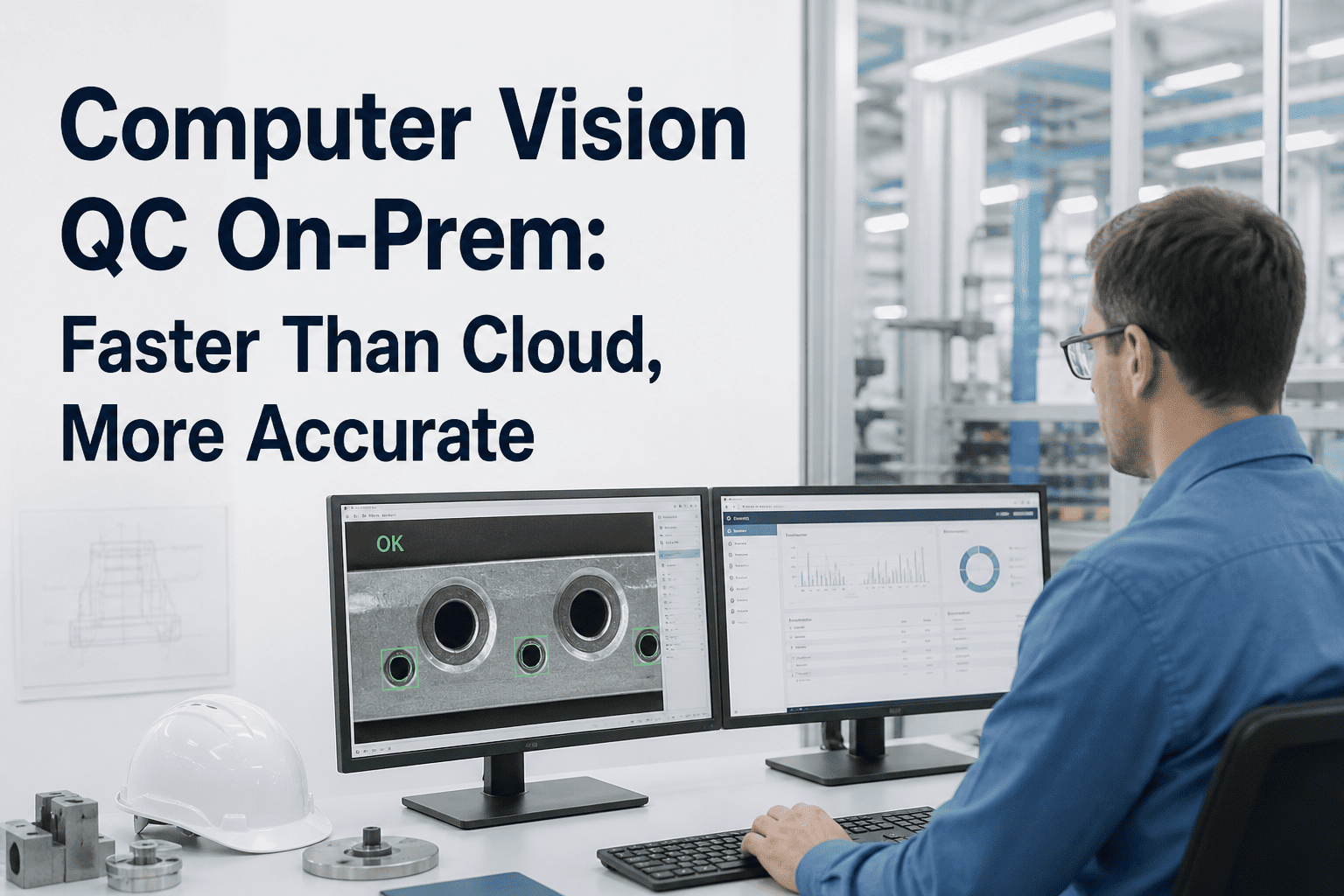
Pre-trained models for foreign-object detection, fill-level variance, seal integrity, label tilt, color drift, and gross particulate. Confidence above 95% auto-rejects with a posted SAP QM usage decision and annotated image attached.
Demand Sensing
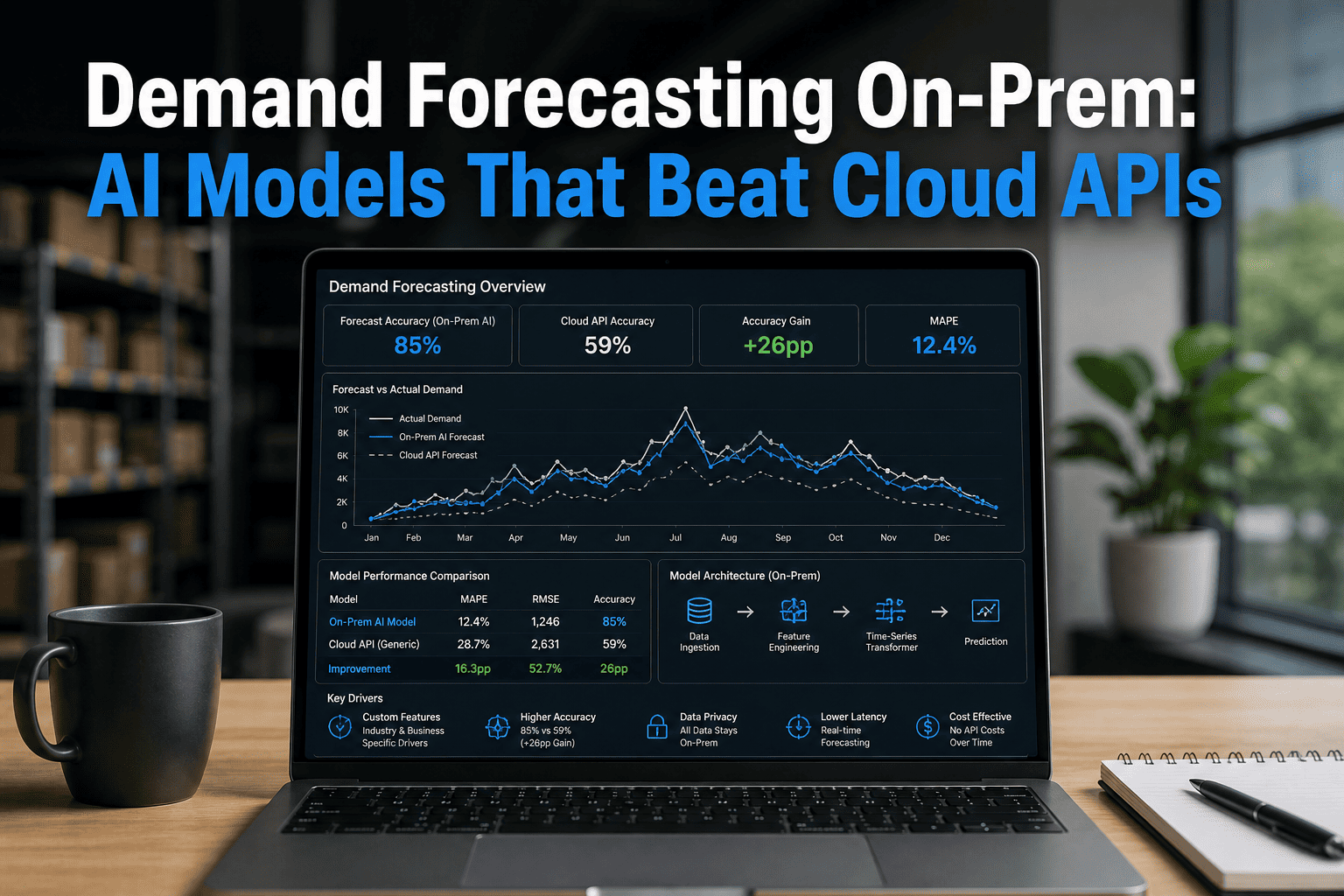
Time-series models on retailer POS data, weather, promotions, and shipment depletion. Feeds revised forecasts into SAP SD and PP for short-cycle production rebalancing — ahead of the next shift, not next week.
HACCP CCP Automation
Continuous monitoring of every critical control point — cook temp, chill curve, metal detector, pH, water activity. Auto-flagged deviations create SAP QM Q-notifications with full sensor evidence packaged for the food safety team.
FSMA 204 Traceability
Key Data Elements and Critical Tracking Events captured at receiving, transformation, and shipping. Sub-2-hour traceback for any batch/lot tied to SAP MCH1 batch master. Compliant by January 20, 2026 deadline.
Recipe Yield Optimization
Detects yield drift across batches running the same SAP master recipe. Correlates against raw material lot, equipment state, operator, and ambient conditions. Recommends recipe-parameter tweaks within HACCP limits.
Cold Chain Monitoring
Continuous temperature monitoring from raw-material receipt to truck-loading dock. Anomaly detection on chillers, freezers, and reefer-pre-cool. Pre-emptive SAP work orders before excursion compromises shelf life.
Four Temperature Zones — Continuously Watched
Every F&B plant runs four distinct temperature regimes. iFactory's sensor mesh and AI brain monitor each zone against its spec range, flagging drift before it becomes excursion.
Long-term frozen storage
IQF tunnels, frozen pallet stores, distribution freezers. AI watches frost build-up, defrost cycle adherence, and door-open events that warm zones.
Fresh storage & chilling
Dairy holds, cured meat chillers, RTE storage. AI tracks chill-curve adherence, predicts compressor failure 5–7 days ahead.
Tempered processing
Wine cellars, chocolate tempering, certain confectionery. AI monitors heat-input vs cooling-load balance, alerts on drift.
Dry goods & ingredients
Flour, sugar, dry mixes, packaging. AI watches humidity (RH) along with temp to prevent caking and pest activity.
Six Defect Types Vision Catches Before They Ship
The catalog below is what an iFactory vision QC pipeline catches on a typical F&B line. Every catch creates a SAP QM usage decision with the annotated image attached as DMS evidence.
Foreign Object
Metal, plastic, glass, hair, packaging fragment. The category that drives most Class I recalls. Vision plus metal-detector fusion.
Fill Underweight / Overweight
Net-weight variance outside SAP QM characteristic spec. Continuous statistical control with auto-trigger on 3-sigma drift.
Label Misalignment
Tilt, fold, smudge, missing best-before date, missing allergen statement. Regulatory hazard — catches before pallet aggregation.
Seal Integrity
Heat-seal voids, leaker risk, contamination in seal area. Vision + leak-test fusion. Critical for MAP and aseptic.
Color / Shade Drift
Bake-color drift, fry-oil aging signals, syrup color in beverage. Predicts process variance ahead of consumer-detectable change.
Particulate Inclusion
Wrong-size particulate, missing inclusion (e.g. nuts in nutty bars), inclusion at wrong density. Recipe compliance check.
- GPU NVIDIA RTX PRO 6000 Blackwell · 96 GB
- CPU AMD Ryzen 9 9900X · 12 cores
- RAM 128 GB DDR5 · 6000 MHz
- Storage 2 TB NVMe M.2 SSD
- Power 1000 W · 80+ Gold
The main AI brain most mid-sized plants use. Runs the full operator copilot, vision QC, predictive maintenance, and digital twin all together. About the size of Meta's Llama 3 70B — the same family of models that powers many enterprise chat assistants.
- Module NVIDIA Jetson AGX Orin
- CPU 12-core ARM Cortex-A78AE
- GPU 2048-core Ampere + 2× DLA
- RAM 64 GB unified LPDDR5
- Network OPC-UA · EtherNet/IP native
An edge brain that sits right next to the machine. Talks to the PLC (the controller running motors, valves, conveyors), processes sensor data in under a second, and sends results to the main AI brain. One unit per line, ruggedized for plant-floor conditions.
- Module NVIDIA Jetson AGX Orin
- Decoder NVDEC hardware video engine
- Codecs H.264 · H.265 · AV1
- Streams 8–16 simultaneous RTSP feeds
- AI CNN / vision models on DLA engines
Watches up to 16 cameras at once. Catches defects, foreign objects, label problems, and safety hazards in real-time. Video never leaves the plant — the AI runs right where the cameras are.
- GPUs 72× NVIDIA Blackwell Ultra (B300)
- CPUs 36× NVIDIA Grace · 72 Arm cores each
- Memory ~20 TB HBM3e pool
- Fabric NVLink Gen6 · 1.8 TB/s GPU-to-GPU
- Compute ~1.4 ExaFLOPS FP4 inference · liquid-cooled
The flagship option — a small data centre in one rack. Big enough to run an entire global manufacturer's AI from one location. Used when a plant needs cross-site digital twin, generative AI for engineers, real-time process optimization across hundreds of lines, all at the same time.
The Recall Drill — From Question to Traceback in Minutes
A quality director runs an unannounced recall drill. The conversation below is what the iFactory copilot returns — grounded in SAP batch master, sensor history, and FSMA 204 KDE/CTE data.
· Produced Line 2 · shift A · 14-Apr · 04:18–11:42
· Raw materials — flour lot F-4471 (supplier 100847), sugar lot S-2298, palm shortening lot P-1108
· Distributed to 4 DCs, 47 retail SKUs, 12,847 cases
· FSMA 204 KDE/CTE complete · all critical control points within HACCP limits · no excursion
· Audit pack assembled · Q-notification 500001284 attached · ready for FDA submission within drill SLA
From Kickoff to Live AI on the F&B Line — 12 Weeks
Same 8–12 week shape as every iFactory deployment, with F&B-specific milestones — HACCP CCP wiring, FSMA 204 graph build, vision-camera commissioning on hygienic lines.
- DGX delivered, racked, network and PLC integration started
- F&B plant survey — CCP locations, sensor coverage, hygienic zoning
- SAP service users, MCH1 batch master read paths, EWM cold-chain feed live
- Vision cameras installed on chosen lines, IP65 enclosures certified
- Vision models trained on plant images, defect catalog calibrated
- Demand model trained on POS and historical SAP SD data
- HACCP CCP automation pilot on one line, with food-safety sign-off
- FSMA 204 graph build · KDE/CTE capture validated
- Plant-wide rollout, all lines, all CCPs monitored
- First unannounced recall drill — sub-2hr target hit
- Operator, supervisor, QA & food-safety training delivered
- 24×7 monitoring active, SLA live, audit pack ready
What F&B Plants Measure After Go-Live
Numbers below are aggregated across F&B deployments running iFactory on SAP — covering dairy, bakery, beverage, meat & poultry, snacks, and frozen foods.
See F&B AI running on SAP at Sapphire 2026
Live demo — vision QC on a line, FSMA 204 traceback drill, cold-chain anomaly alerting, demand sensing pulling from SAP SD. Book a 20-minute walkthrough.
Frequently Asked Questions
Do I need to buy NVIDIA servers separately?
No. Fully-loaded NVIDIA DGX AI servers are supplied and installed as part of the iFactory package — including the food-grade IP65 vision modules and the sensor mesh. They ship pre-racked, pre-cabled, with all NeMo, RAPIDS, NIM, and Agent Toolkit components pre-installed alongside the F&B connector library and HACCP/FSMA playbooks. You provide power and Ethernet. We provide the rest.
How does iFactory help with FSMA 204 compliance?
iFactory captures the Key Data Elements (KDEs) and Critical Tracking Events (CTEs) required by FSMA Rule 204 at receiving, transformation, and shipping — tied directly to SAP batch master MCH1 and EWM handling units. Traceback queries run against a purpose-built graph database and return results in under 2 hours, comfortably inside the FSMA SLA. The system is compliance-ready for the January 20, 2026 enforcement date.
Are the vision cameras food-grade?
Yes. IP65-rated stainless-steel housings are standard. IP69K and washdown-rated enclosures are available for hygienic and high-pressure cleaning zones. Optical glass is FDA-compliant materials of construction. All wiring is sanitary-rated. iFactory ships the camera bracket designs along with a sanitary-zoning plan reviewed by your food safety team.
Does the AI ever stop production by itself?
Only on safety-critical detections that are explicitly authorized — foreign object metal-detector confirmation, sealed-pouch leaker beyond threshold, HACCP critical limit breach. Everything else creates a SAP QM notification and routes to the human operator for decision. Boundaries are agreed during deployment with your food safety team and recorded in the runbook.
How does demand sensing handle promotions and seasonality?
The time-series models ingest promotion calendar data, weather forecasts, school-holiday signals, and historical seasonality patterns. They handle event-driven demand spikes (Thanksgiving turkey, summer ice cream) separately from baseline trend. Forecasts feed SAP SD for short-cycle revisions and SAP PP for production rebalancing — typically a 24–48 hour planning loop, not the weekly batch most ERPs run.
Does it work with co-manufacturer (co-man) plants?
Yes. iFactory supports multi-tenant plant configurations where one site runs several brand-owners' SKUs. Data segregation is enforced at the SAP authorization level — co-man operations team sees their lines, brand owners see only their SKUs and batches. Common for private-label dairy, bakery, and contract beverage plants.
Can the system work in air-gapped plants?
Yes. The full F&B AI stack runs entirely offline — vision QC, demand sensing (against historical baseline only), HACCP, FSMA capture, cold chain, yield. Air-gap is the required posture for some defense-rationed and aseptic-pharmaceutical-adjacent food plants. Demand sensing benefits from external POS data when available but is not dependent on it.
How does this compare to SAP Joule for F&B?
SAP Joule is cloud-only and does not ship vision QC, HACCP CCP automation, FSMA 204 KDE/CTE capture, or cold chain anomaly detection. For F&B plants where recipe IP and supplier pricing must stay on-prem and where regulatory deadlines like FSMA 204 are hard constraints, iFactory is the operational layer; Joule can coexist for enterprise-wide office tasks.
Ship Safer Food, Faster Tracebacks, Higher Yields
The F&B-specific iFactory package — vision QC, demand sensing, HACCP automation, FSMA 204 traceability, recipe yield optimization, cold chain monitoring. Live on your SAP plant in 8–12 weeks. Sovereign, on-prem, audit-ready.