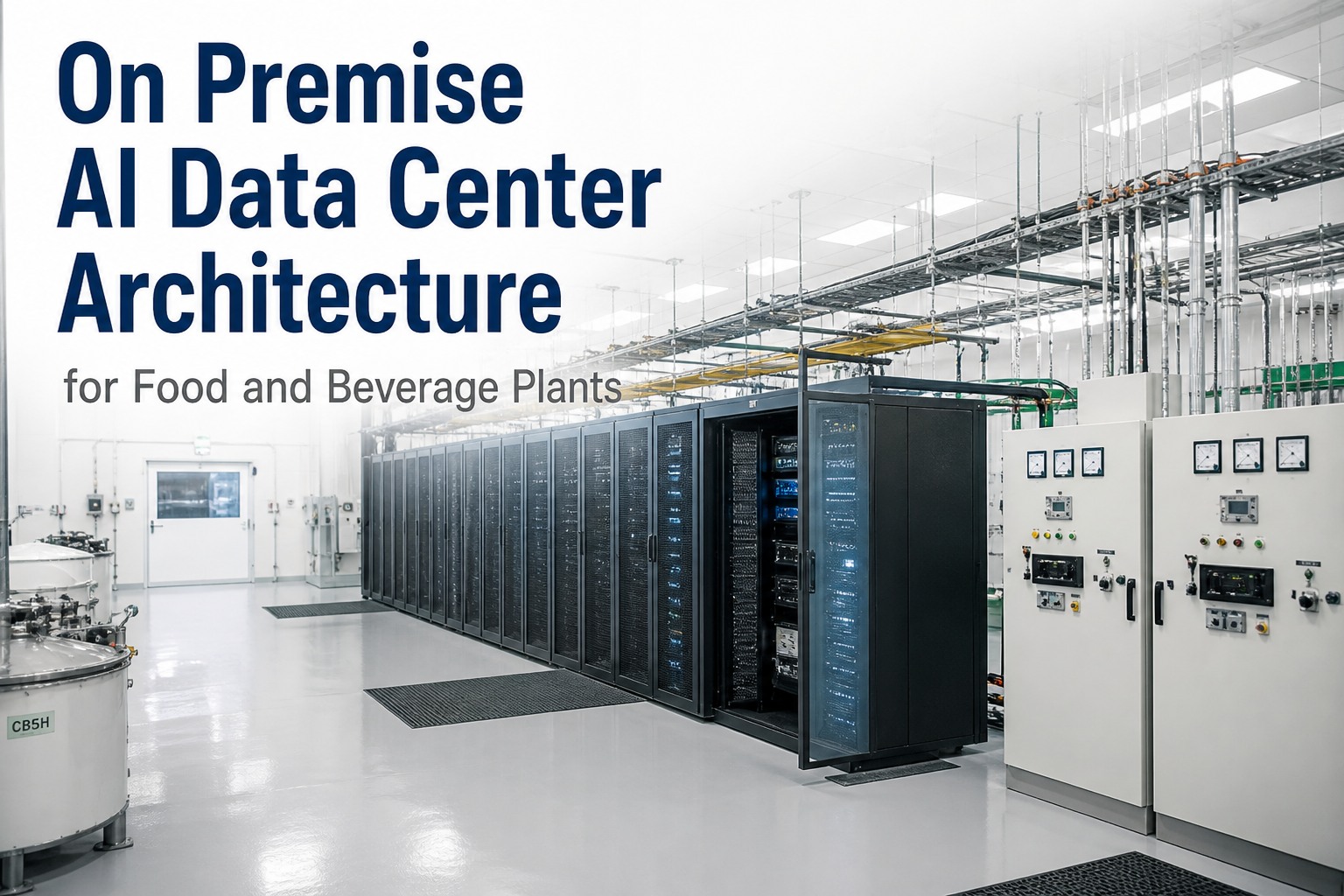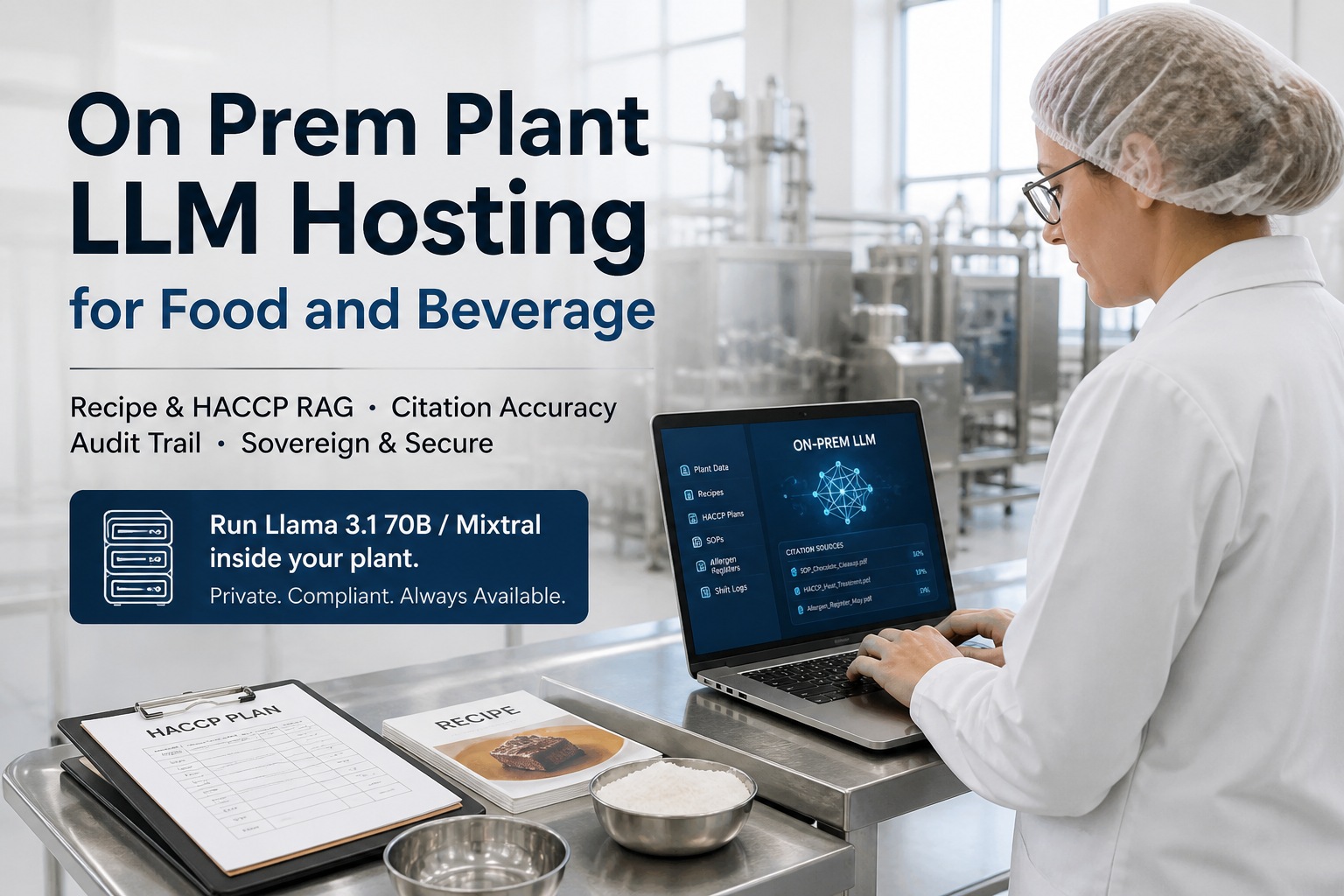
A QA technician asks: "Why did Line 3 fail the allergen swab test on Tuesday's chocolate run?" In a typical food and beverage plant, that answer is buried across 50,000 PDFs of SOPs, last quarter's HACCP plans, the recipe master, allergen registers, and three years of shift logs. Cloud LLMs can't touch that data — recipe IP and supplier formulas leave the building the moment you upload them. The answer is an on-premise plant LLM: Llama 3.1 70B or Mixtral 8x22B running on GB300 NVL72, fine-tuned with LoRA on your plant's documents, with RAG retrieving exact citations from your recipe master and HACCP plans, and hallucination guardrails that force the model to answer "I don't know" rather than invent a fact. This guide breaks down model selection, LoRA targets, the RAG pipeline, citation verification, hallucination defenses, and the audit trail that keeps the system regulator-ready.
On-Prem Plant LLM for Food & Beverage
Join the iFactory team for a live walkthrough of hosting Llama 3.1 70B and Mixtral inside the plant — fine-tuned on SOPs, recipes, HACCP plans, allergen registers and shift logs with end-to-end citation accuracy, hallucination guardrails, and a full audit trail. Built on GB300 NVL72, validated across 1,000+ enterprise deployments.
Five Reasons F&B Plants Run LLMs On-Prem — Not in the Cloud
A plant LLM lives inside the firewall for reasons that are not negotiable: recipe IP, allergen confidentiality, regulatory residency, and inference cost at sustained query volume. Book a 30-minute call with our LLM engineers to walk through your specific data residency constraints.
Recipes are decades of trade-secret R&D. Uploading them to a public LLM endpoint is a one-way IP transfer. On-prem keeps every gram, every step, every supplier code inside the plant.
HACCP plans expose your CCPs and allergen-control weak points. Combined with shift logs, they're a roadmap for adversaries. On-prem hosting keeps regulator-grade docs out of third-party retention.
EU, India, Brazil, and growing US state laws require domestic data residency for production records. An on-prem LLM trivially satisfies any residency clause — there is no cross-border transfer to debate.
30+ users per shift × 4 shifts × multiple plants = ~30,000 LLM queries/day. On-prem inference on GB300 hits 100–300 ms per query. Cloud round-trips to a hyperscaler region break that budget on every hop.
Cloud LLMs bill per token, every shift, forever. On-prem is a one-time capex that amortizes across 3–5 years. At sustained plant query volumes, total cost-of-ownership flips on-prem inside year one.
Llama 3.1 70B vs Mixtral 8x22B vs Llama 3.3 70B — Pick the Right Foundation
Three serious open-weight contenders for a plant LLM. Llama 3.1 70B is the long-context workhorse. Mixtral 8x22B is the Apache 2.0-licensed MoE that runs at 7B-class speed for 70B-class quality. Llama 3.3 70B is the upgrade path with 40% lower hallucination rate per Meta benchmarks.
The proven enterprise default. Long 128K context lets you stuff entire HACCP plans into a single prompt. Largest tooling ecosystem, easiest LoRA path. Pick this when you want a known-good baseline.
Mixture-of-Experts means only ~39B parameters activate per token, giving 70B-class quality at near-7B inference speed. Apache 2.0 license has zero restrictions — the safest legal choice for global F&B deployments.
The 3.1 → 3.3 drop-in upgrade. Roughly 40% lower hallucination rate per Meta benchmarks. Better at acknowledging "I don't know" — exactly the behavior you want around HACCP and CCP queries. Plan as the future state.
How a Plant Question Becomes a Cited Answer — The RAG Pipeline
A plant LLM is not just a model. It's an eight-stage pipeline that converts a QA technician's question into a citation-grounded answer. Each stage has its own job; skipping any one of them is where hallucination sneaks in.
SOPs, recipes, HACCP plans, allergen registers, COAs, shift logs — every plant document, versioned and source-tagged.
Split docs into evidence-coherent chunks (300–500 tokens). Recipe sections, HACCP CCPs, and shift entries each become retrievable units.
BAAI/bge-large-en-v1.5 converts each chunk to a 1024-dim vector. Embedding model runs on GB300, never leaves the plant.
Hybrid index: dense vectors for semantic match, BM25 for exact terms (lot codes, supplier IDs). Both run side-by-side per query.
Top-50 candidates from hybrid search, re-ranked to top-8 by a cross-encoder. Re-ranking is the single biggest accuracy lever.
Top-8 chunks + system prompt + user question → fine-tuned LLM. Temperature 0.0–0.3 for factual answers, never higher for HACCP queries.
Every claim in the response is span-checked against the retrieved chunks. Unsupported claims trigger a rewrite or "I don't know."
Answer + inline citations + audit log entry. The user clicks any citation and lands on the exact source paragraph in the source doc.
What to LoRA-Fine-Tune on — Five Document Classes That Move the Needle
LoRA adapters fine-tune only 0.1–1% of the model's parameters at low computational cost. The art is choosing what to fine-tune on. These five document classes are the ones that consistently improve plant LLM accuracy in production.
Teach the model the plant's procedural voice. Step verbs, safety-cue language ("STOP if...", "DO NOT proceed unless..."), and operator-readable phrasing. Output stays in your house style.
Recipe master data shape, ingredient codes, % composition rules, allergen flags, scale-up coefficients. The model learns to read recipe headers and respect the recipe-edit chain of approvals.
HACCP plan structure, CCP identification language, monitoring frequencies, deviation responses. Critical for the model to never invent a CCP — only cite what the validated plan says.
Allergen-by-line matrices, cross-contact rules, changeover-validation language. The model learns the difference between "allergen present" and "allergen-control point" — and never confuses them.
Three years of shift logs is the most valuable training corpus you have. The model learns the plant's failure language, the way operators describe anomalies, and the vocabulary of root-cause notes — so it answers in the same voice the team writes in.
How Every Answer Gets a Verifiable Source Span
A plant LLM that gives an answer without a citation is useless. The citation pipeline ensures every factual claim points to a specific source-document paragraph — not a vague reference, not a doc title, but the exact span the model used.
Every retrieved chunk carries metadata: doc ID, version, page, paragraph, character offsets. Nothing is anonymous.
The system prompt tells the LLM to mark each claim with [chunk_id]. The model is rewarded during training for citing, penalized for skipping.
Every claim is checked: does the cited chunk actually contain support for this statement? An NLI model scores the entailment.
Verified claims appear with clickable citations. Unsupported claims are stripped or replaced with "I don't have a source for that."
The Five Layers of Hallucination Defense
No single guardrail eliminates hallucination. The defense is layered — each layer catches what the previous one missed. RAG alone reduces unsupported statements by ~60% per medical-QA studies; layering takes that further.
Chunks are evidence-coherent, not arbitrary. A CCP plus its monitoring procedure stays in one chunk so the model never sees half a control point.
Cross-encoder re-ranks the top-50 retrieved candidates to top-8. Drops near-misses that would have led the model to confidently hallucinate.
Every claim's NLI entailment score against its cited chunk has to clear a threshold. Sub-threshold claims get rewritten or removed.
Temperature locked at 0.0–0.3 for factual answers. No creative sampling on HACCP, allergen, or CCP queries — ever.
The fine-tune corpus includes negative examples that teach the model to refuse rather than fabricate. A confident "I don't have a source" beats a confident wrong answer in audit.
What Gets Logged Per Query — The Audit Spine
A plant LLM lives or dies by its audit log. When the FDA, BRC, or SQF auditor asks "how did this answer get produced?" you need a deterministic replay of every step. Talk to our support team for an audit-log spec review of your stack.
What Goes Into the Plant LLM Knowledge Base
The knowledge base is what the LLM retrieves from. Document scope decides answer quality more than model size does. Here's the typical scope for a single plant.
| Document Class | Typical Volume | Update Frequency | Chunk Strategy | Sensitivity |
|---|---|---|---|---|
| SOPs & Work Instructions | 500–2,000 | Quarterly | Procedural section | Medium |
| Recipes & Formulas | 200–800 | Per recipe change | Header + ingredient block | High (IP) |
| HACCP Plans | 10–50 | Annual + on change | Per CCP | High (regulatory) |
| Allergen Registers | 20–100 | Per supplier change | Allergen + line matrix | High (IP + regulatory) |
| Supplier COAs | 10,000+/yr | Per shipment | Per COA + per spec | Medium |
| Shift Logs | ~1,000/day | Continuous | Per shift entry | Medium |
| Deviation / NC Records | 50–200/month | Per event | Per record + linked CAPA | High (audit) |
| Equipment Manuals | 100–400 | On install | Per section | Low |
The 12-Week Plant LLM Rollout
A plant LLM is a coordinated infrastructure, data, model, and audit project. Twelve weeks is realistic with GB300 NVL72 already racked, document scope agreed, and QA stakeholders engaged from week one.
What F&B Plant Teams Ask Before Hosting an LLM On-Prem
These come up in every on-prem LLM scoping call. Reach out to our support team for tailored answers on your data and stack.
Not when wired properly. Five layers of defense — semantic chunking, re-ranking, span verification, temperature lock, and "I don't know" training — get the unsupported-claim rate near zero on factual queries. The model refuses rather than invents.
Almost never for the base model. New documents flow into the RAG knowledge base continuously — that's the point of RAG. LoRA adapters get refreshed annually, or whenever the plant's procedural voice meaningfully changes.
Yes. Every query has a deterministic audit record: input, retrieved chunks, model + adapter ID, system prompt, output, NLI scores, and citations. A regulator can replay any answer end-to-end months later.
No. The model, embeddings, vector DB, retriever, re-ranker, citation verifier, and audit log all run on your GB300 NVL72 inside the plant network. Nothing is uploaded to a cloud LLM endpoint at any stage.
Why F&B Plants Choose iFactory for On-Prem LLM Hosting
A plant LLM is not a developer-laptop demo. It's a production system that QA, regulators, and shift teams rely on daily. Book a deployment-readiness review and we'll model your LLM stack — base model, LoRA targets, RAG pipeline, audit log — before you sign a PO.
Get an On-Prem LLM Plan for Your Plant
Thirty minutes with our LLM engineers. Bring your document inventory, residency constraints, and audit requirements. We'll size the GB300 footprint, recommend Llama vs Mixtral for your use case, scope the LoRA adapters and RAG pipeline, and give you a concrete 12-week rollout plan — before you commit a single dollar to AI hardware.