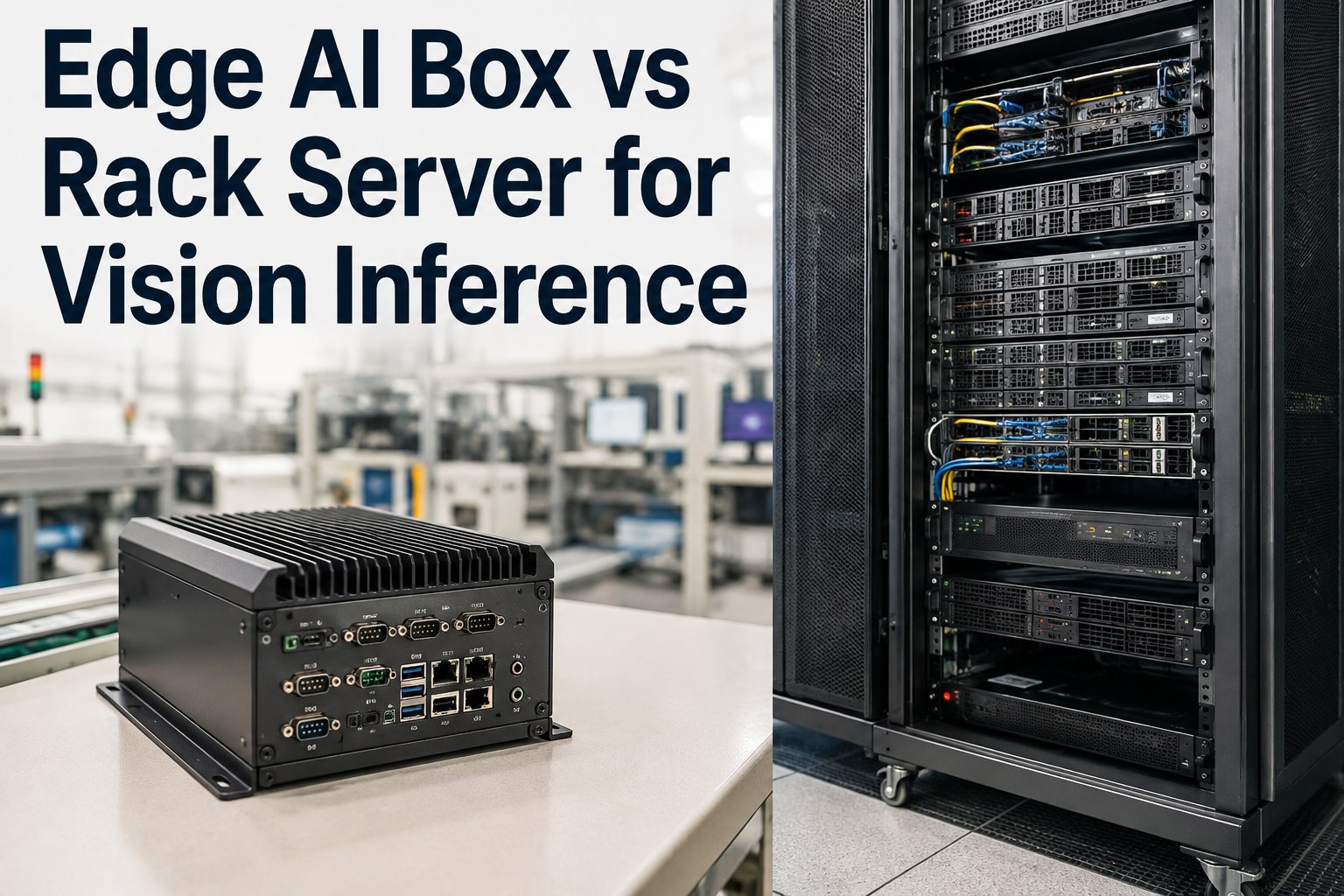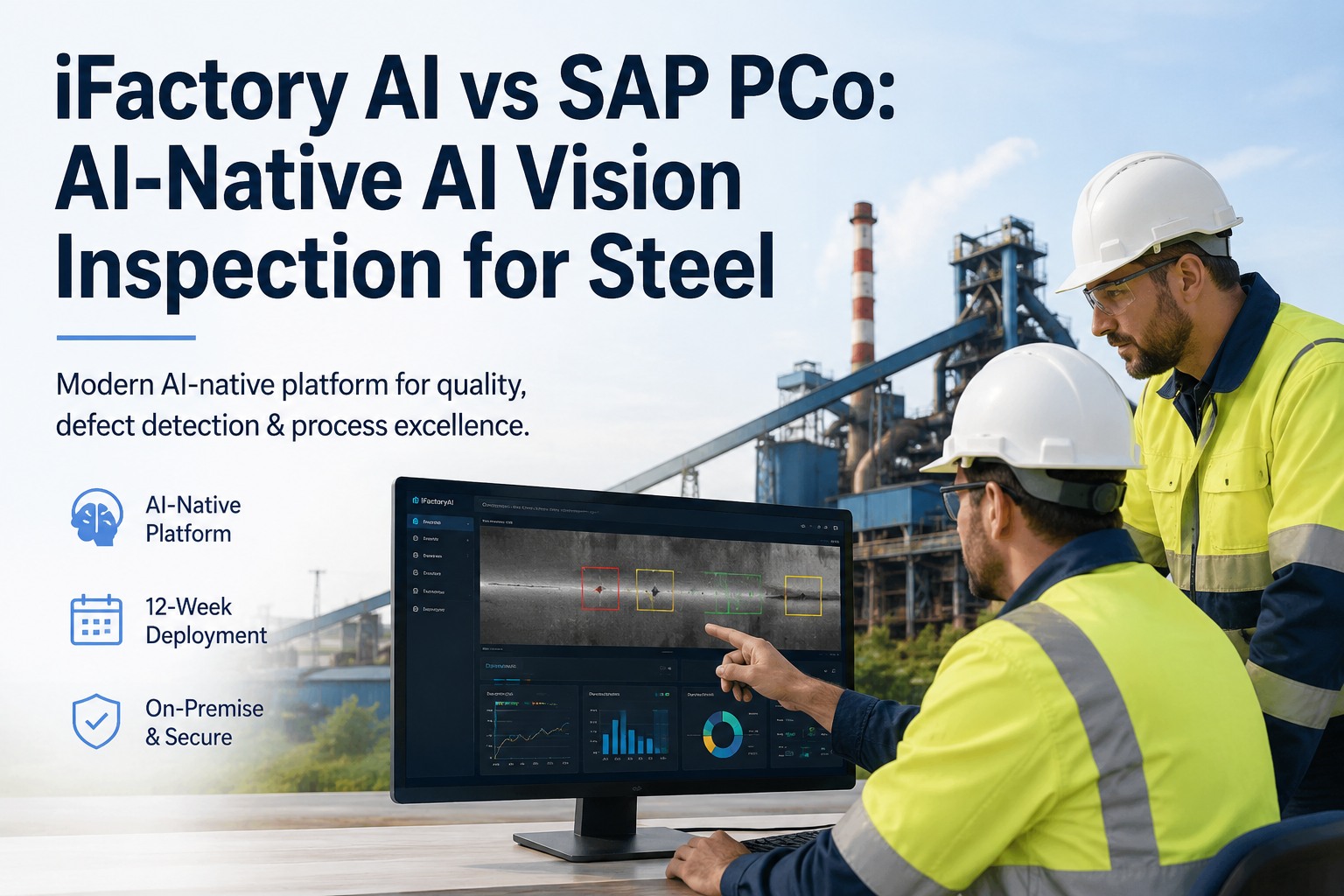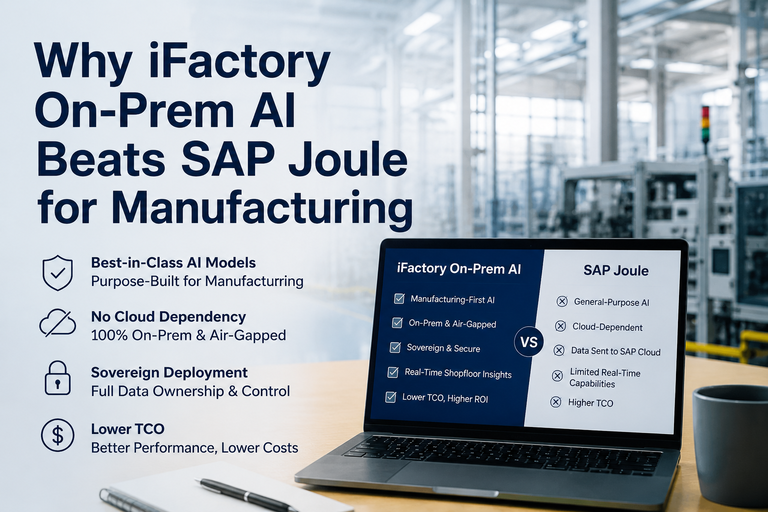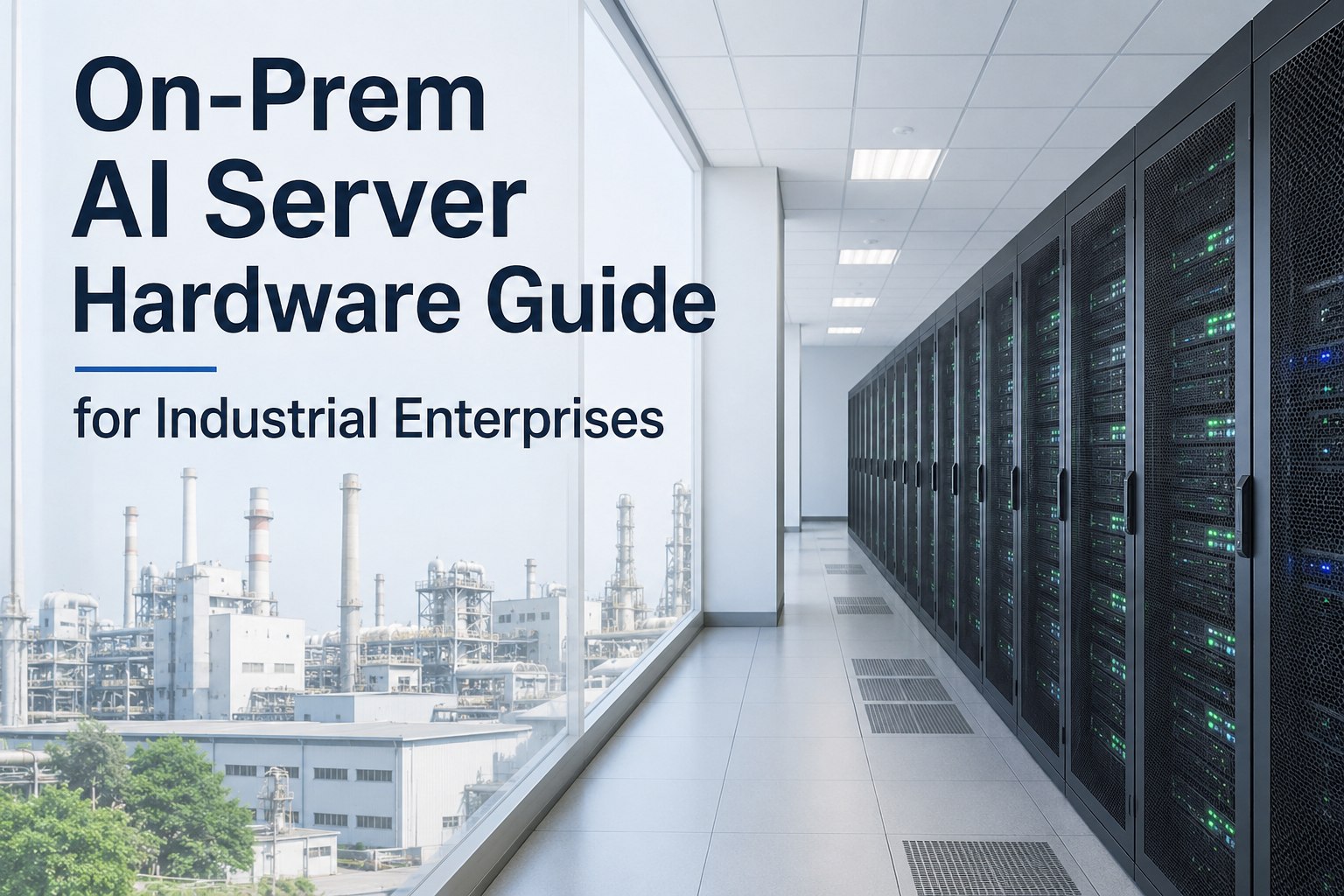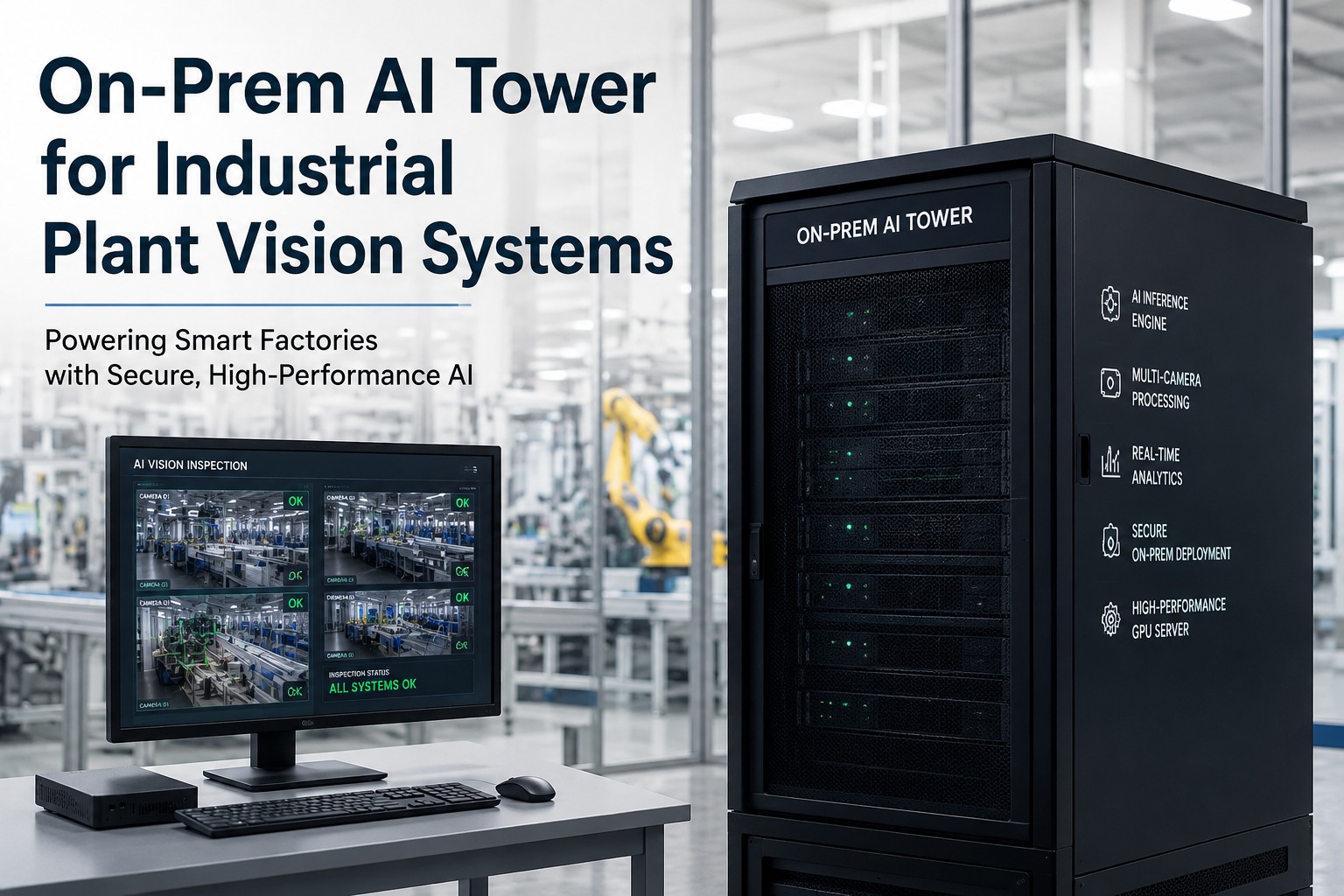
Plant vision systems have a hardware problem that has nothing to do with cameras. The AI models doing the inspecting need serious GPU compute, and where that compute physically lives — and how the images and results move around it — decides whether the system is secure, compliant, and fast enough for a moving line. An on-prem AI tower answers that: a self-contained, GPU-powered appliance that sits inside the plant, runs every inference locally, keeps inspection images and batch genealogy behind your firewall, and connects to cameras and PLCs on the plant network. This guide covers what an on-prem AI tower is, the infrastructure that makes it work — secure networking, data residency, local inference, and managed model updates — and how iFactory delivers it both as an on-premise appliance and as a managed cloud service, so you choose the model that fits each site.
On-Prem AI Tower for Industrial Plant Vision Systems
A self-contained, GPU-powered appliance inside the plant — local inference, secure networking, and full data residency for your vision inspection. Images and genealogy stay behind your firewall; models update under version control; cameras and PLCs connect on the plant network. Delivered on-premise, or as a managed cloud service when that fits better.
What an On-Prem AI Tower Actually Is
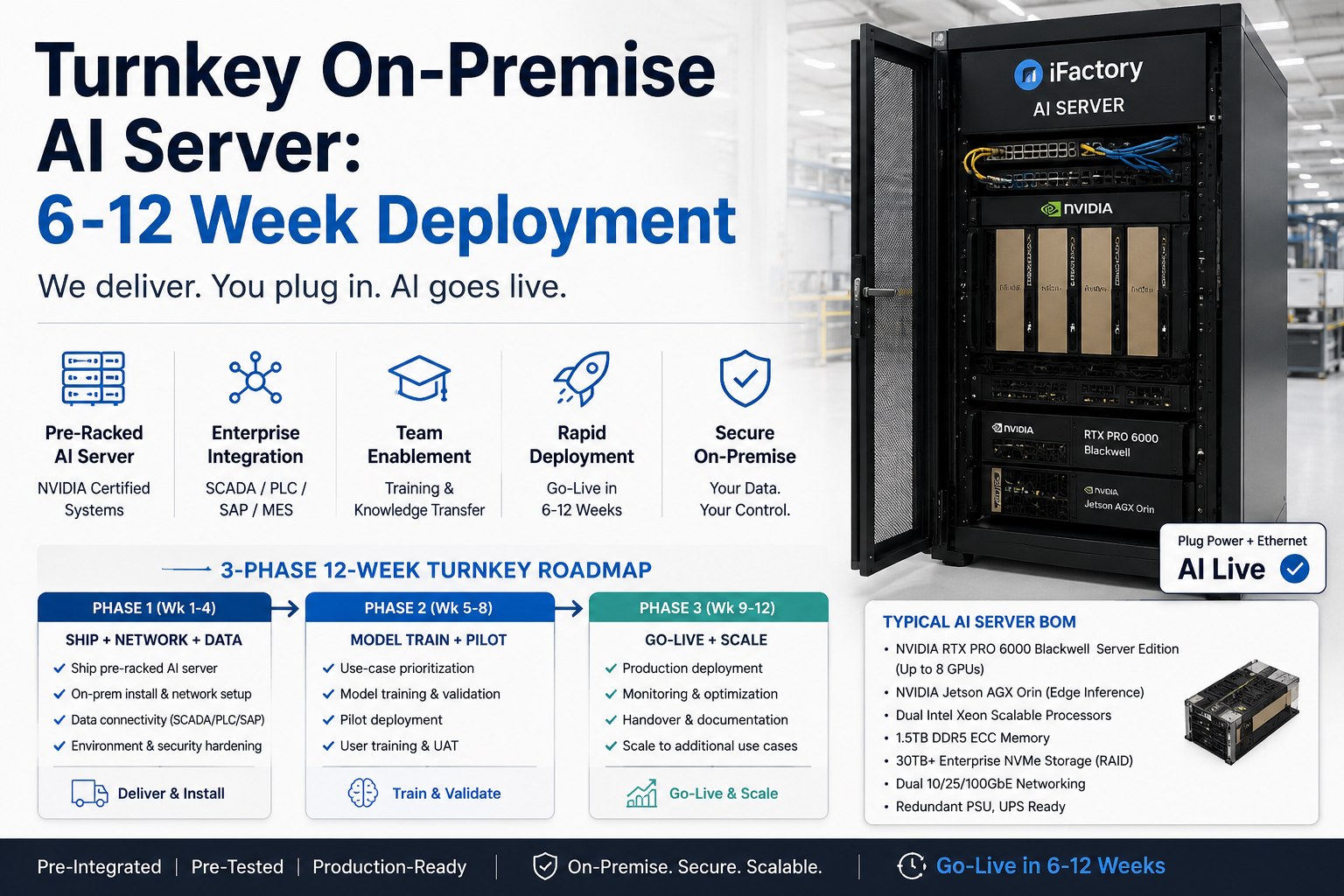
It's not a rack of servers or a cloud subscription — it's a single, self-contained appliance sized for a plant. Inside are the GPU compute, the vision software, and the networking to talk to cameras and PLCs, all pre-configured. It ships racked and ready; you plug in power and network, connect the cameras, and it runs. The whole point is that the intelligence lives where the production does.
GPU compute
Workstation-class GPU for real-time inference across many camera streams.
Vision software
Deep-learning defect models, anomaly detection, and AI SPC pre-loaded.
Secure networking
Segmented plant-network connectivity to cameras, PLCs, and reject gates.
Local storage
Inspection images and results retained on-site for audit and genealogy.
The Four Pillars of On-Prem Vision Infrastructure
An AI tower earns its place by getting four infrastructure concerns right at once — the things that a cloud-only or DIY setup tends to leave as afterthoughts.
Data residency
Inspection images carry batch genealogy and process IP. On the tower they never leave the plant — satisfying residency, export-control, and sovereignty requirements by architecture, not policy.
Local inference
Every pass/reject decision is computed on-site at line latency. No cloud round-trip means no dependence on a WAN link and no lag that could miss a unit on a fast line.
Secure networking
The tower sits on a segmented plant network, talking to cameras and PLCs over standard industrial interfaces while staying isolated from external exposure behind your firewall.
Managed model updates
New and improved models roll out under version control, validated before deployment and reversible — so accuracy improves without risking an unvalidated change on a live line.
Want to see how the tower sits on your plant network without external exposure? Book a 30-minute demo — iFactory will walk through the network architecture, data-residency design, and camera/PLC integration for your site. Sessions available this week.
How the Data Flows — All Inside the Plant
The architecture is what makes the residency and latency guarantees real. Cameras feed the tower, the GPU runs inference locally, reject decisions drive the PLC gates, and every image and result is logged to on-site storage. Nothing in that loop crosses the plant boundary.
Not sure which results you'd want to pass up to SAP or MES versus keep local? Ask iFactory Support with your systems and compliance scope, and the team will map exactly what stays in-fence and what integrates upstream — typically a response within 3 business days, no obligation.
Why On-Prem for Plant Vision
Cloud AI is excellent for many jobs, but plant vision inspection has properties that push toward local infrastructure. These are the reasons manufacturers deploy the tower on the floor.
On-Premise or Cloud — You Choose Per Site
The tower is the on-prem answer, but iFactory delivers the same vision engine as a managed cloud service too — and many manufacturers run a mix. Residency-bound or latency-critical plants get the tower; sites that prefer no on-site hardware and central management get the cloud; multi-site programs often combine both. Same models, same capabilities, deployed where each site needs.
iFactory On-Prem AI Tower For residency, latency, and sovereignty
- Self-contained appliance — GPU, software, networking, pre-configured and racked.
- Images never leave — full data residency behind your firewall.
- Line-latency inference — local, no round-trip, outage-independent.
- Direct camera & PLC wiring — on the segmented plant network.
iFactory Cloud For centrally managed, multi-site vision
- Fully managed — no on-site GPU hardware to maintain.
- Same vision engine — identical defect models, SPC, and analytics.
- Cross-site consistency — one model version rolled out everywhere.
- Elastic scale — add cameras and sites without new local hardware.
Put the AI where the production is — or in the cloud, your call.
An on-prem AI tower gives plant vision what it needs: GPU compute on the floor, secure plant networking, full data residency, local line-latency inference, and version-controlled model updates. iFactory delivers it as a pre-configured appliance inside your fence — or as a managed cloud service when that suits a site better, with the same vision engine either way. ROI proven on one line first.
Frequently Asked Questions
What is an on-prem AI tower?
It's a self-contained, GPU-powered appliance that runs your plant vision system on-site. Inside are the GPU compute, pre-loaded vision software (defect detection, anomaly models, AI SPC), secure plant-network connectivity to cameras and PLCs, and local storage for images and results. It ships racked and ready — plug in power and network, connect cameras, and inference runs locally inside the plant.
Why not just run plant vision in the cloud?
You can — iFactory offers a cloud service too — but plant vision has properties that favor local infrastructure: inspection images carry process IP and genealogy that residency or export-control rules require staying on-site; reject decisions need line latency with no WAN round-trip; the line should keep inspecting through internet outages; and a fixed appliance gives predictable cost versus per-frame cloud metering. Many manufacturers run the tower for those plants and cloud elsewhere.
How does data residency work with the tower?
By architecture, not policy. Cameras feed the tower, the GPU runs inference locally, reject decisions drive PLC gates, and every image and result is logged to on-site storage — none of it crosses the plant boundary. If you want, selected results (pass/reject counts, KPIs) can be passed up to SAP or MES, but the images and raw process data stay in-fence. That satisfies residency, export-control, and sovereignty requirements.
How do model updates work without cloud dependency?
Updates are managed and version-controlled. New or improved models are validated before deployment, rolled out to the tower on your schedule, and are reversible if needed — so inspection accuracy keeps improving without pushing an unvalidated change onto a live line. The tower doesn't need a constant cloud connection to run; updates are a controlled event, not a live dependency.
Does the tower integrate with SAP, MES, or ERP?
Yes, optionally and on your terms. While all inspection images and raw data stay local, the tower can pass selected results upstream — pass/reject counts, quality KPIs, genealogy references — to SAP, MES, or ERP over standard interfaces. You decide what stays in-fence and what integrates, so the tower fits your existing systems without exposing sensitive data.
How do I book a demo or get an infrastructure assessment?
Two routes. For a live walkthrough, schedule a 30-minute demo — it covers the tower architecture, secure networking, data residency, model-update process, and on-prem-vs-cloud choice. For a written infrastructure assessment, contact iFactory Support with your site layout, camera count, and compliance requirements and expect a response within about 3 business days. No obligation either way.
Plant vision that stays in the plant — with cloud when you want it.
The on-prem AI tower puts GPU compute, secure networking, data residency, and local inference on the floor, so your vision system is fast, secure, and outage-independent — with managed, version-controlled model updates. iFactory delivers it as an appliance inside your fence or as a managed cloud service, your choice per site, ROI proven on one line first. The next step is a 30-minute demo mapped to your plant. Sessions available this week.