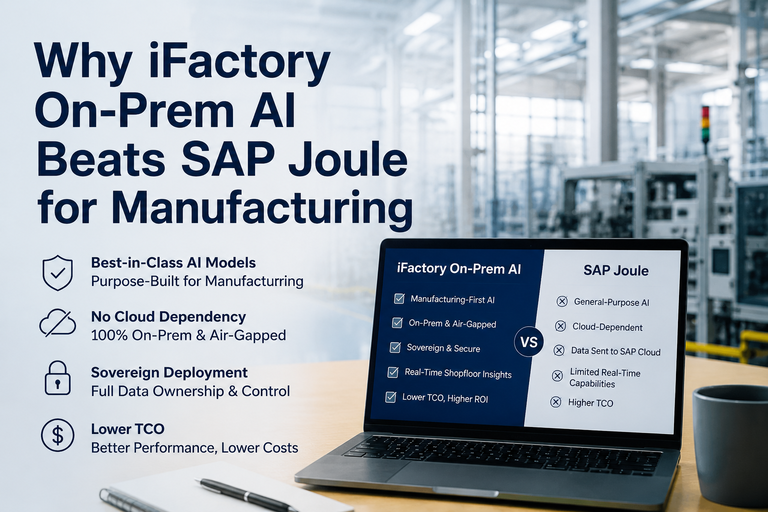
SAP Joule is the AI copilot that lives inside the SAP cloud. For finance, HR, and procurement teams already on RISE — it is a fine assistant. For a manufacturing plant trying to predict a bearing failure, catch a defect on the line, or talk to AI from the shop floor — Joule is the wrong tool. This page is the side-by-side an architect needs to make that call cleanly. Where Joule fits, where it does not, and why an on-prem AI brain built for manufacturing wins on every metric that matters in a factory.
Why iFactory On-Prem AI Beats SAP Joule for Manufacturing
Joule is a brilliant cloud copilot for ERP business users. It is not built to listen to a PLC, look at a camera feed, or run inside a regulated plant with no internet egress. iFactory is. Here is the head-to-head the architect needs.
What Joule Is Good At — And What It Is Not
Before the comparison, the fair picture. Joule is a strong product inside its lane. The trouble starts when SAP and partners stretch it into a plant-floor role it was not designed for.
- Natural-language search inside S/4HANA, Ariba, SuccessFactors
- Auto-drafting POs, finance reports, and HR forms
- ABAP code generation in SAP Build
- Multi-step workflow agents via Joule Studio
- Help-portal search inside Digital Manufacturing apps
- Read raw PLC, OPC UA, or historian tag streams
- Run AI vision on shop-floor cameras for QM
- Operate without internet egress to SAP BTP cloud
- Drive a voice or smart-glasses copilot at the line
- Work with ECC, non-SAP MES, or air-gapped sites
Five Things a Manufacturing Plant Needs From AI — Side-by-Side
Each row below is a real scenario the iFactory team has seen this year at customer plants. Joule's column is filled in honestly from SAP's own documentation. iFactory's column is what ships as standard.
"Predict a bearing failure on Line 3 next week"
No native time-series ingestion from vibration sensors. Joule can query SAP PM work-order history, but cannot consume raw historian tags or run a PdM model. A separate AI Core deployment plus custom skills via Joule Studio is required — and the AI Core inference still runs in BTP cloud.
Vibration, current, and temperature tags ingested live from OPC UA or PI historian. NVIDIA-trained PdM model predicts remaining useful life and auto-drafts a SAP PM notification with parts list — all on the plant DGX, no data leaving the site.
"Catch a label defect on the bottling line in real time"
No vision pipeline. Camera feeds and frame inference are outside Joule's scope. The Joule for SAP Digital Manufacturing capability is a help-portal search assistant — useful for "how do I configure an order", not "is this label crooked".
USB or GigE camera plugged into the DGX. Pre-trained defect models for label, fill, cap, seal, print. Frame-by-frame inference under 80 ms. Rejects pushed to the line PLC, defect images logged to QM with SAP QN auto-created.
"Operator asks AI a question from a noisy shop floor"
Joule is a chat interface inside SAP Fiori. No voice mode on the line. Operators would have to leave the machine, find a terminal, log into Fiori, then type. The user-experience friction kills adoption among floor staff.
Voice copilot on Bluetooth headset or tablet. Push-to-talk in noisy environments. Multilingual. Grounded in live SAP data plus sensor history plus SOP knowledge base. Operator gets the answer hands-free without leaving the machine.
"Site has no internet — pharma cleanroom or defense plant"
Joule runs in SAP BTP cloud. Requires outbound HTTPS to BTP regions. Conversation logs and metadata leave the plant boundary by design. Not deployable in air-gapped, GxP-validated, or sovereign environments. SAP's own answer for on-prem S/4 is "not on the roadmap".
Runs entirely on the plant DGX. Air-gap supported. No outbound calls. GxP and 21 CFR Part 11 ready. Models trained on customer data stay on customer hardware. Sovereign by design — pharma, defense, utilities, regulated chemicals.
"We are on ECC 6.0 — not RISE, not S/4HANA Cloud"
Joule's value depends on cloud SAP. The on-premise S/4HANA path requires SAP BTP, Build Work Zone, Cloud Connector, and identity propagation. ECC is largely outside the Joule envelope. Customers report SAP's response is to migrate to RISE first.
Works with ECC 6.0 EHP4 onward and S/4HANA on-premise or cloud. BAPI, RFC, IDoc, OData out-of-the-box. No BTP dependency. AI deployment proceeds while your S/4HANA migration is on its own timeline.
Where the AI Actually Runs — The Architecture That Decides Everything
The single biggest difference is not features. It is where the inference happens. That choice ripples into latency, sovereignty, cost, and which problems you can actually solve.
AI Units, BTP Surcharges, and What "Included" Actually Means
Joule's pricing reads simple on the slide and reads complex on the invoice. iFactory's reads boring on both. Here is the unfair, accurate breakdown.
- €7 per AI Unit, minimum 100 units per year (€700 floor)
- Variable consumption — token in, token out, prompt size dependent
- Bundle base licensing inside RISE Premium Plus — but heavy usage incurs unit charges
- +BTP AI Foundation subscription separate from Joule itself
- +Effort Cloud Connector, Build Work Zone, IPS, identity propagation setup
- +Custom Joule Studio agents are configurable but require BTP development effort
- Capex NVIDIA DGX hardware, pre-configured, racked, shipped
- Flat annual platform license, no per-token, no per-AI-Unit charges
- Included connector library, PdM models, vision QM models, voice copilot
- Included 24×7 monitoring, model retraining, SLA-backed support
- Optional training and operator playbooks bundled into delivery
- Zero per-prompt charges — operators can talk to AI all day
The Operator Question That Exposes the Gap
A shift supervisor asks the same question to both systems. Joule answers what SAP knows. iFactory answers what the plant knows. Read the difference — it is the whole pitch in one screen.
Capability-by-Capability — Where the Lines Cross
Twelve capabilities a manufacturing AI buyer evaluates. Green is full support, amber is partial or workaround, red is not in the product.
iFactory + Joule — Better Together Than Either Alone
This is not an either-or for every customer. Many plants keep Joule for back-office SAP workflows and add iFactory for the shop floor. The two layers talk through SAP itself.
Back-office SAP workflows
- Finance close acceleration
- Procurement and supplier risk
- HR self-service
- S/4HANA Fiori chat
- SuccessFactors and Ariba
Shop-floor AI brain
- PdM on rotating assets
- Vision QM on lines
- Voice copilot for operators
- Energy and yield optimization
- OEE and downtime root-cause
What You Get — Turnkey iFactory AI Hub
Hardware, software, training, support. Pre-configured, racked, and shipped. Plug power and Ethernet. AI live in 8 to 12 weeks.
Hardware
NVIDIA DGX, pre-racked. Ships ready. No separate server procurement.
Software
Pre-loaded — PdM, vision QM, voice copilot, SAP and historian connectors.
Training
Operator playbooks. Basis runbooks. Plant IT handover docs.
Support
24×7 monitoring. SLA-backed cutover. Model retraining included.
See iFactory and Joule run side-by-side at SAP Sapphire 2026
Live demo — same plant question asked to both. Joule's answer. iFactory's answer. The 60-second decision in front of you.
Frequently Asked Questions
Is iFactory trying to replace Joule entirely?
No. For finance, HR, procurement, and S/4HANA Fiori workflows, Joule is the right tool. iFactory replaces the missing layer — shop-floor AI with PLC, vision, and historian data. Many customers run both. Joule handles ERP; iFactory handles the plant.
We are RISE customers — does that change the answer?
Partially. RISE makes Joule cheaper to start, but the cloud-bound, BTP-dependent, AI-Unit-priced architecture still applies. RISE does not bring Joule onto the plant floor or eliminate the data egress question. The case for iFactory is unchanged for shop-floor use cases.
Do I need to buy NVIDIA servers separately?
No. Fully-loaded NVIDIA DGX AI servers are supplied and installed as part of the iFactory package. Pre-racked, pre-cabled, software pre-loaded. You provide power and Ethernet. We provide the rest. Field techs handle cabling, PLC integration, and operator training.
How long until the AI is actually live?
6 to 12 weeks. Phase one — ship, network, data wire-up. Phase two — model train, pilot one line. Phase three — go-live and operator training. The schedule includes hardware shipping internationally, field-tech dispatch, and PLC integration.
What about Joule Studio custom agents — can we build PdM there?
You can build the orchestration in Joule Studio. The actual PdM model still needs to live somewhere — SAP AI Core in BTP cloud, plus a way to get sensor data into the cloud, plus a way to inference cost-effectively. Architecturally, you end up rebuilding what iFactory ships as standard, and you end up paying token-by-token for inference that should be a fixed cost.
What if our SAP landscape changes — ECC to S/4HANA mid-project?
iFactory carries through. The connector layer abstracts the SAP backend. ECC today, S/4HANA tomorrow, hybrid in between — the AI brain does not care. With Joule, your AI roadmap is locked to your SAP cloud migration timeline.
How does data sovereignty actually work?
Plant data never leaves the DGX. Model training, inference, and storage all occur on the on-prem appliance. Air-gap deployment is supported for sites with no internet egress. For regulated industries — pharma GxP, defense, utilities — this is non-negotiable, and Joule's cloud architecture cannot match it.
What is the typical 3-year cost saving versus a Joule-plus-AI-Core stack?
Customers report two saving categories. First — predictable flat licensing instead of variable AI Unit consumption that scales with usage. Second — net-new value from PdM and vision QM that Joule does not natively provide. Typical outcomes — 45% unplanned downtime reduction, 30% defect reduction, $2.3M average 3-year savings per plant. Most projects pay back inside 14 months.
Pick the Right AI for the Right Floor
Joule for the ERP. iFactory for the plant. Or just iFactory if the plant is what you are trying to fix. Either way — 8 to 12 weeks to live, hardware included, no AI Units on the invoice.