The biggest myth in industrial AI is that one model can do it all. A single foundation model trained on internet text is supposed to predict bearing failures, schedule load dispatch, detect furnace defects from CCTV, and forecast supply chain risk — all from the same neural network. It can't. Every serious manufacturing AI deployment in 2026 looks the same under the hood — a portfolio of specialized models, each best-in-class for its operational domain, fused into a single decision layer. This page explains why that's the only architecture that works at industrial scale, walks through the 9 specialized models iFactory deploys in every plant, and shows the decision framework for picking the right deployment model for your situation. iFactory delivers all of it as a turnkey stack on your choice of on-prem AI appliance or fully managed cloud.
AI Models for Manufacturing — Why Best-in-Class Beats One-Size-Fits-All
Nine specialized models per plant — LSTM, Nelson Rules SPC, Monte Carlo, Graph Neural Networks, RL Schedulers, Autoencoders, Isolation Forest, CNN Vision with PINN, and a Confidence Fusion LLM layer — fused into one Operational Intelligence Score. Available as a turnkey on-prem appliance or fully managed cloud deployment.
The Case Against One-Size-Fits-All AI
The 2026 industrial AI consensus has settled — and it's the opposite of what most vendors are still selling. The performance frontier on every model class is now so close that the "best" model is no longer a "who," it's a "which" — which model is purpose-built for your specific task. For developers and operators, the key skill is no longer using a model, it's system architecture — identifying the problem, selecting the specialized model that excels at that function, and integrating everything into a cost-effective system.
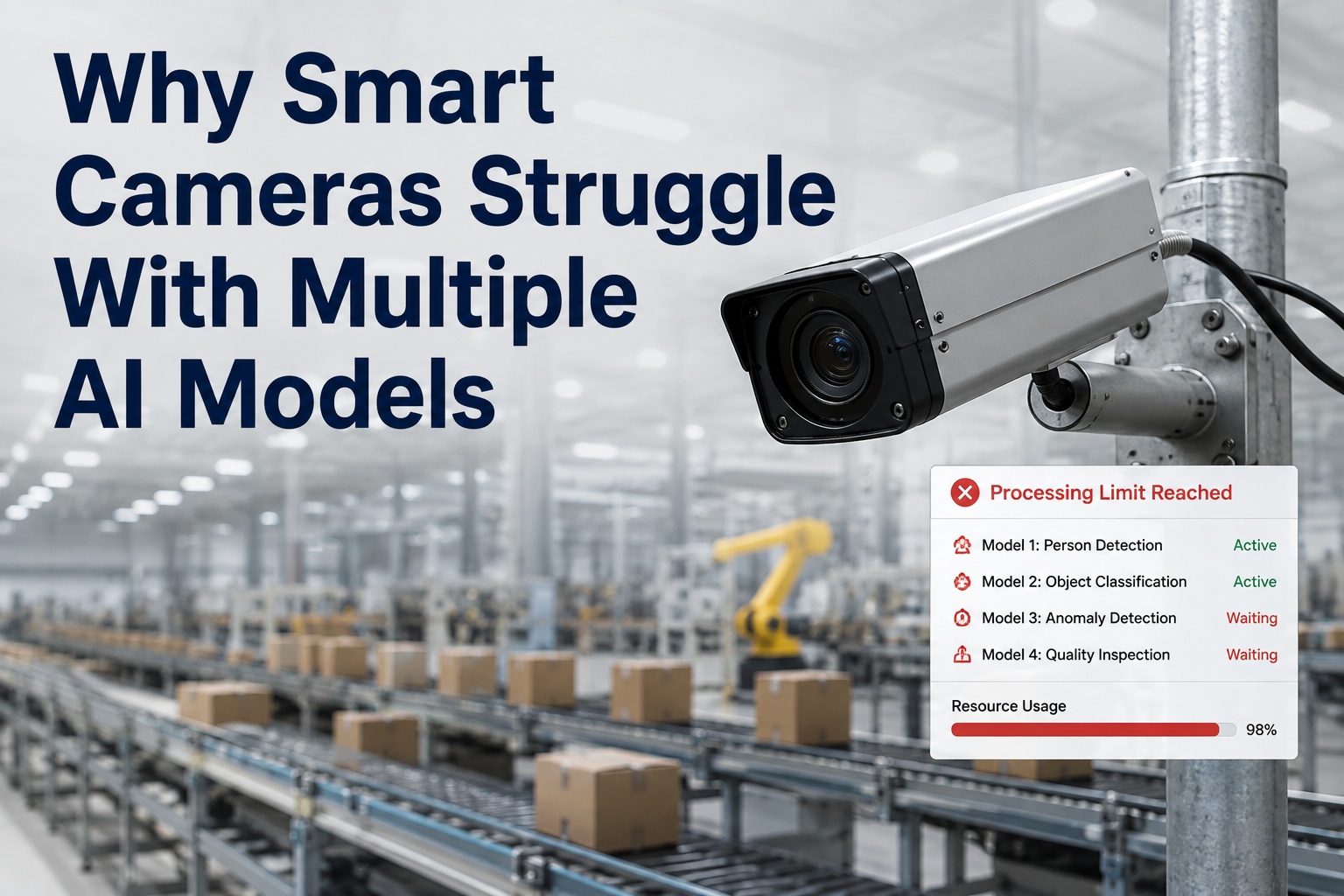
The same logic applies double in manufacturing. Equipment health drift behaves nothing like furnace vision defects. Cross-system cascade risk in a power plant has nothing in common with optimal time-of-day load dispatch. A single foundation model forced to handle all of it produces confident, plausible, wrong answers — and operators stop trusting the system within weeks.
One-size-fits-all — what fails
- Single foundation model asked to predict bearing wear, schedule load dispatch, and inspect furnace CCTV — none done well.
- Generic time-series model trained on benchmark data — fails on plant-specific tag semantics and sensor failure modes.
- No confidence signal — operators can't tell when the model is guessing versus when it's grounded in plant evidence.
- Black-box recommendation — no explanation an operator can verify, no SOP reference, no historical precedent.
- Latency unfit for control loops — a real-time RL scheduling decision can't wait 8 seconds for cloud inference.
- One bad inference contaminates everything downstream — there's no fallback, no second opinion, no fusion logic.
Best-in-class portfolio — what works
- LSTM handles slow temporal drift. Nelson Rules handle SPC. Autoencoder handles 50-sensor signatures. Each plays to its strength.
- Models trained or fine-tuned on your plant's own data — site-specific behavior captured, not approximated.
- Confidence Fusion layer aggregates signals from all 9 models — high-confidence calls separate cleanly from speculation.
- Every recommendation cites the model, the data, and the historical precedent — operator-verifiable, audit-ready.
- Real-time models run on-prem with sub-50ms inference. Heavy training runs cloud or on-prem on schedule.
- Multiple models cross-check each other — false positives drop, true alerts rise, trust compounds over time.
iFactory's architecture is the right side of this comparison by design. Nine specialized models, each best-in-class for its domain, fused into a single Operational Intelligence Score that operators can read at a glance — and deployed on your choice of on-prem appliance or cloud. Get a turnkey quote sized to your plant.
9 Specialized Models Covering Every Operational Domain — Not Just Maintenance
| Model | What It Optimizes in Your Plant | Speed | Operational Domain |
|---|---|---|---|
| LSTM (Time Series) | Equipment health trends — turbine, mills, BFP seal drift | Days–Weeks | Asset Health & Life |
| Nelson Rules (SPC) | Process band drift — O₂, drum level, steam temp off-target | Minutes–Hours | Process Stability |
| Monte Carlo Simulation | Probabilistic failure & production risk — P10/P50/P90 | Days–Weeks | Risk Quantification |
| Graph Neural Network | Cross-system cascade risk: boiler → turbine → grid | Days | System-Wide Risk |
| RL Scheduler (PPO) | Optimal ToD scheduling, load dispatch, aux power allocation | Real-Time | Energy & Cost Opt. |
| Autoencoder (Deep Learning) | 50-sensor deviation from optimal operating signature | Hours–Days | Full-Unit Efficiency |
| Isolation Forest | Unknown fault modes — novel patterns in DCS & process data | Hours | Anomaly Detection |
| CNN Vision + PINN | Furnace CCTV/thermal; separates cycling artifacts from faults | Real-Time | Visual Intelligence |
| LLM Fusion Layer | Plain-language action, financial impact, what-if alternatives | Continuous | Decision Orchestration |
Inside Each Model — What It Does, Why It's Best-in-Class for the Job
Every model in the iFactory stack earns its place by being measurably the right tool for its specific operational domain. Below is the playbook — what each model does, why it dominates its category, and the manufacturing problems it solves.
1. LSTM (Time Series) — Equipment Health & Life
What it does
Long Short-Term Memory networks learn how equipment normally behaves across long time horizons — days, weeks, months — and flag the slow drifts that precede failure. Bearing temperature creeping up over 14 days. Mill vibration baseline shifting after a maintenance event. Boiler feed pump seal degradation patterns invisible to threshold alarms.
Why best-in-class for this job
LSTM's gating mechanism handles long temporal dependencies — exactly what slow-failure modes look like. Production deployments show LSTM autoencoders capturing subtle departures from normal operating conditions and forecasting remaining useful life in rotating machinery — turbines, mills, boiler feed pumps — better than any threshold-based or statistical alternative.
2. Nelson Rules (SPC) — Process Stability
What it does
Statistical Process Control's classical Nelson Rules detect non-random patterns in process bands — eight consecutive points on one side of the mean, six trending up, two of three points past two-sigma. Minutes-to-hours detection for O₂ trim drift, drum level swings, steam temperature off-target, and other control loop instabilities.
Why best-in-class for this job
Deep learning is overkill — and slower — for problems where statistical rules already give explainable, defensible, instant detection. Operators trust SPC. Auditors recognize it. The right tool for process stability is the proven tool, run at machine speed against every loop. iFactory pairs Nelson Rules with the deep-learning models for the cases SPC alone can't catch.
3. Monte Carlo Simulation — Risk Quantification
What it does
Generates probabilistic forecasts for failure rates and production output — P10, P50, P90 — by running thousands of scenarios across uncertain inputs. Lets planners reason about risk numerically instead of in vague language. "There's an 18% chance Unit 3 misses its quarterly output target if Mill A is taken offline this month."
Why best-in-class for this job
Monte Carlo is the gold standard for quantifying uncertainty in industrial systems where inputs are noisy, sample sizes are limited, and decisions need to be defensible at the boardroom level. Deep learning doesn't replace it — it complements it. iFactory uses both, with Monte Carlo for the explicit risk-quantification layer.
4. Graph Neural Network (GNN) — System-Wide Risk
What it does
Models the plant as a graph — assets are nodes, dependencies are edges — and propagates risk across the network. When a boiler trip cascades to turbine impact and then to grid commitment, the GNN sees it. Threshold-based monitoring sees three separate events; the GNN sees one connected cascade.
Why best-in-class for this job
GNNs are the only architecture purpose-built for relational reasoning across asset hierarchies. They handle the fact that a steam pressure deviation in one area changes the meaning of a turbine vibration reading in another. No other model class captures that topology natively.
5. RL Scheduler (PPO) — Energy & Cost Optimization
What it does
Proximal Policy Optimization (PPO) reinforcement learning learns optimal sequencing — time-of-day load dispatch, auxiliary power allocation, raw material feed scheduling, energy procurement timing. Real-time decisions that adapt as energy prices, demand forecasts, and equipment availability shift.
Why best-in-class for this job
Static optimization is a snapshot — it solves yesterday's problem with yesterday's prices. RL learns the policy and re-evaluates continuously, adapting to volatility. PPO specifically is the workhorse algorithm for industrial scheduling because it balances exploration with stability — you don't want the scheduler making wild bets on production days.
6. Autoencoder (Deep Learning) — Full-Unit Efficiency
What it does
Learns the multivariate signature of optimal unit operation across 50+ sensors and flags deviations. Not "Tag X is off" but "the relationship between Tag X, Y, Z, and operating mode is inconsistent with peak efficiency." Reconstruction error is the signal — if the autoencoder can't faithfully rebuild the current state, something has shifted.
Why best-in-class for this job
Autoencoders are the proven architecture for multivariate anomaly detection in industrial cyber-physical systems — research and production deployments consistently show LSTM-Autoencoders outperforming statistical and classical ML baselines for capturing complex temporal relationships in plant sensor data.
7. Isolation Forest — Anomaly Detection
What it does
Fast, unsupervised detection of novel fault modes — patterns the plant has never seen before. Doesn't need training labels. Doesn't need a historical example of the failure. Identifies what's statistically isolated from normal operation and flags it for investigation. Lightweight enough to run on every tag, every shift.
Why best-in-class for this job
Combined with the LSTM autoencoder, Isolation Forest gives the fastest catch on novel anomalies — research shows hybrid LSTM autoencoder plus Isolation Forest systems achieving over 93% detection accuracy with sub-50ms inference. iFactory uses both — Isolation Forest as the fast statistical pass, autoencoder as the deep verification.
8. CNN Vision + PINN — Visual Intelligence
What it does
Convolutional Neural Networks process furnace CCTV, thermal imaging, vision inspection cameras, and drone footage. Paired with Physics-Informed Neural Networks (PINNs) that embed the underlying physics — heat transfer, fluid dynamics — to separate genuine faults from normal cycling artifacts.
Why best-in-class for this job
Generic vision models flag every flicker as a defect. PINNs add physics priors so the model knows what's a real flame-front anomaly versus expected radiation cycling, what's actual furnace tube damage versus glare from a clean-air sweep. Far fewer false positives, much higher operator trust.
9. LLM Fusion Layer — Decision Orchestration
What it does
The Confidence Fusion layer aggregates signals from all 8 specialized models, weights them by historical accuracy, and produces a single Operational Intelligence Score every 15 minutes. The LLM layer translates that score into plain language with recommended actions, dollar impact, and what-if alternatives — grounded in plant evidence, citing the source models.
Why best-in-class for this job
LLMs are great at language and synthesis, terrible at primary time-series prediction. The right job for the LLM is fusion and explanation — not prediction. In 2026, the manufacturing AI consensus is exactly this — industrial foundation models with agentic AI agents acting as the intelligent interface, while proven ML techniques remain the dominant predictive foundation.
What the operator actually sees — fusion in action
Recommended action — schedule Mill A bearing inspection at next planned outage (28 Nov, 04:00). Avoiding unplanned trip preserves estimated $42K production. If deferred past 5 Dec, Monte Carlo gives 34% probability of forced outage in next 14 days.
Alternative — reduce Mill A load by 8% now and run to planned outage — operational efficiency cost ~$3.2K/day, eliminates trip risk per RL scheduler simulation.
Sources — LSTM (turbine health module), Autoencoder (Unit 3 efficiency), Monte Carlo (12-week historical baseline), RL Scheduler. Confidence — 0.87.
This is what a portfolio approach delivers and a single-model approach cannot. Four models contributing evidence, one fusion layer producing a single recommendation, every source cited, every alternative quantified. Book a model walkthrough to see it on live plant data.
The Hidden Layer — Why the Data Engineering Underneath Matters
None of these models work without the data engineering layer feeding them. The 2026 reality check from industry analysts is blunt — through 2027, most AI projects are expected to fall short because of inadequate data governance, with poor master data and fragmented architectures undermining even advanced ML models. iFactory's stack ships the data engineering with the models, because shipping models without the pipeline is the most common failure mode in industrial AI.
What ships with every iFactory model deployment
- OPC UA + MQTT ingestion with Sparkplug B — every model sees the same unified namespace.
- Historian federation — AVEVA PI, Wonderware InSQL, GE Proficy, Honeywell PHD, Yokogawa Exaquantum.
- SAP integration — S/4HANA, ECC, MII, PCo, BTP with continuous master data cleansing.
- Time-series storage — TimescaleDB and InfluxDB 3, pre-tuned for industrial cardinality.
- Vector database — pgvector / Qdrant for SOPs, manuals, P&IDs, and historical incidents.
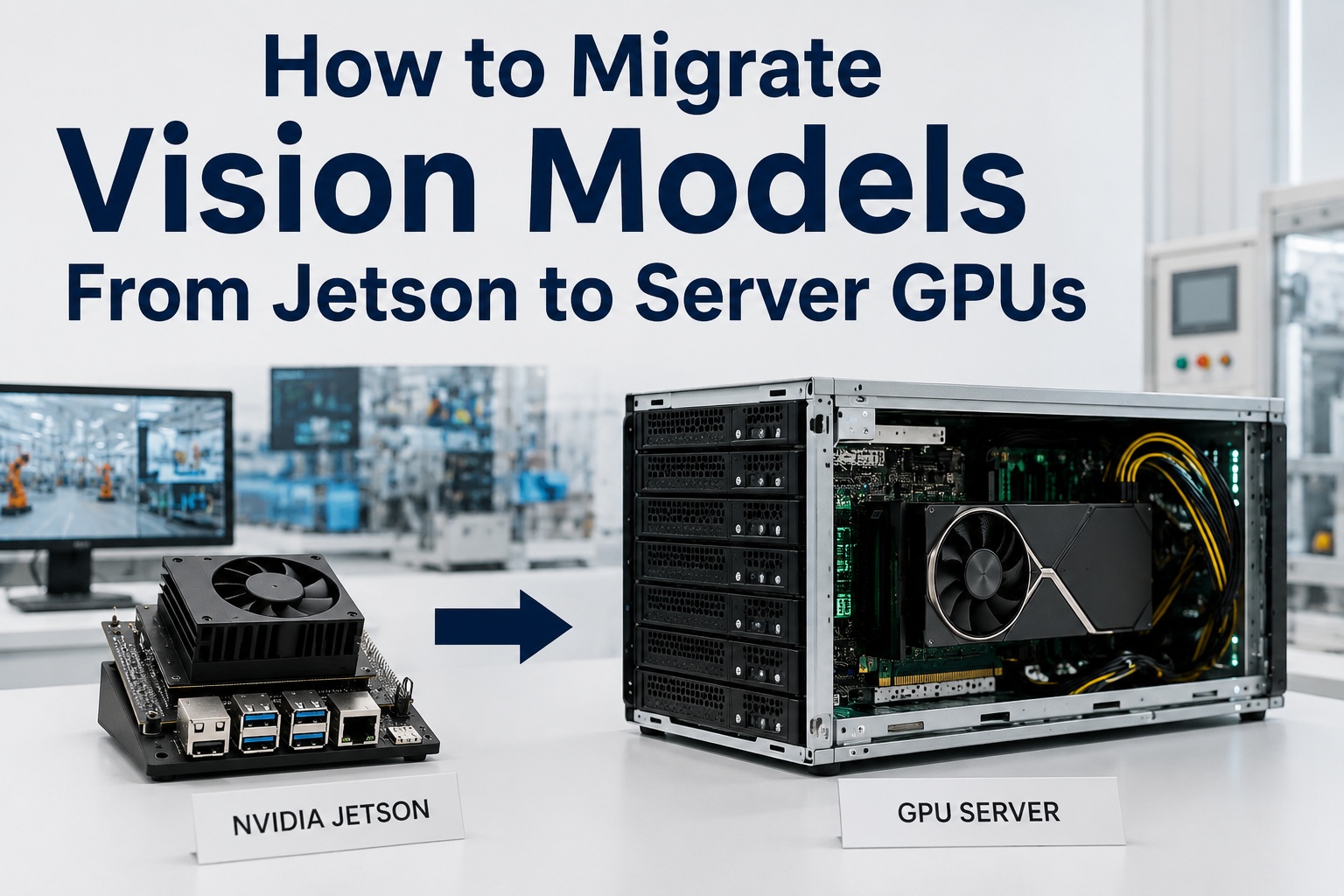
- Pre-configured NVIDIA AI server — racked, software-loaded, ready for plug-in (on-prem option).
- Cloud deployment option — same models, fully managed, no hardware required.
- Confidence Fusion + LLM Layer — Operational Intelligence Score refreshed every 15 minutes.
On-Prem or Cloud — Same Models, Your Choice
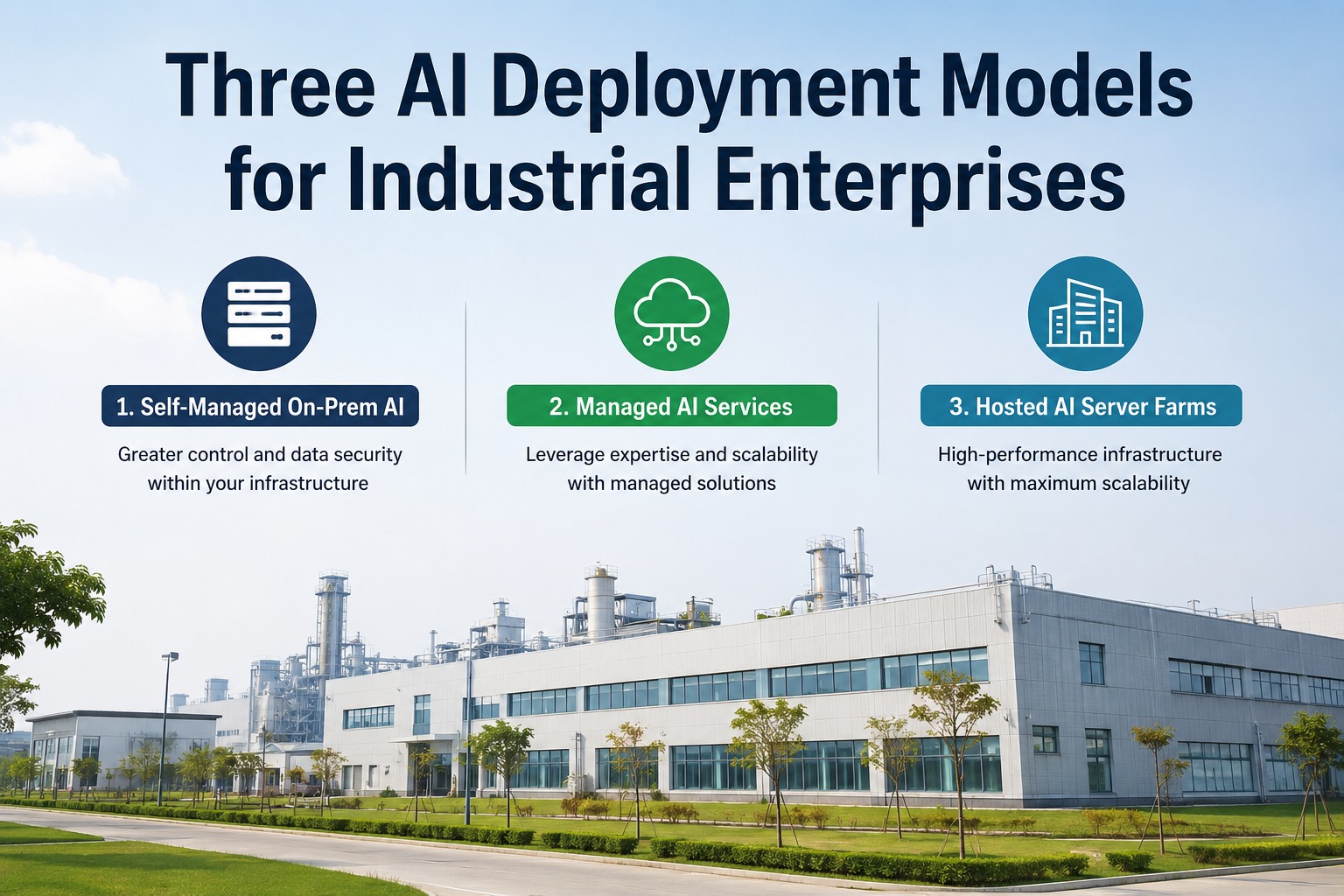
The model portfolio is identical regardless of deployment. The infrastructure is what differs. iFactory offers four deployment patterns — full self-managed on-prem, managed service on-site, hosted AI server farm, and cloud DR add-on — so the deployment matches your IT capability, data sovereignty rules, and budget profile. The decision framework below walks through the trade-offs.
iFactory On-Prem AI Appliance For plants where data sovereignty is non-negotiable
- Pre-configured NVIDIA AI server — racked, software-loaded, ready to plug into power and Ethernet.
- All inference runs locally — sub-50ms latency for real-time models like RL Scheduler and CNN Vision.
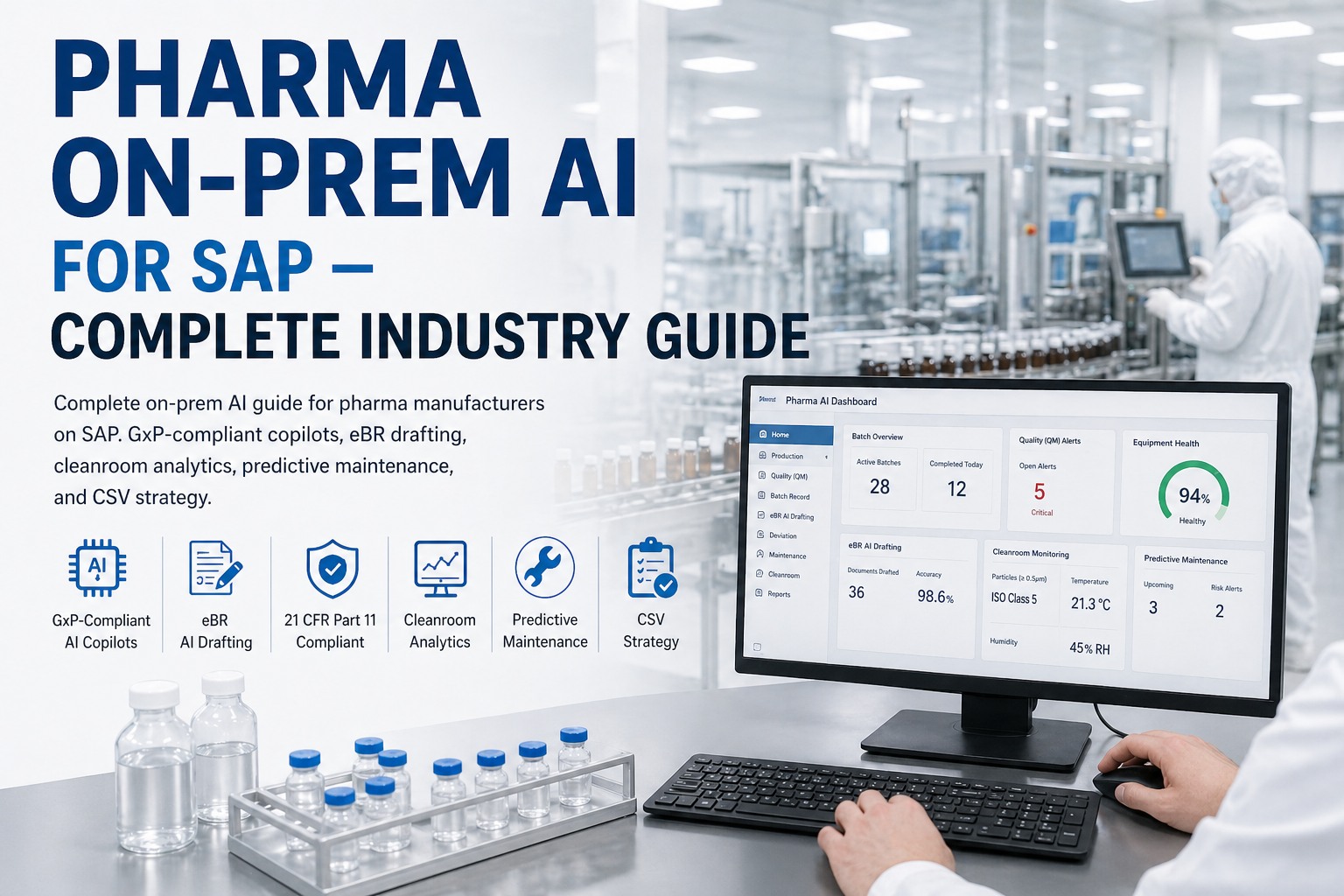
- Plant data never leaves the perimeter — defense, regulated chemicals, pharma, sensitive IP.
- Models keep running during connectivity outages — pipeline buffers, inference continues.
- Best for — air-gapped sites, regulated industries, plants with mature IT/OT teams.
iFactory Cloud For multi-site fleets and faster time-to-value
- No hardware shipment — first model live in 2–4 weeks, full rollout in 6–8 weeks.
- Fleet benchmarking — compare model behavior across plants in a single pane.
- Elastic scale — large historical backfills, heavy retraining cycles, foundation model fine-tuning.
- Region-locked data residency — SOC 2 Type II, ISO 27001 aligned.
- Best for — multi-site CPG, food & bev, discrete manufacturing, greenfield plants.
Which Model Is Right for You?
| Criteria | Self-Managed | Managed Service (On-Site) | AI Server Farm (Hosted) | Cloud DR Add-On |
|---|---|---|---|---|
| Internal IT Capability | Strong AI ops team | Any — ops outsourced | Any — fully outsourced | Cloud skills helpful |
| Data Sensitivity | Maximum — air-gap ok | High — VPN protected | Medium — coloc facility | Standard compliance |
| Budget Model | CapEx preferred | CapEx + OpEx ($12K+/yr) | CapEx + OpEx (+40%/yr) | +$200–20K/mo |
| Time to Deploy | 4–8 weeks | 2–4 weeks (MSP handles) | 2–3 weeks | Days (cloud-native) |
| Scalability | Plan in advance | MSP assists scale-out | Scale via more servers | Elastic cloud scaling |
| On-site Facility | Required | Required | NOT needed | NOT needed |
| Best For | Enterprise IT-mature orgs | SMB to mid-market | No-DC organizations | All — add for resilience |
| Typical Annual Cost* | Power + staff only | +$12K–200K+/yr | +40% hardware/yr | +$2K–50K+/mo |
Most customers don't pick one and stay there forever — they mix. A common pattern is on-prem self-managed for the regulated production site, managed service on-site for satellite plants, hosted AI server farm for plants with no data center room, and cloud DR add-on across the fleet for resilience. iFactory supports all four within a single contract, with consistent model behavior and a single operator interface.
Not sure which deployment model fits your plant?
The 60-minute architecture session covers your data residency rules, network constraints, SAP landscape, IT capability, and budget profile — then recommends the deployment mix with concrete cost numbers and a roadmap.
The 3-Phase Turnkey Roadmap — Live in 6 to 12 Weeks
Nine specialized models, data engineering, deployment, training — all live in 6 to 12 weeks. The roadmap is identical across on-prem and cloud deployments — only the hardware shipment step differs. iFactory handles everything end-to-end, including cabling, PLC integration, operator training, and 24×7 monitoring.
Ship + Network + Data
Hardware arrives (on-prem) or cloud tenant provisioned. Field techs handle cabling, network, PLC integration. Data engineers connect OPC UA, historians, and SAP. Baseline tag inventory and master-data quality assessment delivered.
- NVIDIA AI server racked, powered, software-loaded
- OPC UA + MQTT broker live with Sparkplug B
- Historian and SAP connectors verified
- Data quality baseline report delivered
Model Train + Pilot
All 9 models trained on the plant's own historical data. Time-series storage filling, vector index built from SOPs and manuals. Confidence Fusion calibrated. Pilot OIS live for one production line with feedback loop active.
- LSTM, Autoencoder, GNN, RL Scheduler trained
- Vector index built from plant docs
- Confidence Fusion calibrated to plant baseline
- Operator pilot feedback collected
Go-Live + Training
Full plant rollout. All models running, OIS refreshing every 15 minutes. Operators, technicians, and supervisors trained. SAP work-order integration live. 24×7 monitoring active. ROI baseline captured for tracking.
- 9-model portfolio live across the plant
- Operator and supervisor training delivered
- SAP work-order automation live
- ROI baseline captured
Comparison — One-Size-Fits-All Stack vs. iFactory's Best-in-Class Portfolio
| Capability | Generic AI Platform | iFactory Best-in-Class Portfolio |
|---|---|---|
| Equipment health trends | One general predictive model — same network used for everything | LSTM trained on rotating-machinery temporal patterns specifically |
| Process band drift | Threshold alarms or generic ML | Nelson Rules SPC — explainable, instant, auditor-recognized |
| Probabilistic risk | Single-point forecasts — no uncertainty quantification | Monte Carlo P10/P50/P90 — defensible at the board level |
| Cross-system cascade risk | Asset-by-asset monitoring — misses relational patterns | Graph Neural Network — propagates risk across asset dependencies |
| Real-time scheduling | Static optimization — yesterday's prices, today's decision | RL Scheduler (PPO) — continuous adaptation, sub-second decisions |
| Multivariate anomaly | Single-sensor thresholds — misses cross-sensor patterns | Autoencoder — 50-sensor reconstruction error signature |
| Novel fault detection | Needs labeled training data — can't catch what it hasn't seen | Isolation Forest — unsupervised, catches truly novel patterns |
| Vision inspection | Off-the-shelf CNN — flags every flicker as a defect | CNN + PINN — physics-informed, separates artifacts from real faults |
| Decision orchestration | LLM tries to do primary prediction — confident, plausible, wrong | LLM as fusion + explanation only; predictive ML does the prediction |
| Confidence signal | Single model output — no way to tell when it's guessing | Cross-model fusion — confidence calibrated against historical accuracy |
| Explainability | Black box | Every recommendation cites the source model, data, and precedent |
| Deployment options | Cloud-only typically | On-prem, managed on-site, hosted server farm, cloud DR — all four |
Frequently Asked Questions
Why not just use one large foundation model for everything?
Because the 2026 AI consensus has settled — the "best" model is no longer a "who," it's a "which." Foundation models are excellent at language, synthesis, and explanation. They're not the right tool for primary time-series prediction, multivariate anomaly detection, or real-time control scheduling — where decades of research and production deployment have established specialized architectures (LSTM, autoencoders, GNNs, RL) as the proven approach. iFactory uses the LLM where it excels (fusion and explanation) and the specialized models where they excel (prediction and detection).
Do I have to buy NVIDIA servers separately?
No. The on-prem appliance ships fully loaded — NVIDIA AI server, software pre-installed, network gear, cabling. You provide rack space, line power, and Ethernet. iFactory provides everything else. No separate hardware procurement, no firmware tuning, no driver compatibility issues. For cloud deployment, there's no hardware at all.
What's the difference between iFactory's on-prem and cloud model deployments?
The 9-model portfolio is identical — same architectures, same training methodology, same Operational Intelligence Score. What differs is where the compute lives. On-prem keeps everything inside the plant perimeter, runs inference locally with sub-50ms latency, and survives connectivity outages. Cloud is fully managed by iFactory, faster to deploy, and easier for multi-site fleet benchmarking. Hybrid is common — sensitive production on-prem, satellite plants on cloud, fleet analytics in the cloud layer.
How long does it take to train all 9 models on our plant?
The standard timeline trains and calibrates the full model portfolio in weeks 5–8 of the deployment. LSTM and autoencoder models typically need 6–12 weeks of historical data to capture seasonal patterns. Nelson Rules and Isolation Forest are deployable from day 1. GNN and Monte Carlo configure against asset topology and historical incidents. RL Scheduler trains on simulation initially, then refines on live data. Full plant-wide model coverage usually lands by week 8.
Can we keep our existing AI models and add iFactory's?
Yes. iFactory's Confidence Fusion layer is designed to accept signals from external models alongside the built-in portfolio. If you have a custom predictive model your data science team built, it plugs in as another contributor. The Operational Intelligence Score weights all signals — yours and ours — by historical accuracy. Nothing about iFactory's stack requires replacing what you already have.
How do you train models without exposing our plant data?
For on-prem deployments, training happens entirely on the NVIDIA AI server inside your plant — no data ever leaves. For cloud deployments, your data is held under a data processing agreement with region-locked residency, and models trained on your data are yours — not shared across customers, not used to train shared foundation models. Anonymized benchmarking is opt-in only.
What happens when a model is wrong?
The Confidence Fusion layer is designed for exactly this — no single model is trusted in isolation. If LSTM says "imminent failure" but Autoencoder reconstruction error is normal and Monte Carlo says baseline-low risk, the fusion layer reports a low-confidence signal and doesn't push the alert to the operator. Operators see the score and the contributing models — they can drill into any signal. False positives compound across models far less than within a single model.
Do these models replace our process engineers and operators?
No. The architecture is explicit — AI drafts, humans approve. The LLM Fusion Layer produces recommendations with full source attribution. Process engineers and operators stay in the decision loop, especially for regulated actions. The AI compresses years of apprenticeship into weeks of augmented learning — novice technicians become effective faster because the system surfaces what an experienced operator would notice. It augments expertise, not replace it.
How does this integrate with our SAP S/4HANA system?
iFactory has certified connectors for S/4HANA (OData services, CDS views, ABAP RFC) and SAP BTP. Model recommendations flow back as draft work orders, batch deviations, or quality results in SAP. The model portfolio reads from SAP master data (equipment master, BOMs, material masters) and writes back operationally relevant outputs. SAP remains the system of record. iFactory adds the plant-floor AI layer on top.
What's the Operational Intelligence Score and how often does it refresh?
It's a single 0–100 score per production unit that summarizes the fused output of all 9 models — process stability, equipment health, efficiency, risk. It refreshes every 15 minutes with the LLM-generated plain-language action, financial impact, and what-if alternatives. Operators see one number and one recommendation. Supervisors can drill into the underlying model signals for verification.
Can we pilot the model portfolio on one unit before plant-wide rollout?
Yes. Most customers start with a single production line or asset class for 6–8 weeks. The full data engineering stack is deployed (scoped to the pilot), 3–4 of the most relevant models are configured (typically LSTM, Autoencoder, Isolation Forest, plus Confidence Fusion), and ROI is measured against a baseline. Most pilots convert to full plant deployment within 60 days of go-live.
Is this just for power plants and process industries, or does it work in discrete manufacturing too?
Works in both. The model portfolio is designed to be domain-adapted — LSTM for rotating machinery health applies as well in CPG and automotive as it does in power. CNN Vision with PINN works on furnace CCTV in steel plants and on weld inspection in automotive. GNN works on grid cascade in utilities and on production line dependencies in discrete manufacturing. The training data and fine-tuning are what specialize the models — not the architectures themselves.
Stop running one model on everything. Start running the right model on each thing.
Best-in-class portfolio. Confidence Fusion. Single Operational Intelligence Score. Choose on-prem, managed on-site, hosted server farm, or cloud — iFactory delivers all four. Live in 6 to 12 weeks, fully managed, end-to-end.