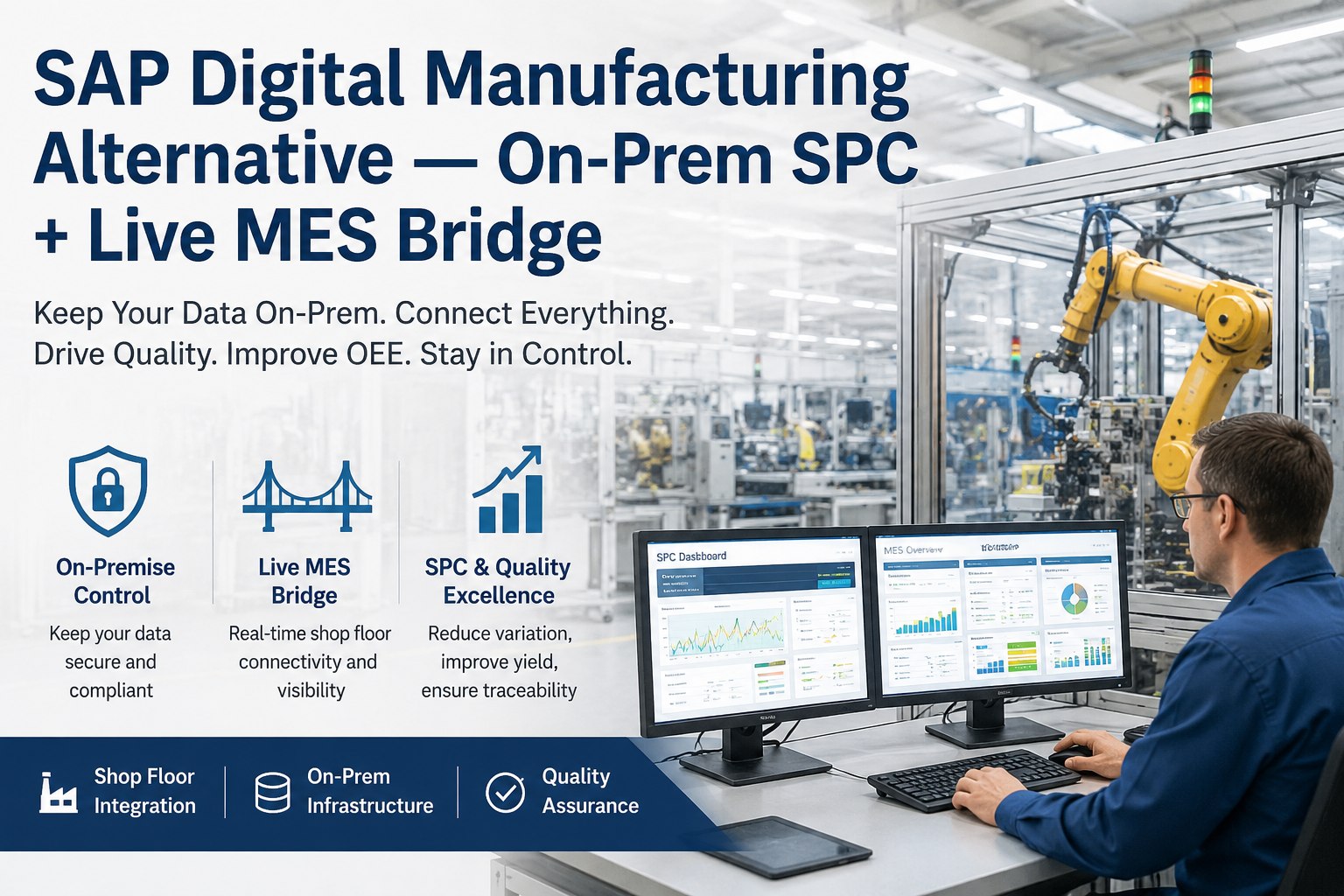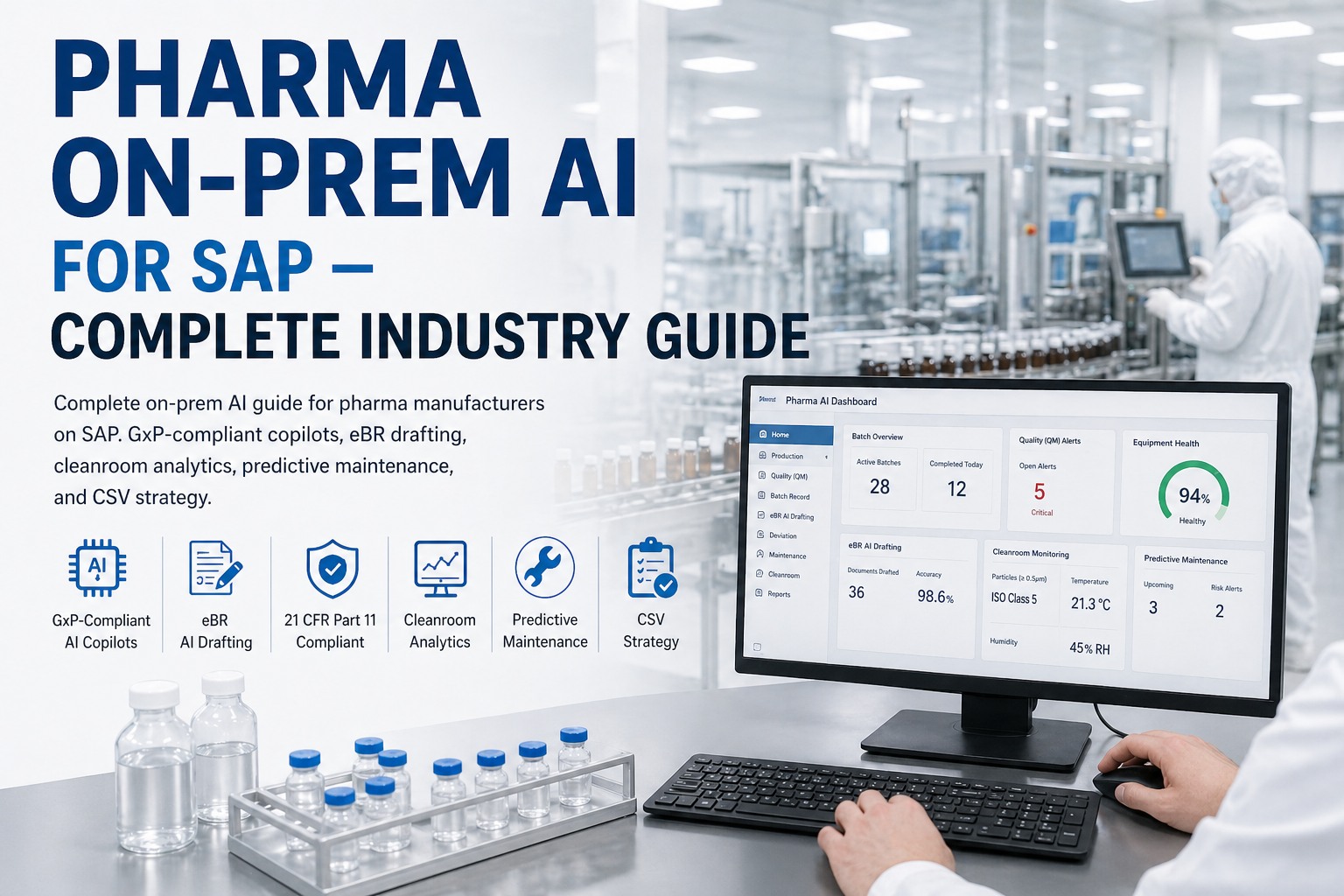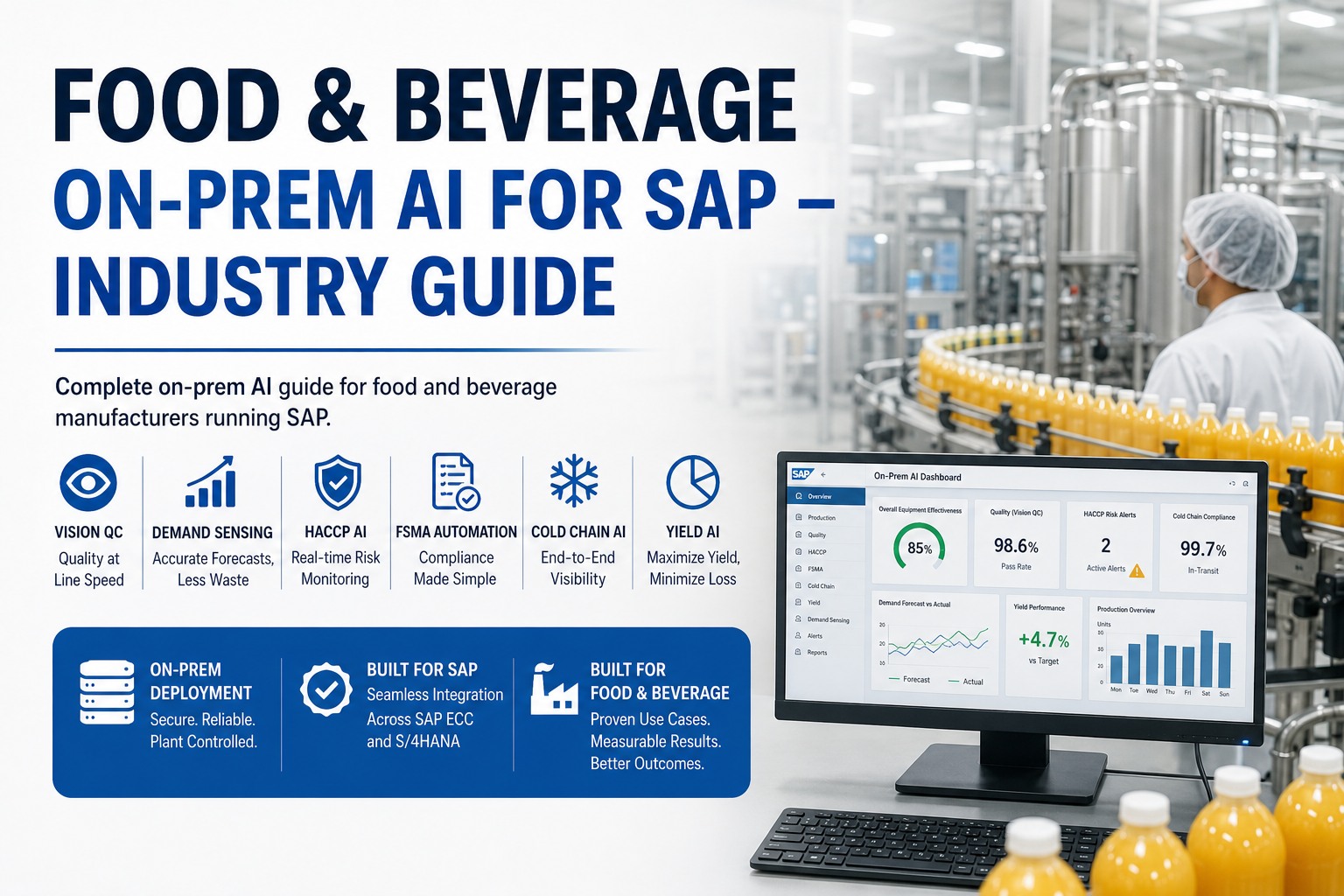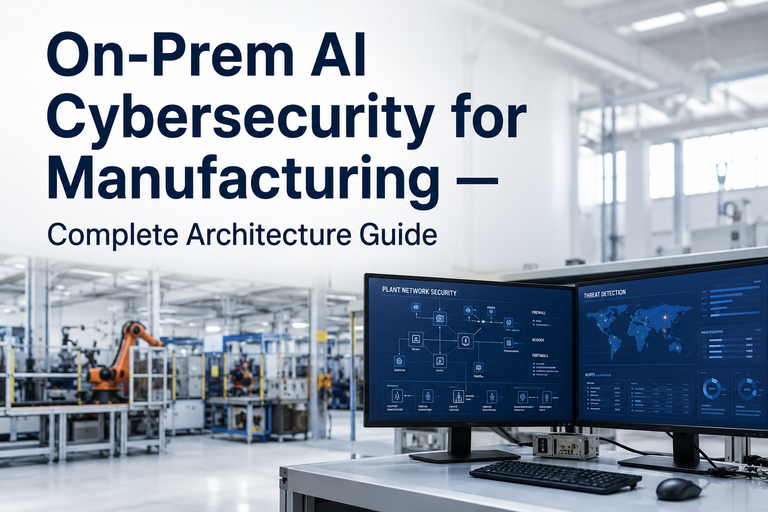
The automotive industry runs on margins narrow enough that a paint defect, a missed weld, or a stalled supplier PPAP can flip a profitable quarter into a loss. In 2026, the OEMs and Tier 1 suppliers winning the EV transition are doing it with AI threaded through every shop on the plant floor — body, paint, assembly — and pulled together by deep integration with SAP PP and SAP QM. Audi's ProcessGuardAIn fuses historical process knowledge with live sensor data to catch anomalies as they form rather than after they propagate. BMW's Regensburg plant is the first automotive facility running comprehensive digitalized inspection of every painted vehicle with AI-controlled deflectometry. BMW's new i3 Munich line has every car reporting 20,000 build characteristics back digitally during assembly. iFactory delivers this category of capability to OEMs and Tier 1 suppliers as a turnkey stack — on a pre-configured NVIDIA on-prem AI appliance for plants where data sovereignty is non-negotiable, or as fully managed cloud where speed-to-value matters more than perimeter control. Same models, same SAP integration, same IATF 16949-ready architecture. Your choice.
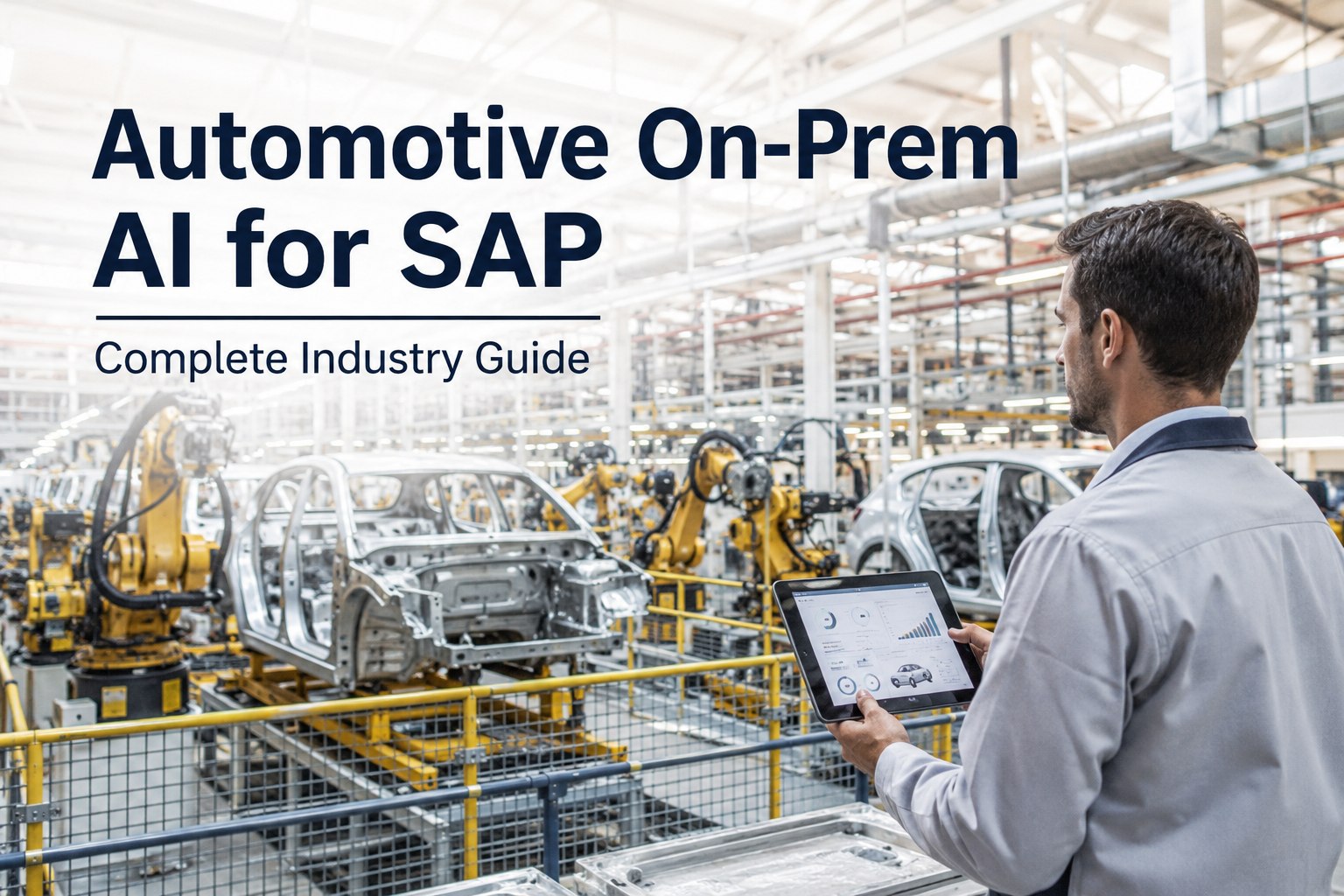
Automotive On-Prem AI for SAP — Complete Industry Guide
Body shop weld vision, paint shop AOI/AOB, assembly sequencing, supplier quality, and OEM copilot — fully integrated with SAP PP, SAP QM, and IATF 16949 quality core tools. Delivered as a turnkey on-prem appliance or fully managed cloud deployment. You pick the model that fits your plant.
What You Get with iFactory's Automotive AI Stack
iFactory ships the complete automotive AI capability — body shop vision, paint shop AOI/AOB, assembly intelligence, supplier quality, SAP PP and QM integration, and the 9-model AI portfolio — as a single integrated delivery. Available on-prem on a pre-configured NVIDIA AI server or in iFactory Cloud, fully managed. Same scope either way.
The complete automotive bundle
- Body shop AI — weld spatter detection, BIW dimensional verification, robot path optimization, joining quality prediction.
- Paint shop AI — AOI/AOB surface inspection with deflectometry, defect classification, automated rework routing, color match consistency.
- Assembly intelligence — sequencing optimization, station load balancing, build characteristic verification, takt time analytics.
- Tier 1 supplier quality — incoming inspection AI, PPAP submission analysis, supplier scorecard automation.
- SAP PP integration — production orders, MRP, sequencing call-offs, capacity planning enriched with AI forecasts.
- SAP QM integration — inspection plans, defect notifications, control plans, PPAP workflows, layered process audit support.
- IATF 16949 quality core tools — APQP, PPAP, FMEA, MSA, SPC native support with audit-ready evidence trails.
- Deployment choice — pre-configured NVIDIA on-prem AI server with sub-50ms inference, OR fully managed iFactory Cloud. Same models, same SAP integration.
Why Automotive AI Pilots Stall — and What Actually Works
The honest industry diagnosis in 2026 is sharp. Automotive AI pilots stall before plant-wide rollout — and the reason isn't the models. The models for visual inspection and defect detection are proven. The obstacle is the requirement for specialist AI expertise to deploy and maintain them, a requirement that most manufacturing organizations cannot sustainably meet. As one industry leader put it bluntly — the ease of use for an industrial engineer or mechanical engineer just isn't there; the tools are built for developers, and even setting up a quality dataset that accommodates real production variation is complex.
iFactory's turnkey approach is the direct response to this pattern. The full stack — vision models, time-series anomaly detection, RL sequencing, vector-RAG operator copilot, SAP cleansing — ships pre-configured. Your industrial and quality engineers consume it. They don't deploy it. And it lands in 6 to 12 weeks, whether on the on-prem NVIDIA AI appliance or in iFactory Cloud.
EV transition pressure
Mixed-model lines running three series with different technology levels (ICE, hybrid, BEV) on a single assembly track demand sequencing intelligence that classical MES doesn't deliver. AI sequencing handles call-off volatility, missing parts, and labor balancing in real time.
Warranty cost compression
Warranty consumes 2–3% of revenue, sometimes 5%, with $51B paid by OEMs in 2023 alone. Catching defects in body and paint before they propagate downstream is the single highest-leverage AI play in the plant. Field failure starts at the line.
IATF 16949 audit readiness
The standard requires APQP, PPAP, FMEA, MSA, SPC discipline plus customer-specific requirements from Ford, GM, Stellantis, Renault, BYD, and others. iFactory's quality stack generates audit-ready evidence trails automatically — no manual reconstruction at re-cert time.
The Three Shops — Body, Paint, Assembly
Every automotive plant runs three coordinated shops. Each has a distinct AI playbook. iFactory's models cover all three with the same data engineering foundation and the same SAP integration, so quality and production data flow end-to-end without manual handoffs.
Body Shop — BIW Welding, Joining & Dimensional Verification
Weld spatter detection
CNN+PINN vision models on Jetson Thor edge devices flag weld spatter on body underbodies in real time. The system projects light directly onto each affected spot, directing grinding robots to the precise location with no human in the loop.
Dimensional verification
3D vision inspection at each joining station verifies critical dimensions before downstream rework becomes expensive. Anomalies feed directly into SAP QM as defect notifications with full traceability.
Robot path optimization
RL models continuously tune welding robot paths against real outcome data — spatter rate, weld strength, cycle time — converging on the optimal trajectory rather than the originally programmed one.
Joining quality prediction
LSTM time-series models predict joining quality from electrode tip wear, current/voltage signatures, and force profiles — flagging when a welder is drifting toward out-of-spec before defects appear.
Adhesive bonding inspection
Vision systems verify adhesive bead continuity, width, and placement — critical for structural joints in BEV battery enclosures and lightweight composite-metal assemblies.
Surface cleanliness
Pre-paint inspection identifies contamination, residual oils, and surface defects before vehicle bodies enter the paint shop — preventing the expensive cascade of paint defects downstream.
Paint Shop — AOI/AOB Surface Inspection & Process Control
AOI / AOB surface inspection
Automated Optical Inspection (AOI) and Automated Optical Boundary (AOB) systems detect the smallest surface deviations digitally and route them for correction — the same approach BMW deploys at its Regensburg paint plant and its Munich i3 line.
Deflectometry on every vehicle
AI-controlled robots use deflectometry — projecting black and white striped patterns and analyzing distortions — to detect paint variations on each vehicle individually. The defects are in different spots on every body; the robots adapt.
Defect classification & rework routing
Multi-class CNN models classify defects (dirt inclusion, sag, orange peel, fish-eye, blister) and route to the correct rework station — flexible sanding/polishing robots are programmed against the specific defect type.
Color match consistency
Spectrophotometer integration and ML color modeling track basecoat consistency across batches and atomizers. Drift detection raises early warnings before customer-visible mismatches occur between adjacent panels or body parts.
Process band monitoring
Nelson Rules SPC monitors booth conditions — temperature, humidity, airflow, paint flow, atomization pressure — and flags process drift in minutes-to-hours, before defect rates climb.
Paint usage optimization
Robotic paint application with AI cuts overspray and material waste. Industry benchmarks show robots reducing paint usage by ~0.5 L per vehicle — substantial savings on hazardous waste and material cost at production volumes.
Assembly — Sequencing, Build Verification & Adaptive Robotics
Smart sequencing
RL Scheduler (PPO) optimizes the build sequence across mixed model series, call-off fluctuations, missing parts, and labor balancing. Avoids station overloads while maintaining optimal staffing — the challenge Porsche Leipzig solves for three model series on one line.
20,000-characteristic verification
Each vehicle reports build characteristics back digitally during construction. iFactory's pipeline ingests this stream, validates each characteristic against SAP PP work-order spec, and flags deviations in real time before vehicle handoff.
Adaptive robotics
When a robot grasps in the wrong place, AI vision detects the error and the robot self-corrects and retries rather than alarming and stopping. The line keeps moving — adaptive robotics is moving from research labs to mainstream factories.
Torque & fastener verification
Smart tool integration captures torque profiles for every critical fastener. ML models flag joints that hit spec on the gauge but show abnormal torque curves — early indicator of cross-thread, debris, or wrong-part conditions.
End-of-line test correlation
Roller test rig results correlate back to upstream build characteristics, identifying which assembly station contributed when a vehicle fails final test. BMW's Munich line is showing how digital build data can make traditional roller test rigs superfluous entirely.
Operator copilot
Plain-language assistant on Jetson Thor edge devices answers operator questions about build variants, torque specs, wiring routing, and assembly sequence — grounded in plant SOPs and SAP work-order context. Reduces training time for new operators.
SAP PP and SAP QM Integration — The Backbone
Automotive AI is only useful if it closes the loop with the system of record. SAP PP (Production Planning) and SAP QM (Quality Management) are the spine of every OEM and Tier 1 operation. iFactory's automotive stack integrates deeply with both — reading from them, enriching them, and writing back actionable insights as draft work orders, quality notifications, and PPAP evidence.
SAP PP — Production Planning & Sequencing
iFactory's RL Scheduler reads MRP, capacity, and call-off data from SAP PP, applies real-time sequencing optimization across mixed-model assembly, and writes the optimized sequence back as adjusted production orders. Handles missing parts, late suppliers, and labor balancing in a single closed loop. Built-in audit trail for every reroute decision.
- Reads — production orders, MRP, BOM, work centers, routings, capacity, call-offs.
- Writes back — optimized sequence, capacity adjustments, work order priority changes.
- Real-time — sub-second decisions as plant-floor conditions change.
SAP QM — Quality Management
SAP S/4HANA Quality Management enables comprehensive quality control including inspection planning, execution, notifications, audits, and corrective actions — and it supports IATF 16949 requirements through supplier quality management, process audits, risk-based assessments, and integration with production planning for automotive processes such as PPAP and control plans. iFactory's vision and SPC layer plugs into all of this — defects detected in the body or paint shop become QM notifications automatically, with photo evidence, classification, and root cause hypotheses pre-populated.
- Reads — inspection plans, control plans, master inspection characteristics, certificates.
- Writes back — defect notifications, inspection lots, results recording, nonconformance routing.
- Audit-ready — every AI inference is logged with model version, confidence, and source data.
Integration architecture — what flows where
Tier 1 Supplier Quality — Where the Real Money Lives
Tier 1 suppliers carry most of automotive quality risk and most of the recall exposure. Incoming inspection, PPAP submission cycles, supplier scorecard tracking, and customer-specific requirements from Ford, GM, Stellantis, Renault, BYD, and Iveco all converge here. The iFactory automotive stack handles supplier-side AI and OEM-side AI with the same architecture — because the OEM and Tier 1 problems are mirror images.
Incoming inspection AI
Vision systems verify dimensional, surface, and assembly conformance on incoming parts at receiving dock. Results flow directly into SAP QM as inspection lots with photo evidence. AI flags trends — a specific supplier drifting on a specific characteristic — before the formal scorecard updates.
PPAP submission analysis
Tier 1 suppliers submit PPAP documentation in cycles defined by the customer. iFactory's stack pre-validates dimensional reports, capability studies (Cp, Cpk), PSW completion, and warrant submission against customer-specific requirements before submission — drastically reducing rework cycles.
Supplier scorecard automation
Customer scorecards (Ford, GM, Stellantis, etc.) are computed from PPM defective, on-time delivery, problem solving response, and customer complaints. iFactory's stack reconciles supplier performance data with SAP records and flags scorecard risk before the OEM does — giving suppliers time to act.
Layered Process Audit (LPA) support
IATF 16949 requires Layered Process Audits across operating shifts. iFactory's mobile copilot prompts auditors with the right checklist for the right station, captures evidence, and flags findings into SAP QM — turning paper-based LPA into a digital trail with statistical analysis.
IATF 16949 Quality Core Tools — Native AI Support
IATF 16949 builds on ISO 9001:2015 with automotive-specific requirements. The standard rests on five Quality Core Tools — APQP, FMEA, MSA, PPAP, and SPC. iFactory's automotive AI is purpose-built around these tools, with the IATF 16949:2027 revision cycle (expected 12–18 months after ISO 9001:2026 publication) and modernization themes around embedded software, cybersecurity (ISO/SAE 21434, UNECE R155), and sustainability already on the roadmap.
| Core Tool | Purpose | How iFactory AI supports it |
|---|---|---|
| APQP — Advanced Product Quality Planning | Structured planning for new programs, prototype to production | Risk-based forecasting on launch timelines; lessons learned indexed in vector RAG for retrieval at the next program kickoff |
| PPAP — Production Part Approval Process | Customer approval of supplier production parts before mass production | Pre-validation of dimensional, capability, PSW, and warrant docs against customer CSRs — drastically reducing submission rework |
| FMEA — Failure Mode & Effects Analysis | Systematic identification of failure modes and risk prioritization | AIAG & VDA FMEA Handbook structure native; AI suggests risk priority based on plant-specific historical data |
| MSA — Measurement System Analysis | Verification of measurement accuracy and repeatability | Automated Gage R&R calculations; drift detection on measurement system performance over time |
| SPC — Statistical Process Control | Monitoring production variables to detect non-random patterns | Nelson Rules SPC running on every control characteristic, every shift, with audit-ready evidence trails |
| Control Plans | Documented quality control methods for each process step | Plans pulled from SAP QM and verified against actual measurement data; deviations flagged with root cause hypotheses |
| LPA — Layered Process Audits | Multi-tier audits across operating shifts | Mobile copilot for auditors; statistical analysis of LPA findings across shifts and locations |
An audit-ready evidence trail is the practical output. Every defect detected, every AI inference, every model version, every confidence score is logged and retained — so when the IATF auditor or the customer auditor asks for evidence of how the AI made a decision, the answer is one query away. Book a quality walkthrough to see the audit evidence stack on live plant data.
On-Prem or Cloud — Same Stack, Either Way
iFactory delivers exactly the same automotive AI capability on a pre-configured NVIDIA on-prem appliance or as fully managed cloud. The 9-model portfolio, the SAP PP and QM integration, the IATF 16949 core tools support — all identical. What differs is where the compute lives. Many OEMs and Tier 1 suppliers run a hybrid — sensitive production sites on-prem, satellite plants on cloud, fleet-wide quality benchmarking in the cloud layer.
iFactory On-Prem Appliance For OEMs and Tier 1 suppliers where data sovereignty rules
- Pre-configured NVIDIA AI server — racked, software-loaded, ready to plug in.
- All production data stays inside the plant — nothing crosses the perimeter.
- Sub-50ms inference at the line for vision, sequencing, and adaptive robotics.
- Works without internet — pipeline keeps running through WAN outages.
- Best fit — defense-adjacent programs, sensitive IP, plants subject to customer data residency CSRs.
- Deployment — 6–12 weeks turnkey, hardware + cabling + training all included.
iFactory Cloud For multi-site fleets and faster time-to-value
- Fully managed — iFactory operates the NVIDIA hardware in our cloud, you consume the AI.
- Fastest deployment — first pipeline live in 2–4 weeks, full rollout in 6–8 weeks.
- Fleet benchmarking — compare body, paint, assembly performance across plants in one pane.
- Elastic scale — model training and historical backfills don't need on-site capacity expansion.
- Best fit — multi-plant OEM groups, Tier 1 suppliers with several sites, greenfield BEV facilities.
- Compliance — SOC 2 Type II, ISO 27001, region-locked data residency.
Not sure whether to deploy on-prem or cloud for your automotive plant?
The 60-minute architecture session covers your customer-specific data residency requirements, IATF site scope, network constraints, SAP landscape, and growth plans — then recommends the deployment mix with concrete cost numbers and a 12-week roadmap.
What the Line-Side Operator Actually Sees
Every AI capability in the stack converges at the same point — a single operator interface, grounded in the plant's own data and the SAP system of record. Here's a paint shop interaction from a customer running the on-prem appliance.
Recommended action — divert next 10 vehicles to manual inspection while atomizer is verified. Maintenance work order WO-72290 drafted in SAP for atomizer service. Past three identical events were resolved by atomizer nozzle replacement (avg 22 min downtime).
Sources — AOI vision (CNN+PINN), Booth 3 atomizer telemetry, SAP IW38 maintenance history, SOP PAINT-CC-04.
This single 90-second interaction touched the AOI vision system on the paint line, the SPC engine on the atomizer telemetry, SAP QM for the defect tagging, SAP PM for the maintenance work order, the SOP vector index for the rework routing, and the operator-facing copilot. No tab-switching. No data hunting. No manual reconstruction. That's what an integrated automotive AI stack actually buys you.
The 3-Phase Turnkey Roadmap — Live in 6 to 12 Weeks
iFactory's turnkey delivery is identical for on-prem and cloud — only the hardware shipment step in Phase 1 differs. The same 6 to 12 week timeline, the same hand-holding through SAP integration, the same operator training plan.
Ship + Connect + Discover
Hardware arrives (on-prem) or cloud tenant provisioned. Field techs handle cabling, network, robot/PLC integration. Data engineers connect OPC UA, plant SCADA, AOI vision systems, and SAP PP/QM. Initial inventory of tags, characteristics, and master-data quality delivered.
- NVIDIA AI server racked, powered, software-loaded
- OPC UA + MQTT broker live with Sparkplug B
- SAP PP/QM connectors live and verified
- Vision systems onboarded
- Master-data quality baseline report
Train + Pilot
Models trained on plant historical data — body vision, paint AOI/AOB, assembly torque profiles, SAP work-order history. Pilot copilot live for one shop (typically paint or body for fastest ROI). Operator and QA feedback loop active.
- CNN+PINN vision trained on plant defect data
- LSTM, Autoencoder, RL Scheduler tuned
- Pilot shop go-live
- SAP QM notification flow tested
- Operator feedback collected
Go-Live + Audit-Ready
All three shops live. Operators, QA, supervisors trained. SAP PP and QM integration end-to-end. IATF 16949 evidence trail capturing every decision. 24×7 monitoring active. ROI baseline captured against warranty cost and first-pass yield.
- Body, paint, assembly all live
- Operator and QA training delivered
- SAP PP/QM full closed loop
- IATF audit evidence active
- ROI baseline captured
Common Automotive AI Use Cases — Where the ROI Actually Lands
| Use case | Shop | Primary models | Typical impact |
|---|---|---|---|
| Weld spatter detection & auto-grinding | Body | CNN+PINN vision + RL robot path | Reduced manual grinding labor, fewer downstream paint defects |
| BIW dimensional verification | Body | 3D vision + LSTM trend | Early detection of fixture wear; reduced rework cost |
| AOI/AOB paint surface inspection | Paint | CNN classifier + deflectometry | 100% inspection coverage; rework routed automatically |
| Paint booth process band monitoring | Paint | Nelson Rules SPC + Autoencoder | Early atomizer/HVLP drift detection; defect rate reduction |
| Color match consistency | Paint | Spectro + ML drift detection | Fewer customer-visible mismatches between body/bumper |
| Mixed-model sequencing | Assembly | RL Scheduler (PPO) | Station load balancing; reduced overload events on mixed lines |
| 20,000-characteristic build verification | Assembly | Anomaly + SAP PP correlation | Defects caught before end-of-line test; lower test-rig load |
| Adaptive robot self-correction | Assembly | CNN vision + RL controller | Lower line-stop events from robot misgrasps |
| Tier 1 supplier incoming inspection | Receiving | CNN vision + SAP QM | Earlier supplier scorecard signal; reduced PPM |
| PPAP pre-validation | Quality | LLM doc analysis + rule engine | Fewer submission rework cycles; faster customer approval |
| Layered Process Audit support | Quality | Mobile copilot + RAG | Digital LPA evidence; statistical view across shifts |
| Operator copilot for new variants | All | LLM + vector RAG of SOPs | Compressed operator ramp-up time; fewer assembly errors on variants |
Frequently Asked Questions
Do I have to buy NVIDIA servers separately?
No. The iFactory on-prem appliance ships fully loaded — pre-configured NVIDIA AI server (DGX, DGX Station, or HGX class depending on plant size), software pre-installed, network gear, cabling, Jetson Thor or IGX Thor edge devices for the body/paint/assembly lines. You provide rack space, line power, and Ethernet. iFactory provides everything else. If you choose the cloud deployment, there's no hardware at all — iFactory operates everything in our cloud and you consume the AI through a browser and operator devices.
How does iFactory integrate with our existing SAP S/4HANA system?
iFactory has certified connectors for SAP S/4HANA covering both production planning (PP) and quality management (QM). The integration reads production orders, MRP data, capacity, BOMs, routings, inspection plans, master inspection characteristics, and control plans — and writes back optimized sequences, defect notifications, inspection lots, work orders, and PPAP evidence. SAP remains the system of record; iFactory layers the AI on top. If you're still on SAP ECC, the same integration works via RFC and IDoc. If you're on SAP MII or PCo, those plug in too.
Is iFactory IATF 16949 compliant out of the box?
iFactory itself isn't a quality management system — your SAP QM remains that. But every iFactory AI inference, model version, confidence score, and source data trace is logged and retained in an audit-ready evidence trail. The standard's quality core tools — APQP, PPAP, FMEA, MSA, SPC, control plans, layered process audits — are all natively supported. When the customer auditor or IATF auditor asks how an AI-driven decision was made, the answer is one query away with full traceability. We're tracking the IATF 16949:2027 revision cycle (expected 12–18 months after ISO 9001:2026) and the modernization themes around embedded software, cybersecurity (ISO/SAE 21434, UNECE R155), and sustainability.
What's the difference between iFactory's on-prem and cloud deployments?
Functionally — none. Same data engineering pipeline, same 9-model AI portfolio, same body/paint/assembly capabilities, same SAP integration, same IATF audit evidence. What differs is where compute lives. On-prem keeps everything inside your perimeter with sub-50ms inference at the line and continuity during WAN outages — best for sensitive programs, plants subject to customer data residency requirements, and air-gapped operations. Cloud is fully managed by iFactory, faster to deploy, and easier for multi-plant fleet benchmarking. Many automotive customers run hybrid — sensitive plants on-prem, satellites on cloud, fleet analytics in the cloud layer.
How does iFactory handle customer-specific requirements (CSRs) from Ford, GM, Stellantis, Renault, BYD?
Each OEM publishes its own CSRs as supplements to IATF 16949. iFactory's stack ingests these rule sets and applies them to PPAP pre-validation, supplier scorecard computation, and quality control plan execution. Ford, GM, Stellantis, Renault, Iveco, and BYD CSRs are already configured. New OEM CSR releases (Renault updated theirs in April 2026, Stellantis consolidated divisional CSRs in 2025) are tracked and updated as part of the managed service.
Can iFactory handle mixed-model assembly with ICE, hybrid, and BEV on the same line?
Yes — this is core to the RL Scheduler use case. Mixed-model sequencing across series with very different technology levels (the Porsche Leipzig pattern of three model series on one line) is exactly what the PPO-based scheduler is designed for. The model optimizes the build sequence to avoid station overloads while maintaining optimal staffing, ingesting call-off volatility, missing parts, and inventory discrepancies as inputs.
Our paint shop already has an AOI vendor. Can iFactory integrate with it or do we replace?
Integrate, not replace. iFactory's stack consumes images and metadata from existing AOI vendors (we work with the major paint shop inspection systems) and layers on classification, defect routing logic, SPC, and SAP QM integration. If you're greenfield, iFactory can deploy AOI/AOB end-to-end including the cameras. If you have legacy AOI working well, we don't rip it out — we make it smarter and connect it into the closed loop.
How fast can we be live in one shop versus the whole plant?
Single-shop pilots typically go live in 4–6 weeks (paint or body — fastest ROI shops). Full plant rollout including body, paint, assembly, supplier quality, and SAP integration is the standard 6–12 week turnkey timeline. Multi-site fleet deployments stage in waves — first site as the reference deployment, subsequent sites compressed to 4–6 weeks each leveraging the established model baselines.
What about Tier 1 suppliers specifically — different setup than OEMs?
The architecture is identical. Tier 1 suppliers benefit most from the supplier-quality-facing capabilities — PPAP submission pre-validation, customer scorecard reconciliation, incoming inspection AI, and Layered Process Audit support. Tier 1s also typically run leaner IT teams, which makes the turnkey delivery model more attractive — iFactory handles deployment, training, and managed service, your quality and operations team just consumes the output.
How does this connect to our supplier portal and PPAP submission workflow?
iFactory integrates with major supplier portals and PPAP exchange systems used by OEMs and large Tier 1s. The pre-validation engine processes draft PPAP packages — Part Submission Warrant, dimensional reports, capability studies, MSA results, control plans — against the receiving customer's CSRs before submission. Reduces submission rework cycles dramatically. The same engine can flag incoming Tier 2 PPAPs at Tier 1s for the same reasons.
What's the ROI we typically see in automotive deployments?
The headline numbers vary by plant. Warranty cost reduction is the biggest line item (warranty consumes 2–3% of revenue, sometimes 5%, with OEMs paying $51B in 2023 warranty claims at industry scale). First-pass yield improvement in paint shops typically delivers 3–6 percentage points within the first year. Mixed-model sequencing typically reduces station overload events by 20–30%. PPAP submission rework cycles compress by 40–60% with pre-validation. iFactory's sizing session quantifies these against your plant's actual baseline data before deployment.
Can we pilot one shop or one use case before committing to the full deployment?
Yes — most automotive customers start with a single shop pilot. Common starting points are paint shop AOI/AOB (most visible defect impact), body shop weld spatter detection (fastest ROI on labor), or PPAP pre-validation for Tier 1 suppliers (lowest-friction quality entry point). 6–8 week pilots with ROI measurement against a baseline. Most pilots convert to full plant deployment within 60 days of go-live.
Body, paint, assembly, supplier quality — covered. SAP PP and QM — integrated. On-prem or cloud — your choice.
The iFactory automotive stack is built for IATF 16949-bound OEMs and Tier 1 suppliers who want the AI capability without the multi-year build. Turnkey delivery, fully managed, live in 6 to 12 weeks on a pre-configured NVIDIA on-prem appliance or in fully managed iFactory Cloud. Same models, same integration, same audit evidence either way.