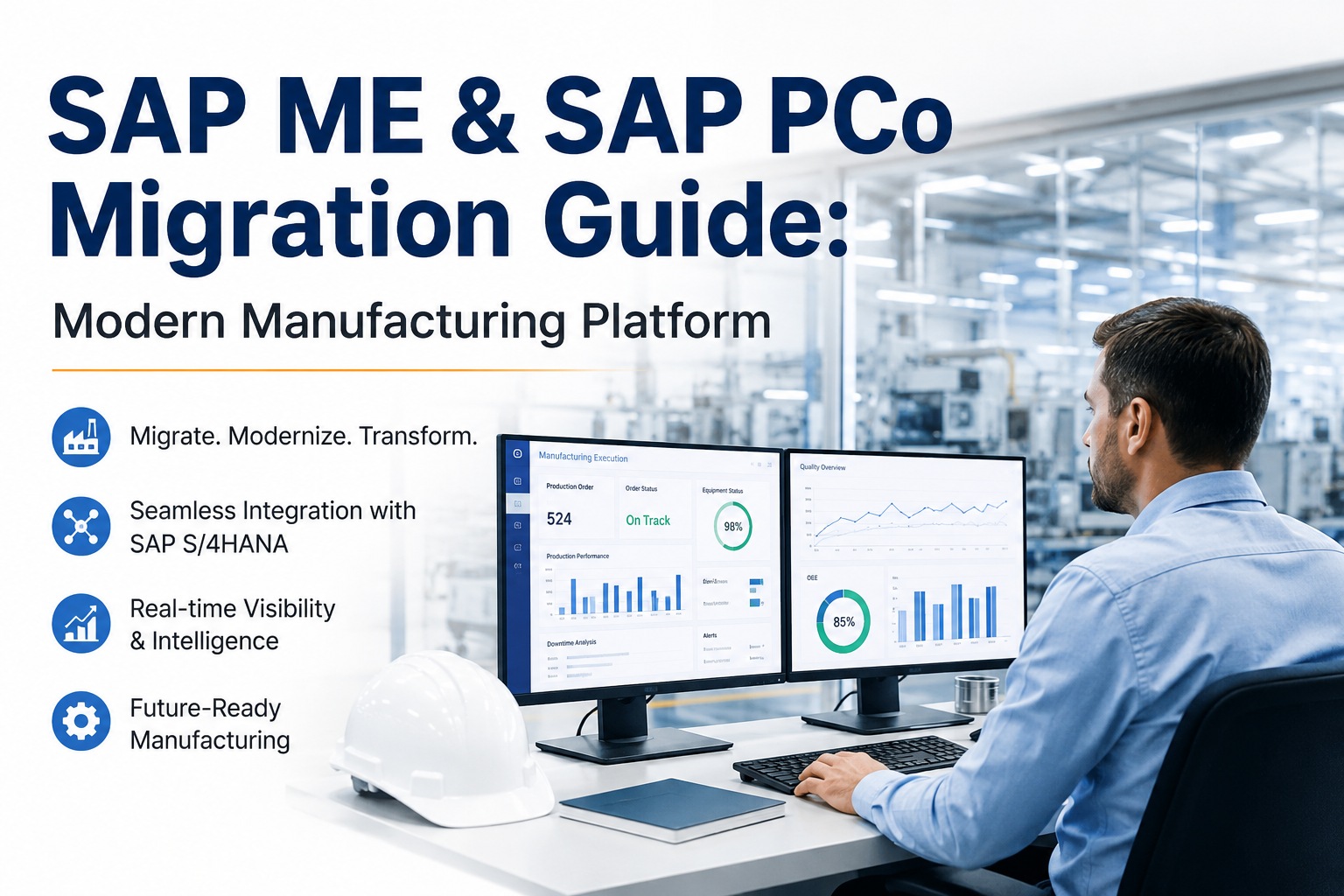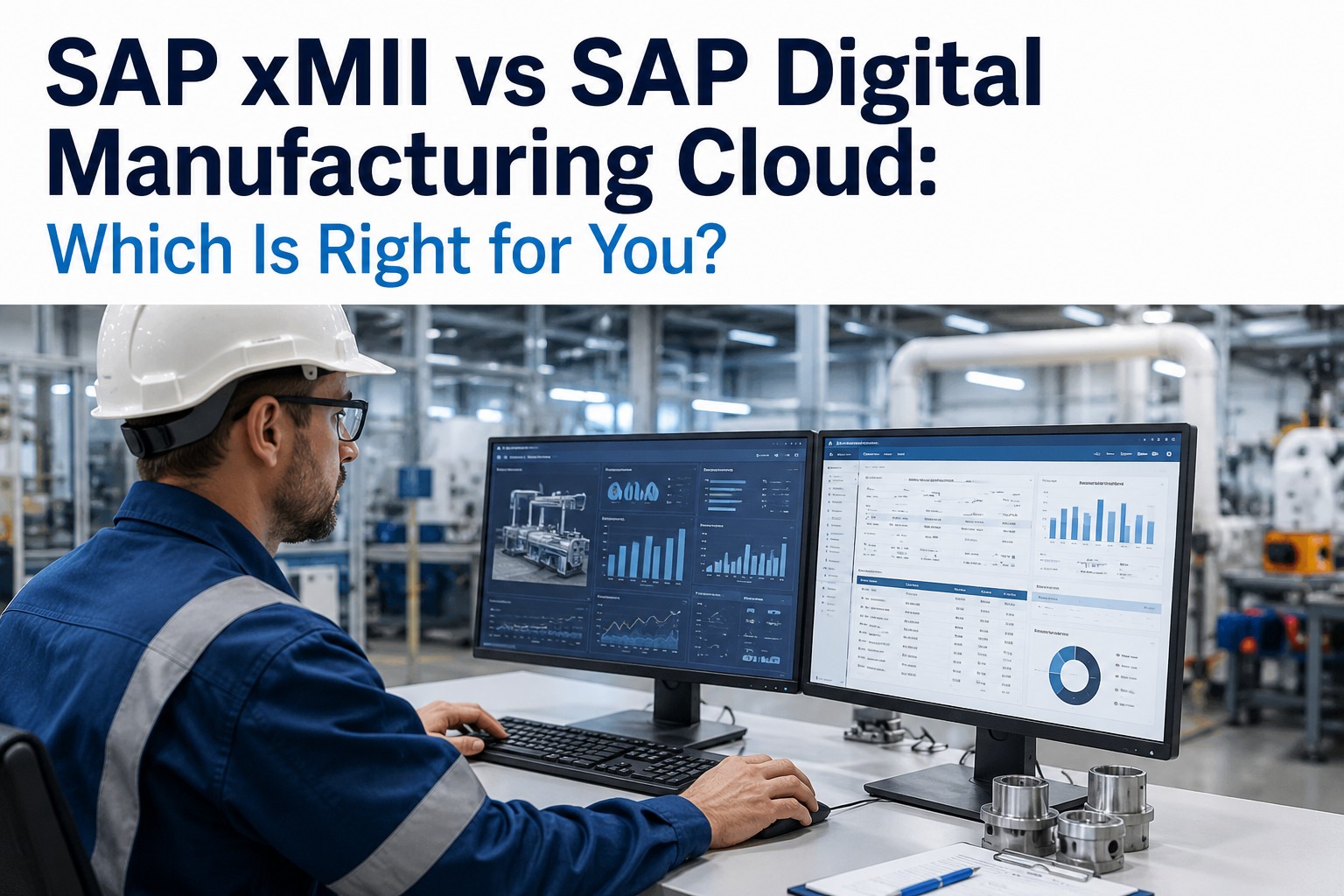
If you're running SAP MII (xMII) today, the clock is real — mainstream maintenance ends December 31, 2027, with paid extended support available until around 2030. SAP's recommended successor is Digital Manufacturing Cloud (SAP DM / DMC), but it's not a drop-in replacement. SAP DM is a clean-core, cloud-native MES with API-only access — meaning most of the custom logic that took years to build in MII has to be redesigned, not migrated. For some plants that's the right move. For others — especially those with deep customization, strict data residency rules, or a need for plant-floor AI — there's a third path. iFactory delivers an industrial AI-native platform that integrates with SAP S/4HANA directly, runs on a pre-configured NVIDIA on-prem appliance, OR in fully managed cloud — your choice. Here's the honest side-by-side.
SAP xMII vs SAP Digital Manufacturing Cloud: Which Is Right for You?
A real-world comparison of SAP xMII (sunsetting), SAP DM Cloud (SAP's recommended path), and iFactory's industrial AI platform — covering customization, AI capability, deployment options, and migration risk for manufacturers with SAP at the core.
The Decision in One Paragraph
SAP MII is sunsetting — sticking with it is a 24-month timer to either pay for premium extended support or be on an unsupported platform. SAP DM Cloud is the official path, and for plants with a standard SAP-centric shop floor and minimal customization, it covers the basics well. But SAP DM is not a like-for-like replacement — its clean-core architecture means heavy MII custom logic must be redesigned, not ported. iFactory is the third option — an AI-native industrial platform that integrates with SAP S/4HANA directly (replacing what MII did for ERP-to-plant integration) and adds the predictive, vision, and operator-copilot capabilities that neither MII nor SAP DM ship with. Available as a pre-configured on-prem NVIDIA appliance or as fully managed cloud, so data residency isn't forced on you.
Side-by-Side — The Detail That Matters
| Capability | SAP xMII (legacy) | SAP DM Cloud | iFactory |
|---|---|---|---|
| Architecture | On-prem, NetWeaver Java stack | Cloud-only, BTP, multi-tenant | On-prem AI appliance OR managed cloud |
| Support timeline | Mainstream ends Dec 2027; extended ~2030 | Active SAP product, ongoing | Active, no EOL on the roadmap |
| Customization model | Open — Java, JSP, direct DB access | Clean-core, API-only, drag-drop logic | Config + open APIs; no clean-core lock |
| Native AI & ML | None | Limited; embedded analytics via DMI | 9-model portfolio — LSTM, GNN, RL, CNN+PINN, autoencoder, LLM fusion |
| Data sovereignty | Maximum — all on-prem | Cloud-residency rules apply | Maximum on-prem; or region-locked cloud |
| SAP S/4HANA integration | Native via RFC, IDoc | Native, deepest fit | Certified — OData, CDS, ABAP RFC, BTP |
| Plant-floor connectivity | Native via PCo, OPC | Via SAP Production Connector (ProdCon) | OPC UA, MQTT, Modbus, Profibus, EtherNet/IP, S7 |
| Historian federation | Possible via custom dev | Limited, evolving | AVEVA PI, Wonderware InSQL, GE Proficy, Honeywell PHD, Yokogawa |
| Edge inference latency | N/A | Cloud round-trip dependent | <50ms on-prem with Jetson Thor / IGX Thor |
| Deployment timeline | Already deployed | Migration projects often 12–24 months | 6–12 weeks turnkey on either deployment |
| Replaces MII as MES? | Itself | Yes (SAP-recommended path) | No — works alongside or with SAP DM |
Three Real Use Cases — When Each Path Wins
The right answer depends on what's actually running in your plant today. Here are three patterns we see across customers, with the honest recommendation for each.
Heavy MII customization, GxP-bound, on-prem mandatory
A pharma API manufacturer running MII since 2010 with deep custom logic for 21 CFR Part 11 e-signature workflows, batch genealogy, and CMO data exchange. Cloud isn't an option — quality data has to stay on-prem under their validated state. SAP DM Cloud doesn't fit because it's cloud-only and the clean-core constraint would force redesigning years of validated GxP logic.
Light MII customization, multi-plant fleet, cloud-first IT strategy
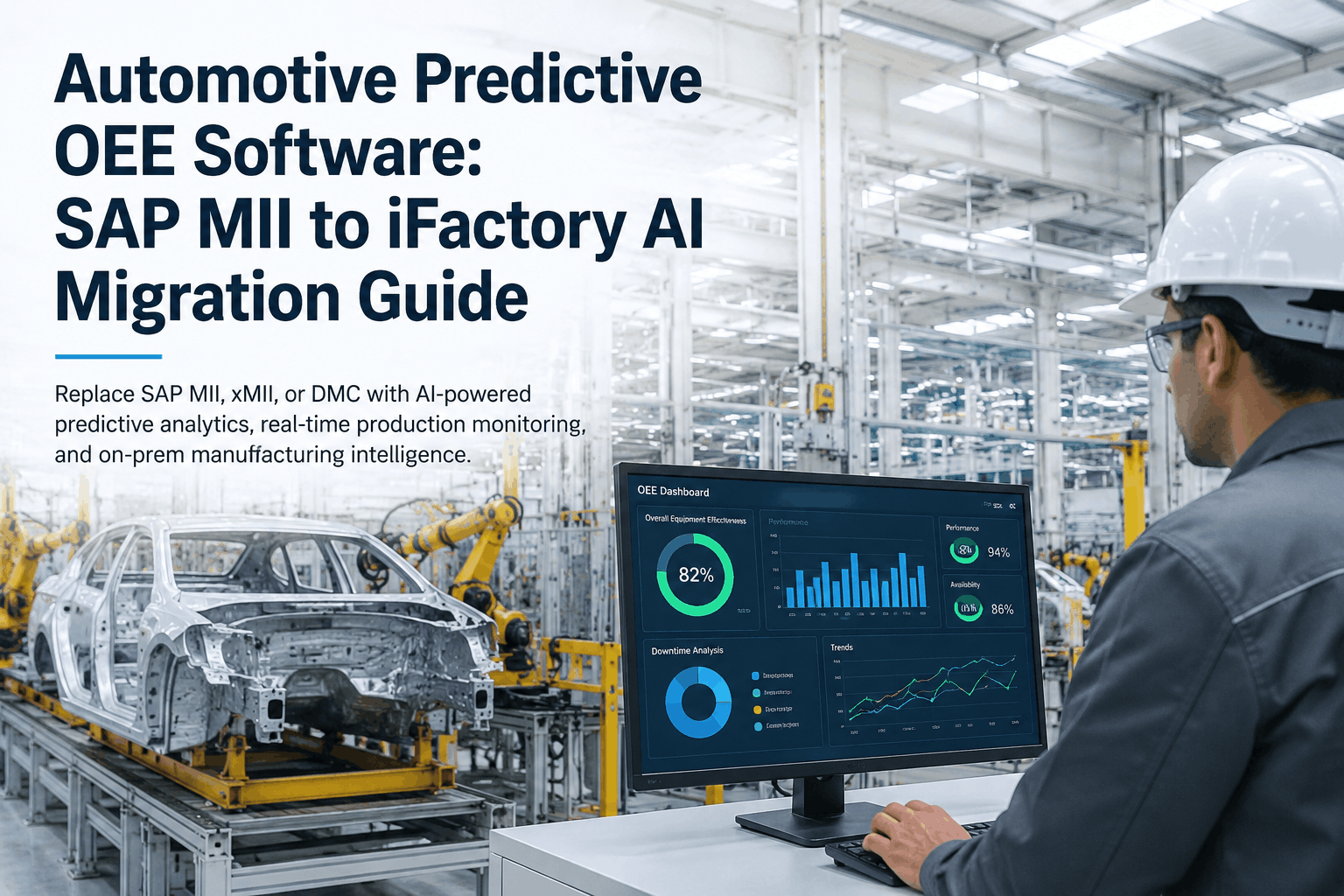
A Tier 1 automotive supplier with 8 plants across 4 countries. MII is mostly used for production reporting and OEE calculations — minimal custom code. The corporate IT strategy is cloud-first, plants are SAP-centric, and the company wants fleet-wide analytics rather than plant-specific solutions. Migration timeline is being driven by SAP DM's roadmap fit and customer-pull (their OEM customers expect cloud-native MES).
Decade of MII customization, complex process control, modernization on a budget
A specialty steel producer with 12 years of MII custom development — slab tracking, ladle metallurgy genealogy, custom OEE for caster/rolling mill, and integration with five different historians (PI, InSQL, Proficy, a homegrown SQL store, and OPC HDA). Rebuilding all of that in SAP DM is estimated at 18 months and seven figures. The pressure isn't just MII EOL — it's that the plant needs predictive maintenance, energy optimization, and a furnace vision system the current stack can't deliver.
The iFactory Difference — On-Prem AND Cloud, Same Stack
The defining gap in the SAP MII vs SAP DM debate is that one is on-prem-only and the other is cloud-only. Real industrial enterprises rarely fit that binary. iFactory delivers identical capability — 9-model AI portfolio, SAP S/4HANA integration, operator copilot, OPC UA + MQTT + historian federation — on either deployment, and supports hybrid mixes across multi-site operations.
iFactory On-Prem Appliance NVIDIA-powered, sub-50ms inference, your perimeter
- Pre-configured NVIDIA AI server — racked, software-loaded, ready to plug in.
- All production data stays inside the plant — no cloud round-trip.
- Works during WAN outages — local inference, local resilience.
- Best fit — regulated, GxP/IATF/IEC sites; sensitive IP; air-gapped operations.
iFactory Cloud Same stack, fully managed, no hardware
- Fully managed by iFactory — no rack, no facility requirements.
- Fastest deployment — first pipeline live in 2–4 weeks.
- Fleet benchmarking — multi-plant analytics in one tenant.
- Best fit — multi-site OEMs and Tier 1s; greenfield plants; cloud-first IT.
Don't pick a deployment model before you pick the architecture
The 60-minute migration assessment maps your current MII footprint, identifies what to retire, what to keep, and what to modernize — then recommends the right mix of SAP DM, iFactory on-prem, iFactory Cloud, or hybrid, with a concrete 12-week roadmap and ROI baseline.
Frequently Asked Questions
Does iFactory replace SAP MII?
Partly. iFactory replaces what MII did for SAP-to-plant data integration, time-series storage, and analytics — and adds AI capabilities (vision, predictive maintenance, RL scheduling, operator copilot) that MII never had. But iFactory is not an MES like SAP DM. If your MII deployment is primarily a production execution system, you'll want SAP DM or another MES. If MII is mostly your integration and analytics backbone, iFactory replaces that fully — on-prem or cloud, your call.
Can iFactory work alongside SAP DM Cloud rather than replace it?
Yes — this is one of the most common patterns. SAP DM handles MES execution (production orders, batch records, operator screens). iFactory layers on top for the AI portfolio that SAP DM doesn't ship — predictive maintenance, vision inspection, RL scheduling, vector RAG operator copilot, fleet benchmarking. Both connect to SAP S/4HANA directly. Most multi-site enterprises end up with this combination.
Do I have to buy NVIDIA servers separately?
No. iFactory's on-prem appliance ships fully loaded — pre-configured NVIDIA AI server (DGX, DGX Station, or HGX class depending on plant size), software pre-installed, network gear, cabling. You provide rack space, line power, and Ethernet. For the cloud option, there's no hardware at all — iFactory operates everything and you consume the AI through a browser and operator devices.
What if SAP extends MII support past 2030?
Even if SAP extends paid premium support beyond 2030 (possible but not announced), MII has had no new features since 2027 and runs on NetWeaver which is itself sunsetting. The risk isn't only EOL — it's increasing technical debt, integration friction with newer SAP products, and a shrinking pool of MII engineers. Most enterprises are using the 2027–2030 window to plan an exit, not to extend indefinitely.
How long does a typical iFactory deployment take vs SAP DM migration?
iFactory's turnkey on-prem or cloud deployment lands in 6 to 12 weeks. SAP DM migrations from a moderately customized MII environment typically run 12 to 24 months, including the 5-phase migration approach (assessment, preparation, development, testing, deployment). Light MII deployments can move to SAP DM in 6 to 9 months. Heavy customization can extend that further.
Can iFactory help us decide between staying on MII, moving to SAP DM, or hybrid?
Yes. The migration assessment is vendor-neutral on the MES question — if SAP DM is the right path for your plant, the recommendation says so, including which iFactory modules complement SAP DM. If a hybrid with MII running for legacy workflows and iFactory handling AI is better, the recommendation says that. Output is a concrete roadmap with timelines, costs, and what each option does for your specific operations.
SAP MII is ending. The right next step depends on your plant.
For some, that's SAP DM Cloud. For others, it's iFactory on-prem or cloud. For most multi-site enterprises, it's a hybrid. iFactory's 60-minute migration assessment gives you a vendor-neutral roadmap with concrete costs and timelines.