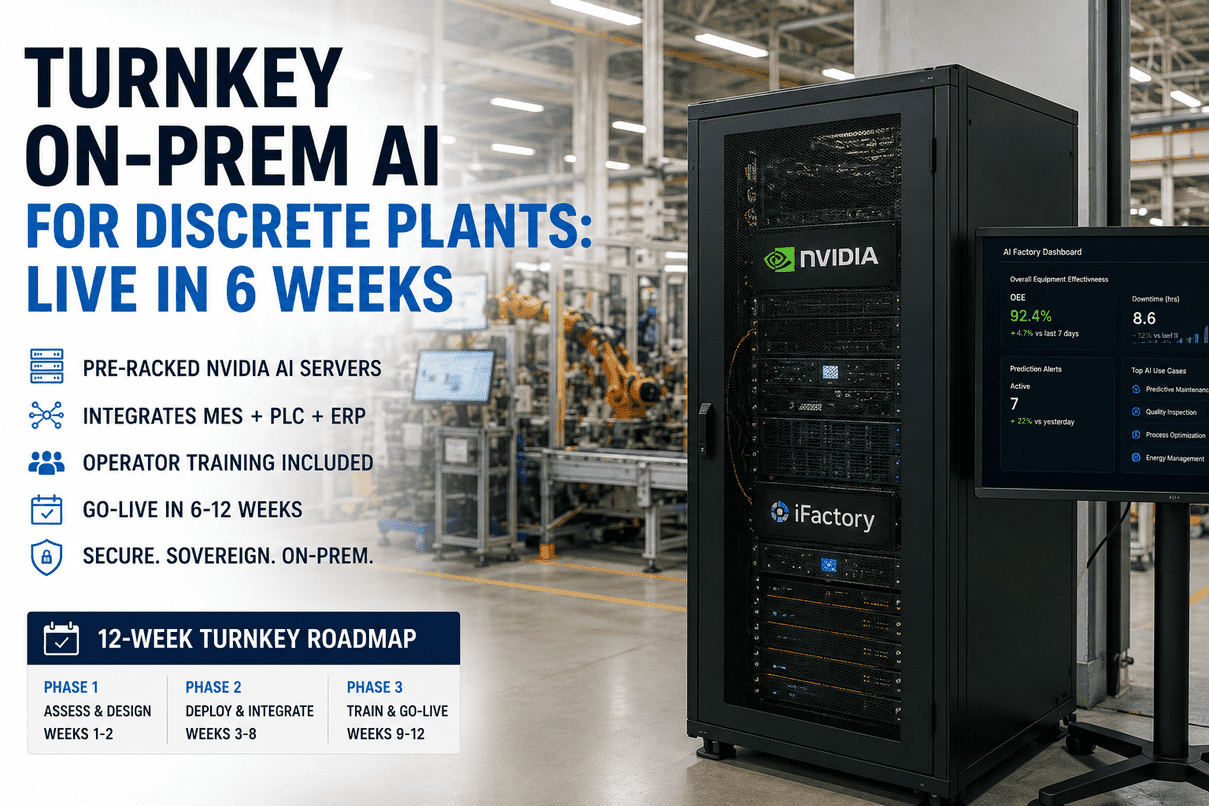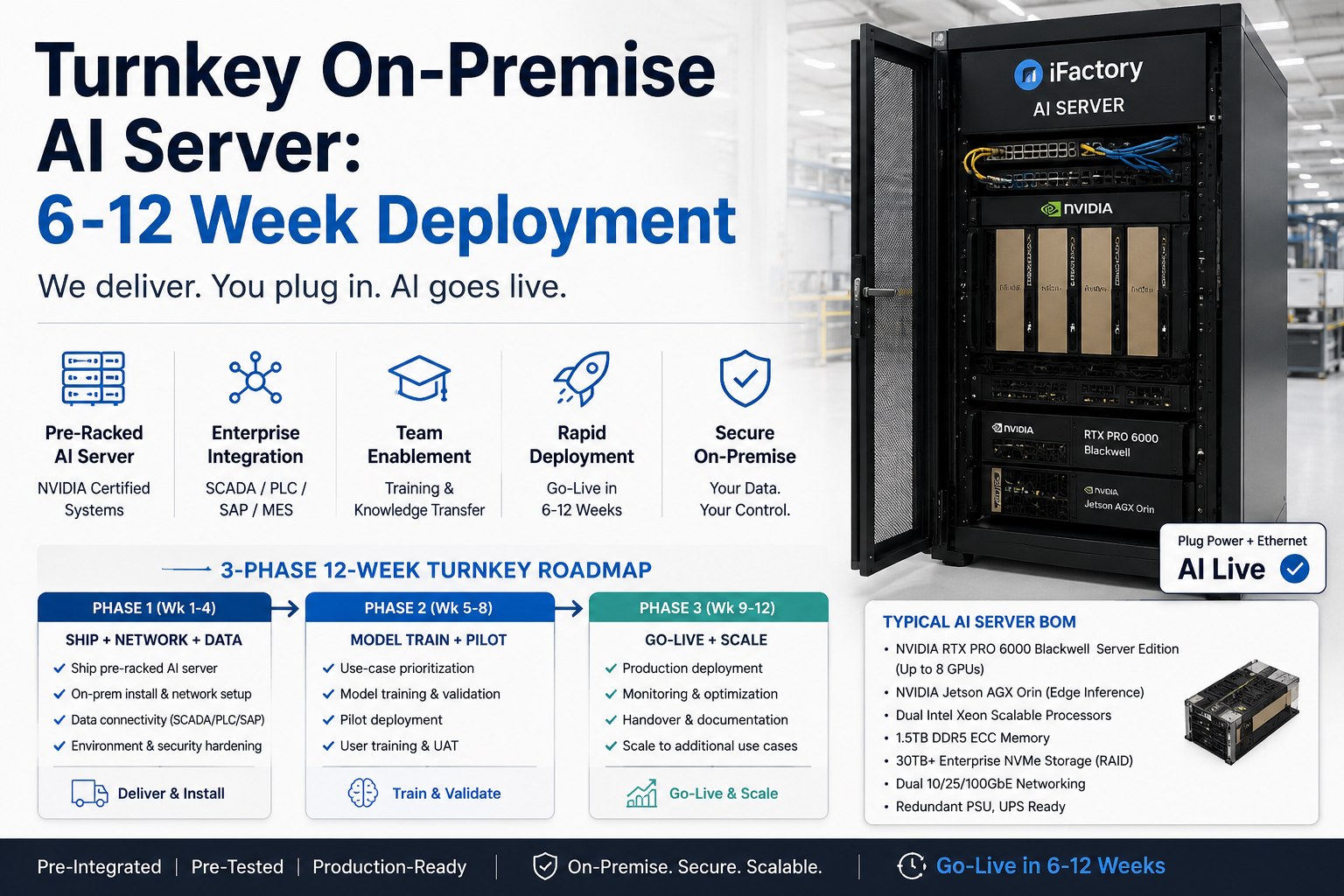
Most industrial AI vendors sell a model. iFactory delivers a working factory. The difference shows up in the parts of the deployment nobody puts in their pitch deck — the cable from the PLC panel to the OPC-UA gateway, the firewall rule that lets the historian write back, the SAP RFC that posts the work order, the operator who needs the dashboard explained on Tuesday's night shift. We do all of that. The customer signs one purchase order; our team handles wire, network, cybersecurity zoning, model training, ERP integration, validation evidence, and operator handover. Below is the architecture that makes "turnkey" a concrete claim instead of a marketing word — a process flow from raw wire on the floor to AI-native production, drawn end-to-end, with the human and machine handoffs visible at every stage. The on-prem server stack underneath is the same RTX PRO 6000 Blackwell + 2× NVIDIA AGX Orin appliance that runs every iFactory application.
From Wire On The Floor To AI-Native Production —
The End-To-End Turnkey Architecture
iFactory delivers the full chain: physical cabling from PLC and CCTV, OT network and cybersecurity zoning, on-prem AI server stack, model training on your data, ERP and SAP integration, validation evidence, and operator training. One PO; one go-live date; one team accountable for every wire and every screen. The architecture is drawn below — eight stages, three nodes, two human gates, zero hand-off gaps.
Industrial AI Doesn't Fail At The Model. It Fails Between Vendors.
A typical industrial AI procurement involves a model vendor, a hardware reseller, an OT integrator, an IT integrator, an SAP partner, and a managed-service provider. Each one delivers a perfectly correct slice, then waits for the next. The customer ends up project-managing the gaps. iFactory's end-to-end model removes the gaps by removing the vendors. Talk to our deployment lead about how this maps to your floor.
Hardware ships from one supplier, model from another, network from a third. Each integration boundary is a meeting, an escalation, a delay. Six months later, the model exists, the hardware exists, and they don't talk to each other. Customer's IT team becomes the unwilling integrator.
iFactory holds every link in the chain. Field engineers run the cabling. OT team builds the OPC-UA bridge. AI team trains the model. SAP team posts the work orders. Training team trains the operators. One Gantt, one go-live certificate, one phone number when something needs attention.
"AI platform" without delivery scope is a UI looking for data. Customer still sources hardware, still hires an OT integrator, still owns the gap. The platform's success metric is logins; yours is uptime on the floor. Different problem entirely.
Eight Stages From Plant Floor To AI-Native Production — Drawn
The architecture below is the actual delivery path. Eight stages, grouped into three logical layers — physical infrastructure, AI inference stack, and business consumption. Each stage shows what arrives, what leaves, who is responsible, and where the human-in-loop gates sit. The two AGX Orin edge nodes feed the RTX PRO 6000 Blackwell twin server; the twin server feeds the dashboards, ERP, and audit trail.
Field engineer on-site. Physical cable runs from your PLC panel to the AGX Orin gateway. RTSP feeds from existing CCTV pulled into Orin Node 2 — no new cameras. Industrial enclosure mounted on DIN rail in your control room.
Network zoning to the Purdue model — Level 2 control, Level 3 OT, Level 4 IT. iFactory drafts the zoning diagram and firewall rule set. Your IT/OT lead signs. Air-gapped from public internet by default.
Pre-racked AI server stack arrives burn-in tested. Field engineer racks, plugs power and Ethernet, runs commissioning script. RTX PRO 6000 Blackwell twin server + two AGX Orin gateways come up on your zoned network.
Orin Node 1 pulls PLC tags via OPC-UA at 1 Hz, less than 10 ms latency. Orin Node 2 decodes 8–16 RTSP streams in hardware. Both forward to the twin server. Historian write to PI / Aveva / Ignition at 500 ms cadence.
Application model runs on the Blackwell twin server. Steady-state filter, model inference, SHAP attribution, confidence scoring. Output goes to two places: a recommendation queue for human review, and the audit-trail writer for retention.
Engineer reviews the recommendation, SHAP factors, safety thresholds. For control adjustments, operator commits manually in the DCS or BMS. For regulated records, QA signs in the eBR system. AI never writes to PLC. AI never signs records. Boundary is architectural.
Real-time dashboards for shift floor, engineering desk, and management review. KPIs, recommendations, model confidence, recent decisions, audit trail snapshots. Mobile-responsive for shift supervisors. Same data, different views per role.
Approved actions flow into the systems your business already runs on. Work orders into SAP / Oracle / IFS. eBR drafts into Werum / Körber MES. Deviations into Veeva / MasterControl QMS. Materials and finance posted to the right ledgers automatically.
Every operator turn, model output, human gate decision, and downstream posting written to an immutable audit trail. 21 CFR Part 11 aligned where regulated. URS, FS, IQ, OQ, PQ documentation maintained as live deliverables for your validation team.
Why three layers, not one: separation of concerns is what makes the architecture audit-ready. Physical infrastructure is owned by your IT/OT and our field team. AI inference is owned by our AI team. Business consumption is owned by your enterprise systems and our SAP team. Each layer has clear inputs, clear outputs, and clear sign-off — which is what regulators, auditors, and your own validation team look for. Walk through the architecture.
A Real RACI Chart, Not A Marketing One
A RACI chart that says iFactory is "Responsible" for everything is a chart that hides the real work. Below is the actual division of labour for an end-to-end deployment. Where you appear, you appear. Where we appear, we appear. Where both of us appear, we agree on the boundary at PO and write it into the contract.
| Activity | iFactory | Your IT / OT | Your Operations | Your Validation / QA |
|---|---|---|---|---|
| Cabling, racking, power-up | Responsible | Consulted | Informed | Informed |
| OT network & IEC 62443 zoning | Drafts & executes | Accountable & signs | Informed | Informed |
| OPC-UA, RTSP, historian config | Responsible | Consulted (credentials) | Informed | Informed |
| Model training on your data | Responsible | Informed | Consulted (edge cases) | Informed |
| Safety thresholds & permit limits | Encodes | Informed | Accountable & signs | Consulted |
| SAP / MES / QMS integration | Responsible | Accountable (sandbox + UAT) | Informed | Informed |
| Validation evidence (URS / FS / IQ / OQ / PQ) | Drafts | Informed | Informed | Accountable & signs |
| Operator & engineer training | Delivers (3 days on-site) | Informed | Accountable (attendance) | Consulted (regulated SOPs) |
| Approve setpoint adjustments / sign records | Never | Informed | Accountable | Accountable (regulated) |
| Year-1 monitoring & recalibration | Responsible | Consulted (patches, change windows) | Informed | Informed |
| Year-2 onwards (your choice) | Optional support | Accountable if in-house | Informed | Informed |
Six Things That Are True On An AI-Native Floor — And Six That Aren't
"AI-native" is one of those terms that means whatever the person using it wants. We use it specifically. An AI-native floor has six concrete properties listed in the left column. It does not have the six properties in the right column — those are the dystopian-vendor-pitch version, and they're either not real or not safe in regulated industrial environments.
Three Boxes Run The Whole Architecture — Same Stack, Every Application
The architecture above doesn't change between deployments. The three boxes that run it don't either. Whether the application is hearth wear forecasting, eBR drafting, operator copilot, or excess-O2 trim — same RTX PRO 6000 Blackwell twin server, same two AGX Orin edge gateways, same delivery model.
What Plant Managers, COOs & IT Directors Ask About End-To-End Scope
Yes. Our field engineers run the physical cable from your PLC panel to the AGX Orin gateway, mount the industrial enclosure on DIN rail, and pull RTSP feeds from existing CCTV. We don't sub-contract the wire to a separate integrator — same engineers who racked your appliance handled the cable. One phone number for the whole layer.
Then they own it. Our deployment model is flexible at the IT/OT boundary — we'll either draft the IEC 62443 zoning diagram and execute it, or we'll review your team's plan and integrate against it. Either way, your IT/OT lead signs off before anything goes live. Most customers prefer we draft and execute; some IT teams prefer to own the network. Both work.
Phase 3 of the deployment includes the ERP tie-in. For SAP S/4HANA or ECC, we use standard BAPIs / RFCs to post work orders, materials movements, and finance entries. Oracle EBS, IFS Cloud, Microsoft D365, Infor, and Epicor are similarly integrated through their standard APIs. Our enterprise team handles the development; your SAP team owns sandbox + UAT acceptance. Posting is always to a draft state requiring human approval before commit.
The architecture is designed against IEC 62443, NIST 800-82, and GAMP 5 Second Edition by default. Audit trails are 21 CFR Part 11 aligned for regulated environments. Read-only credentials to source systems by default. Air-gapped from public internet by default. SOC 2 Type II report available under NDA. We hand over the security architecture documentation as a deliverable at week 12 — your SOC and compliance teams have a single document set to reference.
Yes — most customers do. The first deployment establishes the architecture, network zoning, and integration patterns. Subsequent lines or sites reuse the patterns and run faster. The hardware can either scale (one appliance per site) or centralise (one appliance serving multiple lines), depending on data volume and latency requirements. We Gantt the multi-site rollout at PO with clear go-live dates per location.
The full three-node stack is racked and running at SAP. You can walk the architecture stage by stage with our deployment team, see the dashboards, ask about your specific environment, and leave with a draft Gantt for your floor.We run remote walk-throughs against the same stack on request.
Want To Walk The Architecture Live?
The full eight-stage architecture — wire ingest, edge inference, twin server, dashboards, ERP posting — running on the actual three-node stack at the iFactory booth at SAP. Bring your floor profile and the application you want to start with. Our deployment lead walks the architecture stage by stage and sketches a 12-week Gantt for your environment.