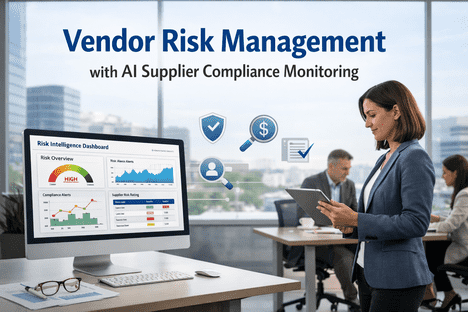
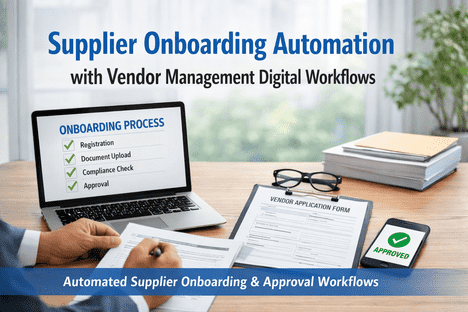
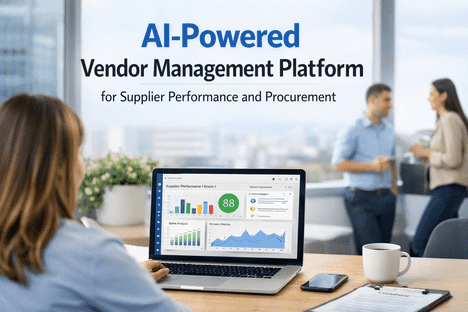
A Tier-1 supplier files for bankruptcy and it takes your procurement team 11 days to notice. A Tier-2 vendor quietly fails a cybersecurity audit, and six months later their breach becomes your data incident. A Tier-3 component supplier is sanctioned in a geopolitical crisis, and you find out when customs holds your shipment. None of these were hidden — every single one was broadcast across public financial, regulatory, cyber, and geopolitical data sources. The only reason they blindsided the plant is that nobody was watching. AI-powered vendor risk management replaces that blind spot with continuous, multi-signal monitoring across every supplier in your base — financial health, cyber posture, compliance status, ESG rating, sanctions exposure, geopolitical volatility — so risk becomes something you manage, not something that manages you.
24/7
Continuous Risk Monitoring
6
Risk Dimensions Tracked Per Supplier
90 Days
Early Warning Before Failure Events
$4.5M
Avg Cost of a Single Supplier Incident
Why Traditional Risk Management Fails at Scale
Most procurement teams manage risk the way they did a decade ago: annual vendor reviews, a spreadsheet of Tier-1 suppliers, and a reactive posture when something breaks. The problem is that supplier risk has changed. It moves faster, spans more dimensions, and originates from supply chain tiers where most teams have zero visibility. By the time a quarterly review catches a problem, the problem has already cost money. AI-powered monitoring shifts the posture from quarterly to continuous, from Tier-1 only to full supplier base, and from reactive to predictive.
Critical
Meridian Electronics Ltd
Cyber Risk
Security rating dropped 180 points after public breach disclosure. 3 active POs at risk.
2 minutes ago · Action required
High
Pacific Casting Works
Financial
D&B credit score declined 2 tiers over 60 days. Payment delays reported by 3 industry peers.
14 minutes ago · Review recommended
Medium
Helix Components GmbH
Compliance
ISO 9001 certificate expires in 23 days. Renewal evidence not yet submitted.
1 hour ago · Auto-reminder sent
Medium
Cascade Industrial Supply
Geopolitical
Operating region flagged for new export controls. Sourcing alternates suggested.
3 hours ago · Intelligence update
Low
Northfield Gasket Co
ESG
Sustainability rating upgraded following audit. No action required.
6 hours ago · Logged
Every alert above is the kind of signal that used to surface weeks later — if it surfaced at all. Book a 30-minute demo and we'll run iFactory's risk engine against a sample of your current supplier base and show you what it surfaces in the first 10 minutes.
The Six Risk Pillars Every Supplier Is Scored On
Supplier risk is not a single number — it is a composition of six independent dimensions, each with its own signals, speeds, and mitigation paths. An AI platform maintains live scores across all six for every supplier in your base, not just the strategic few. Here is what gets monitored, and how each category contributes to the overall risk posture.
Financial Risk
Credit scores, bankruptcy flags, payment delays, revenue trends, and ownership changes pulled from D&B, Bloomberg, and public registries.
D&B ScorePayment BehaviorRevenue Trend
Cyber Risk
Security ratings, breach history, dark web exposure, vulnerability disclosures, and SOC 2 status monitored through continuous scanning of external signals.
Security RatingBreach HistorySOC 2 Status
Compliance Risk
Certification expirations, audit findings, regulatory changes, and industry-specific requirements tracked through accreditation body APIs and document AI.
ISO/IATF StatusAudit FindingsRegulatory Scope
Operational Risk
Delivery performance, quality acceptance rates, capacity constraints, and dependency concentration analyzed from your own transaction data.
OTIF PerformanceQuality PPMCapacity Fit
Geopolitical Risk
Sanctions exposure, export control changes, political stability, and conflict zone proximity monitored via OFAC, EU, UN, and intelligence feeds.
SanctionsExport ControlsRegion Stability
ESG Risk
Sustainability ratings, labor practices, environmental violations, and social governance metrics tracked through ESG data providers and news monitoring.
ESG RatingLabor PracticesEnvironmental
The Incident Pyramid: Why Small Signals Matter
For every supplier incident that makes the news, there are dozens of quieter signals that preceded it. Missed payments before bankruptcy. Minor audit findings before a full failure. Employee complaints before regulatory action. AI-powered monitoring reads the bottom of the pyramid so you never have to face the top. Here is the classic risk escalation hierarchy — and why catching signals early is the entire game.
Bankruptcy, breach, sanctions, recall. Six-to-seven-figure cost. Media exposure.
Delivery failures, quality escapes, compliance lapses, credit downgrades affecting operations.
Declining scorecards, late payments, slipping certifications, process deviations.
Minor rating shifts, news mentions, ownership changes, executive departures, social chatter.
Why It Matters
Humans catch the top of the pyramid. AI reads the base — thousands of weak signals per month — and flags the ones that statistically predict escalation. Catching risk at tier 4 is cheap. Catching it at tier 1 is a crisis.
Read the Signals Before They Become Incidents
Your Next Supplier Crisis Is Already Broadcasting. Start Listening.
iFactory continuously monitors every supplier in your base across six risk dimensions — surfacing weak signals weeks or months before they escalate into disruptions. Built for procurement leaders who want to manage risk, not be surprised by it.
Continuous Monitoring: What 30 Days Actually Looks Like
Continuous monitoring is not a buzzword — it is a measurably different rhythm. Traditional reviews happen 4 times a year. AI-powered monitoring runs constantly and generates structured insights at the cadence of real-world events. Here is a representative 30-day trail across a single supplier, showing the density of signals a modern platform captures — and misses captured under manual review.
Day 1
Day 7
Day 14
Day 21
Day 30
Weak signal · logged
Moderate · review flagged
High · escalation triggered
Manual Quarterly Review
1 check per 90 days
Most signals invisible until after the fact
AI Continuous Monitoring
~15 signals per 30 days
Every event captured, classified, and scored
That cadence difference is the entire value proposition. Book a demo and we'll show a live 30-day risk trail for a representative supplier in your category — the signals you're missing right now, and what your team would do with them.
Compliance Frameworks Covered Out of the Box
Vendor risk management must carry compliance weight. That means more than a dashboard — it means structured support for the frameworks your auditors, regulators, and executive sponsors expect. Modern platforms align to the governance standards that matter, reducing audit preparation from a two-week scramble to a one-click export.
ISO 27001 / 27036
Information security management and supplier relationship controls — full evidence capture and audit trail for third-party risk management.
Full Coverage
SOC 2 Type II
Service organization controls for security, availability, processing integrity, confidentiality, and privacy — with supplier attestation workflow built in.
Full Coverage
NIST 800-161
Cybersecurity supply chain risk management practices aligned to NIST standards — tiered assessment depth by supplier criticality.
Full Coverage
GDPR & CCPA
Data processing agreements, data subject flows, and privacy impact tracking across suppliers handling personal information.
Full Coverage
OFAC / EU / UN Sanctions
Continuous sanctions screening with automated alerts on new listings, expanded controls, or ownership changes affecting compliance status.
Full Coverage
Industry Specific
FDA 21 CFR Part 11, IATF 16949, AS9100, HACCP, and other vertical standards with tailored assessment templates and evidence structures.
Configurable
The Business Case for AI Risk Monitoring
Risk programs are often the first thing cut and the last thing built up — because their value shows only in the absence of crises. AI-powered monitoring changes that conversation by quantifying avoided costs in concrete terms that finance leaders accept. Here is the value accounting that turns "we should do this" into a funded initiative.
$2-5M
per avoided supplier failure
Single-event costs of bankruptcy, breach, recall, or regulatory action typically land in millions. Avoiding one per year pays for a decade of monitoring.
100%
of supplier base monitored
Manual programs cover 5-10% (top suppliers). AI programs cover every supplier, every day, across six dimensions — the long tail is where most surprises originate.
85%
reduction in audit prep time
Evidence is captured as a byproduct of monitoring. Audit packages generate in minutes. Compliance conversations move from defense to documentation.
3-5x
analyst productivity
Risk analysts stop chasing signals manually and start acting on curated intelligence. A team of 3 can cover what used to require 10 in manual mode.
60-90 days
advance notice typical
Statistical models trained on thousands of supplier failures identify patterns that precede disruption, giving your team the time to act, not just react.
30 Days
to first actionable insight
Load your supplier base on day one. First risk signals surface within the week. First avoided incident usually arrives within the first quarter.
Live Risk Trial · Your Actual Suppliers
Let's Find the Risks Your Current System Is Missing.
Bring a list of 20 suppliers to the demo. We'll run them through iFactory's risk engine in real time and show you the signals, ratings, and exposures your current tools aren't surfacing — with zero commitment and zero setup on your side.
Frequently Asked Questions
What is AI-powered vendor risk management?
AI-powered vendor risk management uses machine learning, external data feeds, and continuous scanning to monitor every supplier across financial, cyber, compliance, operational, geopolitical, and ESG dimensions. It replaces annual reviews and tier-1-only coverage with 24/7 monitoring across your entire supplier base — surfacing early warning signals weeks or months before disruptions occur.
How is this different from our existing procurement risk review?
Traditional programs review a subset of suppliers on a quarterly or annual basis using static questionnaires. AI platforms monitor continuously, pull live external signals that questionnaires never capture, and cover every supplier regardless of tier. The typical organization discovers 2-3 significant risk exposures in the first 30 days that their existing program completely missed.
What data sources feed the AI risk models?
Standard sources include D&B financial data, Bloomberg, SecurityScorecard and BitSight cyber ratings, OFAC and EU sanctions lists, ESG rating providers (EcoVadis, MSCI), regulatory databases, industry certification registries, news and social monitoring, and internal transaction data from your ERP and CMMS. The platform correlates across these signals to detect patterns no single source would catch alone.
How quickly can we deploy a risk monitoring program?
A typical deployment runs 4 to 8 weeks — covering supplier data import, risk scoring configuration, alert routing setup, and ERP integration. First actionable signals typically appear within days of go-live, and teams usually identify their first avoidable exposure within the first 30 days of operation.
Can we cover Tier-2 and Tier-3 suppliers, not just Tier-1?
Yes — and this is often where the highest value is found. Most crises originate in lower tiers precisely because traditional programs don't monitor them. AI platforms apply lighter-weight but still continuous monitoring across the long tail, using the same external signals that drive Tier-1 assessments. Coverage expands as you grow, not as you hire.
How does this integrate with our existing compliance frameworks?
Leading platforms align out of the box to ISO 27001, ISO 27036, SOC 2, NIST 800-161, GDPR, CCPA, and industry-specific frameworks like FDA 21 CFR Part 11, IATF 16949, and AS9100. Evidence is captured in formats auditors expect, with tamper-proof logs and e-signatures. Audit preparation compresses from weeks to hours.