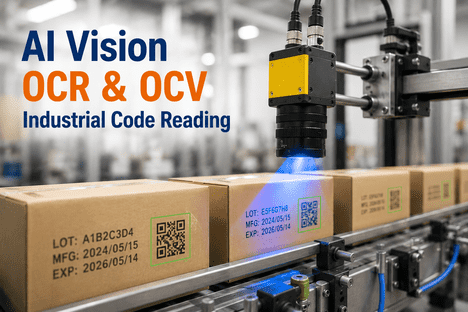
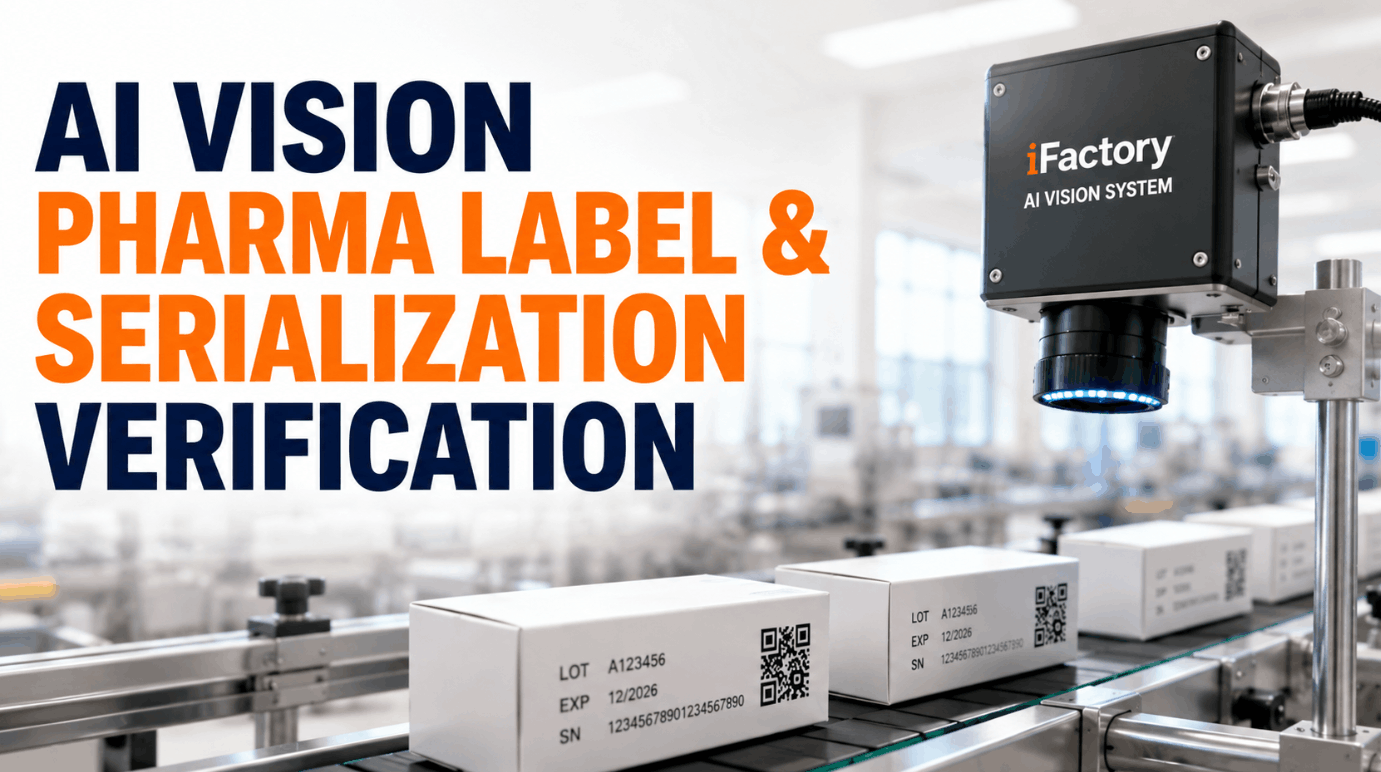
Every manufactured product that carries a lot code, batch number, expiry date, serial number, or regulatory text depends on those characters being present, correct, and legible — not just at the point of printing, but at every point downstream where a regulator, a customer, or an automated track-and-trace system needs to read them. A confectionery manufacturer in Germany printed 620,000 units of a seasonal product without a legible date code after an inkjet coder ribbon failure went undetected for four hours — because the plant's manual date code check had sampled 40 units at the start of the ribbon change and then proceeded on assumption. The batch was quarantined at the distribution centre at a cost exceeding €340,000 in product write-off, re-labelling, and audit preparation. This is not an edge case — it is the predictable consequence of applying sampling-based, human-dependent code verification to production lines running at 300 to 600 units per minute, where an inkjet nozzle clog, a thermal transfer ribbon exhaustion, a laser engraver power drift, or a printing plate misalignment can propagate through thousands of units before the next manual check catches it. iFactory's AI vision OCR and OCV inspection platform closes this verification gap permanently by reading and verifying every lot code, batch number, expiry date, serial number, and regulatory text field on every unit at full line speed — detecting absent codes, faded characters, smeared print, incorrect date formats, wrong batch references, and character merge anomalies in real time, on curved surfaces, low-contrast substrates, and variable-lighting environments where conventional rule-based OCR consistently fails.
AI VISION OCR · OCV VERIFICATION · LOT CODE READING · INDUSTRIAL TRACEABILITY
Read and Verify Every Lot Code, Batch Number, and Expiry Date at Line Speed — On Any Surface
iFactory's AI vision OCR and OCV platform verifies lot codes, batch numbers, expiry dates, serial numbers, and regulatory text on every unit at full production speed — on curved packaging, low-contrast substrates, and challenging print surfaces where rule-based OCR systems generate false reads and missed codes.
What AI Vision OCR and OCV Deliver in Industrial Code Verification
Industrial OCR — Optical Character Recognition — reads printed, engraved, or embossed text and converts it to machine-readable digital data. Industrial OCV — Optical Character Verification — compares that reading against an expected value: the correct batch number for the current production run, the expiry date format mandated by the applicable regulation, the serial number range active in the current job configuration. Together, OCR and OCV close the complete code quality verification loop: every character is read, every reading is verified, every deviation generates a reject signal and a time-stamped digital record — without manual transcription, without sampling gaps, and without the reading errors that human visual inspection introduces at production line speed.
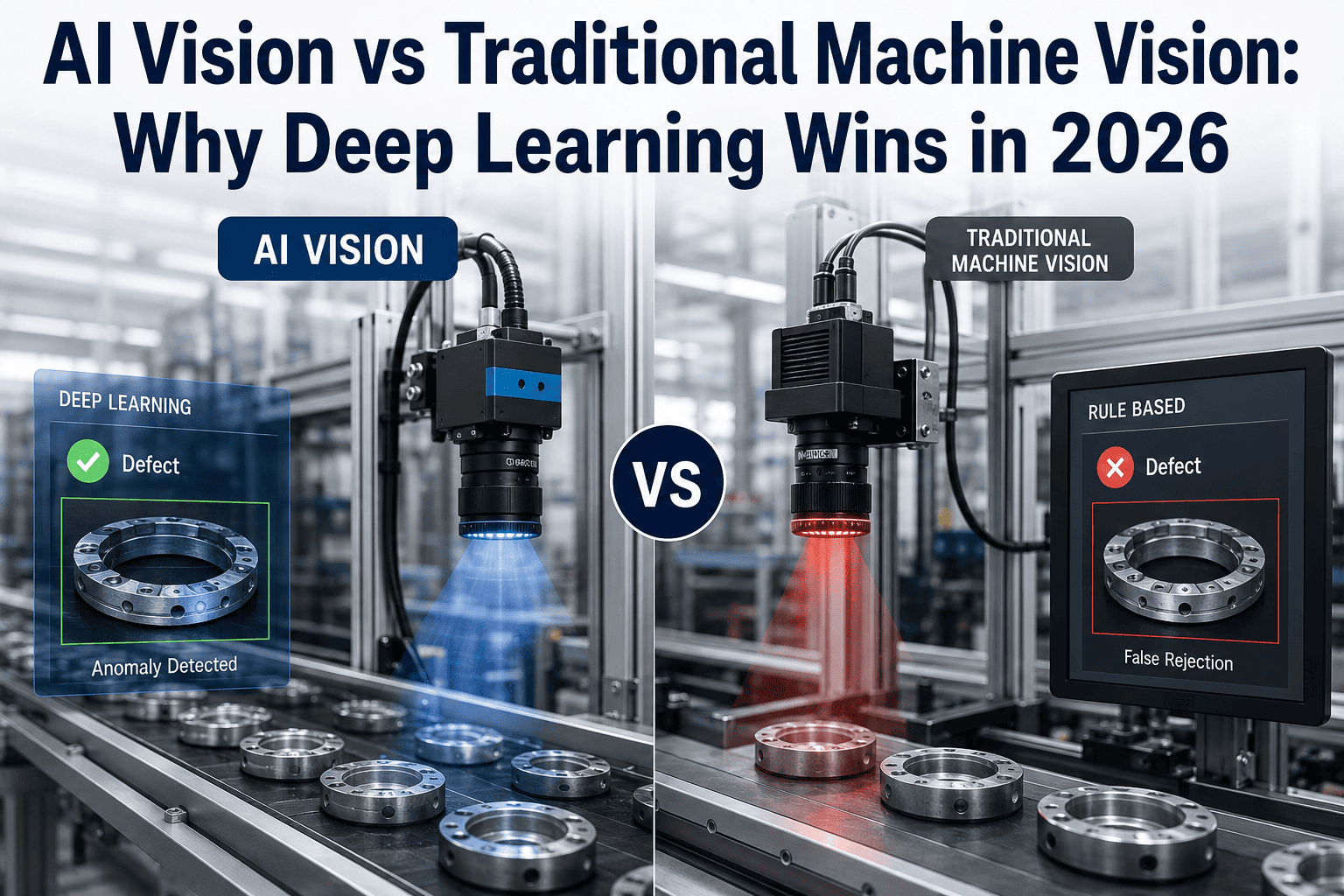
The critical distinction between rule-based OCR and AI-powered OCR is adaptive performance under real production conditions. Rule-based systems apply fixed character segmentation and threshold algorithms calibrated in laboratory conditions — and degrade in performance as ink viscosity varies across a production shift, as substrate reflectance changes between packaging SKUs, as print head temperature rises through extended operation, and as characters on curved surfaces or flexible packaging distort under imaging. AI OCR models learn the normal variation range of text appearance across printers, materials, and environmental conditions — maintaining consistent read accuracy where rule-based systems generate escalating false reject and missed read rates. Pharmaceutical quality managers, food safety officers, and automotive traceability engineers ready to see this performance difference demonstrated on their specific code formats and substrate types can Book a Demo with iFactory's OCR inspection specialists.
99.5%
OCR read accuracy achieved at line speed across lot codes, expiry dates, and serial numbers on curved and low-contrast surfaces
100%
unit-level code verification coverage — replacing 1-in-300 manual sampling with per-unit confirmation on every code field
<200ms
read-verify-reject cycle time per unit — enabling real-time code verification at 600+ units per minute without line speed reduction
38%
of pharmaceutical and FMCG recalls involve labelling and coding failures detectable by 100% AI OCR verification at the packaging line
Root Cause Analysis
Why Industrial Code Verification Failures Still Occur at Scale
Code verification failures — misprinted lot codes, absent expiry dates, wrong batch references, illegible serial numbers — are among the most common and most expensive quality events in manufacturing. They generate regulatory enforcement actions, supply chain disruptions, and product recalls that cost manufacturers tens of millions of dollars annually across pharmaceuticals, food and beverage, automotive, and electronics industries. The root causes are structural rather than procedural — they cannot be eliminated by better operator training or more frequent sampling, because they originate in the inherent limitations of the inspection architectures deployed on most production lines in 2026. iFactory's AI vision OCR platform addresses each of these structural failure modes directly.
01
Sampling Gaps Between Manual Verification Checks
At 500 units per minute, manual date code verification sampling 2 units every 15 minutes means 14,940 units pass uninspected between checks. An inkjet coder nozzle that clogs at unit 3 of a 15-minute interval produces 14,997 units with a missing or partial code before the next manual check. This is not a low-probability scenario — coder failures causing incomplete or absent codes are among the most frequently reported packaging line quality events in the food, pharmaceutical, and consumer goods industries. AI OCR covers every unit, eliminating the sampling interval window in which coder failures propagate to thousands of shipped units before detection.
02
Rule-Based OCR Degradation Under Production Variability
Conventional rule-based OCR systems are calibrated to a specific ink type, substrate reflectance, and printing resolution at the time of setup — and performance degrades as those conditions change during production. Ink viscosity shifts with temperature across a production shift. Substrate reflectance varies between packaging material batches from different suppliers. Print head nozzle wear reduces resolution gradually across a production run. Rule-based systems do not adapt to these changes — they generate escalating false reject rates that operators learn to override, or missed reads that escape as uninspected units. AI OCR models learn the variation range of acceptable code appearance and maintain consistent read accuracy as production conditions drift.
03
Curved and Low-Contrast Surfaces Defeat Standard Imaging
Lot codes and expiry dates are frequently printed on cylindrical containers, flexible pouches, embossed closures, and metallic foil surfaces — all of which present imaging challenges that conventional rule-based OCR handles poorly. Curved surfaces distort character geometry relative to the camera focal plane. Low-contrast printing on metallic or translucent substrates reduces the pixel intensity differential that threshold-based segmentation requires. Embossed or debossed characters on moulded packaging eliminate the colour contrast that printed character recognition depends on entirely. iFactory's AI OCR models are trained on code images from these challenging surface types — maintaining read accuracy on curved packaging, low-contrast substrates, and direct part marking applications where rule-based systems consistently fail.
04
Verification Without Context — OCR Without OCV
Many production lines deploy OCR that reads codes but does not verify them against the active production batch parameters — detecting that a code is present and legible but not confirming that it contains the correct batch number, the correct expiry date for the current production run, or the serial number range active in the current job configuration. A system that reads "LOT: A24B" and confirms legibility without checking whether A24B is the correct lot for the batch currently being packaged provides no protection against wrong-lot coding events — the failure mode most likely to generate a Class II recall in pharmaceutical and food production environments. iFactory's OCV layer compares every OCR reading against the active production record, rejecting any unit where the code content does not match the expected value for the current batch.
Platform Capabilities
Five Core OCR and OCV Capabilities of iFactory's Industrial Vision Platform
iFactory's AI vision OCR and OCV inspection platform is designed for cross-industry deployment across pharmaceutical packaging, food and beverage labelling, automotive component marking, electronics serialization, and consumer goods traceability programmes. Each capability delivers verified code reading against production batch parameters at full line speed, with automatic reject integration and time-stamped digital records that satisfy the traceability documentation requirements of FDA 21 CFR Part 11, EU GMP Annex 11, BRC Global Standard, FSSC 22000, and customer-specific supply chain quality agreements. Manufacturers who want to see all five capabilities demonstrated on their specific code formats and packaging substrates can Book a Demo with iFactory's OCR inspection team.
01
Lot Code and Batch Number OCR Verification
iFactory's OCR engine reads lot codes and batch numbers on every unit at line speed, verifying the read against the batch number active in the current production job. Alphanumeric lot codes in inkjet, thermal transfer, laser engraved, and label-printed formats are recognised across variable character spacing, partial smearing, and substrate texture variation. OCV verification confirms that the read batch number matches the expected batch identifier — flagging any unit where the code is absent, partially illegible, or contains a batch reference that does not match the active production record. Every verification event is logged with the unit identifier, read result, verification status, and timestamp for the complete traceability audit trail.
02
Expiry Date and Best Before Date Reading and Format Verification
Expiry date and best before date reading covers all standard date format conventions — DD/MM/YY, MM/DD/YYYY, YYYYMMDD, Julian date, and customer-specific abbreviated formats — with format verification confirming that the read date matches the expected format specification and passes a plausibility range check against the active batch parameters. Missing date codes, date format non-conformances, and out-of-range dates are flagged and rejected automatically. The plausibility check prevents a common date coder failure mode — where a date advances to the wrong year or falls outside the permitted shelf life window for the product — from propagating to shipped units without detection. This single capability addresses the most frequent cause of FMCG and pharmaceutical batch recall from labelling failure.
03
Serial Number and Unique Identifier Verification for Track-and-Trace
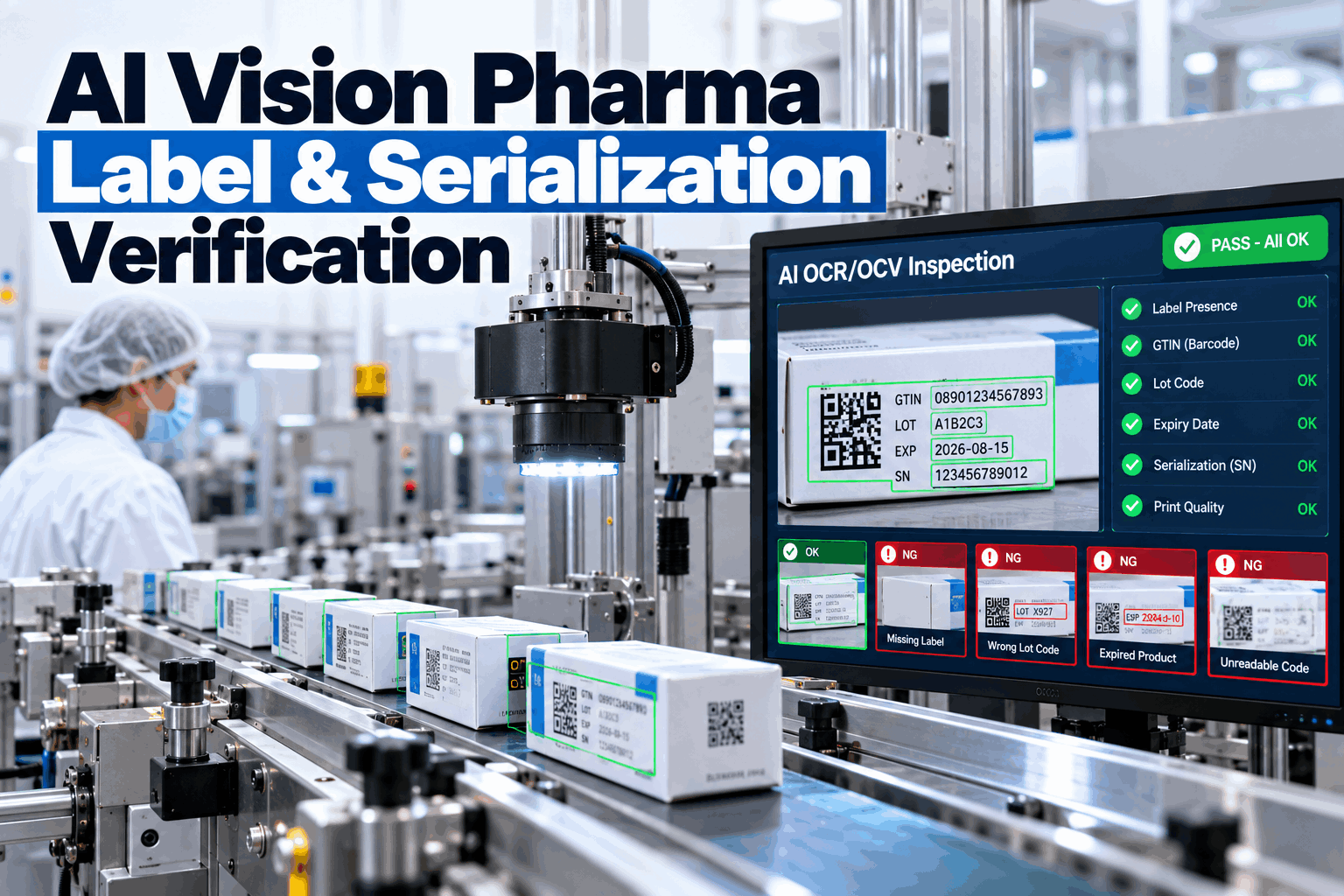
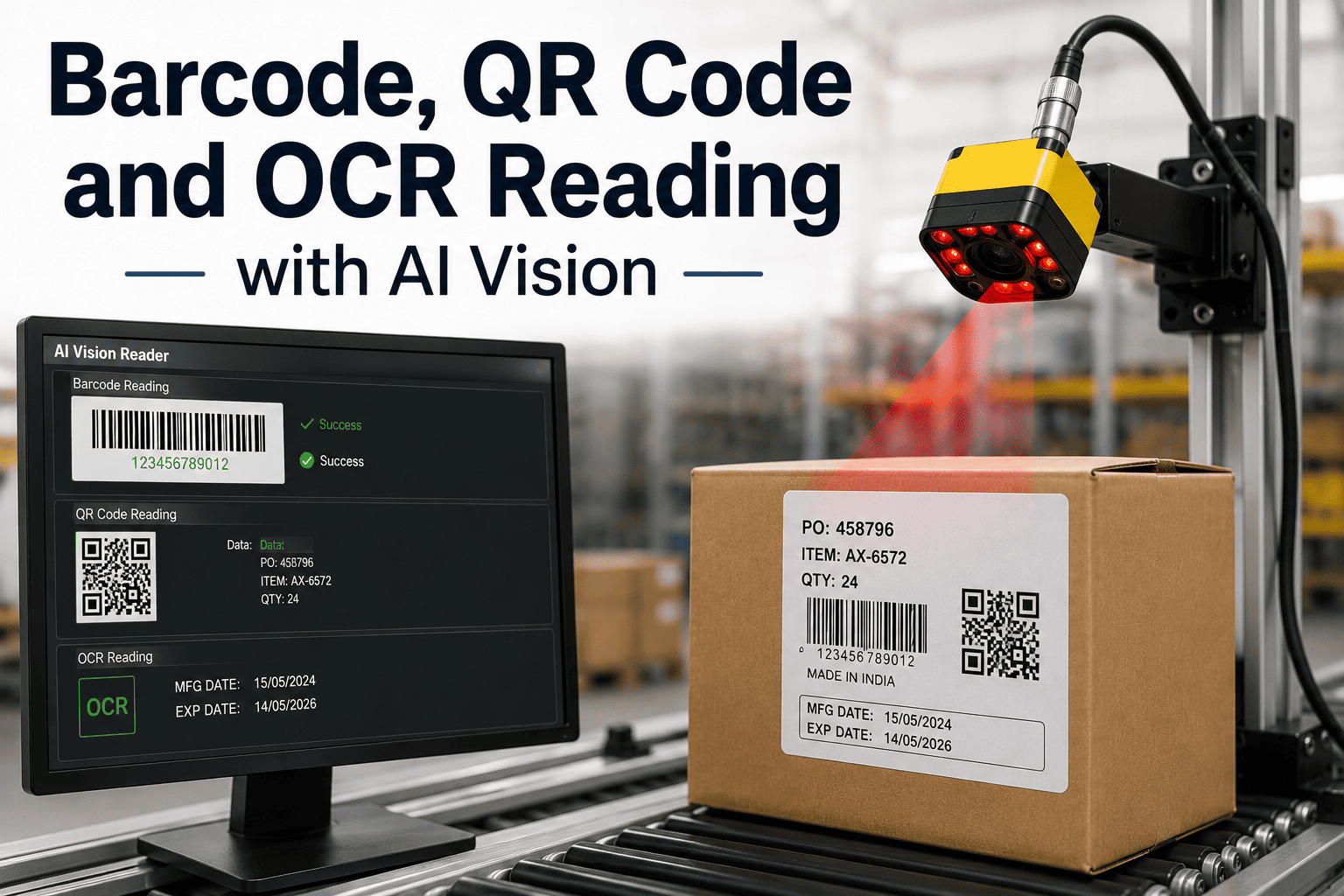
Serial number verification for DSCSA pharmaceutical serialization, EU FMD falsified medicines compliance, GS1 SSCC pallet tracking, and automotive component traceability requires reading human-readable text fields alongside 1D and 2D barcode verification on every unit — confirming that the serial number in the printed human-readable text matches the encoded barcode value and falls within the serial number range commissioned for the current production batch. iFactory's OCR module reads the human-readable serial field and passes it to the OCV layer for cross-reference against the 2D matrix code read on the same unit — delivering the linked OCR-plus-barcode verification that track-and-trace compliance requires without requiring a separate barcode reader station for each packaging line.
04
Print Quality Scoring and Character Legibility Assessment
Beyond read accuracy, iFactory's OCR platform scores the print quality of every code field — quantifying character stroke width consistency, inter-character spacing uniformity, ink density distribution, and void or fill anomaly presence within each character — to identify codes that are technically readable by the AI model but approaching the legibility threshold where downstream scanning systems or human inspectors will fail to read them reliably. Print quality scoring provides the early warning of coder performance degradation that prevents the scenario where a coder produces codes that pass in-line OCR verification but fail the downstream reader at the distribution centre or pharmacy dispensing terminal. Maintenance alerts are generated when print quality score trends indicate coder head wear or ink system issues before they generate illegible codes.
05
Multi-Field Verification and Cross-Field Consistency Checking
Complex packaging — pharmaceutical blister cards, food multi-pack outer cartons, automotive component trays — carries multiple code fields that must be individually correct and mutually consistent: the lot number on the primary label must match the lot number on the secondary carton, the expiry date printed in the top right must match the expiry date embossed on the seal closure, and the batch reference on the inner unit must match the outer case label batch field. iFactory's multi-field OCV verification checks every code field independently and confirms cross-field consistency — detecting the category of coding error where individual fields appear correct in isolation but contain inconsistent information that indicates a label application error, a wrong-carton event, or a mixed-batch packaging sequence. This cross-field consistency check is the verification layer that prevents mixed-lot events from reaching the supply chain.
INDUSTRIAL OCR · OCV VERIFICATION · LOT CODE · EXPIRY DATE · SERIALIZATION
Deploy 100% AI Vision Code Verification at Line Speed Across Your Production Lines
iFactory's AI vision OCR and OCV platform integrates with existing packaging line infrastructure to deliver per-unit lot code, batch number, expiry date, and serial number verification at full production speed — without line slowdown, without sampling gaps, and without the false reject escalation that rule-based OCR generates as production conditions vary.
Performance Benchmark
AI Vision OCR vs. Rule-Based OCR vs. Manual Verification: Industrial Code Reading Performance
The following benchmark compares code verification programme performance across manual sampling, rule-based automated OCR, and iFactory's AI-powered OCR and OCV architecture. Performance data reflects operational outcomes across pharmaceutical, food and beverage, and consumer goods packaging line deployments where code verification programmes have been assessed against industry audit standards.
Industrial OCR and OCV Performance Benchmark — 2026
Industry Applications
AI Vision OCR and OCV Across Industries: Where Code Verification Failures Cost the Most
The financial and regulatory consequences of code verification failure vary significantly across industries — but in every sector where products carry mandatory traceability codes, the cost of a missed or incorrect code that reaches the supply chain is orders of magnitude higher than the cost of detecting and rejecting it at the packaging line. iFactory's AI vision OCR platform is deployed across the following industrial contexts where code verification failures carry the highest downstream cost — and where 100% per-unit verification at line speed delivers the most measurable return on inspection investment. Quality and compliance managers from any of these sectors can Book a Demo to see iFactory's OCR performance demonstrated on their specific code formats and packaging substrates.
Pharmaceutical — FDA DSCSA and EU FMD Serialization Compliance
Pharmaceutical packaging under DSCSA and EU FMD requires 100% verification of serialized codes on every saleable unit — with the verification event logged and reported to national medicines verification systems. iFactory's OCR and OCV platform reads and verifies every human-readable text field alongside the 2D matrix code on every blister pack, bottle label, and carton — generating the per-unit electronic verification records that DSCSA transaction documentation and EU FMD authentication requirements specify, without dedicated serialization hardware additions to the packaging line.
Food and Beverage — BRC, FSSC 22000, and GFSI Traceability Requirements
BRC Global Standard and FSSC 22000 require manufacturers to demonstrate that date code and lot number verification is performed as part of the production quality control programme — with documented evidence of verification frequency, method, and acceptance criteria. iFactory's 100% per-unit AI OCR verification provides the objective, per-unit verification evidence that GFSI scheme auditors require, replacing the manual sampling records that auditors increasingly challenge as insufficient evidence of code quality control at the production volumes these standards cover.
Automotive — Part Marking Verification and Direct Part Marking Reading
Automotive components carry permanent identification markings — laser engraved, dot-peen stamped, or chemically etched — that must be read and verified against production records for lifetime traceability under IATF 16949 and customer-specific quality requirements. These direct part marking characters present the most challenging OCR environment: they have no ink contrast, no consistent character fill, and degrade in readability as surface machining produces texture variation around the marking area. iFactory's AI OCR models trained on direct part marking image data maintain consistent read accuracy on dot-peen and laser-engraved characters where template-based OCR systems fail to segment characters reliably.
Electronics — Serial Number Verification and Component Traceability
Electronics manufacturing requires serial number verification at component, board, and finished product levels — confirming that serial numbers in human-readable format match the barcode or QR code encoding on the same unit, and that the serial number falls within the range commissioned for the current production batch. iFactory's combined OCR plus 2D code reading and cross-verification capability confirms the linked human-readable and machine-readable code consistency that electronics traceability programmes require — detecting the character recognition errors and code printing mismatches that create irreconcilable records in component management systems during warranty and repair processes.
Implementation Roadmap
Deploying AI Vision OCR and OCV on Industrial Packaging Lines: A Phased Approach
Deploying AI vision OCR and OCV verification on industrial packaging lines requires a structured commissioning sequence that validates read accuracy against the full range of code format variations, packaging substrate types, and production speed conditions before activating automatic reject authority. The following roadmap reflects deployment patterns validated across pharmaceutical, food and beverage, and consumer goods packaging line OCR deployments from single-coder verification to multi-field cross-checking programmes on complex packaging configurations.
Phase 1
Code Format Specification and Substrate Assessment (Weeks 1–3)
Document every code field to be verified — lot code format, expiry date format and plausibility range, serial number structure, and any cross-field consistency requirements — and collect sample packaging units representing the full range of substrate types, print methods, and format variants in the production scope. Assess each code field for the specific OCR challenge it presents: curved surface distortion, low-contrast substrate, variable ink density from thermal transfer ribbons at end-of-life, or direct part marking surface texture variation. This assessment determines the camera configuration, illumination strategy, and AI model fine-tuning requirements for each inspection point. Manufacturers can start this scoping process by scheduling a session at our
Book a Demo page with iFactory's OCR inspection engineers.
Outcome: Code format specification, substrate challenge assessment, camera and illumination configuration design
Phase 2
AI Model Training and Shadow Mode Validation (Weeks 4–8)
Install AI vision cameras at the code verification station and commission the OCR and OCV models using the production substrate samples collected in Phase 1 — fine-tuning the pre-trained OCR base models on the specific font styles, print quality range, and substrate reflectance characteristics of the facility's actual packaging materials. Activate shadow mode operation where the AI performs 100% OCR and OCV on every unit and logs all read results, verification outcomes, and print quality scores without activating the reject mechanism. Shadow mode data is reviewed daily against the manual sampling records to validate read accuracy and false reject rate across the full production variability range before reject authority is granted.
Outcome: Validated read accuracy by code field, false reject rate established, production team trained on verification workflow
Phase 3
Live Verification Activation and Production System Integration (Weeks 9–14)
Activate live OCR and OCV verification with automatic reject authority for the code fields validated in Phase 2 shadow mode. Connect the iFactory verification database to the production MES, batch management system, or ERP via API — enabling automatic retrieval of the expected batch number, expiry date, and serial range for each production job without manual operator entry into the inspection system. Activate real-time coder health monitoring dashboards that track print quality score trends by coder head, identifying gradual performance degradation before it produces illegible codes. Generate and review the first set of automated per-batch verification certificates confirming code quality compliance across the inspection period.
Outcome: Live verification active, MES integration live, coder health monitoring established, batch verification certificates generated
Frequently Asked Questions
AI Vision OCR and OCV Industrial Code Verification — Frequently Asked Questions
What types of code printing methods can iFactory's AI OCR read and verify?
iFactory's AI OCR platform covers all industrial code printing methods used in manufacturing and packaging: inkjet (continuous inkjet, thermal inkjet, piezoelectric), thermal transfer overprint, laser coding (CO2 and fiber laser engraving), dot-peen stamping and vibro-engraving for direct part marking, label printing (thermal direct, thermal transfer, laser-printed), and embossed or moulded character marking on plastic and metal components. Each print method presents specific OCR challenges — character edge definition, contrast variability, surface reflection — that iFactory's substrate-specific model training addresses to maintain consistent read accuracy across the production variability range for each method.
How does AI OCR maintain read accuracy on curved containers and flexible packaging?
Curved containers and flexible packaging distort character geometry relative to the camera focal plane — compressing or stretching characters depending on surface curvature and viewing angle. iFactory addresses this through a combination of multi-angle illumination that maximises character contrast at the imaging geometry, optical configurations that minimise focal plane curvature effects, and AI model training that incorporates the character shape variation produced by curved surfaces into the recognition model's training data. The result is consistent OCR read accuracy on cylindrical bottles, curved blister card spines, flexible pouches, and shrink-wrapped outer packaging — the surface types where fixed-focal-plane, threshold-based OCR systems generate the highest false reject and missed read rates in production environments.
How does iFactory's OCV layer verify code content against the active production batch?
iFactory's OCV content verification layer connects to the active production record via API integration with the facility's MES, batch management system, or ERP — automatically retrieving the expected batch number, expiry date format and value range, and serial number range for the current production job at batch start. Every OCR reading is compared against these active batch parameters in real time: if the read batch number does not match the expected batch identifier, or the read expiry date falls outside the permitted shelf life range, or the serial number is outside the commissioned range, the unit is flagged for automatic rejection and the mismatch event is logged with the read value, expected value, and timestamp. This active production record connection eliminates the wrong-lot coding failure mode that OCR without OCV content matching cannot prevent.
What audit trail and compliance documentation does iFactory's OCR platform generate?
iFactory's OCR and OCV platform generates per-unit electronic inspection records for every verified unit — containing the unit identifier, all code field read results, OCV verification status by field, print quality score, reject or accept disposition, and timestamp. Records are written to an immutable audit log with cryptographic integrity protection satisfying FDA 21 CFR Part 11 and EU GMP Annex 11 data integrity requirements. Batch verification certificates are generated automatically at production job completion, summarising total units verified, code field pass rates, print quality trend statistics, and any OCV content mismatch events with the associated code read values. These certificates are exportable for direct attachment to batch manufacturing records, customer quality portal submission, and regulatory inspection evidence packages without manual data compilation.
How quickly can iFactory's AI OCR system be deployed on an existing packaging line?
A single-station OCR and OCV deployment on one packaging line typically reaches validated live operation within six to ten weeks from hardware installation — including AI model fine-tuning on facility-specific substrates, shadow mode validation against existing manual verification records, production team training, and MES or batch record integration. Lines with clean, well-defined code format specifications and readily available packaging substrate samples for model training consistently complete at the lower end of this range. The phased deployment approach — shadow mode before reject authority, single code field before multi-field cross-checking — allows the inspection programme to generate verification value from the first week of shadow mode operation while the validation process completes.
What ROI should manufacturers expect from deploying AI vision OCR and OCV on packaging lines?
Manufacturers typically achieve positive ROI from AI vision OCR and OCV deployment within three to eight months — primarily through avoided product recall costs from mislabelled or miscoded batches, reduced manual inspection labour from replacing sampling programmes, and GFSI or FDA audit finding reduction from demonstrating 100% per-unit code verification. A single avoided mid-sized FMCG batch recall from a date code failure — with typical direct costs of £200,000 to £500,000 in product quarantine, re-labelling, and audit preparation — frequently recovers the total system deployment cost in a single event. Pharmaceutical manufacturers under DSCSA and EU FMD serialization requirements achieve additional ROI through simplified compliance documentation and reduced serialization error investigation costs. Manufacturers ready to model the ROI case for their specific production volumes and code verification risk profile can contact iFactory's team directly at their
Book a Demo page.
AI VISION OCR · OCV VERIFICATION · LOT CODE · BATCH NUMBER · EXPIRY DATE · 2026
Start an AI Vision OCR Pilot on Your Packaging Line — Any Surface, Any Code Format
iFactory's AI vision OCR and OCV platform delivers 99.5% per-unit code verification at line speed on any packaging substrate — generating the complete per-unit electronic audit trail that pharmaceutical, food, automotive, and electronics traceability programmes require.